
Evidence-based medicine (EBM) is the conscientious, explicit, and judicious use of current best evidence combined with clinical expertise and patient preferences to make clinical decisions. The standard industry term is "evidence-based medicine," coined formally by Gordon Guyatt and the Evidence-Based Medicine Working Group at McMaster University in the early 1990s. Applying these evidence-based medicine tips correctly means integrating three equal pillars: the best available research, your clinical expertise, and your patient's values. Authoritative sources including the NIH, MSD Manuals, and the British Journal of Nursing all reinforce this triad as the foundation of best practices in medicine. Clinicians who master this integration make faster, more defensible decisions and deliver measurably better patient outcomes.
1. What are the essential evidence-based medicine tips for daily practice?
The five steps of EBM give you a repeatable process: Ask, Acquire, Appraise, Apply, and Assess. Each step has a specific purpose, and skipping one compounds errors downstream.
Ask a focused clinical question
Vague questions produce vague answers. Frameworks like PICO (Population, Intervention, Comparison, Outcome) and SPICE (Setting, Perspective, Intervention, Comparison, Evaluation) sharpen your search and retrieve more relevant evidence. A question like "In adults over 65 with hypertension, does amlodipine reduce cardiovascular events compared to lisinopril?" is searchable. "What's the best blood pressure drug?" is not.

Acquire evidence from trusted sources
Systematic reviews and RCTs in databases like PubMed and Cochrane Library represent the highest level of evidence for most clinical questions. Institutional library services, NICE guidelines, and clinical trial registries add depth and accountability. Accessing these through services like OpenAthens or NHS library portals gives you peer-reviewed, rigorously filtered results.
Pro Tip: Target systematic reviews first. They synthesize multiple RCTs and save you hours of individual appraisal time. Use PubMed filters to limit results to "Systematic Review" before broadening your search.
Appraise critically
Not all published research is equal. Appraisal tools like CASP (Critical Appraisal Skills Programme) checklists help you evaluate study design, bias risk, and applicability to your patient. A statistically significant result in a poorly designed trial is not clinically meaningful.
Apply and assess
Apply the evidence within your patient's specific context, then measure the outcome. Evaluation closes the loop and builds institutional knowledge over time.
2. How to minimize cognitive errors in clinical decision-making
Most medical errors stem from cognitive failures, not knowledge gaps. Faulty pre-test probability assessment and failure to consider alternative diagnoses drive the majority of diagnostic mistakes. Recognizing this shifts your focus from "knowing more" to "thinking better."
The most common cognitive traps include:
- Anchoring bias: Locking onto an initial diagnosis and ignoring contradictory evidence
- Premature closure: Stopping the diagnostic search once one explanation fits
- Availability bias: Overweighting diagnoses you have seen recently
- Framing effect: Letting how a case is presented distort your probability estimates
- Confirmation bias: Seeking evidence that confirms your working diagnosis rather than tests it
Diagnostic decision-making improves when you treat each case like a hypothesis to be tested, assigning pre-test probabilities and updating them as new data arrives. This mirrors the scientific method and reduces reliance on pattern recognition alone.
Pro Tip: After your initial assessment, ask two questions: "What else could this be?" and "What is the most dangerous possibility I have not yet ruled out?" These two questions reduce premature closure more reliably than any checklist.
Structured reflection does not mean slow reflection. In high-volume settings, reserve analytical reasoning for complex or uncertain cases. Routine presentations handled by heuristics are fine, as long as you recognize when a case stops being routine.
3. How to integrate patient values into evidence-based practice
EBM is not a blind application of literature. Decisions must account for patient-specific factors including values, risk tolerance, religious beliefs, and economic constraints. A treatment supported by strong RCT evidence may still be the wrong choice for a specific patient.
Practical strategies for integrating patient values:
- Ask "What matters most to you about your treatment?" before presenting options
- Distinguish between what the evidence recommends and what the patient can realistically sustain
- Adapt guidelines for patients whose demographics differ from the trial population
- Recognize when a patient's risk tolerance overrides a standard recommendation (for example, a patient who declines anticoagulation after weighing bleeding risk against stroke prevention)
- Use shared decision-making tools to present options with transparent trade-offs
- Document patient preferences explicitly so the care team maintains consistency
Patient-centered care within EBM is not a soft add-on. It is the third pillar of the triad, equal in weight to research evidence and clinical expertise. Clinicians who skip this step apply evidence-based practices incompletely.
Recent policy changes across health systems have reinforced the patient voice in care planning. Shared decision-making is now an explicit requirement in many institutional governance frameworks, not an optional best practice.
4. Which tools and resources keep clinicians current?
Staying current is a structural problem, not a motivation problem. The volume of published research makes ad hoc reading unsustainable. The solution is a curated, tiered resource system.
| Resource | Type | Best used for |
|---|---|---|
| PubMed | Database | Primary literature searches |
| Cochrane Library | Database | Systematic reviews and meta-analyses |
| NICE | Guideline body | UK-based clinical practice guidelines |
| Clinical trial registries | Registry | Identifying ongoing and completed trials |
| OpenAthens / NHS libraries | Access portal | Institutional full-text access |
Trusted databases like PubMed, Cochrane, and NICE provide rigorously reviewed evidence that supports defensible clinical decisions. Institutional library access through OpenAthens or equivalent portals adds accountability to your evidence trail.
AI tools for literature searches are useful but require validation. AI-generated citations are sometimes fabricated or outdated. Always verify AI-suggested references against the original source before applying them clinically. The role of AI in clinical decision support is growing, but human appraisal remains mandatory.
Clinical guidelines have limitations. They often rely on RCTs that exclude patient heterogeneity and clinical uncertainty. Professional judgment is required to bridge the gap between guideline recommendations and individual patient realities.
Continuing professional development and quality improvement projects reinforce EBM skills over time. Linking evidence use to your professional goals builds a sustainable habit rather than a reactive one.
5. How to adapt evidence-based practice across different clinical settings
Evidence does not arrive pre-fitted to your ward, your patient population, or your resource level. Adaptation is a core EBM skill, not a workaround.
- Assess your local context first. Identify what resources, staffing, and patient demographics actually exist in your setting before selecting an intervention.
- Check trial populations against your patients. If a landmark RCT enrolled predominantly young, male, urban patients, apply its findings cautiously to elderly, rural, or comorbid populations.
- Manage evidence quality variation. Not every clinical question has a high-quality RCT behind it. In those cases, use the best available evidence and document the uncertainty explicitly.
- Balance guideline recommendations with patient safety. A guideline recommendation that cannot be safely implemented in your setting is not a mandate. Adapt it, document your reasoning, and escalate if needed.
- Measure the impact of evidence-based changes. Implement a feedback loop: track outcomes before and after adopting a new practice, and share results with your team.
- Share lessons learned. A culture of evidence-based care grows when clinicians discuss what worked, what did not, and why. Team-level learning compounds individual learning.
Evaluating and sharing evidence-based changes within your team creates institutional memory. That memory reduces repeated errors and accelerates adoption of proven practices.
Pro Tip: Check the latest medical research updates regularly to catch guideline changes before they affect your practice. A quarterly review of major specialty guidelines takes less than an hour and prevents outdated evidence from driving decisions.
Key takeaways
Effective evidence-based medicine requires integrating current research, clinical expertise, and patient values through structured questioning, critical appraisal, and deliberate reflection to reduce cognitive errors and improve patient outcomes.
| Point | Details |
|---|---|
| Use PICO or SPICE frameworks | Focused clinical questions retrieve more relevant evidence and reduce wasted search time. |
| Target systematic reviews first | Cochrane and PubMed systematic reviews synthesize multiple trials and save appraisal time. |
| Cognitive errors drive most mistakes | Pause after initial assessment and ask what else the diagnosis could be. |
| Patient values are a core EBM pillar | Shared decision-making is mandatory, not optional, for complete evidence-based practice. |
| Adapt evidence to your setting | Check trial populations against your patients before applying guideline recommendations. |
What I have learned from applying EBM under real clinical pressure
The hardest part of evidence-based practice is not finding the evidence. It is knowing when to stop searching and make a decision. Early in my career, I treated EBM as a completeness exercise. I wanted every question answered before acting. That approach is not sustainable in a busy ward, and it is not what EBM actually demands.
Formal EBM analysis is most valuable for complex or uncertain cases. Routine decisions should run on well-internalized guidelines and structured heuristics. The skill is recognizing which category a case falls into, and that recognition comes from practice, not from reading more papers.
The cognitive error literature changed how I work more than any clinical guideline. Knowing that cognitive failures cause most errors rather than knowledge gaps reframed my self-assessment. I stopped asking "Do I know enough?" and started asking "Am I thinking clearly right now?" That shift is worth more than any database subscription.
Humility is the underrated skill in EBM. Evidence evolves. A practice that was standard five years ago may now be contraindicated. Clinicians who stay current and remain open to revising their approach deliver better care than those who rely on training-era knowledge. Build the habit of updating your priors, not just your reading list.
— David
Connectedmedics: resources built for evidence-based clinicians
Healthcare professionals who apply evidence-based practices need more than databases. They need a community that speaks their language and surfaces relevant knowledge without the noise of generic professional networks.
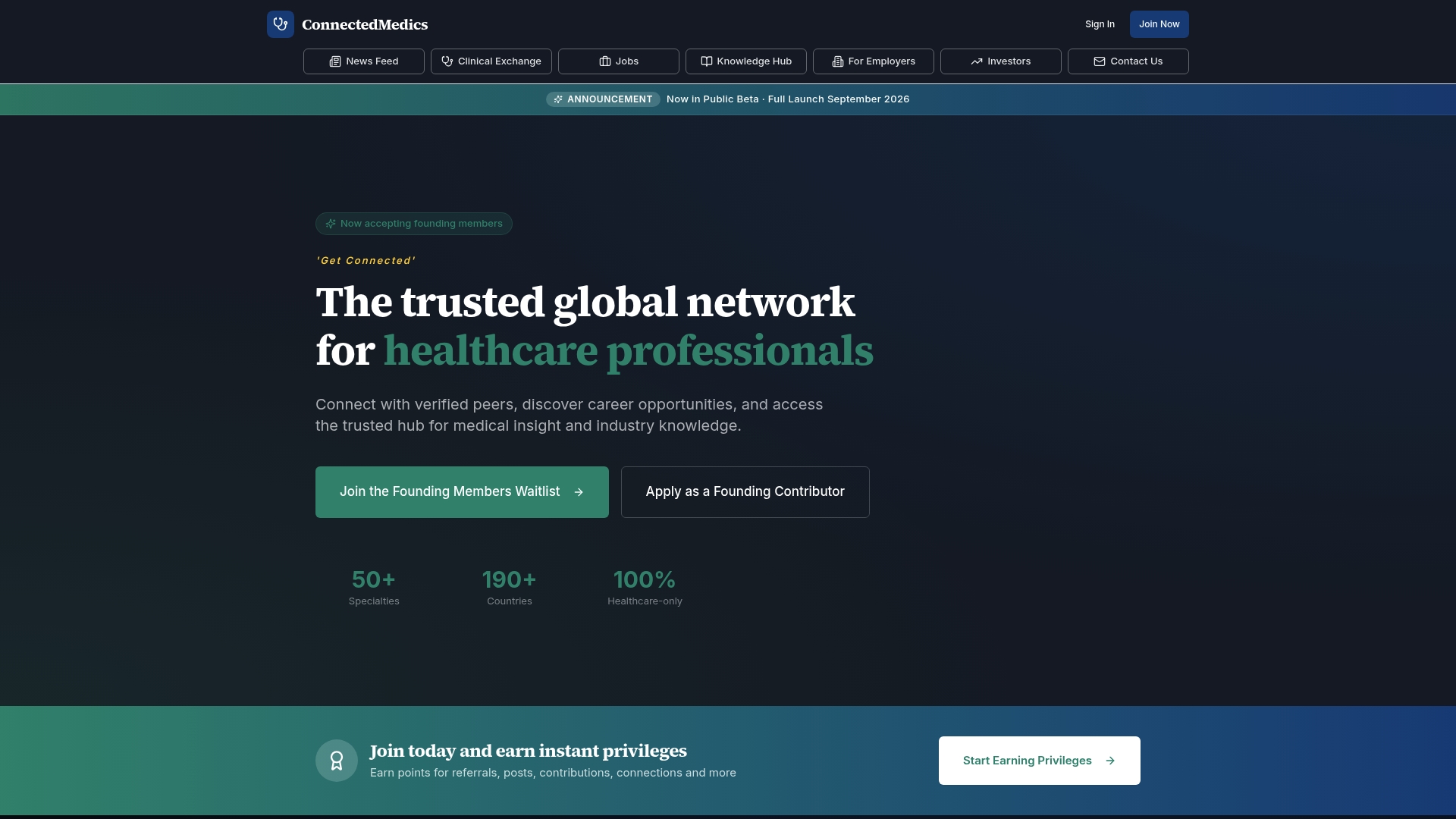
Connectedmedics is a verified global network built exclusively for healthcare professionals. The Knowledge Hub curates clinical guides, medical research summaries, and evidence-based insights contributed by verified medical experts. Clinicians use it to stay current, connect within their specialty, and access peer-reviewed resources without sifting through irrelevant content. With over 4,600 active healthcare vacancies and a growing library of clinical knowledge, Connectedmedics gives you the professional infrastructure to practice evidence-based medicine at a higher level.
FAQ
What is evidence-based medicine?
Evidence-based medicine is the explicit, judicious use of current best research evidence combined with clinical expertise and patient values to guide individual clinical decisions. It is not a formula but a disciplined process applied to specific patient questions.
What are the five steps of EBM?
The five steps are Ask, Acquire, Appraise, Apply, and Assess. Each step builds on the previous one, and skipping any step reduces the quality of the final clinical decision.
How do cognitive errors affect clinical decision-making?
Cognitive failures, including anchoring bias, premature closure, and availability bias, cause most diagnostic errors. Structured reflection and deliberate hypothesis testing reduce their impact more reliably than additional knowledge alone.
Which databases are most reliable for clinical evidence?
PubMed, Cochrane Library, and NICE are the most widely used and rigorously reviewed sources for clinical evidence. Institutional access through OpenAthens or equivalent portals provides full-text retrieval for most relevant studies.
How should clinicians handle conflicting evidence and guideline gaps?
When evidence is conflicting or a guideline does not cover your patient's situation, apply professional judgment, document your reasoning explicitly, and factor in patient values and local resources. Uncertainty is a clinical reality, not a failure of EBM.