
A physician cover letter is a one-page note that goes with the CV. It states the position, why the job fits, and what the applicant brings. It does not repeat the CV. Employers do read it: a 2023 survey of 625 U.S. hiring managers found that 83% frequently or always read cover letters, including 73% at companies that do not require one.
TL;DR
- Keep it to one single-spaced page, in a 10- to 12-point font, sent as a PDF.
- Open with who is applying, which position, and why it fits.
- Use one to three middle paragraphs with concrete examples. Do not restate the CV.
- Tailor each letter to the employer, practice, patient population and location.
- Close with thanks, contact details and next steps. Have someone else proofread.
Table of Contents
- Does a physician cover letter still matter?
- What a physician cover letter includes
- How to tailor the letter to the job
- Show, do not repeat
- Adjusting by career stage
- Physician cover letter example
- Format, length and proofreading
- Common mistakes
- Where the letter fits in the job search
- Find roles worth a tailored letter
- Perspective
- FAQ
- Sources
Does a physician cover letter still matter?
Yes. A physician cover letter is a succinct summary of background and interests tied to a specific position. The CV lists facts. The letter explains the match.
Some physicians treat the letter as old-fashioned. The same survey data points the other way. A recruiting consultant quoted by the American Association for Physician Leadership notes that applicants cannot know whether a given hiring manager values the letter. Sending one costs little and can set an application apart.
The letter also shows what a CV cannot. UCSF's career office says a strong letter can demonstrate skills that are hard to convey on a resume, such as communication.
Cover letter, CV and letter of intent
| Document | Purpose | Length |
|---|---|---|
| CV | Full record: training, licensure, positions, publications | As long as needed |
| Cover letter | Why this job, why this applicant, what value is added | One page |
| Letter of intent | Often follows an interview; outlines key job terms | Short, one to two pages |
For the CV side, see the guides on doctor CV writing and physician CV tips.
What a physician cover letter includes
The structure is short and fixed. Guidance published in the medical literature describes a letter that introduces the applicant, uses one to three middle paragraphs to support relevant skills, and closes with thanks, contact information and next steps.
1. Header and greeting
- Name, phone, email, date.
- Recipient name, title, organization and address, when known.
- A named greeting is best. When the name cannot be found, the American Academy of Orthopaedic Surgeons says "Dear Hiring Manager" is acceptable.
Check the job posting, the practice website or the recruiter's email for a name first.
2. Opening paragraph
Three things, in two or three sentences:
- Who is applying (specialty, training status, board status).
- Which position is being applied for.
- Why the position is of interest.
A professional connection or the way the job was found can go here or in a later paragraph.
3. Middle paragraphs
This is where the letter earns its place. Pick two or three points from the job description and give one example each.
Good material:
- Clinical activity: case mix, procedures, volume, settings.
- Quality or safety projects, with an outcome.
- Teaching, research or community outreach, if the employer values them.
- Geographic ties or family reasons for the location.
The American Academy of Orthopaedic Surgeons lists teaching, research, community outreach, geographic ties and professional connections as items to mention concisely. It also says a trailing spouse seeking employment, or local ties, can be stated to give context.
4. Closing
- Thank the reader for their time.
- Restate availability and contact details.
- Say what happens next, for example that a follow-up call is welcome.
- Sign off with "Sincerely" and a full name with credentials.
How to tailor the letter to the job
A generic letter reads as generic. The American Academy of Family Physicians' practice management journal advises including a specific detail about the particular practice, such as the patient population, the job description or the location.

The American Academy of Pediatrics gives the same direction: express interest, summarize qualifications and align them with the employer's needs. Target each letter to the specific position and employer.
Research checklist before writing
- Read the full posting. Note the three or four requirements that come up most.
- Read the organization's website: locations, services, physician group, mission.
- Identify the setting: academic center, health system, independent group, rural clinic, telehealth.
- Find the recipient's name and title.
- Match each requirement to one real example from training or practice.
Match the tone to the setting
The AAMC guide for first jobs in academic medicine advises tailoring the letter to the institution's mission, values and tone. An academic department may care about scholarship and teaching. A community hospital may care about volume, availability and community ties. Same facts, different order.
| Setting | Lead with | Support with |
|---|---|---|
| Academic medical center | Teaching, research, publications | Clinical niche, mentoring |
| Hospital-employed role | Clinical volume, quality metrics | Team work, EHR experience |
| Private or group practice | Patient relationships, productivity | Local ties, long-term plans |
| Rural or underserved area | Commitment to community | Breadth of practice, ties to the region |
The table is a planning aid, not a rule. The posting decides.
Show, do not repeat
UCSF's career office warns against a letter that restates the resume in prose. That adds nothing and wastes the reader's time. The AAMC guide says the same: give concrete evidence such as publications or dollar figures where appropriate, and show the value to be added.
Weak and strong versions
Weak: "I completed my residency in internal medicine and have experience in inpatient care."
Stronger: "During my chief year, I led a team that reworked our discharge handoff process on a 40-bed medicine unit. Our group tracked 30-day readmissions and presented the results at departmental grand rounds."
The second version names a setting, an action and an outcome. Use only facts that are true and can be verified in an interview. Do not invent figures.

Focus on contribution
The AAMC perspective is to promote what you can contribute and avoid centering perceived weaknesses. Lead with strengths. Keep the letter forward-looking.
For more on turning clinical work into employer-ready language, see how to present care experience to employers.
Adjusting by career stage
Resident or fellow applying for a first job
A resident applying for a first job should briefly describe relevant training experiences. Support each skill with a specific example and tie it to a benefit for the new role.
Useful content:
- Procedures, rotations or clinics that match the job.
- Chief resident or quality improvement roles.
- Teaching of students or junior residents.
- Expected completion date and licensure or board eligibility status.
Attending changing jobs
An experienced attending has more material and less space. Choose the two accomplishments that best fit this employer. Examples: building a service line, leading a committee, mentoring, patient volume, quality results. Then state the reason for the move in neutral, forward-looking terms.
Gaps in training or employment
The American Academy of Pediatrics advises explaining a gap briefly and clearly, stating what the experience taught you about becoming a better physician. Leave the longer discussion for the interview. Two sentences are enough.
Physician cover letter example
The example below is a template with placeholders, written for an attending-level hospital medicine role. Replace every bracket with true details.
Dr. [Recipient Name], Chief of Hospital Medicine [Hospital name], [City, State]
Dear Dr. [Last Name],
I am a board-certified internist applying for the hospitalist position posted on [where you saw it]. I have [number] years of inpatient experience at [current employer], and [Hospital name]'s focus on [specific program or value from their website] is the reason this role stands out.
At [current employer], I lead a team of [number] clinicians on a [number]-bed unit. Last year I [specific project, such as redesigning discharge handoffs], which [specific measured result]. I would bring the same quality-improvement approach to your program.
I also teach [residents or students] and [other relevant activity]. Your posting mentions [teaching, committee work or other requirement from the posting], and I have [one concrete example].
My family and I have [local tie, if true], and I am committed to a long-term position in [region].
Thank you for your time. My CV is attached. I can be reached at [phone] or [email] and would welcome a call.
Sincerely, [Name, MD]
That runs about 200 words. One page leaves room for a little more.
Format, length and proofreading
Published guidance gives clear limits:
- Length: a single, single-spaced page.
- Font: readable, 10 to 12 point, such as Times New Roman, Arial or Cambria.
- File: PDF, to preserve formatting. Both rules come from the same guide.
- Language: reuse the job description's wording where it is accurate.
- Proofreading: read it yourself, then have someone else read it. The AAOS makes the same point about having a second reader.
Common mistakes
- Sending the same letter to every employer.
- Retelling the CV line by line.
- Misspelling the practice, hospital or recipient name.
- Opening with a long personal history.
- Focusing on what the job gives the applicant and not on what the applicant gives the employer.
- Running past one page.
- Leaving out contact details.
Where the letter fits in the job search
The letter is one part of an application. The CV, references, licensure details and interview preparation all matter as much. These guides cover the rest: medical job application tips, the healthcare job search checklist for doctors and CV and interview preparation for clinicians.
Finding relevant openings is its own problem. Why doctors struggle to find relevant jobs explains the usual causes.
Find roles worth a tailored letter
ConnectedMedics is a healthcare-only network. It offers verified profiles, a global jobs board with specialty filters and peer discussion. The platform lists over 22,000 active healthcare vacancies.
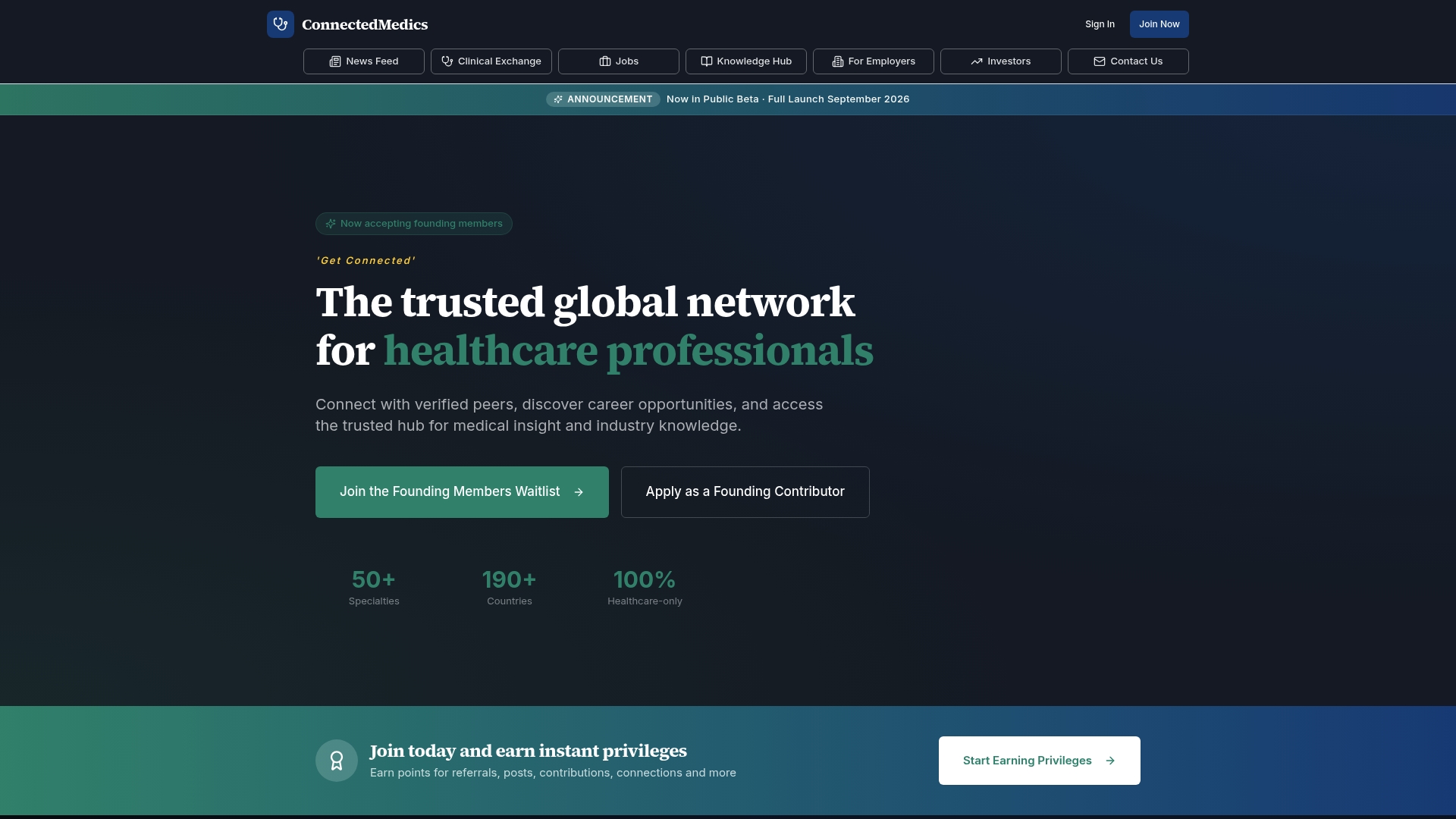
Search by specialty, read the posting closely and write one letter per role. Start at the ConnectedMedics home page or browse the Knowledge Hub for clinical and career content.
Perspective
A cover letter is only as good as the match behind it. Most of the effort belongs before the first sentence: finding the roles that fit a specialty, a setting and a location.
That is why we built ConnectedMedics for healthcare only. Generic networks mix physicians with every other profession. Our network is built around verified clinicians, specialty targeting and a jobs board where the filters are medical. A tailored letter works best when the posting is relevant in the first place.
We also see the letter as part of a profile. A clear CV, a verified profile and a short, specific letter tell an employer the same story three times. Keep them consistent.
David
FAQ
How long should a physician cover letter be?
One page, single-spaced. Guidance in the medical literature says to keep it to a single page in a 10- to 12-point font. Send it as a PDF so the formatting holds.
Do I need a cover letter if the posting does not ask for one?
Sending one is a safe choice. In the 2023 survey cited above, 73% of managers at companies that do not require cover letters still read them frequently. A short, tailored letter can help an application stand out.
Who should I address the letter to?
To the named recruiter, department chair or hiring physician. Look on the posting and the organization's website. If no name is available, "Dear Hiring Manager" is acceptable.
What should a new graduate put in the letter?
Briefly describe relevant training experiences, and give one specific example per skill the job requires. Mention your expected completion date and licensure or board status. Tie each example to what the new employer needs.
Should I explain a gap in my career?
Yes, briefly. Explain it in a sentence or two, say what you learned, and move on. The American Academy of Pediatrics suggests leaving the fuller discussion for the interview.
Sources
- A guide to creating a high-quality cover letter (PMC)
- Cover Letters Still Matter, Even If They're Not Required (AAPL)
- How to Write a Cover Letter (AAOS)
- A Guide to Prepare for Your First Job in Academic Medicine (AAMC)
- Prepare a Curriculum Vitae and Cover Letter (AAP)
- Do I have to write a cover letter? (UCSF Career and Professional Development)
- Tips for Writing Effective CVs and Cover Letters (AAFP)