
Six concrete changes make a home care application noticeably stronger: a role-specific resume headline, your state license and top certifications on page one, one quantified patient outcome, a cover letter that mirrors the agency's mission language, one STAR-formatted crisis example, and a polite follow-up at 7–10 calendar days. Copy this checklist into your application tracker now:
- Resume headline names your license and specialty
- State license number and CPR/BLS certification appear in the header
- One bullet states a measurable outcome (clients served, readmission rate, acuity level)
- Cover letter echoes one phrase from the agency's "About" page
- One STAR crisis story is written and ready to paste or speak
- Follow-up email drafted and scheduled for day 7–10 post-submission
Key Takeaways
A verified profile, a quantified resume, and a STAR-ready crisis example are the three application assets that move home care candidates from the screening pile to the interview.
| Point | Details |
|---|---|
| Resume page one | Lead with license, top certs, and one quantified outcome in the first three lines. |
| Cover letter length | Keep it under 300 words; mirror one phrase from the agency's mission statement. |
| STAR preparation | Write three job-specific STAR stories before any interview or phone screen. |
| Pre-employment readiness | Gather license, CPR/BLS, TB test, background check, and references before the offer. |
| Connectedmedics profile | Publish a verified profile to give hiring managers instant credential confirmation. |
Table of Contents
- How to stand out in home care applications: resume tailoring
- A cover letter formula hiring managers actually read
- STAR examples that prove judgment and autonomy
- Interview as a fit-check: what to ask and how to answer
- What to have ready: references, background checks, and health screening
- How to show alignment with agency values on paper and online
- Polite follow-up and hiring timeline expectations
- What hiring teams actually see in the first 30 seconds
- Connectedmedics gives your application a verified edge
- Sources
How to stand out in home care applications: resume tailoring
Hiring reviewers scan a resume in under 30 seconds. They look for three signals first: current role and tenure, state-specific licensure, and direct in-home experience. Everything else is secondary.
Lead page one with a two-line professional headline. Example: Licensed Practical Nurse | Home Health | Pediatric and Geriatric Complex Care. Below that, list your state license number, expiration date, and certifications (CPR/BLS, HHA, CNA) in a single line. ApplyGlide recommends displaying certifications prominently and using ATS-safe formatting with standard section labels like "Work Experience," "Certifications," and "Education."
Quantify every experience bullet you can. Instead of "Provided personal care to elderly clients," write "Delivered personal care to 6 concurrent home-bound clients with dementia and post-surgical recovery needs, with zero missed visits over 14 months." That one line answers acuity, volume, and reliability.
Formatting rules:
- Font: Calibri or Arial, 11pt body, 12pt headings
- Length: one page for under five years of experience; two pages maximum for experienced clinicians
- File format: PDF unless the job posting specifies otherwise
- Section order: Header → Summary → Certifications/Licenses → Work Experience → Education → Skills
Pro Tip: Add a "Key Skills" section with terms pulled directly from the job posting (e.g., "OASIS documentation," "medication management," "fall prevention") to pass ATS keyword filters before a human ever reads your resume. More medical job application tips are available for clinicians who want to go deeper on formatting.
A cover letter formula hiring managers actually read
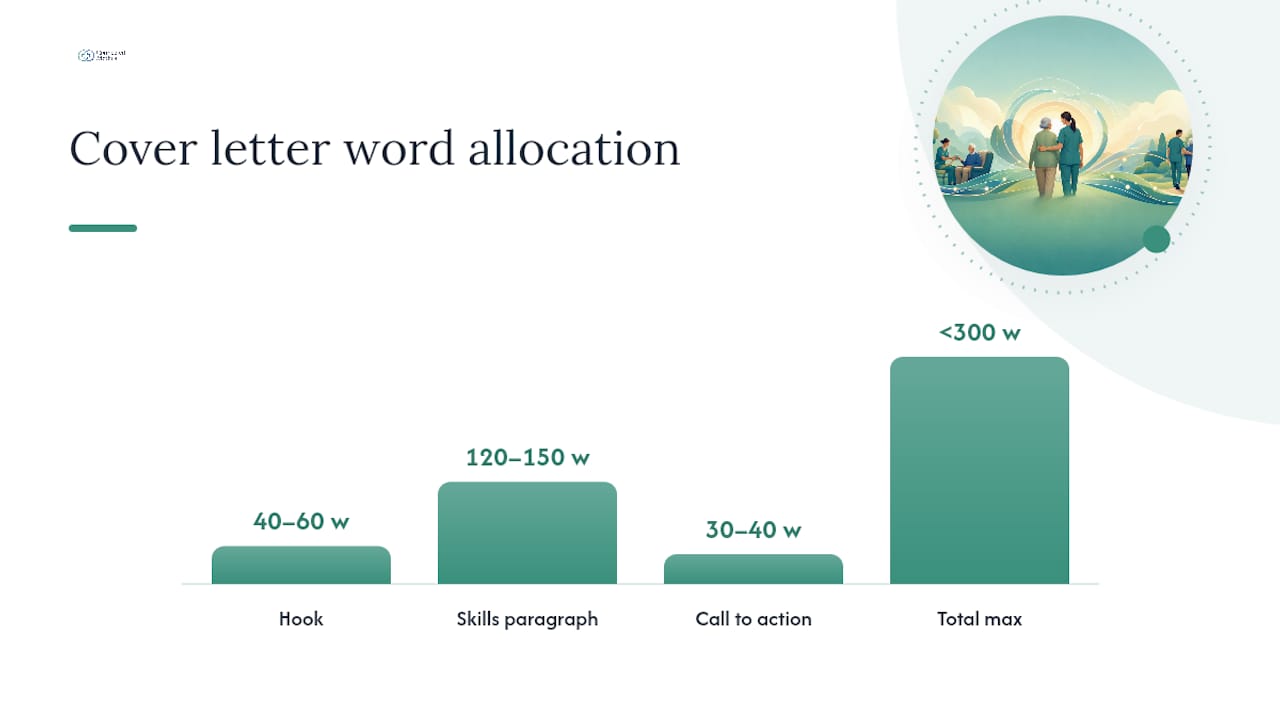
A cover letter under 300 words that mirrors the agency's own language gets read. One that runs 500 words and restates the resume does not. ResumeGeni recommends opening with a direct hook, connecting one measurable achievement to a stated agency need, and closing with a clear call to action.
Three-paragraph formula:
- Hook (40–60 words): Name the role, state your license, and use one phrase from the agency's "About" or "Mission" page.
- Skills and example (120–150 words): Describe one specific achievement in STAR-lite format. Connect it to a challenge the agency faces.
- Call to action (30–40 words): Request an interview, confirm availability, and thank the reader.
Ready-to-adapt snippet:
"I am applying for the Home Health RN position at [Agency Name]. Your commitment to 'keeping patients safely independent at home' aligns directly with my four years of post-acute home care experience. In my most recent role, I managed a caseload of eight complex patients and reduced preventable ER visits by coordinating medication reconciliation with each patient's primary care provider. I would welcome the chance to bring that same focus to your team."
Dos and don'ts:
- Do echo specific language from the agency's website
- Do name one measurable result
- Don't repeat every resume bullet
- Don't use vague phrases like "passionate about helping people"
Pro Tip: Paste the agency's "About" page into a text editor and highlight three phrases. Use at least one of them verbatim in your opening paragraph.
STAR examples that prove judgment and autonomy
Behavioral examples are the fastest way to prove fit in home care. AAPACN advises that agencies use behavioral-based interviews specifically because home care happens in private settings where judgment and cultural fit matter as much as clinical skill. Prepare three job-specific STAR stories before any interview.
STAR Example 1: Clinical crisis
- Situation: Arrived for a morning visit and found a 78-year-old patient unresponsive, with labored breathing.
- Task: Assess immediately and activate emergency response without on-site supervision.
- Action: Called 911, initiated rescue breathing, contacted the supervising RN, and stayed with the patient until EMS arrived. Documented the incident in the agency's EMR within two hours.
- Result: Patient was stabilized and discharged from the hospital within 72 hours. Supervisor cited the response in my annual review.
STAR Example 2: Family de-escalation
- Situation: A patient's adult daughter disagreed with the care plan and became verbally hostile during a visit.
- Task: Maintain the patient's care without escalating the conflict.
- Action: Acknowledged the daughter's concerns, paused non-urgent tasks, and called the care coordinator to facilitate a three-way conversation that afternoon.
- Result: The care plan was updated to reflect the family's preferences. The daughter later confirmed satisfaction in a post-visit survey.
STAR template for your own experience:
"When [situation], my responsibility was to [task]. I [specific actions taken]. The result was [measurable or observable outcome]."
If you lack OASIS documentation experience, state willingness to complete COS-C training rather than overstating competence. Agencies depend on OASIS accuracy for reimbursement, and honesty tied to a training plan builds more trust than a gap covered up.
Pro Tip: Review interview prep resources for clinicians to convert more of your work history into ready STAR stories before your next screening call.
Interview as a fit-check: what to ask and how to answer
Treat the interview as a two-way evaluation. Relias notes that employers look for personable, confident applicants who come prepared with concrete examples. Asking the right questions signals commitment beyond pay.
Eight questions to ask the interviewer:
- How is the on-call schedule structured?
- What does the orientation and field-training period look like?
- How does the agency handle scheduling conflicts or last-minute cancellations?
- What EMR system does the team use, and is training provided?
- How are performance reviews conducted?
- What continuing education support does the agency offer?
- How does the agency handle patient safety concerns raised by field staff?
- What is the typical caseload size for this role?
Four compact answer templates:
- Why home care? "I prefer the one-on-one model. In a facility, I managed 10 patients per shift. In home care, I can give one patient my full attention and see real progress."
- Handling family conflict: "I listen first, then involve the care coordinator if the concern goes beyond my scope. I documented a similar situation last year and the outcome was a revised care plan."
- Describing a fall or emergency: Use your STAR Example 1 above, condensed to 90 seconds.
- Complex medication regimens: "I use a written reconciliation checklist at every visit and flag discrepancies to the supervising nurse before leaving the home."
CareAcademy recommends aligning answers with the agency's stated competencies. Review the job posting for those competency keywords before the interview. Sit upright, maintain steady eye contact, and pause briefly before answering behavioral questions. A two-second pause reads as thoughtful, not unprepared.
What to have ready: references, background checks, and health screening
Gather documentation before the offer arrives. Delays in background checks or missing immunization records are the most common reasons a timely offer stalls.
| Document | Where delays occur | Notes |
|---|---|---|
| State nursing/HHA license | Renewal backlog at state board | Confirm current status at your state's license lookup |
| CPR/BLS certification | Expired card | Renew before applying; most agencies require current AHA or Red Cross |
| TB test or chest X-ray | Lab scheduling | Get a two-step TB test if required; results take 48–72 hours |
| Background check | Court record retrieval | Disclose known issues proactively; unexplained gaps slow approval |
| Motor vehicle record | DMV processing time | Required for roles with driving; order your own copy first |
| Immunization records | Lost records | Request from your primary care provider or state immunization registry |
Reference checklist: For each reference, record full name, current title, relationship to you, direct phone number, and preferred contact time. Prep each reference with a two-minute summary of the role you are applying for and the one or two strengths you want them to emphasize. Consistency between your application and your references' answers matters.
Proactively confirming professional liability coverage during the interview signals hiring maturity. If you are unsure whether the agency provides coverage or whether you need your own, ask directly.
How to show alignment with agency values on paper and online
Explicitly echo agency language in your cover letter and profile summaries. Hiring teams notice when an applicant's materials reflect the agency's stated values rather than a generic caregiver description.
Profile summary template (LinkedIn or Connectedmedics):
"Licensed [RN/LPN/CNA] with [X] years of home health experience. Focused on patient dignity, safe independence, and measurable outcomes. Skilled in [medication management / wound care / OASIS documentation]. Committed to patient-centered care in private home settings."
Connectedmedics allows healthcare professionals to publish verified profiles with confirmed licenses and certifications. A verified profile linked in your cover letter or application gives hiring managers a fast, credible credential check without a phone call.
Pro Tip: When listing a CareAcademy course or state CE in your profile, name the course title and completion date. Write "Completed CareAcademy Alzheimer's and Dementia Care module, March 2025" rather than "ongoing training." Specificity reads as credible; vague claims do not.
Polite follow-up and hiring timeline expectations
Send a thank-you email within 24 hours of any interview. If you have not heard back within 7–10 calendar days of submitting an application or completing an interview, send one concise follow-up. Efficient application tracking prevents missed windows.
Follow-up email template:
Subject: Follow-up — [Your Name], [Role Title] Application
"Hello [Hiring Manager Name], I wanted to follow up on my application for the [Role Title] position submitted on [date]. I remain very interested in joining [Agency Name] and am happy to provide any additional information. Thank you for your time."
Typical hiring timeline:
- Application submitted: response within 3–5 business days for active postings
- Phone screen: scheduled within 1–2 business days of contact
- In-person or video interview: within 5–7 business days of phone screen
- Background check and health screening: 5–10 business days
- Offer: typically within 2 business days of cleared checks
If day 10 passes with no response, one phone call is appropriate. State your name, the role, and the date you applied. Keep it under 60 seconds.
What hiring teams actually see in the first 30 seconds
Most applications fail before a human reads them carefully. The first screen is fast, often under 30 seconds, and the reviewer is looking for three things: a recognizable credential, a current role that matches, and one concrete result. Long narratives, vague summaries, and generic cover letters all look the same in that window.
The applicants who move forward fastest are not always the most experienced. They are the ones whose materials answer the reviewer's three questions immediately. A verified credential on a platform like Connectedmedics, a one-line quantified outcome, and a cover letter that uses the agency's own language do more work in that window than two additional pages of experience.
Connectedmedics gives your application a verified edge
Connectedmedics is a healthcare-specific professional network with over 4,600 active vacancies and verified clinician profiles. Unlike a generic job board, every profile on the platform is tied to confirmed credentials, which means hiring managers can check your license and certifications without a separate verification call.
Three steps to use it now:
- Create your profile at Connectedmedics and submit your license and certifications for verification.
- Add your STAR bullet points to the experience section and paste your 300-word cover-letter snippet into the profile summary.
- Search the healthcare jobs board using specialty and location filters to apply directly to home health roles.
Keep credentials current and upload updated certifications as they renew. A complete, verified profile on Connectedmedics reduces the back-and-forth that slows most offers.
Sources
These are the practical, recruiter-facing sources worth reviewing before your next application:
- Home Health - The Right People for the Right Care: Strategic Tips for Smart Home Health Agency Hiring Practices - AAPACN
- Home Health Interview Questions | Relias
- Home Health Aide Resume & Cover Letter Guide (2026) | ApplyGlide
- Tips and example interview questions | CareAcademy