
Specialty job boards, association career centers, and employer pages fill more healthcare administrator openings than general aggregators. Set targeted job alerts, request an informational interview soon, and start a tracked application spreadsheet before you send a single resume. Expect this to take some weeks of steady effort, not just one weekend of applying. Platforms like specialized healthcare networks narrow the search to verified healthcare postings right from the start.
TL;DR:
- Special healthcare job boards and association career centers tend to list leadership and operations roles earlier than general aggregators, especially in niche disciplines.
- Tailoring a master resume with specific keywords and measurable achievements enhances ATS visibility and significantly improves application success rates.
- Building a network through brief informational interviews and maintaining a disciplined application tracker boosts referral opportunities and overall job search efficiency.
- Location impacts opportunities, with metro areas offering more openings but higher competition, while smaller systems may provide faster hiring and easier relocation options.
- Verified profiles and targeted alerts on specialized platforms like ConnectedMedics help candidates access fresher, higher-quality openings before they appear on general job boards.
Table of Contents
- Where to Find Healthcare Administrator Job Openings
- How Do You Optimize a Resume for Healthcare Admin Roles?
- Why Networking Fills Most Healthcare Admin Openings
- How to Track and Organize Your Job Applications
- What to Expect in a Healthcare Admin Interview
- Which Degrees and Certifications Matter Most?
- A Practical Workflow Using ConnectedMedics
- Geographic Considerations for Healthcare Admin Roles
- What This Search Actually Rewards
- ConnectedMedics: Your Next Step in the Search
- Sources
- FAQ
Where to Find Healthcare Administrator Job Openings
Four types of sources dominate a productive search, and each serves a different purpose.
- Specialized healthcare job boards filter for admin, ops, and leadership roles instead of burying them under clinical postings.
- Association career centers, including AAHAM's career center and the NAHSE career portal, list leadership and operations roles with discipline-specific filters experienced candidates rarely find elsewhere.
- Employer career pages (hospital systems, clinic networks, insurers) often post openings days or weeks before they hit an aggregator, since internal postings and referral windows come first.
- Staffing agencies and recruiters who specialize in healthcare operations get calls from employers who want to skip the public posting entirely.
Set up each channel deliberately. Save searches using the exact job title variants employers use ("practice administrator," "clinical operations manager," "medical office manager"), turn on daily or weekly alerts, and add location radius filters if you're open to relocation. A medical job board guide can help you decide which specialty boards deserve a saved search and which general sites are worth checking weekly. General boards still have a role. Use their advanced filters (industry, seniority, remote/hybrid) to cut through noise, but treat them as a supplement, not your primary source. Specialized boards and employer pages surface roles earlier and filter better than most general aggregators manage.
How Do You Optimize a Resume for Healthcare Admin Roles?
Build one Master Resume that holds every role, metric, and accomplishment you have. Then extract a tailored version for each application, matched to that specific job description's language and keywords. This single habit does more for applicant tracking system (ATS) visibility than any formatting trick.
- Mine the job description for exact phrasing. If it says "revenue cycle management," don't write "billing operations." ATS software matches text, not intent.
- Quantify every outcome. Replace "improved patient scheduling" with "cut average wait times by 18% across a 12-provider clinic." Hiring teams for admin roles specifically look for evidence of measurable process improvements, vendor migrations, and budget accountability.
- List concrete technical skills, not vague competencies: EHR platforms you've used (Epic, Cerner, athenahealth), billing software, advanced Excel, and HIPAA compliance experience.
- Rewrite your LinkedIn headline and summary to mirror your target title, update your experience bullets with the same metrics from your resume, and turn on "open to work" recruiter settings for healthcare recruiters specifically.
Close your LinkedIn summary with a one-line networking ask, something like: "Open to conversations with healthcare operations leaders about process improvement roles." A medical job application guide breaks down ATS-specific formatting choices if you want a deeper checklist.
Pro Tip: Keep your Master Resume in a single document with every bullet you've ever written, even outdated ones. Tailoring takes ten minutes when you're cutting from a stocked list instead of writing from scratch.
Why Networking Fills Most Healthcare Admin Openings
Referrals and direct connections routinely account for the majority of healthcare hires, which is exactly why a resume-only strategy underperforms. A short, focused informational interview does more for your pipeline than a dozen cold applications.
Career-services research recommends keeping these conversations brief and low-pressure: a 15-minute informational interview focused on learning about someone's role, not asking for a job outright, builds rapport that leads to referrals naturally.
Where to find these conversations:
- Association events and local chapter meetings (AAHAM, ACHE, NAHSE chapters run regular networking nights).
- National conferences, where hallway conversations often outperform the sessions themselves.
- Local healthcare management groups, including hospital-adjacent professional meetups.
- Verified platforms like ConnectedMedics, where credentialed profiles make it easier to identify who actually works in the department you're targeting.
Prepare three specific questions before every call: one about their day-to-day, one about a challenge their department is facing, and one asking who else they'd recommend you speak with. Send a thank-you note within 24 hours, and follow up again in 4 to 6 weeks with a specific update, not a generic check-in.
Pro Tip: End every informational interview by asking, "Is there anyone else in your network you think I should talk to?" That single question is what turns one conversation into three.
How to Track and Organize Your Job Applications
A tracked spreadsheet beats mass-applying because it forces follow-up discipline. Career-services guidance points to a structured tracking process over unfollowed, scattershot applications, and the format is simple enough to build in ten minutes.
- Employer and role name — so you can quickly reference it in follow-ups.
- Posting link and date applied — for citing specifics if you get a callback weeks later.
- Contact name and stage — who you've spoken with, and where you are (applied, phone screen, onsite, offer).
- Follow-up date and notes — set a specific date, not "soon."
Rank open applications using a fit, timeline, and interest matrix: strong fit and fast-moving employer gets a follow-up call within a week; lower fit or slow-moving employer gets a two-week check-in. A weekly Sunday-night routine, updating five to ten rows and sending two to three follow-ups, keeps momentum without turning the search into a full-time obsession.
What to Expect in a Healthcare Admin Interview
Healthcare admin interviews lean heavily on behavioral questions using the STAR format (Situation, Task, Action, Result), plus specific probes into compliance knowledge and systems experience.
- Expect questions about HIPAA and regulatory compliance, even for roles that aren't compliance-focused.
- Prepare two or three process-improvement stories with real numbers: a wait-time reduction, a budget saved, a vendor transition you managed.
- Research the employer's mission and recent operational news before the interview, and reference a specific challenge (a merger, an EHR rollout, a service-line expansion) in your answers.
- Send a thank-you note within 24 hours, follow up politely if you haven't heard back by the stated timeline, and know your salary range before any negotiation conversation starts.
Timelines for healthcare admin hiring are often several weeks between application and offer, with longer timelines for senior roles that include multiple interview rounds. Patience during that stretch matters as much as preparation.
Which Degrees and Certifications Matter Most?
Entry-level healthcare administration roles typically require a bachelor's degree in health administration, business, or a related field. Senior and director-level roles usually expect a master's, an MHA, MPH, or MBA.
- Certifications like Certified Medical Manager (CMM) or Certified Healthcare Administrative Professional (cHAP) signal readiness for operational responsibility, and association membership often comes with career-center access as a bonus.
- Short courses and microcredentials in EHR systems, advanced Excel, and project management fill resume gaps fast. A course like MIT's machine learning for healthcare curriculum shows the kind of practical, technical training hiring managers respond to.
- Review the skills healthcare employers actually seek before choosing which credential to pursue next.
A Practical Workflow Using ConnectedMedics
A working profile beats a passive one. Verify your credentials, post relevant summaries of your work, and use saved searches to prioritize leads from your specialty.
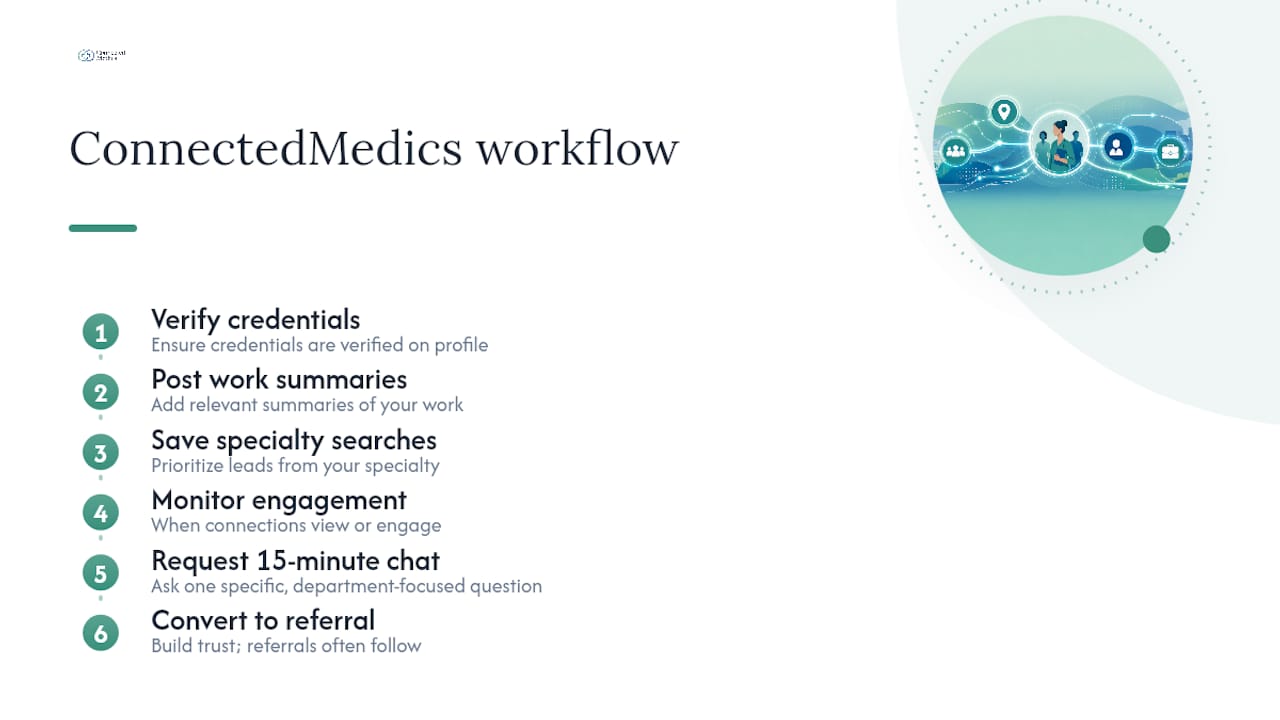
When a connection views your profile or engages with your post, request a 15-minute chat with one specific question attached, something that shows you've done homework on their department. That single exchange often converts into a referral once trust is established. Verified networks work because the person on the other end knows your credentials are real before the conversation even starts.
Geographic Considerations for Healthcare Admin Roles
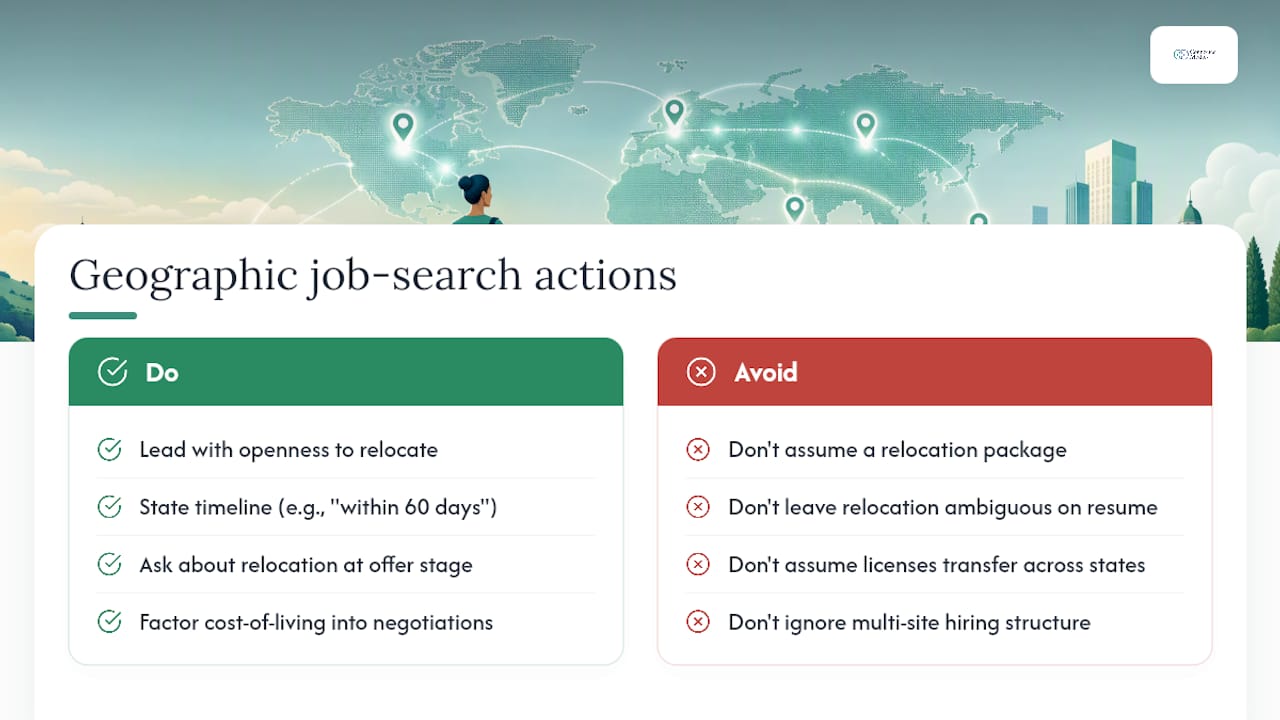
Location changes your job search math more than almost any other factor. Metro areas with large hospital systems (Boston, Houston, the Bay Area) post more admin openings, but they also draw more applicants per role, especially for entry-level and mid-level positions.
Rural and smaller regional health systems often have less competition and faster hiring timelines, since they struggle to attract candidates willing to relocate. If you're open to moving, lead with that in your outreach. A recruiter scanning fifty resumes will prioritize the one that states "open to relocating within 60 days" over one that leaves it ambiguous.
Relocation for a healthcare admin role rarely comes with a full relocation package unless you're moving into a director-level or C-suite position. Ask directly during the offer stage rather than assuming it's included, and factor cost-of-living differences into any salary negotiation, since a raise that looks generous on paper can be a pay cut once you account for housing costs in a major metro.
Licensing isn't usually the barrier it is for clinical roles, but some state-level hospital administrator positions carry specific certification or continuing-education requirements. Check state hospital association pages before assuming your credentials transfer cleanly across state lines. If you're targeting multi-site clinic networks, understanding how those systems structure regional versus corporate admin roles matters too. A multi-clinic operations playbook offers useful context on how these organizations structure hiring across locations.
What This Search Actually Rewards
Most job-search advice treats healthcare administration like any other office job: polish the resume, apply broadly, wait. That advice undersells how relationship-driven this field actually is. Hospital systems and clinic networks are small worlds. The department director interviewing you today probably trained under someone your informational interview contact already knows.
The conventional wisdom oversells volume. Sending forty applications a week feels productive and produces almost nothing, because it skips the referral layer that fills most roles before they're ever posted publicly. What the research actually supports is narrower and slower: fewer applications, more conversations, and a tracking system disciplined enough that no lead goes cold from neglect.
If you take one thing from this, prioritize the specialty channels first. General job boards are a supplement, not a strategy. Association career centers, verified networks, and direct employer pages consistently produce better-fit roles faster than mass application ever will. The spreadsheet isn't busywork. It's the difference between a search that compounds and one that just accumulates rejections.
— David
ConnectedMedics: Your Next Step in the Search
Some healthcare networks give admin candidates something a general job board can't: a jobs board built exclusively around healthcare roles, verified professional profiles, and a knowledge hub with clinical insights and industry trends, all in one place instead of scattered across a dozen bookmarks.
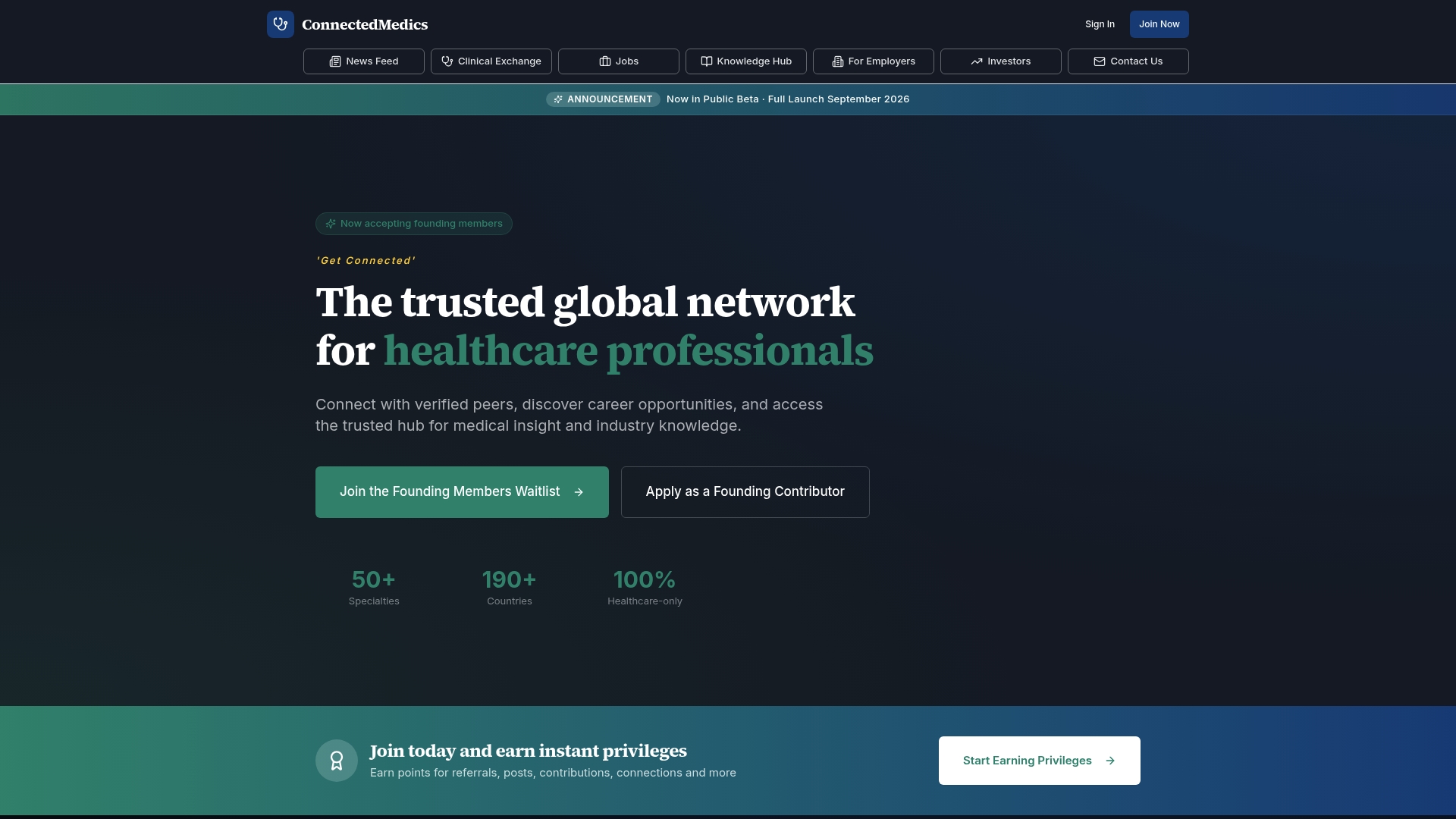
Two moves get you started today. First, create a verified profile so recruiters and connections can confirm your credentials at a glance. Second, set targeted job alerts filtered to your specialty and location, so new admin postings reach you before the applicant pool floods in. Recruiters and hospital hiring teams use the employer tools to post roles directly to a healthcare-only audience, and the Premium Employer tier speeds up candidate discovery even further, which means the postings you see there are often fresher than what hits a general aggregator. Start by building your profile and setting your first alert this week.
Sources
- How to Become a Healthcare Administrator — ACE
- Informational interviewing and career search strategies — Yale OCS
- How to Find Administrative Jobs in Healthcare — KG Career Academy
FAQ
Are Healthcare Administrators in High Demand?
Yes. Hospital systems, clinics, and insurers continue expanding operations and compliance staff, which keeps demand for qualified administrators steady across most regions, though competition is heavier in major metro markets.
How Do You Get a Job as a Healthcare Administrator?
Combine specialty job boards, association career centers, and employer pages with active networking and a tracked application process. Platforms like ConnectedMedics and association portals like AAHAM and NAHSE surface roles general boards often miss.
Are Healthcare Administration Jobs Hard to Get?
Entry-level roles are competitive in large metro areas but more accessible in smaller regional health systems. A tailored, keyword-matched resume and at least one referral connection meaningfully improve your odds over a resume-only approach.
Where Do Healthcare Administrators Get Paid the Most?
Pay tends to run highest in large metro hospital systems and senior leadership roles requiring an MHA, MPH, or MBA, though smaller systems sometimes offer faster advancement to compensate for lower starting pay.