
Employer branding is the fastest way to reduce vacancy rates and attract clinicians who stay. It works by aligning what you promise candidates with what staff actually experience on the floor. Start with a short audit of your careers page and job ads, paired with an honest interview with a frontline clinician. Track time-to-fill or vacancy rate before and after to see if the message is landing.
TL;DR:
- Conduct a quick audit of your careers page and job ads, then interview frontline clinicians to ensure your messaging aligns with their actual experience.
- Build your EVP around culture, professional development, scheduling flexibility, benefits, and authenticity to distinguish your workplace beyond marketing language.
- Pilot employer branding strategies in one unit for four to six weeks, using clinician quotes and day-in-the-life content to validate messaging before system-wide implementation.
- Integrate branding into every hiring touchpoint by pairing recruiters with clinician liaisons and giving candidates a peer view to reduce mismatch and early turnover.
- Use KPIs like time-to-fill, offer acceptance, and 6-12 month retention, along with specialized healthcare platforms, to measure and support your employer brand’s effectiveness.
Table of Contents
- What Is Healthcare Employer Branding, and Why Does It Matter?
- What Belongs in Your Healthcare Employer Value Proposition?
- How Do You Build a Healthcare Employer Brand From Scratch?
- How Do You Showcase an Authentic Employer Brand?
- How Does Employer Branding Connect to the Hiring Process?
- Which KPIs Prove Your Employer Brand Is Working?
- How Can a Healthcare-Specific Platform Support Your Employer Brand?
- Treating Employer Branding as an Operational Discipline
- Get Started With ConnectedMedics for Employer Branding
- Sources
- FAQ
What Is Healthcare Employer Branding, and Why Does It Matter?
Healthcare employer branding is the reputation your organization has as a place to work in medicine, built from what candidates see online, hear from current staff, and experience during hiring. It is distinct from your public brand as a care provider. A hospital can have an excellent community reputation for patient care and a poor one among nurses deciding where to apply next.
The stakes are measurable. Employer branding is positively associated with organizational identification and retention among healthcare staff, meaning a distinctive, honest brand keeps people longer, not just gets them in the door faster. That distinction matters because most health systems still spend their recruitment budget on ads and sign-on bonuses rather than on the deeper work of defining what makes their workplace genuinely different.
Money alone will not fix a leaky pipeline. Research on recruitment and retention of healthcare professionals finds financial incentives have limited long-term effectiveness. Clinicians weigh team fit, scope of practice, and professional development more heavily when deciding whether to stay. A sign-on bonus gets a resume submitted. A believable brand gets a two-year commitment.
What Belongs in Your Healthcare Employer Value Proposition?
Your employer value proposition, or EVP, is the set of promises you make to clinicians in exchange for their skills and time. A strong healthcare EVP needs to speak to the specific tradeoffs clinicians weigh, not generic corporate values.
Build it around five categories:
- Culture and daily experience. Scope of practice, staffing ratios, and whether new hires get real team support in their first 90 days.
- Professional development. Clear career ladders, tuition support, and certification pathways rather than vague "growth opportunity" language. This is where resources like career progression guidance for HCAs and nurses can shape what you actually offer.
- Scheduling flexibility. Self-scheduling options, predictable shift patterns, and honest disclosure of on-call expectations.
- Benefits and well-being support. Mental health resources, burnout prevention programs, and physical safety measures, not just a benefits PDF linked from the careers page. Practical wellness strategies for healthcare professionals can anchor this pillar in something concrete.
- Authentic voices and DEI commitments. Real clinician stories and a visible, specific diversity strategy, not a stock photo of a diverse team on the homepage.
Skip any of these five and the EVP reads as marketing copy instead of a workplace description.
How Do You Build a Healthcare Employer Brand From Scratch?
Building the brand happens in a sequence: audit, listen, draft, pilot. Skipping the listening step is the most common reason employer branding projects fail to move the numbers.
- Audit your current channels. Review your careers page, job postings, Glassdoor and Indeed reviews, and social presence. Note gaps between what you claim (flexible scheduling, strong culture) and what candidates or reviewers report experiencing.
- Interview frontline clinicians. Run short 20 to 30 minute conversations with nurses, techs, and physicians across departments. Ask what made them stay and what nearly made them leave. A quick pulse survey across a unit works if one-on-ones are not feasible.
- Draft the EVP. Translate what you heard into three or four core messages, each backed by a specific proof point (a real program, a real number, a real name attached to a quote with permission).
- Pilot with one hiring team. Test the new messaging on a single service line or unit before rolling it system-wide. The AONL Workforce Compendium points to focused pilots as the fastest way to validate whether branding changes actually move vacancy and time-to-hire numbers.
- Build the execution plan. Set a content calendar, assign owners for careers page updates and social posts, and map where the new messaging shows up in each recruitment touchpoint.
A single-unit pilot typically takes four to six weeks to design and run, with minimal direct cost beyond staff time. A system-wide rollout is a multi-month effort involving legal review, brand design, and coordination across HR, marketing, and clinical leadership.
Pro Tip: Record the clinician interviews (with consent) and pull direct quotes for your careers page. Paraphrased "culture statements" read as marketing. Verbatim quotes from named staff read as proof.
How Do You Showcase an Authentic Employer Brand?
Showcasing the brand means giving candidates real evidence, not polished claims. The gap between what a careers page promises and what a new hire experiences in week one is the single fastest way to burn trust and drive early turnover.
Your careers page needs a few non-negotiables:
- Searchable job listings with actual scheduling details, not just "competitive schedule."
- Day-in-the-life content showing what a shift actually looks like, department by department.
- Clear disclosure of onboarding length, preceptorship structure, and orientation expectations.
Short-form video outperforms long promotional pieces. A 60 to 90 second clip of a charge nurse describing what she likes about her unit tends to hold attention better than a five-minute produced piece with a voiceover. Instagram reels and unit takeovers work because they look unscripted, even when they are lightly guided. LinkedIn performs better for physician and leadership recruiting, where longer-form posts and article shares carry more weight.
Set a repost policy before you launch anything: define what staff can film, what needs patient-privacy review, and who signs off before publishing. Avoid overselling dramatic clinical scenes or lifestyle claims that do not match the actual pace of the unit. Nothing damages a brand faster than a recruit discovering the "relaxed pace" from the recruitment video does not exist on the floor.
How Does Employer Branding Connect to the Hiring Process?
Employer branding fails when it lives only in marketing and never touches the actual hiring workflow. The brand has to show up in every conversation a candidate has with your organization, not just the job ad that got their attention.

The highest-leverage change here is pairing recruiters with a clinician liaison for screening and interviews. Embedding branding directly into the hiring workflow, rather than running it as a separate campaign, reduces mismatch hires and early turnover because candidates hear the same message from HR and from the people they will actually work beside.
Practical changes worth testing:
- Map the full candidate journey and set a target number of days for each stage, so nobody waits two weeks for a callback after a strong interview.
- Give recruiters a role-based script per specialty so an ICU nurse and a radiology tech hear promises specific to their unit, not a generic pitch.
- Have the clinician liaison join at least one interview round so candidates get an unfiltered peer view before accepting.
Vacancy data backs the urgency here. The nurse vacancy rate has been reported at 9.6%, with average time-to-hire for experienced nurses running around 83 days. Organizations that align talent acquisition and clinical leadership on hiring workflows have shown measurable reductions in both figures.
Which KPIs Prove Your Employer Brand Is Working?
Four numbers tell you whether your employer brand is actually converting into hires who stay: time-to-fill, offer-acceptance rate, 6 to 12 month retention, and candidate satisfaction (often captured as a candidate NPS score).
Secondary signals worth watching alongside them:
- Careers page traffic and time on page for day-in-the-life content
- Video completion rate on recruitment clips
- Social engagement on employee story posts
- Source-to-hire ratio by channel
Run pilots with a control group. Test new messaging with one unit or service line while a comparable unit continues with existing materials, then compare time-to-fill and 90-day retention between the two. Pilot programs that succeed typically track speed and retention together, since a fast hire who leaves in four months is not a win.
Report results monthly to a joint HR and clinical leadership group. That cadence keeps the pilot from stalling and gives clinical leaders a reason to stay invested in the messaging their name is attached to.
How Can a Healthcare-Specific Platform Support Your Employer Brand?
A verified, specialty-only network changes who sees your job posting and how much they trust it before they click apply. Generic job boards mix healthcare roles with every other industry, forcing candidates to filter through noise. A platform built exclusively for healthcare, like Connectedmedics, puts your opening in front of clinicians already sorted by specialty and credential status.
Practical uses for a platform like this include:
- Targeted campaigns filtered by specialty, so an ICU opening reaches ICU-credentialed nurses specifically.
- Clinician Q&A sessions or verified testimonials attached directly to your employer profile.
- Integration points with existing applicant tracking systems to avoid duplicate data entry.
Specialty-targeted platforms and verified networks let employers reach passive candidates with less noise than broad job-board postings generate. Consider adding one to your stack once your EVP is drafted and tested. Feeding an untested message into any channel, however targeted, wastes the reach.
Treating Employer Branding as an Operational Discipline
Employer branding fails as a campaign and succeeds as infrastructure. The organizations that see real movement in vacancy rates are not the ones with the best recruitment video. They are the ones who wired their EVP directly into the hiring workflow, so every recruiter call and every clinician interview reinforces the same promise.
Recruiter and clinician pairings are the highest-leverage change available, and they cost almost nothing to test. One unit running a four-week pilot, with a clinical liaison sitting in on interviews, will tell you more about your real employer brand than a year of polished social content ever will.
— David
Get Started With ConnectedMedics for Employer Branding
Connectedmedics gives you a way to put a tested EVP in front of clinicians who are already sorted by specialty and verified by credential, instead of competing for attention on a generalist job board. Verified profiles and specialty filters mean your ICU posting reaches ICU nurses, not a mixed pool of unrelated applicants.
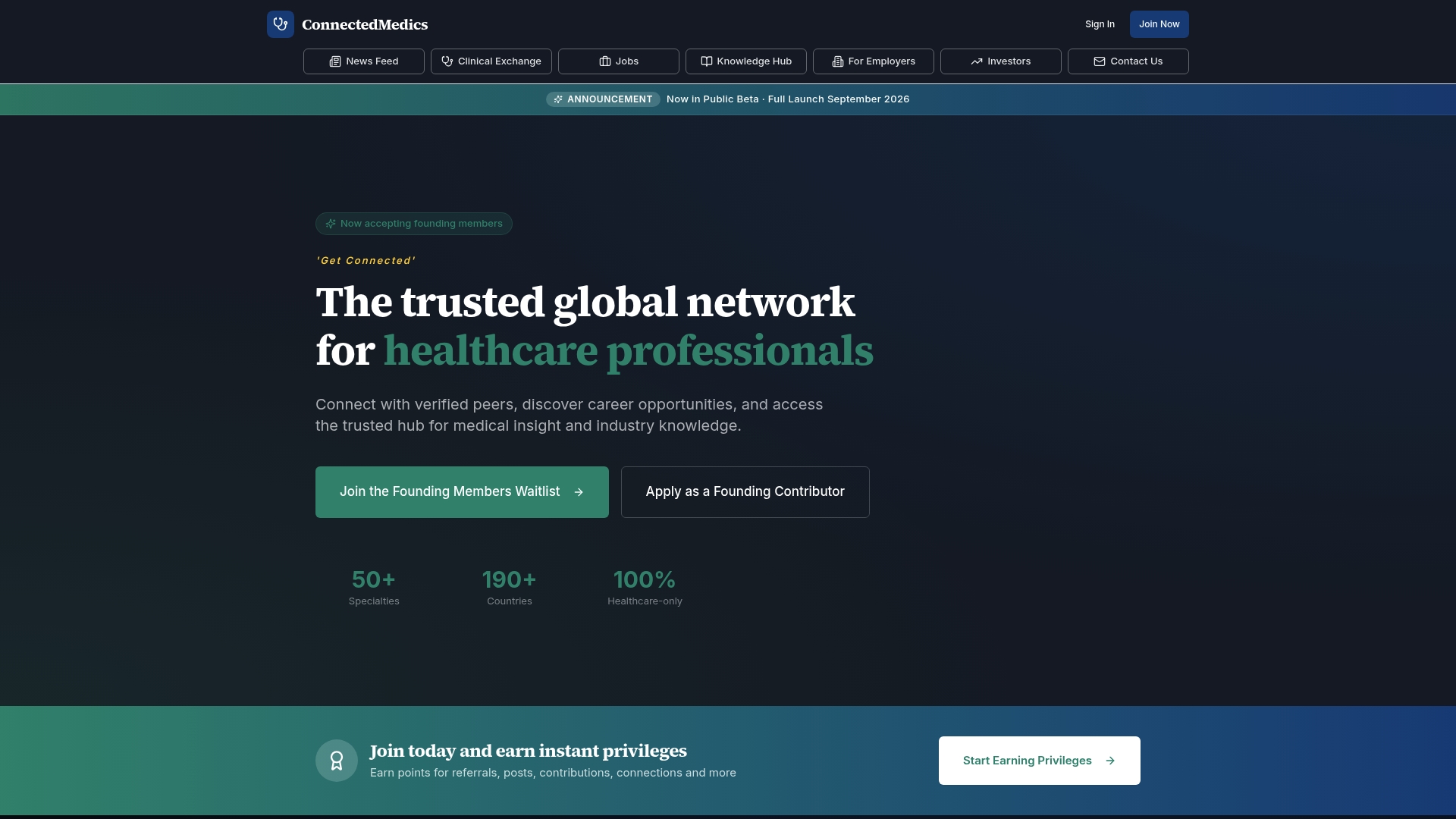
Employer plans start with a Free tier and scale to Growth, with Enterprise and Premium Employer options for organizations running larger recruitment operations. Each tier gives your team access to the global healthcare jobs board and employer tools for verified hiring. If your organization is running a branding pilot and wants a channel built specifically for healthcare rather than repurposed from generalist recruiting, review the employer plans page to see which tier matches your hiring volume.
Sources
- Factors influencing recruitment and retention of healthcare professionals — PubMed Central (PMC)
- Employer branding and organizational identification — Journal of Nursing Management (2023)
- AONL Workforce Compendium (2025) — recruiting and retaining nursing talent
- Incredible Health — Healthcare recruitment strategies (2026 guide)
FAQ
What Is Healthcare Employer Branding?
It is the reputation an organization holds among clinicians and candidates as a place to work, shaped by messaging, employee experience, and how consistently the two match.
How Long Does It Take to See Results From an Employer Branding Pilot?
A single-unit pilot typically runs four to six weeks before you have enough time-to-fill and early-retention data to judge whether the messaging is working.
What KPIs Should We Track First?
Start with time-to-fill, offer-acceptance rate, and 6 to 12 month retention, then add candidate satisfaction and careers page engagement once the basics are stable.
Does Connectedmedics Help With Employer Branding Specifically?
Connectedmedics offers verified clinician profiles and a specialty-filtered job board that let employers target messaging directly at qualified candidates rather than a generalist applicant pool; plans are listed on the employer page.
Do Financial Incentives Fix Recruitment and Retention Problems on Their Own?
No. Research on healthcare workforce recruitment shows financial incentives have limited long-term effect compared with team fit, scope of practice, and professional development.