
A structured referral program built on a specialty-focused, verified clinician network is the fastest way to hire trusted physicians. Pair it with integrated verification and tracking, and you get faster time-to-fill, better-matched candidates, and higher 90-day retention than job-board posting alone. The playbook below breaks the process into steps you can start this week.
TL;DR:
- Building a specialty-focused verified clinician referral network accelerates hiring, improves candidate fit, and increases 90-day retention compared to traditional job postings.
- Use targeted mapping, streamlined tracking, consistent outreach, and complete verification to sustain long-term referrer engagement and trust.
- Prioritize high-yield channels like specialty societies, regional events, peer communities, and automation platforms to scale referral volume efficiently.
- Offer recognition, modest cash bonuses after onboarding, and enforce confidentiality measures to ensure reliable and compliant referral processes.
- Track key metrics such as time-to-fill, source-of-hire, cost-per-hire, and retention to experiment, optimize, and justify program scaling.
Table of Contents
- What Is a Clinician Referral Network and Why Build One?
- How Do You Actually Build the Network, Step by Step?
- Which Tools and Channels Actually Move Referrals?
- What Incentives and Verification Steps Make Referrals Reliable?
- How Do You Measure and Scale a Referral Program?
- How Do You Handle Confidentiality and Privacy in Referrals?
- How Do You Overcome Common Referral Objections?
- What Communication Style Actually Works with Clinicians?
- What Do Recruiters Consistently Get Wrong About Referral Programs?
- Build Your Referral Network on ConnectedMedics
- Sources
What Is a Clinician Referral Network and Why Build One?
A clinician referral network, in the recruiting sense, is the web of connections among verified physicians, employers, and specialty communities that surfaces trusted candidates before a role ever hits a public job board. This is not about directing patients between providers. It is about who vouches for whom in a hiring pipeline.
For recruiters, a working network delivers three concrete outcomes: faster hires because candidates arrive pre-vetted by a colleague, higher-quality matches because referrers self-select for fit, and lower cost-per-hire because you spend less on sourcing and screening. Referral hires consistently outperform cold applicants on retention, which compounds the savings over time.
For clinicians, the same network cuts both ways:
- Access to opportunities that actually match their specialty and career stage, not mass-blasted postings.
- Entry into peer communities where career moves, compensation norms, and department reputations get discussed honestly.
How Do You Actually Build the Network, Step by Step?
Building a referral network isn't a single campaign. It's five connected habits that reinforce each other over a hiring cycle.
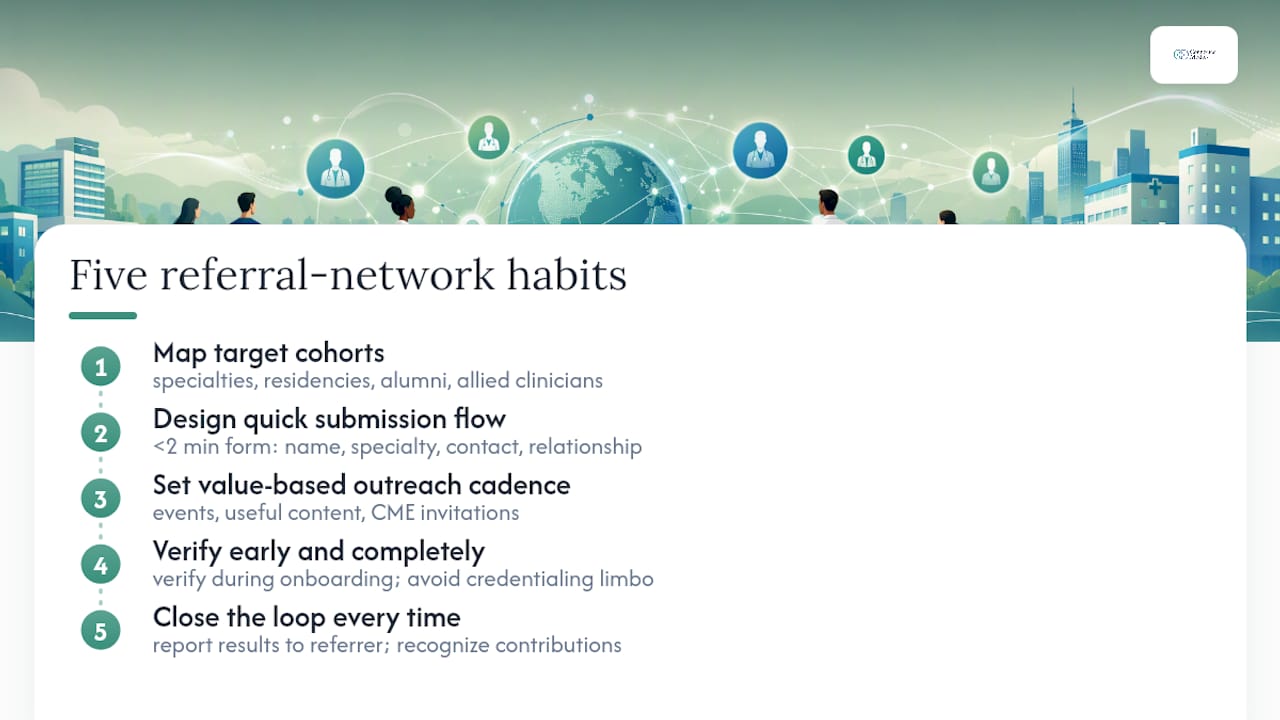
1. Map your target cohorts first. Before you contact anyone, define who you actually need: specific specialties, residency programs that feed those specialties, alumni networks, and allied clinicians who work alongside your target hires daily. A hospitalist referral program that ignores residency program directors is leaving its best source untapped.
2. Design a submission and tracking flow that takes under two minutes. Referrers drop off when the process is confusing. Decide upfront who can submit a referral, what minimum information they need to provide (name, specialty, contact, relationship context), and how you'll report back on status. A clunky spreadsheet kills participation faster than a weak incentive.
3. Set an outreach cadence built on real value exchange. This is not a quarterly email blast. Recruiting leaders who move beyond posting and screening build relationships through events, useful content, and CME invitations that give clinicians a reason to stay engaged between hiring needs, which shortens time-to-fill when a role does open.
4. Verify fast, but verify completely. A referral that stalls in credentialing limbo damages the referrer's trust in the program. Build verification into the earliest stage of onboarding, not the last.
5. Close the loop, every time. Tell the referrer what happened, win or lose. Recognition, not just cash, is what keeps a referrer submitting a second and third candidate.
Pro Tip: Curiosity beats transactional asks. Approach a colleague with a question about their department's biggest staffing challenge instead of "do you know anyone looking?" NEJM Career Center guidance finds this builds the kind of trust that produces repeat referrals, not one-off tips.
Read the full physician recruiting strategies playbook for a deeper breakdown of each step applied to specific specialties.
Which Tools and Channels Actually Move Referrals?
Not every channel deserves equal investment. Specialty societies, residency and alumni partnerships, targeted regional events, peer communities, and referral automation platforms each solve a different part of the problem, and mixing them wrong wastes budget.
- Specialty societies and residency partnerships go deep on a narrow pool. Slow to build, but the trust is durable.
- Targeted events and CME sessions create the face-to-face moments that convert acquaintances into referrers.
- Peer communities keep the relationship warm between active hiring needs.
- Referral automation platforms handle scale. KPG Healthcare's partnership with Staffing Referrals shows how pairing a modest bonus structure with a simple submission and tracking platform increases participation without adding recruiter workload.
Where a healthcare-specific network fits: a platform with verified profiles and a dedicated jobs board complements your applicant tracking system rather than replacing it. The platform currently lists thousands of active healthcare vacancies alongside verified professional profiles, which means recruiters spend less time confirming a referral's credentials before ever reaching out. That verification layer is the piece most ATS platforms don't handle well on their own.
For a broader view of how clinicians network day to day, see how healthcare professionals network in 2026.
What Incentives and Verification Steps Make Referrals Reliable?
The right incentive is rarely the biggest one. Cash bonuses that feel disproportionate to the effort attract low-quality submissions, while recognition and professional development credits tend to sustain genuine engagement over multiple hiring cycles.
Effective incentive structures usually combine:
- Public or team recognition for successful referrals, not just a payout.
- A modest cash bonus tied to the hire completing a probationary period, not the initial submission.
- Continuing education credits or conference stipends as an alternative reward tier.
Verification cannot be an afterthought. At minimum, confirm the National Provider Identifier, current state license status, and board certification before a referral advances past initial screening. Build that checklist into your credentialing workflow rather than running it as a separate manual step.
Governance matters just as much as incentives. Decide early who owns the referral pipeline internally, how referrer and candidate data gets stored, and who has access to it.
Pro Tip: Assign one person, not a committee, to own referral tracking. Split ownership is the single fastest way a promising program quietly dies from neglect.
How Do You Measure and Scale a Referral Program?
Track four numbers from day one: time-to-fill from referral submission to signed offer, source-of-hire percentage attributed to referrals, cost-per-hire compared to job-board sourcing, and 90-day retention specifically for referral hires.
Run small experiments before committing budget at scale:
- Pilot the program with a single specialty cohort before rolling it out organization-wide.
- Test two incentive structures side by side and measure which produces more completed hires, not just more submissions.
- Compare email outreach against SMS or direct messaging for follow-up response rates.
Small, structured experiments produce measurable learning fast, and that data tells you where to scale incentive spend rather than guessing. Pipeline visibility also reduces reactive, last-minute job posting because you can see three or four candidates in motion before a vacancy becomes urgent, which shortens the entire hiring cycle.
How Do You Handle Confidentiality and Privacy in Referrals?
Referring a colleague means sharing personal career information, sometimes before that colleague has told their current employer they're looking. Treat that information with the same care you'd expect if the roles were reversed.
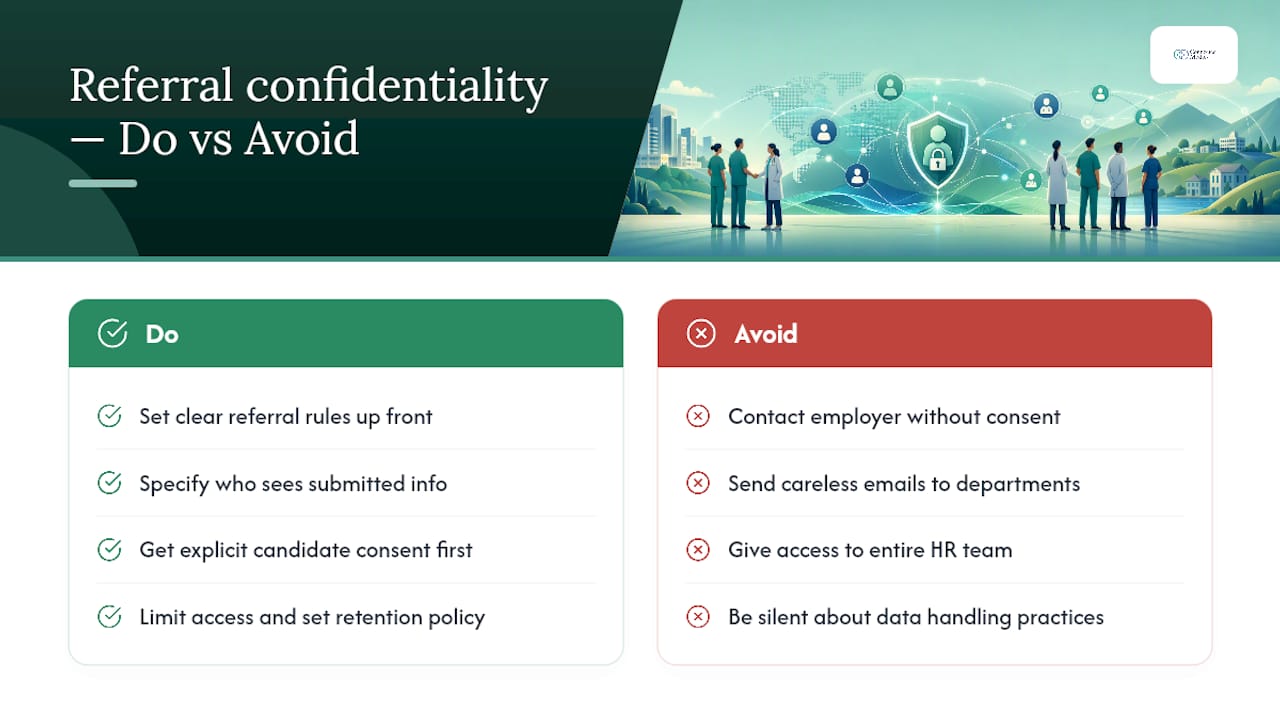
Set clear rules before your first referral comes in. A referrer should know exactly what happens to the information they submit: who sees it internally, whether the candidate is contacted before or after the referrer, and how long the data stays in your system if nothing comes of it. Silence on these points is what makes clinicians hesitant to refer a second time.
Get explicit consent from the referred candidate before you contact their current employer, request references, or share their details with a third party like a staffing agency. Many referred physicians are passive candidates who haven't decided to leave. A careless email to the wrong department can end a professional relationship and a referral pipeline in the same afternoon.
Store referral data the way you'd store any sensitive personnel record. That means limiting access to the recruiters actually working the pipeline, not the entire HR department, and setting a retention policy for candidates who don't move forward. If your program runs through a third-party referral platform, confirm in writing how that vendor handles data retention and deletion requests. Confidentiality isn't a compliance checkbox here. It's the reason a physician trusts you with their network in the first place.
How Do You Overcome Common Referral Objections?
The most common objection isn't skepticism about the program. It's simple inertia: clinicians are busy, and referring a colleague takes effort that competes with patient care and their own administrative load. Make the submission process shorter than the objection. If it takes longer than two minutes, most referrers won't finish it.
The second objection is trust in the outcome. Physicians hesitate to refer someone if they suspect the referral will disappear into a black hole with no update. Fix this by closing the loop every single time, even when the answer is no. A referrer who gets a clear "not a fit right now, but thank you" is far more likely to submit again than one who hears nothing.
A third objection shows up specifically with senior or in-demand specialists: concern that referring a friend or former colleague might look like favoritism or create an awkward dynamic if the hire doesn't work out. Address this directly by making clear the referred candidate goes through the same evaluation process as any other applicant. The referral gets them a warmer introduction, not a shortcut around screening.
Finally, expect pushback on incentives that feel too transactional. Some clinicians don't want to feel like they're being paid to recommend a friend. Offering recognition alongside, or instead of, cash resolves this for a meaningful share of your most engaged referrers.
What Communication Style Actually Works with Clinicians?
Physicians respond to a different register than the average professional referral ask. Clinical schedules are unpredictable, so timing and brevity matter more than polish.
Lead with curiosity, not the pitch. Asking about a colleague's career trajectory or their department's current staffing pressure builds authentic trust that outlasts a single transaction, while opening with "do you know anyone looking for work?" tends to close the conversation before it starts.
Keep messages short and specific. A recruiter who references a specific department, a specific need, and a specific reason they thought of this clinician will get a response far more often than a generic mass message. Respect the reality that most physicians read messages between patients, not at a desk.
Match the channel to the relationship. A quick text or direct message works for someone you already know. A more formal introduction, ideally through a mutual connection or a verified platform profile, works better for a cold outreach into a new specialty community. For guidance on framing that first message well, the doctor networking guide for physicians and med students breaks down what separates a message that gets ignored from one that gets a reply.
What Do Recruiters Consistently Get Wrong About Referral Programs?
Three mistakes show up over and over in referral programs that fizzle out within a year. Over-incentivizing is the first: throw too much cash at a referral and you attract volume over fit, which drowns your recruiters in low-quality submissions. Poor tracking is the second, and it's the quiet killer. A program run on email threads and memory loses referrals and referrers alike within a few months. Ignoring referrer follow-up is the third. Nothing kills a program's second wave faster than a referrer who never hears what happened to the colleague they vouched for.
The shortcuts that actually work are smaller than most recruiters expect. Set a micro-goal at events, like meeting two new clinicians in your target specialty, rather than a vague mandate to "network." Build a scheduled nurture sequence so referrers hear from you on a rhythm, not only when you need a hire urgently. And find your specialty champions early: one respected physician who actively refers colleagues is worth more than a dozen passive names on a distribution list.
Case studies and testimonials from active referral programs back this pattern consistently: the programs that last are the ones built on process discipline, not incentive size.
— David
Build Your Referral Network on ConnectedMedics
Everything in this playbook gets easier when the network you're building on is already verified. ConnectedMedics gives recruiters a specialty-organized pool of clinician profiles that have already cleared identity and credential checks, so the verification step in your workflow starts faster instead of stalling submissions.
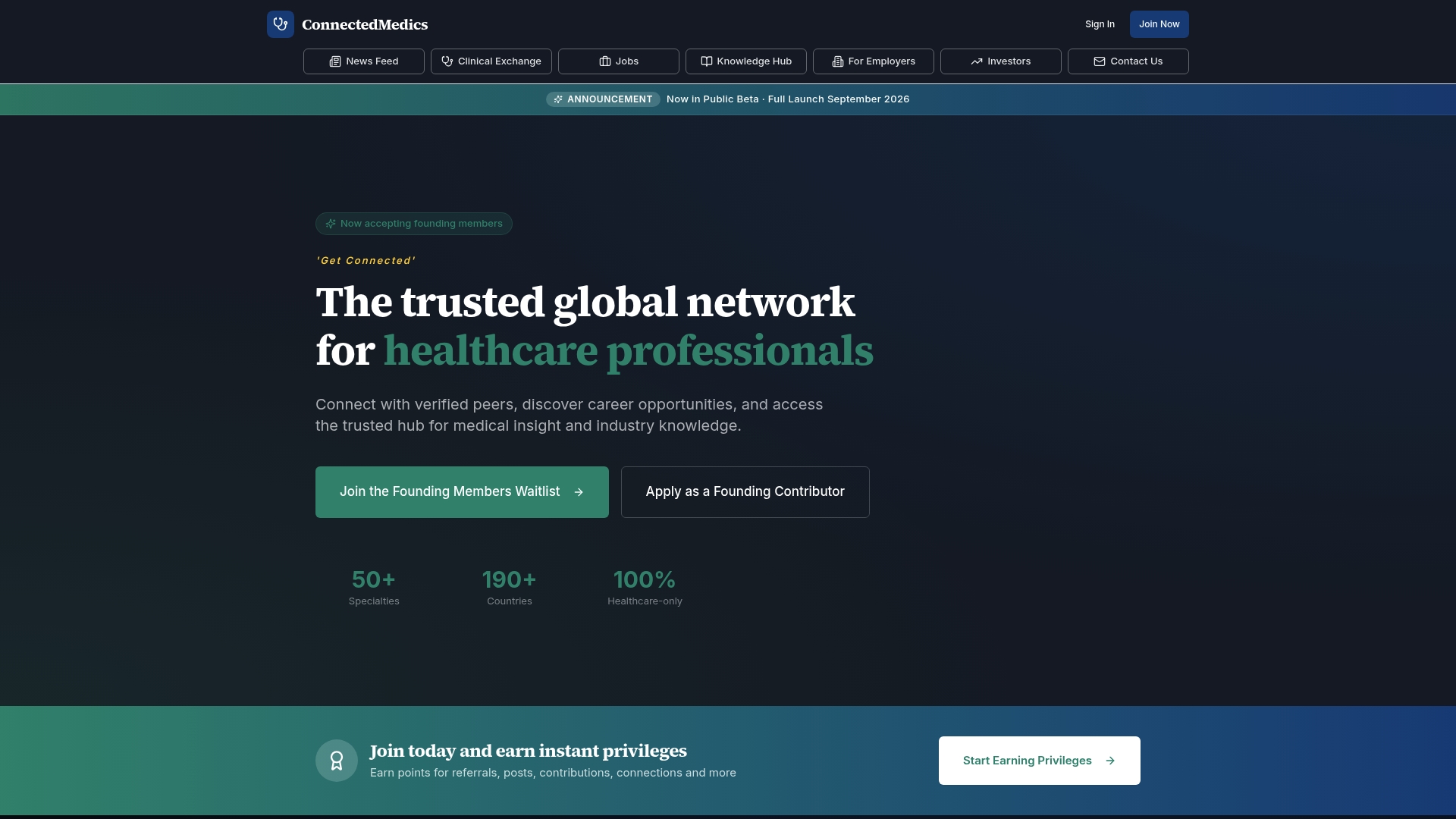
The platform's jobs board currently carries more than 4,600 active healthcare vacancies, and its specialty communities give referrers a natural place to stay engaged between hiring cycles instead of going quiet after one submission. For clinicians, that same structure means referrals arrive matched to their actual specialty and career stage rather than a generic mass posting. Recruiters looking to plug referral tracking directly into a verified talent pool can start on the ConnectedMedics recruiter page and see current candidate availability before committing to a subscription tier.
Sources
- 10 Healthcare Recruitment Strategies to Attract Talent
- Healthcare Talent Acquisition in 2026: Beyond the Job Board
- How to launch and manage a successful physician job search