
A good doctor bio opens with what you treat and who you treat, runs two to three short paragraphs, and ends with how to book. Below are a copy-ready template, five sample bios (all fictional), and the rules behind them, drawn from hospital and university style guides.
TL;DR
- Put your specialty, title and the conditions you treat in the first two sentences. University of Utah Health gives this as its core rule for patient-facing bios.
- Aim for 250 to 450 words on a website and under 300 for a university summary. Cut a long version down for shorter uses.
- Lead with experience, name your board, and say whether you accept new patients.
- Write a long master bio first, then trim it to a directory bio, a social bio and a one-line headline.
- Check every credential and affiliation each time your role changes.
Table of Contents
- What a strong doctor bio contains
- A doctor biography template you can copy
- Doctor bio examples by specialty
- Examples for nurses, pharmacists and researchers
- Short versions for directories and social profiles
- Common bio mistakes
- Getting the story behind the bio
- Perspective
- Keeping your profile accurate
- Put your bio where healthcare professionals look
- FAQ
- Sources
What a strong doctor bio contains
A bio is a summary of who you are professionally: education, experience and unique skills. That is how Harvard T.H. Chan School of Public Health's biography guide defines it. A patient-facing bio has a narrower job. It helps a stranger decide whether you are the right clinician for a specific problem.
The first paragraph carries the weight
Valley Medical Center's provider guidelines ask for a first paragraph covering clinical specialty, board certification, conditions treated, preventive care, procedures, patient populations and unique skills. Later paragraphs cover education, training and interests outside work.
The reason is practical. Directories and search results often show only the opening lines, so those lines must do the selling.
Lead with experience, not credentials
Research from Aha Media Group reports that 55% of people rate experience among the most important factors when choosing a physician. It recommends opening with areas of expertise, specialties, years in practice and notable achievements. Education and credentials come after, because a reader on a hospital site already assumes them.
The same research found that patients care about your care philosophy, your reason for practicing medicine and your values. One or two honest sentences on your 'why' are enough.

Use numbers that do not expire
The University at Buffalo's clinician guidance suggests figures that need no yearly edit, such as 'more than a decade of experience in pain management practice'. It also advises one sentence on how your expertise or ongoing research supports patient care, and a clear tie to a specific patient base.
Optional details worth including
Valley Medical Center lists these as optional:
- Languages spoken
- Other credentials
- Society memberships and academic roles
- Prior healthcare experience
- Volunteer work
- Care philosophy
- Awards, publications and research interests
One tip from DEOCAs: if you speak Spanish, say so in the bio text, not only in a footer badge. The same source says to spell out society names on first mention and to skip awards nobody can verify.
A doctor biography template you can copy
University of Utah Health's template begins with specialties, conditions treated and a scheduling call to action. Later paragraphs cover special training, research, recent work, leadership, awards and education. The structure below follows that order. Replace every bracket.
Paragraph 1: who you treat and how to book
[Full name, credentials] is a [board-certified specialty] physician who treats [top three conditions or procedures] in [patient population] at [practice name] in [city, state]. [He/She/They] [accept/accepts] new patients. To schedule a visit, [call number or book online].
Paragraph 2: experience and approach
With [number]+ years in [setting], [Name] focuses on [subspecialty or unique skill]. [One sentence on care philosophy in plain words.] [One sentence on how your research or recent work helps patients.]
Paragraph 3: training and life outside work
[Name] earned [degree] at [school] and completed [residency/fellowship] at [institution]. [He/She/They] [is certified by the name of the board] and belong[s] to [full society name]. [Name] speaks [languages]. Outside work, [one real interest].
Add a recent headshot. Give your template room to bend, too. After writing more than 1,000 physician profiles, Gowan Communications says a template should save time, not stifle creativity. Standardize education, certification and specialization, and allow room for research or leadership roles.
Doctor bio examples by specialty
These samples are fictional. They show structure, not real people. Each one opens with specialty and conditions, names the board and ends with a next step.
Primary care physician
Dr. Maria Alvarez, MD, is a board-certified family medicine physician who cares for adults and children at Riverside Family Health in Tucson, Arizona. She treats high blood pressure, diabetes, asthma and everyday illness, and she focuses on preventive care. Dr. Alvarez is accepting new patients. Call or book online.
With more than 12 years in community practice, Dr. Alvarez has built her work around long-term relationships. She explains each plan in plain language and asks patients what matters most to them before she recommends treatment. She speaks English and Spanish.
Dr. Alvarez earned her medical degree at the University of Arizona and completed her residency in family medicine in Phoenix. She is certified by the American Board of Family Medicine. Outside the clinic, she hikes and coaches youth soccer.
Why it works: the first paragraph answers 'what do you treat, where and can I book?'. Experience comes before education. Language skills appear in the body text.
Surgeon
Dr. James Okafor, MD, is a board-certified orthopedic surgeon who specializes in knee and shoulder surgery at Lakeside Orthopedics in Columbus, Ohio. He treats sports injuries, arthritis and rotator cuff tears, and he performs minimally invasive and joint replacement procedures. He sees new patients by referral or self-referral.
Dr. Okafor has treated athletes from high school to professional level during more than a decade in practice. He wants every patient to know what recovery looks like before surgery, week by week, so there are no surprises.
He trained at Ohio State University College of Medicine and completed a sports medicine fellowship. He is a member of the American Academy of Orthopaedic Surgeons.
Why it works: procedures are named, the patient group is clear and the 'decade' figure never needs updating.
Academic physician with two audiences

University of Utah Health handles this with two tabs on one profile, so patients and scholars each see relevant content. You can copy that approach: one clinical bio, one academic bio.
Clinical tab:
Dr. Priya Raman, MD, is a cardiologist who treats heart failure and cardiomyopathy at Mercy University Hospital. She is board certified in cardiovascular disease and is accepting new patients.
Academic tab:
Dr. Raman is a national expert in heart failure. She completed fellowship training at [institution] and now studies how remote monitoring reduces hospital readmissions. Her work helps cardiologists identify at-risk patients earlier.
The academic line follows Utah's academic bio template: expert in a field, fellowship training, current research focus, and a sentence on who benefits and how. Academic bios run three to five paragraphs, with research specialties first and academic title second.
Resident or fellow
Dr. Tom Nguyen, MD, is a third-year internal medicine resident at Westview Medical Center. He cares for hospitalized adults and is interested in infectious disease and global health. He earned his medical degree at [school] and plans to pursue an infectious disease fellowship. He speaks English and Vietnamese.
Short, honest and forward-looking. Utah treats residents and fellows as their own profile type, because they serve both clinical and academic audiences.
Examples for nurses, pharmacists and researchers
Bios for other healthcare roles follow the same logic: role and focus first, credentials second, a human detail last.
Nurse practitioner
Valley Medical Center's own guideline examples include a nurse practitioner bio. It covers clinical specialty, national certification, conditions treated, education, memberships, volunteer work and personal interests. A model in that shape:
Sarah Lindqvist, DNP, FNP-C, is a family nurse practitioner who provides primary care and treats acute and chronic infections at Harbor Community Clinic. She is certified through a national nurse practitioner certifying body and sees patients of all ages.
Sarah earned her Doctor of Nursing Practice at [university]. She volunteers with a mobile health outreach program and enjoys cooking and long walks with her dog.
Pharmacist
The University at Buffalo School of Pharmacy guidance advises pharmacists to give enough detail about their methods and tools, and at least one sentence on the goal and importance of their work. Use separate paragraphs for each topic and stay under 300 words.
Dr. Kevin Brooks, PharmD, BCPS, is a clinical pharmacist in critical care at St. Anne's Hospital. He reviews medication plans for patients in the intensive care unit, with a focus on antimicrobial stewardship. His work aims to shorten antibiotic courses safely and reduce drug-related harm.
Researcher
Dr. Elena Torres, PhD, studies how wearable sensors can detect early signs of kidney disease. Her lab uses machine learning on sensor data from community clinics. Her goal is to help primary care teams identify patients who need specialist referral months sooner.
Note the one sentence on who benefits. Both Utah and Buffalo ask for it.
Short versions for directories and social profiles
Write the long version first. Harvard's guide recommends a long bio of three to five paragraphs as the base for shorter versions. It defines four lengths:
| Version | Length | Where it fits |
|---|---|---|
| Long bio | 3-5 paragraphs, 3-5 sentences each | Author bios, speaker introductions, board descriptions |
| Short bio | 1-2 paragraphs, 2-4 sentences each | Website About sections, professional directories |
| Professional statement | 2-4 sentences, present-past-future | Pitches, event programs |
| Headline | A short list of words or phrases | Social profiles, taglines |
A sample headline
Cardiologist | Heart failure | Remote monitoring research | Accepting new patients
Pipe characters keep a social bio scannable within character limits. Skip emoji slogans and generic lines like 'Healer by heart' for professional channels. They tell a reader nothing about what you treat.
A sample professional statement
Use a present, past, future formula:
I treat adults with heart failure at Mercy University Hospital. I trained in advanced heart failure and research. I am now building a remote monitoring program to keep patients out of the hospital.
Common bio mistakes
- Starting with education. Patients assume you are qualified. Start with what you do.
- Vague claims. 'Compassionate, patient-centered care' says nothing. Name a condition, a procedure or a promise.
- Unclear credentials. Name the certifying board. DEOCAs calls board certification the credential patients recognize most.
- Wrong person. Hospital style guides such as Valley Medical Center's call for third person on patient websites. Buffalo's university guidance asks for first person. Follow your employer's rule and stay consistent.
- Dense blocks. Use short paragraphs and, where it helps, bullets. Aha Media Group also recommends active voice and plain language.
- Out-of-date text. Harvard recommends updating after job changes, anniversaries and major accomplishments.
- Unchecked AI drafts. University of Utah Health says AI-written text must be reviewed for accuracy before posting.
Getting the story behind the bio
If you write bios for clinicians, skip generic prompts. Aha Media Group recommends open questions such as 'What's something you wish every patient knew?' and story prompts such as 'Tell me about the moment you chose to become a doctor'. Those draw out specific answers instead of canned ones.
Perspective
Most physician bios are written for a hospital website and then forgotten. A bio does more work than that. Employers, peers and referrers read it too, often before they read anything else about you.
We built ConnectedMedics around that idea. Our platform is for healthcare professionals only, with verified member profiles and specialty-focused communities. A profile on a healthcare-only network can speak in clinical terms, because the people reading it work in the same field.
Our advice: keep one master bio, written answer-first. Adapt it for a hospital page, a network profile and a CV summary. Keep the facts identical across all of them. Consistency makes your credentials easy to trust, and trust is what brings the right opportunities and the right conversations.
David
Keeping your profile accurate
A bio is not a one-time task. DataSpring advises reviewing your professional profile before a credentialing deadline or practice transition. Check that licenses, certifications, affiliations, locations and contact details are current. Know who maintains your information on your behalf, and which organizations are authorized to receive it.
Google also generates profiles and location listings on its own. University of Utah Health notes that managing roughly 7,000 generated profiles is difficult for an institution. Search your own name now and then and correct what you can.
For your CV, use the same facts in a different shape. Our guides on physician CV tips and doctor CV writing cover that. If you are shaping a public reputation, see our piece on clinician personal branding. Before you publish details anywhere, review medical networking privacy controls.
Put your bio where healthcare professionals look
ConnectedMedics is a networking platform for healthcare professionals. It offers verified profiles, a global healthcare jobs board with specialty filters, peer discussion forums and a knowledge hub. Build your profile, paste in your master bio and connect with peers in your specialty.
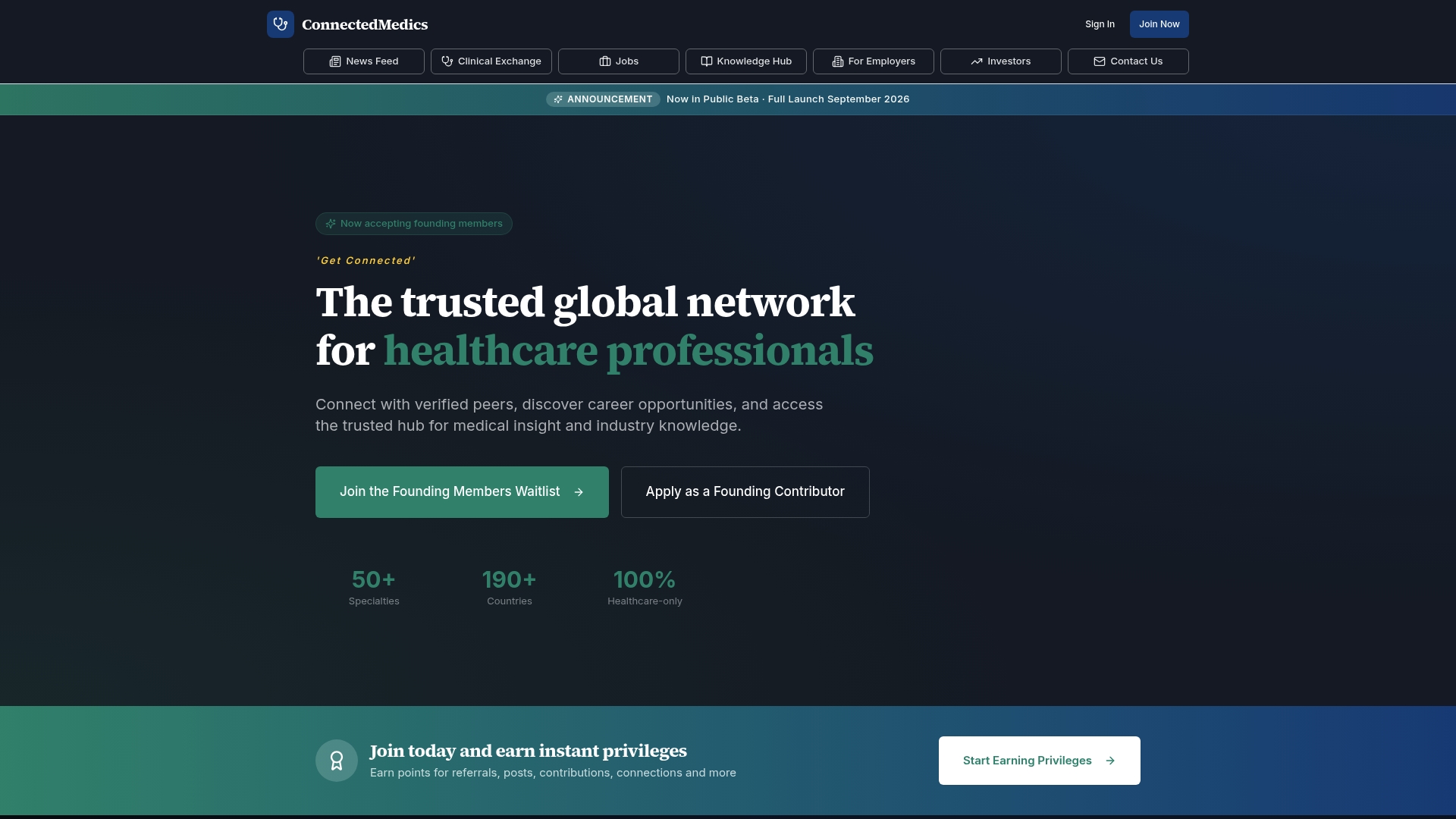
Visit ConnectedMedics to create your profile. Employers hiring verified clinicians can see the employer plans.
FAQ
How long should a doctor bio be?
For a patient-facing website, 250 to 450 words works well, according to DEOCAs. University of Utah Health suggests two to three paragraphs. The University at Buffalo caps university summaries at 300 words. Directory and social versions should be much shorter.
Should a doctor bio be in first or third person?
Follow your employer's style guide. Valley Medical Center and Harvard's guide call for third person. Buffalo's clinician summaries use first person. Pick one and use it in every version.
What should I put in the first two sentences?
Your specialty, your title and what you treat. University of Utah Health recommends this order for clinical bios. For academic bios, put your research specialty first and your academic title second.
Do I need a photo?
Yes. DEOCAs recommends a recent photo with the physician bio, and Harvard's guide recommends a professional headshot. Use one that looks like you today.
Sources
- University of Utah Health: clinical bio optimization
- University of Utah Health: academic bio optimization
- Valley Medical Center: provider website bio guidelines
- University at Buffalo: professional summary for clinicians
- Harvard T.H. Chan School of Public Health: professional biography guide
- Aha Media Group: how to write a doctor bio
- DEOCAs: how to write a physician bio
- Gowan Communications: lessons from 1,000+ physician profiles
- DataSpring: take control of your professional profile