
If you want telehealth work now, three routes get you there fastest: apply directly through employer telehealth career pages, register on verified clinician job platforms or niche staffing agencies, and build a telehealth-ready profile that speeds up credentialing before a recruiter ever calls. Update your resume with telehealth-specific keywords and licensure status today, then apply. The sections below cover qualifications, pay ranges, and an initial starter plan spanning the first months.
TL;DR:
- Clinicians should prioritize multi-state licensure and have all necessary documents ready to streamline credentialing and avoid delays during onboarding.
- Telehealth roles vary widely, with salary structures influenced by specialty, licensure speed, and employment model, making negotiation crucial.
- Building a verified profile on specialized platforms accelerates job matching and reduces the friction caused by repetitive credential submissions.
- The fluctuating regulatory landscape requires clinicians to stay informed and adapt quickly, especially regarding licensure rules and reimbursement policies.
- Starting with platform or staffing jobs helps early-career clinicians gain experience quickly, while experienced providers can leverage negotiations for more stable, higher-paying roles.
Table of Contents
- Telehealth Career Paths: Roles and Employment Models Clinicians Should Expect
- Where to Find Telehealth Jobs: Channels That Actually Work
- Licensure, Credentialing, and Compliance Basics Clinicians Must Handle
- Skills, Training, and Credentials Employers Look For
- Typical Pay Models, Scheduling, and What to Expect for Compensation
- Step-by-Step Starter Plan: Your First 30 to 90 Days
- How ConnectedMedics Helps: Verified Jobs, Verified Profiles, and a Knowledge Hub
- Career Advancement and Specialization Opportunities Within Telehealth
- Typical Salary Ranges and Total Compensation Benchmarks for Telehealth Roles
- Challenges and Common Pitfalls in Telehealth Careers
- Work-Life Balance Considerations Unique to Telehealth Jobs
- Impact of Telehealth Regulations and Policy Changes on Career Stability
- Author Perspective: Practical Advice From a Clinician-Facing Careers Editor
- How to Use ConnectedMedics to Find Telehealth Roles
- Sources
Telehealth Career Paths: Roles and Employment Models Clinicians Should Expect
Telehealth is not one job. It is a set of clinical roles delivered through a screen instead of an exam room, and the role you pick shapes your schedule, your pay structure, and how much clinical autonomy you get.
The most common telehealth roles include:
- Virtual primary care — routine visits, chronic disease management, prescription refills
- Urgent care — same-day triage for acute, non-emergency complaints
- Behavioral health — therapy, psychiatric medication management, crisis intervention
- Specialty consults — dermatology, endocrinology, cardiology follow-ups conducted remotely
- Remote patient monitoring (RPM) — reviewing device data and flagging outliers for intervention
- Asynchronous messaging — answering patient questions and reviewing intake forms outside live visits
- Care coordination — managing referrals, discharge planning, and care-team communication remotely
Employment structures vary just as much. W-2 employee roles offer benefits and predictable scheduling but less flexibility. 1099 contractor work suits clinicians who want control over hours but must handle their own taxes and malpractice coverage. Locum tenens and per-diem shifts fill short-term staffing gaps at higher hourly rates. Network or platform clinician roles, common on verified jobs boards, let you pick up shifts across multiple employers under one credentialing process.
Early-career clinicians often start per-diem or platform-based to build a caseload. Full-time remote seekers usually target W-2 roles for stability. Portfolio clinicians blend a salaried anchor job with 1099 moonlighting for extra income.
Where to Find Telehealth Jobs: Channels That Actually Work
Finding telehealth openings is less about volume and more about matching the right channel to the role you want.
- Employer career pages. Set job alerts directly on health system and telehealth company sites, search using terms like "telehealth" or "remote clinician," and tailor your resume with those exact keywords so applicant tracking systems don't filter you out.
- Staffing agencies and locum firms. These firms handle much of the licensing legwork and match you to open assignments, which can shorten placement time for clinicians who arrive with documents already in order, as staffing partners like CompHealth demonstrate. Use them when you want speed over long-term control.
- Niche clinician platforms and verified jobs networks. Verified profiles and specialty filters cut through generic listings, since platforms that pre-validate licenses and specialties reduce the back-and-forth that slows down traditional hiring.
- Professional societies and targeted boards. Specialty associations often post niche openings you won't find elsewhere.
Watch for recruitment scams: unsolicited offers, requests for payment, or pressure to move fast off-platform are all red flags the FTC warns job seekers to avoid.
Licensure, Credentialing, and Compliance Basics Clinicians Must Handle
Licensure is the single biggest bottleneck in telehealth hiring, and it trips up more clinicians than any skills gap does.
Physicians practicing across state lines can apply through the Interstate Medical Licensure Compact, which speeds multi-state licensure for eligible doctors but doesn't eliminate the need for a license in every state where a patient is located at the time of care. Nurse practitioners and physician assistants face a patchwork of state-specific telehealth rules, and some states still require a separate telehealth registration even if you already hold a full license there.
Credentialing typically requires:
- Active, unrestricted state license(s)
- DEA registration if you prescribe controlled substances
- Current malpractice insurance
- Background check clearance
- Verified education and residency/training documentation
Pro Tip: Build a single digital folder with scanned copies of every license, DEA certificate, and diploma before you start applying. Recruiters move fastest on candidates who can produce documents same-day, and slow document turnaround is the number one reason offers stall.
A partner compliance checklist can help you track state-specific requirements as they shift.
Skills, Training, and Credentials Employers Look For
Clinical competence gets you the interview. Webside manner gets you hired and rehired.
The American Medical Association specifically calls out webside manner as a distinct skill from bedside manner, covering camera presence, active listening without physical cues, and structuring a virtual visit so patients feel heard in 15 minutes or less. Clinicians who pursue this training proactively tend to outperform peers who wait for an employer to teach it after hire.
Employers also expect:
- Telehealth documentation habits — charting that captures what a physical exam would normally show, plus clear notes for asynchronous follow-up
- Video platform fluency — comfort troubleshooting on the fly when a patient's connection drops
- EHR navigation across systems — many telehealth employers use platforms different from what you trained on
- Remote-monitoring interface literacy — reading RPM dashboards accurately and flagging outliers quickly
Pro Tip: Short micro-certifications in telehealth documentation and virtual communication signal readiness on a resume faster than years of unrelated clinical experience. Reviewing clinical skills courses built for this shift is a practical first step.
Typical Pay Models, Scheduling, and What to Expect for Compensation
Pay in telehealth follows four broad shapes: salaried W-2 (predictable, benefits included), hourly/shift pay (common in urgent care and behavioral health), 1099/per-visit models (you're paid per completed encounter), and locum arrangements (higher hourly rates, no benefits, short-term).
What moves your rate:
- Specialty (psychiatry and dermatology typically command premiums)
- How fast you can complete credentialing
- Years of experience and multi-state licensure
- State cost-of-living and payer mix
Statistic Callout: Employers and staffing firms increasingly emphasize how quickly a clinician can clear credentialing and licensing steps, since faster-credentialed clinicians get first pick of open shifts and often the better-paying ones.
Before accepting an offer, ask about CME allowances, malpractice coverage, and minimum guaranteed hours, not just the headline rate. Reviewing current salary benchmarks before negotiating helps you avoid underselling multi-state licensure.
Step-by-Step Starter Plan: Your First 30 to 90 Days
- Prep your documents. Gather licenses, DEA registration, updated CV with telehealth keywords, and any webside manner or documentation certifications.
- Apply broadly, register narrowly. Set alerts on two or three employer career pages, register on one verified clinician platform, and contact a staffing agency if you want speed.
- Onboard with intention. Expect tech checks, protocol training, and a supervision period; treat the first two weeks as a chance to master the EHR before patient volume ramps up.
Pro Tip: In your first 90 days, ask your supervisor for feedback on documentation specifically. Telehealth charting habits that pass muster in person often don't hold up to remote audit standards.
How ConnectedMedics Helps: Verified Jobs, Verified Profiles, and a Knowledge Hub
Credential friction is the biggest drag on telehealth hiring speed, and it's exactly what a verified network is built to solve.
ConnectedMedics gives clinicians:
- Verified profiles that let recruiters trust your credentials on sight, cutting back-and-forth
- Specialty filters that surface roles matching your actual training
- A curated jobs board built specifically for healthcare, not scraped from generic listings
- A knowledge hub summarizing clinical research and telehealth trends
Uploading your credentials once and getting matched to relevant openings beats re-submitting the same documents to five different employers.
Career Advancement and Specialization Opportunities Within Telehealth
Telehealth is no longer just an entry point. It has become a legitimate career ladder with its own specialization tracks.
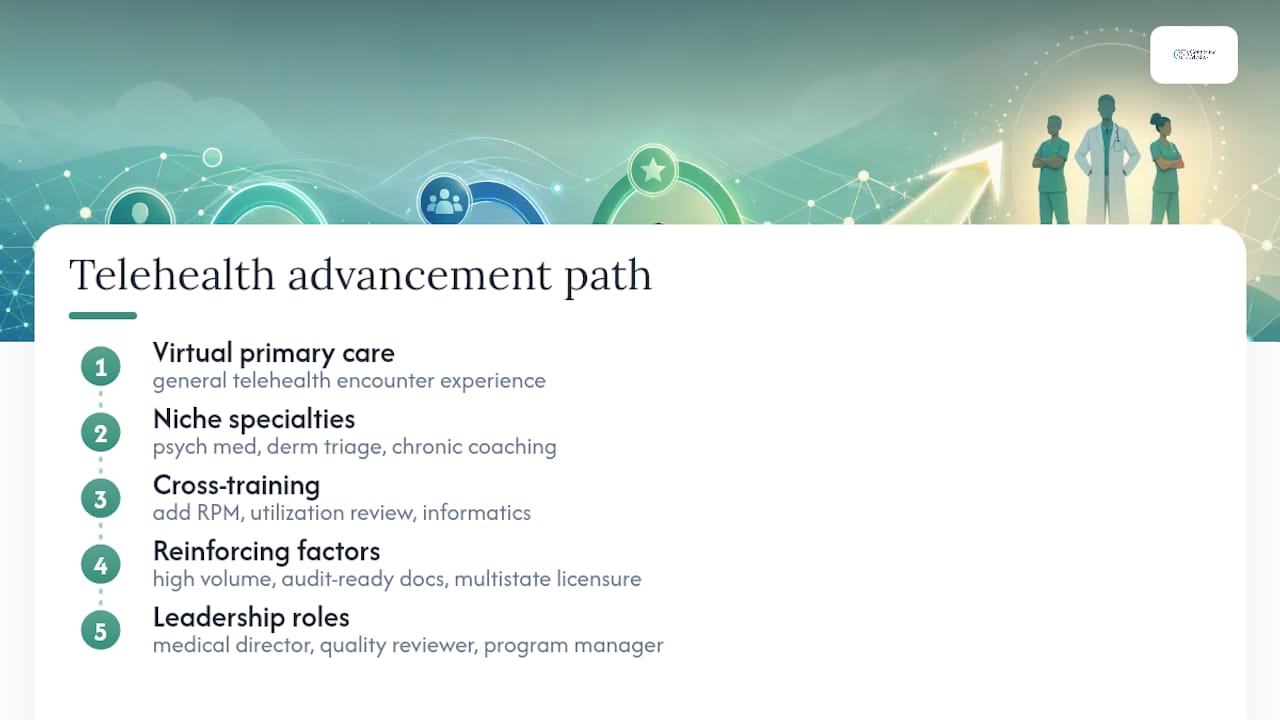
Clinicians who start in general virtual primary care often move toward niche telehealth specialties like psychiatric medication management, dermatology triage, or chronic disease coaching for diabetes and hypertension. These tracks tend to pay more because fewer clinicians have built the specific documentation habits and diagnostic workflows they require.
Leadership tracks are opening up too. Telehealth medical directors, clinical quality reviewers for virtual platforms, and telehealth program managers are increasingly common titles at larger health systems and staffing firms. These roles typically require two to three years of direct telehealth experience plus demonstrated comfort auditing virtual visit quality.
Cross-training matters here. A nurse practitioner who adds RPM program management to a virtual primary care background becomes far more valuable than one who only sees patients. Similarly, physicians who pair a telehealth specialty with utilization review or informatics experience often move into higher-paying hybrid roles that combine clinical work with platform strategy.
The clearest path to advancement is volume plus documentation quality. Clinicians who rack up encounter hours while maintaining clean, audit-ready charting get first consideration for supervisory and specialty-lead openings. Multi-state licensure compounds this advantage, since it makes you eligible for a wider pool of higher-tier assignments as they open.
Typical Salary Ranges and Total Compensation Benchmarks for Telehealth Roles
Total compensation in telehealth spans a wide range depending on specialty, employment model, and how many states you're licensed in.
Salaried, W-2 telehealth physicians in primary care and urgent care generally see pay comparable to their in-person counterparts, with the tradeoff usually appearing in schedule flexibility rather than base pay. Behavioral health clinicians, particularly psychiatrists and psychiatric nurse practitioners, tend to command some of the higher hourly and per-visit rates in telehealth due to sustained demand outpacing supply.
Nurse practitioners and physician assistants working per-diem or platform-based telehealth shifts typically earn hourly or per-visit rates that scale with the number of states they're licensed in and how quickly they can complete a visit without sacrificing documentation quality. Locum tenens telehealth assignments generally pay a premium over comparable W-2 roles, reflecting the short-term nature and lack of benefits.
Total compensation should always be evaluated beyond the base rate. CME stipends, malpractice coverage, health benefits for W-2 roles, and guaranteed minimum hours all shift the real value of an offer. A 1099 role advertising a higher hourly rate can end up paying less in practice once you account for self-funded malpractice insurance and the lack of paid time off.
Reviewing current salary trend data before an offer conversation gives you a benchmark to negotiate against, rather than accepting the first number a recruiter offers.
Challenges and Common Pitfalls in Telehealth Careers
The biggest pitfall in telehealth isn't clinical. It's licensing logistics catching clinicians off guard mid-hiring process.
Many clinicians accept a telehealth role assuming their home-state license covers them everywhere, only to discover they need separate licensure or registration in every state where a patient is physically located during the visit. This single misunderstanding causes more offer delays and rescinded start dates than any skills gap.
Another common pitfall is underestimating documentation standards. Telehealth charting gets audited more closely than many clinicians expect, particularly around medical necessity and the absence of a physical exam. Clinicians who treat virtual documentation as a shortcut version of in-person charting often get flagged during compliance review.
Isolation is a quieter but real challenge. Clinicians accustomed to hallway consults with colleagues can feel cut off from peer support in a fully remote role, which affects both clinical confidence and job satisfaction over time.
Technology friction also trips up otherwise strong candidates. Struggling with video platforms or EHR navigation during onboarding can create a poor first impression even when clinical skills are solid.
The fix for most of these pitfalls is preparation, not talent. Confirm licensure requirements state by state before accepting an offer, treat documentation training as mandatory rather than optional, and seek out platforms or employers that build in peer connection, whether through case conferences or specialty communities. Clinicians who prepare for these friction points in advance report smoother transitions than those who learn them the hard way mid-assignment.
Work-Life Balance Considerations Unique to Telehealth Jobs
Telehealth's biggest selling point, flexibility, is also its most common trap.
Without a commute or a waiting room forcing natural breaks between patients, many telehealth clinicians find their days blur together. Back-to-back virtual visits with no built-in transition time can lead to faster burnout than in-person shifts with the same patient volume, simply because there's no physical movement between rooms to reset mentally.
Boundary-setting becomes a skill you have to build deliberately rather than one the environment enforces for you. Clinicians working from home need to draw a hard line between "logged in" and "off," because the always-available nature of a laptop makes it easy to answer one more asynchronous message after hours, which becomes ten more messages over a few months.
On the upside, telehealth genuinely does support caregiving responsibilities, chronic health needs, or geographic flexibility in ways bedside work can't. A per-diem or platform-based schedule lets you build shifts around school pickups or a partner's relocation in a way full-time hospital work rarely allows.
The clinicians who report the best work-life balance in telehealth tend to be the ones who treat their home office like a real clinical space: dedicated hours, a closed door, and a clear end-of-shift ritual. Those who blur home and work environments completely tend to report the most fatigue, even when their total hours look reasonable on paper.
Impact of Telehealth Regulations and Policy Changes on Career Stability
Telehealth's regulatory landscape shifts more often than almost any other area of clinical practice, and that volatility directly affects job security.
Pandemic-era flexibilities that allowed broader interstate practice and relaxed prescribing rules have been rolled back or extended piecemeal, state by state and sometimes payer by payer. Clinicians who built a caseload around one set of rules have had to adjust licensure strategy or patient panels when a state let a temporary allowance expire.
This is exactly why the Interstate Medical Licensure Compact matters beyond convenience. It offers physicians a more durable path to multi-state practice that doesn't depend on emergency waivers staying in place. Nurse practitioners and physician assistants without an equivalent compact in every state face more exposure to sudden rule changes, which makes it worth tracking policy updates in the states where you plan to practice.
Reimbursement policy carries similar weight. Payers that reduce telehealth reimbursement rates or narrow which visit types qualify for coverage can shrink demand for certain telehealth roles almost overnight, particularly in specialties that rely heavily on private insurance reimbursement rather than direct-pay or employer-sponsored care.
The clinicians with the most career stability in this environment tend to diversify: multi-state licensure, a mix of employment models, and comfort across more than one specialty niche. Staying current on regulatory shifts, rather than assuming today's rules are permanent, is part of the job now in a way it never used to be for clinical work.
Author Perspective: Practical Advice From a Clinician-Facing Careers Editor
Early-career clinicians should start with staffing or platform work to build volume fast. Experienced clinicians have more leverage to negotiate salaried roles or specialized contracts. Every telehealth path trades some income certainty for flexibility, so pick your trade-off deliberately, then invest in verified networking and microtraining rather than waiting for an employer to hand you both.
— David
How to Use ConnectedMedics to Find Telehealth Roles
ConnectedMedics gets you in front of verified employers faster than cold-applying to scattered listings, because your credentials get checked once instead of five separate times.
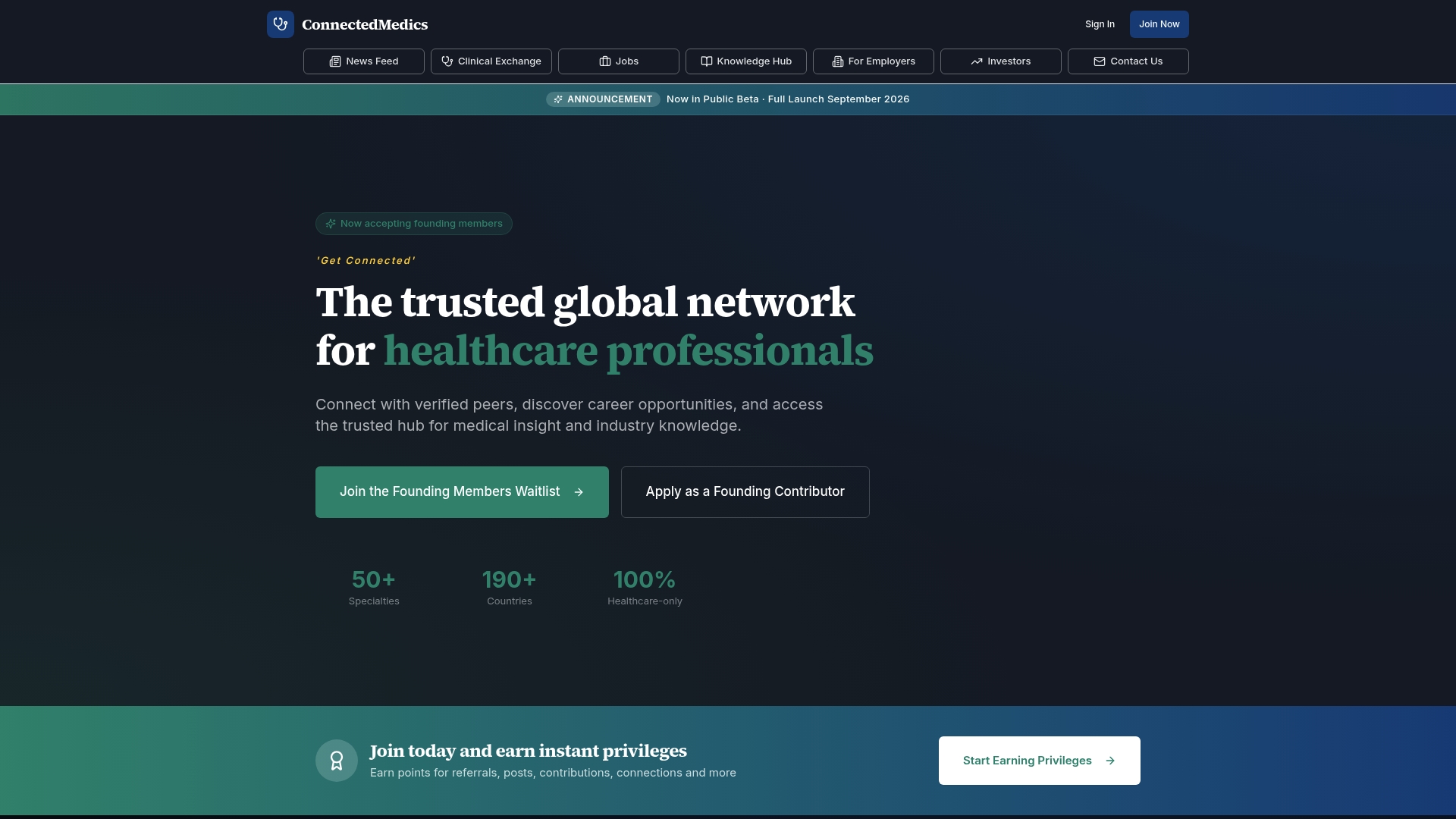
Signing up gets you a verified profile, targeted job alerts filtered by specialty, and access to a knowledge hub built specifically for clinicians navigating virtual care. The quick start is simple: create your account, upload your active licenses and certifications, and set your specialty filters so openings come to you instead of the other way around. Compare that to hunting across a dozen employer career pages one at a time, and the time saved adds up fast.
Ready to see what's open right now? Visit ConnectedMedics to build your verified profile and start matching with telehealth roles in your specialty.
Sources
- Succeed in telehealth: know your webside manner — AMA
- Consumer
- Telehealth compliance checklist for providers in 2026 — Chameleon