
Online medical education is the delivery of accredited clinical training through digital platforms, replacing or supplementing traditional classroom and lab-based instruction for healthcare professionals. The field now spans free continuing medical education (CME) modules from bodies like the CDC and European Medical Journal, certificate programs from institutions like eCornell and MIT xPRO, and high-fidelity virtual reality simulations from platforms like SimX. Healthcare professionals who engage with digital medical education gain flexible, verifiable credentials without leaving clinical practice. The formats available in 2026 range from short three-hour telehealth modules to eight-week AI programs, making structured skill growth accessible regardless of schedule or geography.
1. What are the best accredited platforms for online medical education?
Accreditation separates credible digital medical education from generic online content. Reputable platforms tie course completion to post-activity assessments that verify learning objectives, a standard required by most licensing bodies for CME credit. Free, accredited CME courses from organizations like the European Medical Journal and CDC's TRAIN platform require professionals to pass assessments, typically around 10 questions, before credit is awarded. That structure confirms learning rather than just attendance.
The range of formats on accredited platforms is wide. Self-paced modules suit professionals with unpredictable schedules, while structured cohort programs provide accountability and peer interaction. Most platforms offer both free audit tracks and paid certificate options, giving professionals control over budget and credential requirements.
- Free accredited CME: CDC TRAIN, European Medical Journal (EMJ Learning), and specialty society portals offer no-cost modules with formal credit.
- Short clinical skills courses: Telehealth-focused modules run approximately three hours and cover virtual care logistics and patient communication, with free audit or paid certificate options.
- Structured certificate programs: Platforms like eCornell and MIT xPRO deliver multi-week programs with projects, live sessions, and formal credentials.
- Leadership development: The American College of Healthcare Executives (ACHE) offers virtual interactive programs that include pre-course assessments, live discussions, and 180-day access to recordings.
Pro Tip: Before enrolling, confirm that the platform's accreditation body is recognized by your licensing board. CME credit from an unrecognized body does not count toward renewal requirements.
2. How do VR simulations improve clinical skills online?

Virtual reality simulation is the most significant shift in virtual healthcare training since the introduction of online courses. High-fidelity VR platforms allow professionals to practice clinical scenarios using natural speech with virtual patients, replicating the psychological pressure of real encounters in ways that passive video cannot. SimX's autonomous VR platform eliminates physical lab constraints and faculty burden by tracking learner performance automatically, making large-scale competency assessment feasible without additional staffing.
The scalability advantage is substantial. A single VR simulation module can be accessed by hundreds of professionals simultaneously, at any hour, without scheduling a standardized patient or booking a lab room. That removes two of the biggest barriers in traditional clinical training: geography and time.
"On-demand immersive simulations effectively increase learner access and competency validation without additional educator burnout or lab space requirements. Immersive VR platforms that allow natural language interaction with virtual patients simulate the psychological pressures and complexity of real clinical scenarios better than passive videos."
Effective virtual simulation requires several specific features to deliver real learning value:
- Natural language interaction: Learners must speak to virtual patients, not click through menus, to replicate real clinical communication.
- Autonomous operation: The simulation runs without a live facilitator, allowing asynchronous access at any time.
- Automatic performance tracking: The system records decisions, timing, and outcomes for competency review.
- Scenario variety: A library of cases across specialties prevents skill gaps from forming in low-frequency but high-stakes situations.
- Debriefing tools: Post-scenario feedback tied to specific decisions accelerates skill correction.
Asynchronous virtual training in high-stakes topics like trauma care is validated for professional competence, confirming that self-paced simulation produces measurable learning outcomes comparable to in-person formats.
3. Which certificate programs offer deep expertise in healthcare e-learning?
Certificate programs deliver focused expertise that short CME modules cannot. They combine live sessions, self-paced work, and applied projects to build skills that transfer directly to clinical practice. The workload is manageable for working professionals: specialized certificate programs typically require three to five hours of study weekly over about two months, cost around $3,750, and include 40 professional development hours (four CEUs) plus a certificate of completion.
That structure suits professionals who need verifiable credentials for promotion, licensing renewal, or a career pivot into a new specialty.
| Program Type | Duration | Weekly Hours | Credential |
|---|---|---|---|
| Evidence-based clinical pharmacology | ~2 months | 3–5 hours | Certificate + 4 CEUs |
| AI in healthcare (MIT xPRO) | 8 weeks | Self-paced | Certificate of completion |
| Healthcare leadership (ACHE) | Varies | Varies | Certificate + CME credits |
| Telehealth clinical essentials | ~3 hours total | Flexible | Certificate (paid track) |
The MIT xPRO AI in Healthcare program is an eight-week, self-paced online program that covers AI models, machine learning, clinical decision support, and ethical deployment in healthcare. It uses expert-led instruction, case studies, and applied projects to help professionals translate AI concepts into clinical workflows. That applied focus is what separates high-impact learners from those who complete a course but cannot act on it.
Pro Tip: Look for programs that include applied projects, not just lectures. Projects force you to connect theory to a real clinical problem, which is where lasting skill development happens.
4. What emerging technologies are shaping digital medical education?
Artificial intelligence is the most consequential technology entering online healthcare certification and training. AI-driven adaptive learning platforms adjust content difficulty and pacing based on individual performance, reducing time spent on mastered material and focusing effort where gaps exist. AI-driven healthcare courses that blend self-paced theory with applied projects help professionals translate complex AI concepts into practical clinical workflows, distinguishing high-impact learners from passive consumers of content.
Virtual interactive education for healthcare leaders adds a layer that traditional e-learning lacks: structured engagement. ACHE's virtual programs include pre-course assessments, interactive discussions, and live sessions. Participants access course materials and recordings for 180 days after the program ends, extending the learning window well beyond the live event.
Key technologies reshaping the field include:
- AI-powered adaptive learning: Personalizes content sequencing based on performance data, reducing time to competency.
- Autonomous VR simulation: Delivers high-fidelity clinical practice without live faculty, at any time and from any location.
- Natural language processing: Powers voice-interactive virtual patients that respond to spoken clinical reasoning, not just button clicks.
- Learning analytics dashboards: Give educators and professionals real-time visibility into competency gaps and progress.
- On-demand asynchronous platforms: Validated for high-stakes topics like trauma care, removing geographic and scheduling barriers.
The shift toward outcome measurement is the most important trend for professionals to understand. Platforms now track not just course completion but specific clinical decisions made during simulations, giving employers and licensing bodies verifiable competency data rather than attendance records.
5. How to choose the right online medical education resource for your career goals
The right platform depends on three factors: the credential you need, the learning format that fits your schedule, and the clinical relevance of the content to your current role. Choosing based on price alone produces certificates that do not advance practice or satisfy licensing requirements.
Start with accreditation. Confirm the platform is recognized by your specialty board or licensing authority before enrolling. CME credit from an unrecognized source does not count toward renewal, regardless of content quality. The role of continuing medical education in career advancement goes beyond compliance; it signals clinical currency to employers and peers.
Use this checklist when evaluating any platform:
- Accreditation status: Is the CME or CEU credit recognized by your licensing board or specialty society?
- Learning format: Does the platform offer self-paced, live, or hybrid options that match your schedule?
- Clinical relevance: Does the content apply directly to your current specialty or target role?
- Practical application: Are there projects, simulations, or case studies, or is the program lecture-only?
- Cost and certificate value: Does the credential justify the fee relative to your career goals?
- Technology requirements: Does the platform require specific hardware (such as a VR headset) that you do not have access to?
For professionals targeting clinical skills development, short modular courses in telehealth or pharmacology provide fast, verifiable skill gains. For those targeting leadership or AI roles, structured multi-week certificate programs from institutions like eCornell or MIT xPRO deliver the depth required. Matching the tool to the goal is the decision that determines return on time invested.
Key takeaways
Online medical education delivers the most value when professionals match accredited, format-appropriate programs to specific clinical or career goals rather than enrolling based on cost or convenience alone.
| Point | Details |
|---|---|
| Accreditation is non-negotiable | Confirm CME or CEU credit is recognized by your licensing board before enrolling. |
| VR simulation scales clinical practice | Autonomous platforms like SimX remove lab and faculty constraints while tracking competency automatically. |
| Certificate programs offer deep credentials | Programs like eCornell and MIT xPRO require three to five hours weekly and deliver formal CEUs. |
| AI is reshaping learning delivery | Adaptive AI platforms personalize pacing and content, reducing time to competency. |
| Match format to career goal | Short modules suit CME renewal; multi-week programs suit career pivots or specialty advancement. |
Why most healthcare professionals pick the wrong online course
The most common mistake I see is choosing a course based on price or brand recognition rather than clinical fit. A free CME module from a well-known institution sounds like a safe choice. But if the content does not map to your current specialty or your next career move, you have spent time on compliance rather than growth.
The second mistake is treating lecture-based courses as equivalent to simulation or project-based learning. Passive content consumption does not build clinical decision-making skills. The research on VR simulation and applied AI programs is clear: active engagement, whether through voice-interactive virtual patients or real case projects, produces measurably better outcomes than watching video. Effective virtual healthcare education integrates active engagement such as assessments and discussions, not just passive watching, to enhance retention and application.
My practical advice: map your next 12 months of learning to a specific clinical gap or career target before you open a course catalog. If you are moving into telehealth, a three-hour clinical essentials module is the right starting point. If you are building toward a leadership role, an ACHE virtual program with live sessions and 180-day access to recordings gives you both the credential and the network. The medical CPD landscape in 2026 has more quality options than ever. The constraint is no longer access. It is choosing with intention.
— David
Connectedmedics: a global hub for healthcare professionals
Connectedmedics is a verified professional network built exclusively for healthcare professionals, with a knowledge hub that aggregates clinical insights, research summaries, and career resources contributed by verified medical experts. For professionals who want to stay current between formal courses, the platform provides on-demand access to specialty-specific content without the noise of generic professional networks.
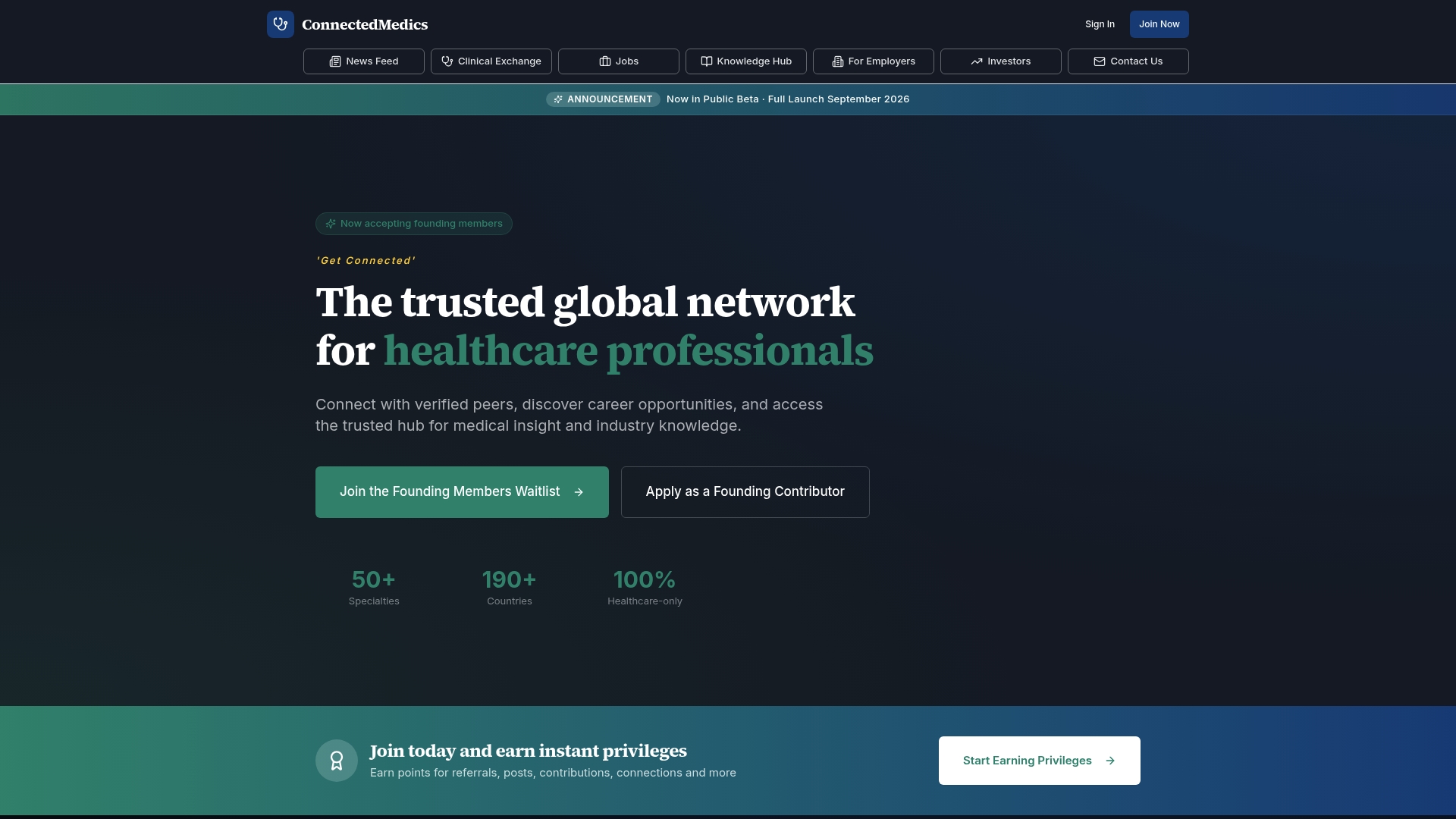
The platform lists over 4,600 active healthcare vacancies alongside its educational content, connecting learning directly to career opportunity. Whether you are tracking emerging AI developments in clinical practice or searching for your next role, Connectedmedics keeps both in one place. Join the global network for healthcare professionals and access verified clinical knowledge alongside real career opportunities.
FAQ
What is online medical education?
Online medical education is the delivery of accredited clinical training, CME, and certificate programs through digital platforms, accessible remotely by healthcare professionals. Formats include self-paced modules, virtual simulations, and live interactive sessions.
How do I earn CME credits online?
Accredited platforms like CDC TRAIN and EMJ Learning award CME credits after professionals complete a course and pass a post-activity assessment, typically around 10 questions, verifying that learning objectives were met.
Are VR simulations effective for clinical training?
Yes. Autonomous VR platforms like SimX track learner performance automatically and eliminate physical lab constraints, and asynchronous virtual training is validated for competency in high-stakes clinical topics like trauma care.
How much do online medical certificate programs cost?
Specialized certificate programs typically cost around $3,750, require three to five hours of study weekly over about two months, and include 40 professional development hours with four CEUs.
What should I look for when choosing an online medical course?
Confirm accreditation recognition by your licensing board, check for practical application through projects or simulations, and match the program format and content to your specific clinical role or career target.