
Medical technology news covers the latest advances in devices, AI systems, and clinical techniques that change how healthcare professionals diagnose, treat, and manage patients. The pace of change in 2026 has been exceptional. From FDA-approved cardiovascular prostheses to AI systems that predict sudden cardiac death from a standard ECG, the field is producing results that belong in clinical workflows now, not in five years. This article covers the ten most significant developments healthcare professionals need to understand, with evidence from peer-reviewed journals, regulatory approvals, and major industry reports.
1. What's new in medical technology news for cardiovascular care?
Cardiovascular medicine has seen two major advances this year that directly affect clinical practice.

The FDA approved Artivion's AMDS hybrid prosthesis for aortic repair. The device produced a 72% reduction in all-cause mortality at 30 days compared to standard procedures. That figure also came with a 54% reduction in primary major adverse events. For vascular surgeons and cardiac teams, this approval changes the risk calculus on complex aortic cases.
Separately, an AI neural network trained on ECG data identified a hidden signal that predicts sudden cardiac death. The model flagged 2.2% of patients as high risk, and that group carried a 7% annual rate of sudden cardiac death. Critically, 86% of those patients were missed by traditional risk markers. That gap represents a large population of patients who currently receive no preventive intervention.
- AMDS approval covers complex aortic arch repair cases
- AI ECG model validated across large population datasets
- Both advances are available or near-available for clinical integration
Pro Tip: When evaluating AI ECG tools for your cardiology unit, request validation data on the specific population demographics your department serves. Models trained on homogeneous datasets may underperform in diverse patient groups.
2. How AI is reshaping vaccine development and pandemic preparedness
AI-enabled vaccine research has grown at a rate that few predicted. Published research in this area increased from 4 papers in 2015 to 212 papers in 2025, representing a 5,200% surge in a single decade. That growth reflects both increased computing power and the maturation of protein structure prediction tools.
The most significant milestone is the first human trial of an AI-designed vaccine. The candidate targets Sarbeco coronaviruses using a "super-antigen" approach designed to produce broad immunity across multiple variants. Researchers aim to create protection that does not depend on predicting the next dominant strain. For clinicians and medical researchers tracking pandemic preparedness, this trial represents a structural shift in how vaccines get designed.
The implications extend well beyond COVID. The same AI-driven design methodology applies to influenza, respiratory syncytial virus, and other rapidly mutating pathogens. Clinicians interested in the full scope of this research can find detailed context in this 2026 guide for clinicians on medical research updates.
- AI vaccine design reduces reliance on strain prediction
- Sarbeco trial is the first human test of a fully AI-designed antigen
- Methodology is transferable to other high-mutation pathogens
3. AI clinical decision support for hematological malignancies
Standard AI models in clinical settings often produce stable but incorrect recommendations. The problem is that these models lack the contextual grounding that experienced clinicians apply automatically. A new system called HemaGuide addresses this directly.
HemaGuide is a case-grounded AI agent designed to support tumor board decisions in hematological malignancies. In a published study in Nature Medicine, the system achieved 82.8% concordance with tumor board decisions across 64 cases. It also ran with latency under 40 seconds on standard commodity hardware. That combination of accuracy and speed makes it practical for real-world multidisciplinary team settings.
The key design difference is case grounding. HemaGuide retrieves similar historical cases before generating a recommendation, which mirrors how experienced clinicians reason. Generic large language models skip that step, which is why they produce confident but contextually wrong answers in complex oncology scenarios.
Pro Tip: When piloting AI decision support tools in multidisciplinary teams, assign a clinical lead to review concordance rates monthly. Drift in accuracy often appears before it becomes clinically significant.
4. Robotic exoskeletons and stroke rehabilitation outcomes
Stroke rehabilitation has long been constrained by therapist availability and the physical limits of manual-assisted gait training. Robotic exoskeletons are changing both constraints. The TEPI system introduces a three-way interaction between therapist, exoskeleton, and patient in real time.
Studies show that therapist-exoskeleton-patient interaction produces better joint range of motion and walking performance than standard treadmill training. The therapist does not step back from the process. Instead, the system gives the therapist real-time feedback on patient gait mechanics, allowing precise adjustments during each session. Scaling this technology depends on keeping the therapist active in the loop, not replacing them.
For rehabilitation medicine specialists and neurologists, the clinical takeaway is clear. Passive robotic assistance produces modest gains. Interactive systems that incorporate therapist judgment produce measurably better outcomes. The technology works best when it augments clinical expertise rather than substituting for it.
5. How healthcare leaders are approaching technology adoption in 2026
Healthcare executives are not early adopters. According to the KPMG Global Tech Report, 55% of healthcare leaders describe themselves as "fast followers." They wait for early adopters to absorb regulatory risk, then move quickly once a technology proves compliant and effective.
That posture is rational given the environment. Data sovereignty rules, AI liability frameworks, and interoperability mandates all create compliance exposure that does not exist in other industries. At the same time, 90% of those same executives commit to long-term technology investment. The strategy is controlled acceleration, not avoidance.
Healthcare leaders are not resisting technology. They are managing the gap between innovation speed and regulatory readiness. The 90% long-term commitment figure shows that adoption is a timing question, not a willingness question.
For clinicians involved in technology procurement decisions, this context matters. Proposals that include documented compliance pathways and phased implementation timelines move faster through executive approval than those that lead with capability claims alone. Reviewing how technology adoption strategies align with workforce planning can sharpen those proposals.
6. CMS interoperability mandates and vendor compliance in 2026
The 2026 CMS interoperability framework has reshaped which vendors can operate in US healthcare settings. The requirements are specific: FHIR readiness, 24-hour notification, and standardized claims exchange are now non-negotiable entry conditions. Vendors that cannot meet these standards are being excluded from enterprise contracts.
This creates a practical filter for clinical technology teams evaluating new tools. Compliance is no longer a procurement checkbox. It is a market entry barrier that has already removed non-compliant vendors from consideration at major health systems. The shift also accelerates real-time data exchange across care settings, which benefits clinicians who need complete patient records at the point of care.
For medical researchers, the interoperability push has a secondary benefit. Standardized data formats make multi-site research datasets more consistent and easier to analyze. The infrastructure built for compliance also serves clinical research at scale.
7. What selecting new medical technologies actually requires
Selecting a new medical technology is not primarily a purchasing decision. It is a workflow redesign decision. Treating AI as an add-on to existing processes consistently produces poor outcomes. Successful integration requires redesigning the clinical workflow around the tool, assigning governance ownership, and managing the AI system's performance over time.
Procurement teams and clinical leads now face a higher bar from hospital administrators. Purchasers require documented clinical outcomes such as fall rate reductions or measurable cost savings before approving enterprise-wide rollouts. The pilot-only phase is over. Vendors and clinical champions must arrive at the table with outcome data, not just proof-of-concept results.
| Evaluation Criterion | What to Assess |
|---|---|
| Clinical validation | Peer-reviewed outcomes in comparable patient populations |
| Workflow fit | Impact on existing staff roles and care pathways |
| Regulatory compliance | FHIR readiness, FDA clearance, data sovereignty alignment |
| Governance structure | Defined ownership, performance review cadence, escalation path |
| Cost-effectiveness | Total cost of ownership against documented outcome improvements |
Pro Tip: Before any enterprise rollout, map the current clinical workflow in detail. Gaps between the existing process and the tool's design assumptions are where implementation failures originate.
8. What's new in telemedicine and virtual care delivery
Telemedicine has moved past the access-expansion phase and into a quality differentiation phase. The question is no longer whether virtual care reaches patients. It is whether virtual care produces outcomes equivalent to in-person care for specific condition categories.
Current evidence supports virtual care for chronic disease management, post-surgical follow-up, and behavioral health. The technology infrastructure supporting these services has also matured. AI-assisted triage, remote patient monitoring devices, and asynchronous specialist consultation tools now integrate with major electronic health record platforms. That integration reduces the documentation burden that previously made telemedicine less efficient for clinicians.
The next frontier in what's new in telemedicine is remote procedural guidance. Augmented reality tools that allow an experienced specialist to guide a less experienced clinician through a procedure in a remote setting are entering clinical trials. For rural healthcare systems and low-resource settings, this capability addresses a structural gap that no amount of workforce expansion has solved.
9. Advances in medical devices for continuous patient monitoring
Continuous monitoring devices have shifted from hospital-only tools to ambulatory platforms. Wearable cardiac monitors, continuous glucose monitors, and implantable hemodynamic sensors now generate data streams that feed directly into clinical decision systems.
The clinical value is in early detection. Devices that monitor patients between appointments catch deterioration that point-in-time clinical visits miss entirely. The challenge for healthcare professionals is managing the volume of data these devices generate. Alert fatigue is a documented problem when monitoring systems are not calibrated to the patient's individual baseline.
The solution is AI-assisted filtering. Systems that learn a patient's normal range and flag only statistically significant deviations reduce alert volume without reducing sensitivity. This is an area where the combination of hardware advances in medical devices and AI-driven data interpretation produces outcomes that neither technology achieves alone.
10. How medical innovation news shapes professional development
Staying current with medical innovation news is a professional competency, not a passive interest. Clinical guidelines update faster than they did a decade ago because the evidence base grows faster. Clinicians who track healthcare technology trends maintain a shorter gap between published evidence and their own practice.
Structured knowledge sources matter more than informal news consumption. Peer-reviewed journals, regulatory approval databases, and specialty society updates provide verified information. Platforms that aggregate verified clinical insights from credentialed professionals add a layer of peer context that raw journal access does not provide. Connectedmedics serves this function directly, offering a knowledge hub built from contributions by verified medical experts alongside over 4,600 active healthcare vacancies for professionals tracking both clinical and career development.
Key Takeaways
The most effective approach to medical technology adoption in 2026 combines validated clinical evidence, workflow redesign, and regulatory compliance from the start, not as afterthoughts.
| Point | Details |
|---|---|
| AI cardiovascular tools are clinically ready | AI ECG models identify high-risk patients missed by standard markers, with validated population-scale data. |
| Vaccine AI has reached human trials | Research grew 5,200% in a decade; the first AI-designed vaccine is now in human trials for Sarbeco coronaviruses. |
| CMS compliance is a market filter | FHIR readiness and standardized claims exchange now determine which vendors can operate in US health systems. |
| Workflow redesign drives AI success | Treating AI as a digital team member with governance and performance review produces better outcomes than add-on deployment. |
| Fast-follower strategy is deliberate | 55% of healthcare executives self-identify as fast followers, but 90% commit to long-term technology investment. |
The part of medtech adoption that most articles skip
The volume of medical technology news in 2026 is genuinely difficult to process. New FDA approvals, AI model publications, and regulatory updates arrive faster than any individual clinician can track. The instinct is to wait for the field to settle. That instinct is wrong.
The clinicians I have seen benefit most from new technology are not the ones who adopted everything early. They are the ones who built a disciplined process for evaluating what was worth adopting. They read the validation data, not the press releases. They asked whether the tool fit their specific patient population, not whether it worked in a general trial. They involved their teams in the integration decision before the contract was signed.
The HemaGuide concordance data and the AMDS mortality figures are not marketing claims. They are peer-reviewed outcomes that should change clinical practice. The gap between published evidence and actual adoption is where patient harm accumulates quietly. Regulatory caution is legitimate. Indefinite delay is not.
The trend I watch most closely is the convergence of AI decision support with real-time monitoring data. When a system like HemaGuide can draw on continuous patient data rather than static case records, concordance rates will rise further. That convergence is two to three years away from clinical deployment at scale. Healthcare professionals who understand the components now will integrate the combined system faster when it arrives.
— David
Connectedmedics: medical technology news and networking in one place
Healthcare professionals need more than a news feed. They need verified peers, specialty-specific insights, and career tools that reflect how the field actually works.
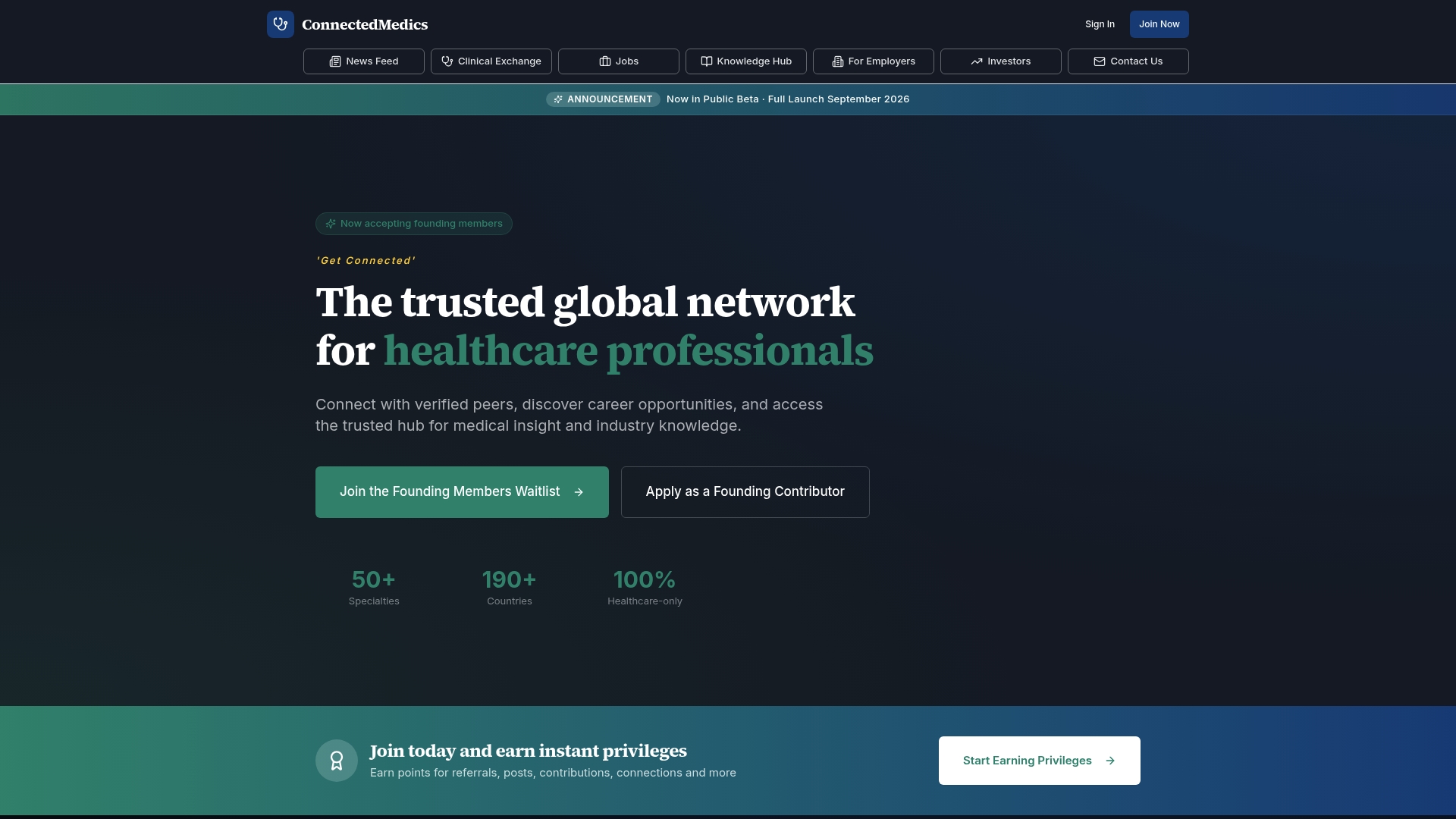
Connectedmedics is a global network for healthcare professionals built exclusively for the medical field. The platform provides a knowledge hub with clinical insights from verified medical experts, covering the latest healthcare technology trends and research summaries. It also lists over 4,600 active healthcare vacancies across specialties worldwide. For professionals who want to stay current on medical innovation news and connect with verified peers in their specialty, Connectedmedics provides both in one place.
FAQ
What is medical technology news?
Medical technology news covers new devices, AI systems, clinical techniques, and regulatory approvals that change how healthcare professionals deliver care. It includes FDA clearances, peer-reviewed trial results, and emerging tools entering clinical practice.
Which AI medical technology advances are most significant in 2026?
The most significant advances include an AI ECG model that identifies sudden cardiac death risk missed by standard markers, HemaGuide for hematological malignancy decision support with 82.8% tumor board concordance, and the first human trial of an AI-designed vaccine.
How do CMS interoperability rules affect medical technology adoption?
The 2026 CMS framework requires FHIR readiness, 24-hour notification, and standardized claims exchange from all vendors. Non-compliant vendors are excluded from enterprise contracts, making technical compliance a baseline market requirement.
Why do healthcare executives describe themselves as fast followers?
55% of healthcare executives identify as fast followers because regulatory complexity and data sovereignty risks make early adoption costly. They wait for compliance pathways to clarify before committing, while still maintaining long-term technology investment plans.
How should clinicians evaluate new medical devices for their practice?
Clinicians should assess peer-reviewed validation data, workflow compatibility, regulatory compliance status, and documented outcome improvements before adoption. Enterprise purchasers now require measurable clinical outcomes, not pilot results alone, before approving full deployment.