
Healthcare professionals and analysts face a real problem: too many sources, too little signal. Identifying the top healthcare industry insight sources requires more than a quick search. It demands applying consistent criteria around vendor neutrality, data recency, methodological transparency, and scope of coverage. With 55% of global biopharmaceutical R&D concentrated in American firms alone, the volume of data, reports, and commentary generated each year is enormous. This article cuts through the noise. It evaluates the most reliable sources by category so you can make faster, better-informed decisions.
Table of Contents
- Key takeaways
- 1. Key criteria for evaluating insight sources
- 2. Leading global consulting firms
- 3. Independent healthcare market research providers
- 4. Specialized healthcare data and technology platforms
- 5. Leading healthcare publications and news outlets
- 6. Healthcare analytics platforms and digital tools
- 7. Comparing sources: a decision framework
- My perspective on navigating these sources
- Connectedmedics: access trusted insights and connections
- FAQ
Key takeaways
| Point | Details |
|---|---|
| Vendor neutrality matters most | Sources free of commercial partnerships deliver more reliable, unbiased healthcare intelligence. |
| Data recency beats record volume | Refresh rate and cleaning practices are stronger quality signals than total record counts. |
| Triangulate across source types | Combining consulting insights with independent data providers gives a more complete picture. |
| Technology adds value with caveats | AI-assisted platforms require human oversight to maintain accuracy in clinical data. |
| Match source to use case | Consulting firms suit strategic planning; independent data vendors suit market access and operational decisions. |
1. Key criteria for evaluating insight sources
Before choosing any source, apply a consistent evaluation framework. Not all healthcare intelligence is created equal, and the criteria you use to screen providers will determine how useful the insights actually are.
Credibility and vendor neutrality. A source that earns revenue from the vendors it evaluates has a structural conflict of interest. Vendor neutrality is non-negotiable for trusted healthcare intelligence. Ask directly whether the provider accepts payment from the companies it rates or covers.
Data recency and refresh rate. Stale provider records and outdated market data can skew analysis significantly. According to industry veterans, data recency and cleaning practices are the metrics that actually matter. Total record counts are often vanity figures.
Methodology and transparency. Credible sources publish their methodologies. If a report does not explain how data was collected, weighted, or validated, treat it with caution. Look for primary research, validated survey instruments, or peer-reviewed backing.
Scope and depth of coverage. Some sources cover one segment well. Others span the full healthcare system. Match the source's scope to your specific decision. A payer-focused analyst needs different coverage than a clinical researcher.
Accessibility and format. Insights that sit behind multi-thousand-dollar paywalls or require custom engagements are not accessible to most professionals. Prioritize sources with free tiers, searchable archives, or structured summaries.
Pro Tip: When evaluating any healthcare data provider, ask for a sample dataset or methodology document before committing. Providers confident in their quality will share it without hesitation.
2. Leading global consulting firms
Large consulting firms produce some of the most widely cited healthcare analysis available. Their reports cover policy, operations, financing, and technology at both national and global levels.
- McKinsey & Company. McKinsey's healthcare practice publishes regular reports on financial performance, workforce trends, and care delivery models. Their 2026 data shows healthcare EBITDA declining from 11.2% in 2019 to 9.4% in 2024, with 85% of organizations showing increased interest in outsourcing and digital solutions. Practical for executives tracking financial benchmarks.
- Boston Consulting Group (BCG). BCG's healthcare work spans pharmaceutical strategy, health system transformation, and emerging market analysis. Their reports are especially strong on technology adoption curves and cross-sector comparisons.
- Bain & Company. Bain publishes detailed research on growth strategies, mergers and acquisitions, and healthcare consumer behavior. With healthcare executives redefining growth beyond geographic expansion amid economic pressures, Bain's work on alternative growth models carries added relevance.
The value of consulting firm reports lies in their strategic framing and executive accessibility. The limitation is that they rarely disclose full methodologies and can reflect the worldview of their fee-paying clients. Use these sources for directional context, not as sole evidence for operational decisions.
3. Independent healthcare market research providers
Independent research providers occupy a different niche. These organizations exist specifically to produce unbiased, data-driven intelligence rather than to support consulting engagements.
- Black Book Market Research. Black Book operates with a strict no-consulting, no-vendor-partnership model. With over 3 million crowdsourced surveys, their ratings are grounded entirely in verified client experience. This makes them one of the most credible sources for vendor comparisons in health IT and managed care. Connectedmedics lists Black Book among the trusted intelligence platforms worth monitoring regularly.
- MMIT (Medication Management + Intelligence Technology). MMIT specializes in pharmaceutical market access research. Their work helps pharma firms integrate market access planning in early development phases, phase 1 through 3, to anticipate payer behavior and refine launch strategies. This is highly specialized intelligence not available through generalist research firms.
- KLAS Research. KLAS conducts direct customer interviews to rate healthcare IT vendors and clinical solutions. Their reports are widely referenced in health system procurement decisions. The interview-based methodology produces nuance that survey data alone cannot.
Pro Tip: For unbiased vendor comparisons in health IT, cross-reference KLAS and Black Book findings. Agreement between two methodologically different sources signals stronger evidence than either alone.
4. Specialized healthcare data and technology platforms
Beyond research firms, a distinct category of healthcare data providers focuses on raw data quality, compliance infrastructure, and clinical data management.
- Data recency and cleaning. The most dependable platforms flag outdated or relocated provider records automatically. Refresh rate and cleaning practices outperform total record counts as quality indicators. A database with 2 million current, verified records outperforms one with 10 million that includes years-old entries.
- FHIR compliance and HIPAA readiness. Normalization using FHIR standards and proper de-identification of EHR and claims data is technically complex. Data integration and HIPAA compliance involving EHR normalization frequently becomes the bottleneck in analytics projects, requiring months to execute properly.
- AI-assisted clinical data abstraction. AI platforms have accelerated the extraction of structured data from clinical records, but clinical data abstraction still requires human expert review to maintain accuracy for research and registry reporting. Platforms that pair AI with clinical oversight are more reliable than fully automated alternatives.
| Platform type | Strength | Key limitation | Best use case |
|---|---|---|---|
| HCP data providers | Large verified provider databases | Record freshness varies | Sales and outreach targeting |
| EHR/claims data vendors | Deep clinical detail | HIPAA compliance complexity | Population health analysis |
| AI abstraction platforms | Speed and scalability | Requires human oversight | Clinical registries and reporting |
| Telehealth analytics tools | Real-time care utilization data | Narrower scope | Virtual care strategy |
The telehealth market alone is projected to reach $1,027.3 billion by 2032. Data platforms capable of capturing virtual care utilization alongside traditional claims data will become increasingly necessary for analysts working in this space.
5. Leading healthcare publications and news outlets
Reliable healthcare news outlets and publications serve a different function than research providers. They surface emerging trends, policy changes, and market signals in near real time.

Becker's Healthcare. Becker's Hospital Review and Becker's Health IT are two of the most widely read publications among hospital executives and health system administrators. Coverage spans financial performance, workforce issues, and operational strategy. The May 2026 issue addressed how healthcare leaders are restructuring growth strategies amid reimbursement declines. Content is free and updated daily.
NEJM Catalyst. Published under the New England Journal of Medicine brand, NEJM Catalyst targets health system leaders with research-backed perspectives on care delivery and payment reform. It occupies the space between academic rigor and practical application, which is rare among reliable healthcare news outlets.
Modern Healthcare. Modern Healthcare provides business-focused reporting on health systems, insurers, and policy. It is a strong source for tracking mergers, financial results, and regulatory activity. Subscription-based but widely available through institutional access.
STAT News. STAT offers deeper investigative coverage on pharmaceuticals, health policy, and biotechnology than most general healthcare outlets. Their reporting on drug pricing, FDA decisions, and clinical trial outcomes is frequently cited by analysts.
6. Healthcare analytics platforms and digital tools
Beyond static reports and publications, several platforms offer interactive analytics that allow professionals to explore data on their own terms.
IBM Watson Health (now Merative). Merative offers enterprise-level analytics drawing on real-world evidence and claims data. Primarily used by health systems and payers for population health and utilization management.
Definitive Healthcare. This platform provides data on hospitals, physicians, and health systems with filtering by geography, specialty, and financial performance. It functions as one of the more practical top healthcare analysis tools for market sizing and competitive intelligence.
Trilliant Health. Trilliant focuses on consumer healthcare demand data, showing where patients seek care and how those patterns are shifting. Useful for strategy teams modeling service line expansion or volume forecasting.
The distinction between these platforms and traditional research sources matters. Analytics platforms let you ask your own questions against structured datasets. Research reports give you pre-framed answers. Both are necessary, and neither replaces the other.
7. Comparing sources: a decision framework
Choosing between source types depends on your specific question, not on which source is universally "best."
| Source type | Vendor neutral | Update frequency | Best for |
|---|---|---|---|
| McKinsey/BCG/Bain | Partial | Quarterly to annual | Strategic planning |
| Black Book/KLAS | Yes | Ongoing | Vendor selection, IT decisions |
| MMIT | Yes | Ongoing | Pharma market access |
| HCP data platforms | Varies | Monthly to real-time | Targeting and outreach |
| Analytics platforms | Yes | Real-time to monthly | Operational and market analysis |
| Publications (Becker's, STAT) | Yes | Daily | Trend monitoring |
A few practical filters to apply when making your selection:
- For strategic planning at the executive level, consulting firm reports from McKinsey, BCG, or Bain provide the directional framing needed.
- For vendor selection or technology procurement, KLAS and Black Book produce the most methodologically sound comparisons.
- For pharma-specific market access work, MMIT is the most specialized source available.
- For day-to-day trend monitoring, Becker's Healthcare and STAT News give the fastest signal without paywalls.
- For raw data and analytics, platforms like Definitive Healthcare and Merative support custom analysis that reports cannot.
Healthcare workforce trends are also worth tracking through staffing-focused sources. Platforms that track urgent healthcare vacancies give analysts an early signal on workforce supply shifts that often precede broader market changes.
My perspective on navigating these sources
I've worked with enough healthcare data providers and consulting reports to know that the biggest mistake analysts make is over-relying on a single source. It feels efficient. It is actually a risk.
What I've found is that the most reliable signal comes from triangulation. When a finding from a McKinsey report aligns with what KLAS customer interviews show and with what claims data from a platform like Merative reflects, that's when you can act with confidence. When they diverge, that divergence is itself the insight worth investigating.
I've also learned to be skeptical of sources that don't publish their methodology. In my experience, the gap between what a report claims and what the underlying data supports is widest in commercially sponsored research. Vendor neutrality isn't a marketing checkbox. It's the structural condition that makes a finding trustworthy.
One thing most articles on this topic miss: qualitative sources often surface what quantitative data is too slow to capture. A pattern in what Becker's is covering, or what health system executives are saying at conferences, frequently predicts a shift that won't show up in claims data for another 12 to 18 months. The best analysts I've worked with treat leading and lagging indicators as complementary, not competing.
Understanding verified professional profiles also matters here. The credibility of a source often depends on who contributed to it. Knowing whether insights come from verified practitioners versus anonymous respondents changes how much weight you should give them.
— David
Connectedmedics: access trusted insights and connections
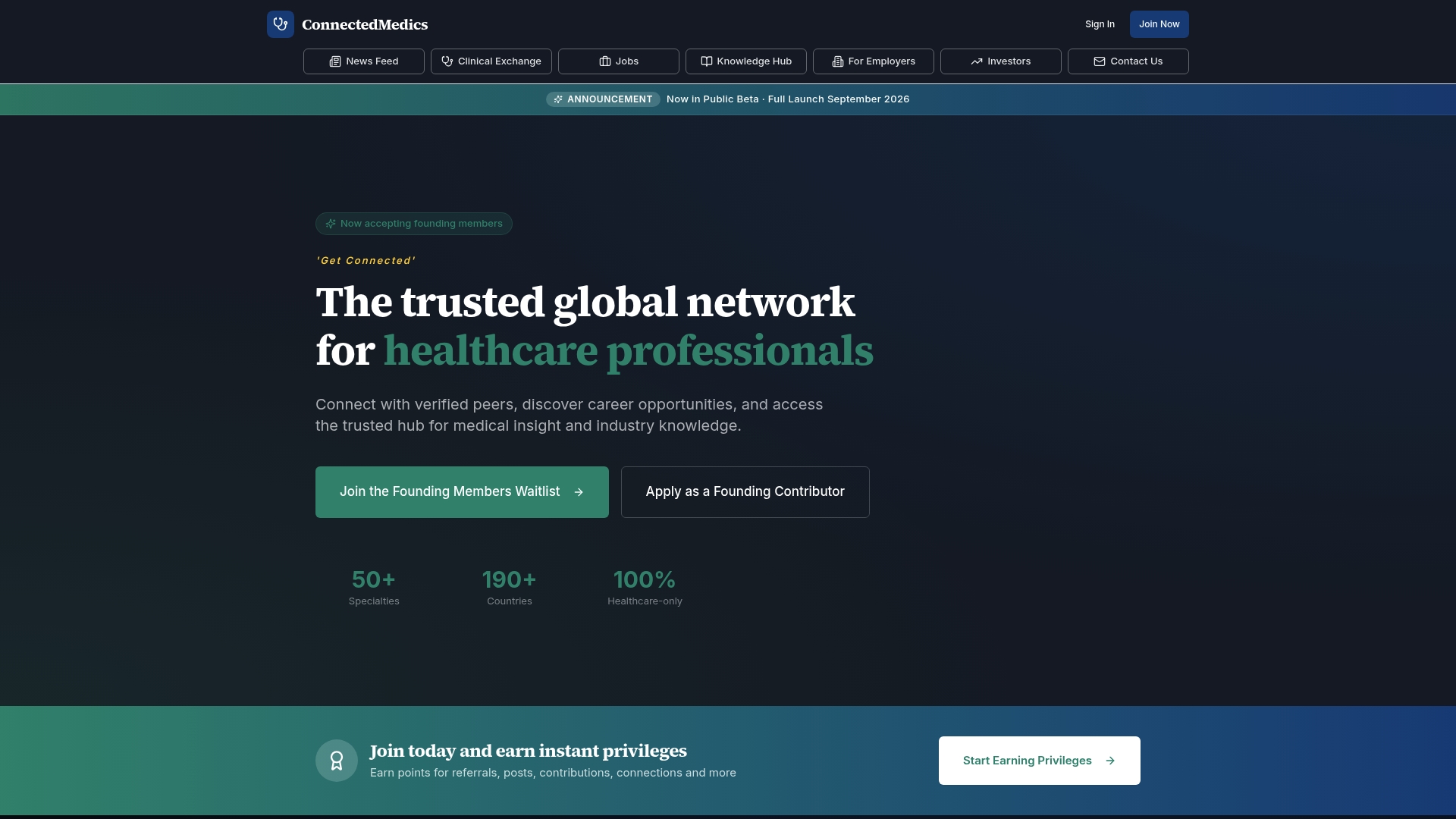
Connectedmedics is built specifically for healthcare professionals who need more than a generic professional network. The platform provides a Knowledge Hub with clinical guides and market insights contributed by verified medical experts, covering both clinical practice and industry trends. With over 4,600 active vacancies on the jobs board and a recruiter portal offering access to verified professional profiles, Connectedmedics connects professionals with opportunities that are directly relevant to their specialty. For healthcare analysts and clinicians looking to stay current, build their network, and access reliable industry resources, the Connectedmedics platform is a direct extension of the research workflow described in this article.
FAQ
What makes a healthcare insight source reliable?
Reliability depends on vendor neutrality, transparent methodology, and regular data refresh rates. Sources without commercial ties to the vendors they evaluate consistently produce more credible findings.
Which sources are best for healthcare market access research?
MMIT is the most specialized source for pharma market access, with early-phase planning research designed to help firms anticipate payer behavior from phase 1 onward.
How do I evaluate healthcare data provider quality?
Focus on data recency, refresh frequency, and cleaning practices rather than total record counts. Ask for a sample dataset and methodology documentation before committing to any provider.
Are consulting firm reports reliable for healthcare decisions?
Consulting reports from McKinsey, BCG, and Bain are useful for strategic framing but should be cross-referenced with independent data sources, since full methodologies are rarely disclosed.
What free sources track healthcare industry trends daily?
Becker's Healthcare and STAT News are two of the most widely used free outlets for daily healthcare trend monitoring among executives and analysts.