
Many healthcare professionals assume that an updated LinkedIn page or a hospital bio constitutes a verified profile. It does not. Verified medical professional profiles explained properly reveal a much more structured process. One grounded in regulatory mandates, primary source confirmation, and documented audit trails. Understanding what separates a truly verified profile from a self-reported one has direct consequences for your credentialing outcomes, your professional reputation, and your ability to move between roles or states without delays.
Table of Contents
- Key takeaways
- Verified medical professional profiles explained: the PSV foundation
- Key platforms and tools for verified profiles
- Licensure, board certification, and peer recognition
- Practical benefits of maintaining verified profiles
- Common challenges and best practices
- My perspective on verified profiles and career longevity
- Build your verified profile on Connectedmedics
- FAQ
Key takeaways
| Point | Details |
|---|---|
| PSV is the standard | Primary Source Verification confirms credentials directly with issuing bodies, not from self-reported data. |
| Platforms reduce redundancy | Tools like FCVS and CMS NPI Registry centralize verified data, cutting repeated verification steps. |
| Licensure and board certification differ | A state license permits practice; board certification signals specialty expertise verified by rigorous exam. |
| Timing affects credentialing | Peak licensure seasons extend processing times, so early submission prevents career-delaying bottlenecks. |
| Audit trails are mandatory | Documented verification evidence is required for compliance, not just holding a copy of your license. |
Verified medical professional profiles explained: the PSV foundation
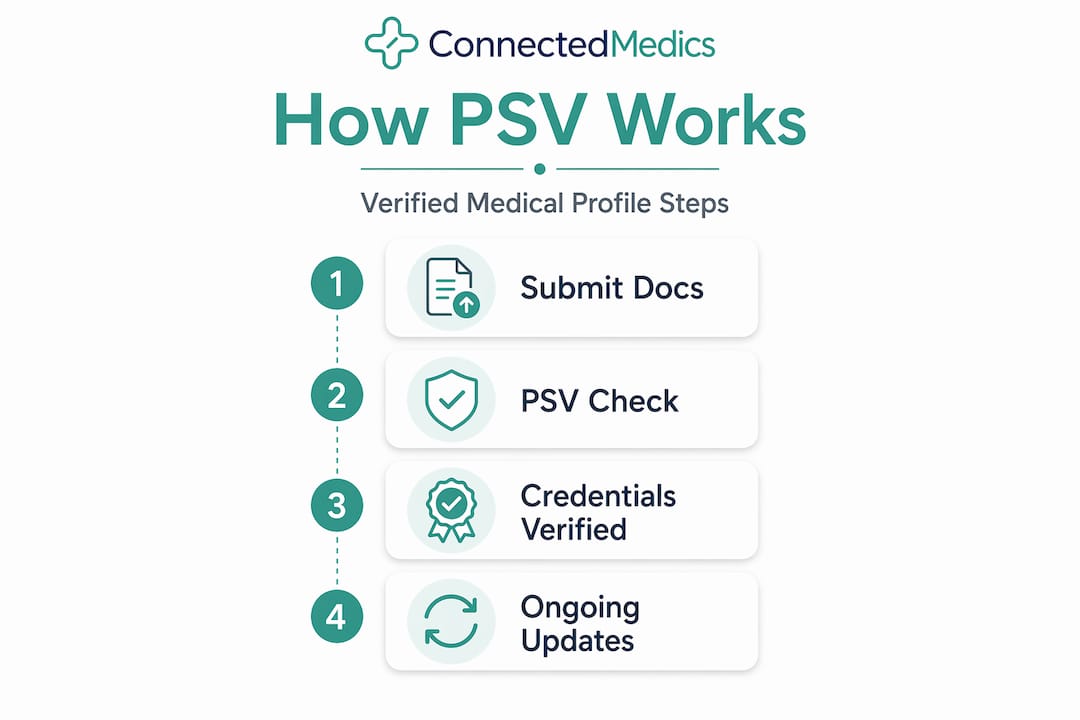
The term "verified" in a medical professional profile has a precise meaning. Primary Source Verification (PSV) is the industry-standard process for confirming that a provider's credentials are accurate, by going directly to the issuing source. That means contacting the medical school, the state licensing board, or the certifying body directly. Not reviewing a photocopy the physician submitted.
The Joint Commission mandates PSV for all credentialed practitioners at initial hire and at each renewal cycle. This is not optional for accredited hospitals and health systems. The process covers licenses, board certifications, and training records.
What PSV does not include:
- Self-reported CVs or resumes
- LinkedIn profiles or personal websites
- Copies of documents provided by the applicant
- Verbal confirmation from the practitioner
Self-reported profiles carry no legal standing in the credentialing process. A hospital or health system relying on them for privileging decisions would be out of compliance. This distinction matters enormously for healthcare professionals who believe their online presence substitutes for formal verification.
PSV also has a timing component. Credentials confirmed at initial hire must be re-verified when licenses are renewed or when a practitioner joins a new organization. Each verification event must be documented with an audit trail, including date-stamped records or secure verification reports.
Pro Tip: Request a copy of your own PSV documentation from your credentialing department after each hire or renewal. Keeping a personal record of what was verified and when will save significant time during future credentialing cycles.
Common PSV pitfalls include delays caused by unresponsive primary sources, discrepancies between a practitioner's stated training dates and institutional records, and gaps in foreign medical school verification. Knowing these risks in advance lets you address them proactively.
Key platforms and tools for verified profiles
Medical professional verification does not have to start from scratch every time you change employers or apply for a new state license. Several centralized platforms exist specifically to reduce that redundancy.
The Federation Credentials Verification Service (FCVS) allows physicians to create a lifetime portfolio of verified credentials that can be shared with participating licensing boards and credentialing entities. Many state medical boards accept FCVS-verified documents directly, which eliminates repeated requests to medical schools and training programs.
The CMS NPPES database underpins a large portion of U.S. provider identification. Over 7 million active provider records are currently housed there, making the NPI Registry one of the most widely referenced tools for confirming a provider's identity and specialty. The FSMB DocInfo tool complements this by providing consolidated views of licensure status, specialty certification, and disciplinary history across states.
Key platforms worth knowing:
- FCVS: Lifetime verified credential portfolio for physicians; accepted by most state boards
- CMS NPI Registry: Public database of provider identity, specialty, and practice location
- FSMB DocInfo: Cross-state licensure and disciplinary history lookup
- ABMS Certification Verification: Confirms board certification status for over 40 specialties
- AMA Physician Profiles: Combines education, training, and licensure data in a single reference
Credentialing software platforms such as Modio Health and Symplr integrate with several of these databases to automate verification workflows. For healthcare professionals, this means your profile data can be continuously monitored for changes rather than only checked at hire.
Pro Tip: Set up an FCVS profile early in your career, even before you need it. The upfront documentation effort pays off significantly when you apply for licenses in multiple states or move between health systems.
The shift toward continuous monitoring is worth noting. Rather than a point-in-time check, modern credentialing systems flag changes in licensure status or disciplinary actions as they occur. This protects both the practitioner and the organization.
Licensure, board certification, and peer recognition
These three credential types appear on verified healthcare provider profiles, but they represent very different things. Conflating them is one of the most common mistakes healthcare professionals make when presenting their qualifications.

| Credential Type | What It Confirms | Verified By |
|---|---|---|
| State medical license | Legal authorization to practice in a specific state | State medical board via PSV |
| Board certification | Specialty expertise beyond licensure, requiring rigorous exams | ABMS or equivalent certifying board |
| Peer recognition | Professional reputation and clinical contributions, qualitative | Peer nomination and research panels |
A state license confirms that a practitioner has met the minimum requirements to practice medicine in a given jurisdiction. It does not indicate specialty expertise. Licensed doctors differ from board-certified doctors; the latter have passed specialty-specific examinations and must maintain certification through ongoing education and assessment.
Board certification, verified through the American Board of Medical Specialties (ABMS), signals a level of expertise that licensing alone does not convey. For employers and peers, it is a meaningful differentiator. For patients, it is often the primary trust signal they look for when selecting a specialist.
Peer recognition, such as inclusion on Top Doctors lists, functions differently. These designations are qualitative rather than regulatory. They reflect clinical reputation, peer nominations, and research contributions. They do not replace licensure or board certification, but they complement objective credentials by adding a layer of professional standing that formal verification processes do not capture.
Combining verified credentials with peer-recognition helps physicians distinguish themselves in a competitive healthcare market. A profile that shows active licensure, current board certification, and peer-nominated recognition presents a more complete picture of professional standing than any single credential alone.
Practical benefits of maintaining verified profiles
The importance of verified profiles extends well beyond regulatory compliance. For healthcare professionals focused on career mobility and peer collaboration, a well-maintained verified profile delivers concrete advantages.
-
Faster credentialing and onboarding. Organizations that receive complete, pre-verified credential packages process applications significantly faster. Delays in credentialing directly delay your ability to see patients and generate revenue. A verified profile with a current FCVS portfolio can cut weeks from this process.
-
Greater visibility to employers and recruiters. Verified profiles appear in professional databases and credentialing platforms that recruiters actively search. An unverified or incomplete profile is simply invisible in those channels.
-
Reduced administrative burden. Credentialing software increasingly automates audit trail generation and continuous monitoring. Healthcare professionals with organized, verified profiles spend less time responding to documentation requests.
-
Stronger peer trust and patient confidence. Verified credentials are foundational to building trust in clinical practice, both with colleagues and with patients. A profile that has been independently confirmed carries more weight than one that has not.
-
Competitive distinction in job mobility. When applying across state lines or for competitive subspecialty roles, a verified profile with documented credentials signals professionalism and preparation. It removes friction from the hiring process at a time when that friction can cost you an opportunity.
Pro Tip: Treat your verified profile as a living document. Update it within 30 days of any credential change, including license renewals, new certifications, or changes in practice location. Outdated information creates discrepancies that slow down future verifications.
Common challenges and best practices
Managing verified profiles is not a one-time task. Healthcare professionals encounter several recurring challenges that, if unaddressed, can create significant professional setbacks.
Discrepancies between self-reported and verified data. The most common problem in step-by-step medical profile validation is a mismatch between what a practitioner reports and what primary sources confirm. Dates of training, name variations, and institution name changes are frequent culprits. Address these proactively by reviewing your own records before submitting to a credentialing body.
Seasonal processing delays. Licensure applications peak between April and September, which extends verification timelines. A physician who submits a license renewal in June may wait significantly longer than one who submits in February. Plan renewal submissions at least 90 days before expiration.
Insufficient audit documentation. Holding a copy of your license is not the same as having an audit trail. Compliance requires documented evidence of the verification process itself, including records of when and how each credential was confirmed. Credentialing software platforms now automate much of this, but professionals working with manual processes must maintain their own logs.
Best practices for ongoing profile management:
- Store primary source verification reports in a secure, organized digital folder
- Set calendar reminders 90 days before each license or certification expiration
- Use a centralized platform like FCVS to reduce redundant verification requests
- Review your NPI Registry and FSMB DocInfo entries annually for accuracy
- Respond promptly to any credentialing discrepancy notices from employers or licensing boards
The dispute resolution process for credential discrepancies varies by state and organization, but most require written documentation and may involve direct contact with the primary source. The earlier a discrepancy is identified, the faster it can be resolved.
My perspective on verified profiles and career longevity
I have watched healthcare professionals lose job offers, miss contract start dates, and face credentialing committee reviews, all because they treated their professional profile as an afterthought. The assumption that a current license and a good reputation are enough is genuinely costly.
In my experience, the professionals who advance most efficiently are those who treat their verified profile as infrastructure, not paperwork. They maintain FCVS portfolios before they need them. They track expiration dates. They know exactly what their primary sources will confirm and when.
What I have also seen is that trusted medical professional identities built on verified credentials create compounding advantages over time. Peer collaborators are more willing to engage. Employers move faster. Patients feel more confident. None of that happens with a self-reported profile that no one has independently confirmed.
The technology side is changing quickly. Continuous monitoring, automated audit trails, and integrated credentialing platforms are reducing the manual burden significantly. But the foundational principle stays the same: verification must come from the primary source. That will not change regardless of how the tools evolve.
My advice is straightforward. Start with PSV compliance, build a centralized verified portfolio, and keep it current. Everything else in your professional profile, peer recognition, platform visibility, networking reach, builds on that foundation.
— David
Build your verified profile on Connectedmedics
Connectedmedics is built exclusively for healthcare professionals, and verified profiles are central to how the platform works. Every profile on the network is tied to confirmed credentials, which means the connections you make and the opportunities you find are grounded in professional accuracy rather than self-reported claims.
The platform hosts over 4,600 active healthcare vacancies and a knowledge hub contributed by verified medical experts. Whether you are looking to expand your professional network, find specialty-specific roles, or stay current on clinical developments, Connectedmedics provides the infrastructure to do it within a verified professional community.
Join the network to create your verified profile, connect with peers in your specialty, and access career opportunities matched to your confirmed credentials. Recruiters using the Connectedmedics recruiter platform search specifically for verified professionals, which means a complete profile directly increases your visibility to the right employers.
FAQ
What is primary source verification in medical credentialing?
Primary source verification (PSV) is the process of confirming a healthcare professional's credentials directly with the issuing institution or authority. It is required by The Joint Commission at initial hire and at each renewal cycle.
How does board certification differ from a state medical license?
A state license authorizes a physician to practice medicine within a specific state. Board certification, verified through ABMS, confirms specialty expertise beyond licensure and requires passing rigorous exams and ongoing education.
Can a LinkedIn profile substitute for a verified medical profile?
No. Self-reported profiles, including LinkedIn, carry no legal standing in formal credentialing processes. Official verification requires primary source confirmation with a documented audit trail.
What is the FCVS and why does it matter?
The Federation Credentials Verification Service (FCVS) allows physicians to build a lifetime verified credential portfolio accepted by most state licensing boards, significantly reducing redundant verification steps when applying across states.
When should healthcare professionals update their verified profiles?
Profiles should be updated within 30 days of any credential change, including license renewals, new board certifications, or changes in practice location, to prevent discrepancies during future credentialing reviews.