You can build a dependable remote nursing support network in weeks by combining short, regular peer huddles, a vetted membership group, mentorship pairings, and a healthcare-specific platform for resources and job leads. The single next step: schedule a 20–30 minute peer huddle with two or three colleagues this week. That one meeting is the foundation on which everything else builds.
Remote nursing roles carry a specific risk most nurses underestimate before starting: the assumption that the work will feel social. It rarely does. Proactively building a professional nursing community is not optional for long-term sustainability in a remote role. It is the work itself.
Table of Contents
- What does it take to build a nursing support network remotely?
- Your week-by-week checklist to get the network running
- Why a remote nursing support network improves patient care and clinician wellbeing
- Step-by-step playbook: how to build and run a remote nursing support network
- Which tools help you run a remote nursing network effectively?
- How do you keep a remote nursing network running long-term?
- What are the most common problems in remote nursing networks and how do you fix them?
- What do successful nurse-led remote networks actually look like?
- Key Takeaways
- Why the platform you choose shapes the network you get
- Connectedmedics: one platform for peer networking, job leads, and clinical resources
- Useful sources and further reading
What does it take to build a nursing support network remotely?
Building a remote nursing support network means creating a structured set of recurring connections, shared resources, and professional development opportunities that replace the informal hallway conversations and team huddles of a clinical setting. The core components are a small peer group, a regular meeting cadence, a shared resource hub, and a platform that keeps everything organized and verified.

The term "peer support network" is the recognized professional standard here. Online nursing support and virtual nursing groups are the delivery mechanism. The distinction matters because peer support implies reciprocity, structured facilitation, and confidentiality norms — not just a group chat.
Your week-by-week checklist to get the network running
Busy nurses need a realistic timeline, not a theory. Here is a practical sequence with honest time estimates.
Week 1 (30–60 minutes total)
- Identify three to five peers in similar remote roles and send a brief message proposing a 20–30 minute video call.
- Choose a platform for your first meeting (Zoom or Google Meet for video; Slack or Microsoft Teams for persistent chat between meetings).
- Draft two or three basic norms: confidentiality, no patient identifiers, and a simple agenda format.
- Schedule the first huddle within seven days.
Month 1 (1–2 hours per week)
- Establish a recurring meeting cadence (weekly or biweekly works best for early momentum).
- Create a private, invite-only channel or group where members can share resources between meetings.
- Start a shared document folder with triage scripts, protocol one-pagers, and job leads. Sharing clinical resources online works best when the format is standardized from the start.
- Assign one person as a rotating facilitator for each meeting.
Month 3 (2–3 hours per month, ongoing)
- Launch mentorship pairings: match experienced remote nurses with those newer to the format.
- Integrate one CE or learning session per month, either live or recorded for asynchronous access. The Nurse Fern community offers six new CE courses annually, providing a model for ongoing professional development.
- Review participation: track attendance, resource downloads, and member satisfaction with a short monthly poll.
- Adjust meeting cadence based on what the data shows. If attendance drops below 60%, shorten the format or shift to asynchronous threads.
Why a remote nursing support network improves patient care and clinician wellbeing
The benefits split cleanly into two categories: clinical outcomes and clinician health.
On the clinical side, peer networks accelerate problem-solving. A nurse facing an unfamiliar triage scenario can post to a vetted group and get a response from someone who handled the same situation last week. That shortens decision time and reduces errors. Networks also ease onboarding for nurses new to remote roles by providing access to structured resources and peer mentorship that employers often do not supply.
On the wellbeing side, isolation is the primary occupational hazard of remote nursing. Scheduled peer connection directly counters it. Research published in the Online Journal of Issues in Nursing identifies lack of peer interaction as one of the key barriers to sustainable remote work in nursing, alongside technology access and role clarity.
Key finding: Practitioners consistently report that nurses who proactively schedule short virtual huddles, even as infrequently as once a month, experience less isolation and maintain clinical skills more effectively than those who rely on employer-provided touchpoints alone.
Word-of-mouth inside a trusted community also surfaces job openings before they reach public boards. Peers share postings internally, giving members an early edge in a competitive market for remote roles.
Step-by-step playbook: how to build and run a remote nursing support network
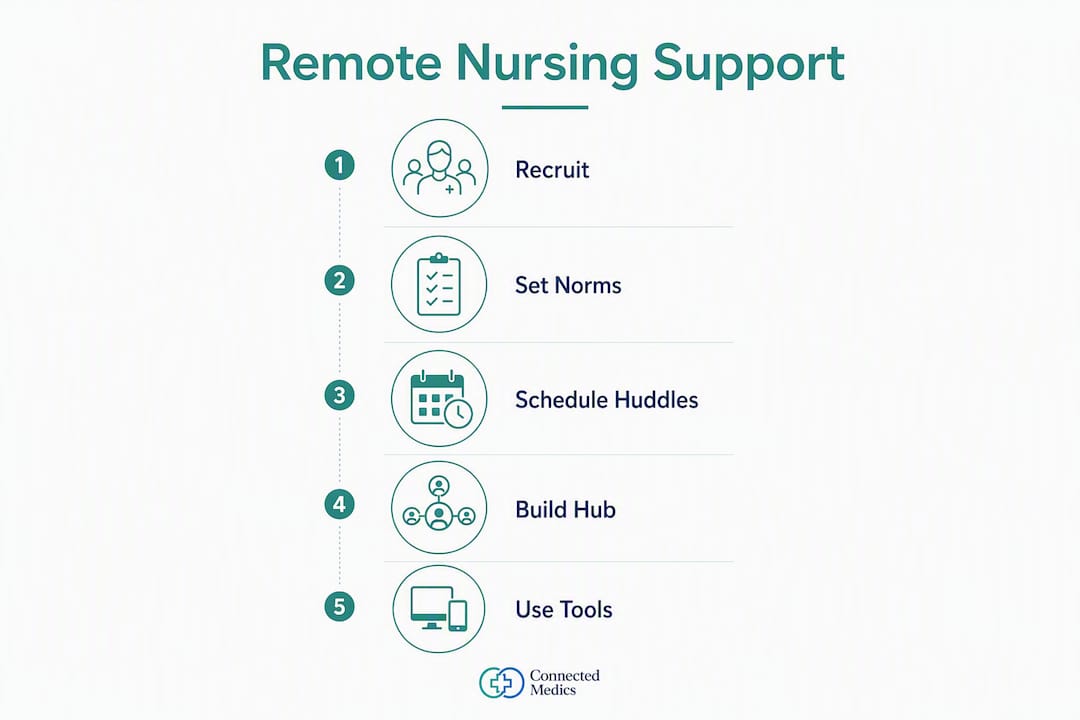
1. Recruit a core group
Start with five to ten nurses. Larger groups fragment quickly. Recruit through existing professional contacts, specialty associations, or a healthcare-specific platform with verified profiles. A vetted starting group sets the quality standard for everyone who joins later.
2. Set norms in writing
Document three to five ground rules before the first meeting: confidentiality, no identifiable patient information, respectful disagreement, attendance expectations, and a clear escalation path for clinical questions that exceed the group's scope.
3. Schedule recurring huddles
Short and regular beats long and occasional. Practitioners recommend 20–60 minute sessions on a fixed schedule. The format below shows three meeting types that cover different needs.
| Meeting type | Duration | Purpose | Required roles | Sample agenda |
|---|---|---|---|---|
| Weekly peer huddle | 20–30 min | Check-in, quick clinical questions | Facilitator, timekeeper | 5 min grounding, — open discussion, 5 min action items |
| Peer case review | 20–60 min | Structured case debrief, protocol review | Facilitator, note-taker | 10 min case summary, 30 min group input, 10 min documentation |
| Mentorship check-in | 20 min | Mentor/mentee progress, goal review | Mentor, mentee | 5 min update, 10 min focused question, 5 min next steps |
4. Build a resource hub
Create a shared folder (Google Drive, SharePoint, or a platform-native document space) with triage scripts, protocol one-pagers, resume templates, and a running list of job leads. Successful remote nursing communities treat this hub as an operational tool, not an archive.
5. Design mentorship pairings
- Pairing criteria: match by specialty, years in remote nursing, and time zone proximity.
- Meeting cadence: biweekly for the first three months, then monthly.
- Check-in prompts: "What clinical situation challenged you most this week?" / "What resource do you wish you had when you started?"
- Confidentiality rule: mentorship conversations stay between the pair unless a safety concern requires escalation.
6. Track what matters
- Attendance rate per meeting type
- Resource hub downloads per month
- Time-to-hire for members using shared job leads
- Participant satisfaction score (monthly one-question poll)
Which tools help you run a remote nursing network effectively?
The right tool stack depends on what your group needs to do. No single platform covers every function well.
| Tool category | Best use case | When to use it instead of another |
|---|---|---|
| Synchronous video (Zoom, Google Meet) | Live huddles, case reviews, CE sessions | When real-time discussion and nonverbal cues matter |
| Persistent chat (Slack, Microsoft Teams) | Async questions, resource sharing, announcements | When members are in different time zones or shifts |
| Forum/message board | Long-form case discussion, searchable Q&A | When threads need to be archived and referenced later |
| Learning/CE delivery | Accredited courses, recorded webinars | When professional development is a core network goal |
| Document/resource hub | Triage scripts, templates, job lists | When the group needs a single source of truth |
| Secure file sharing | HIPAA-sensitive documents, credentialing files | When documents contain any protected health information |
A general-purpose platform like Slack handles chat well but lacks clinical verification, specialty filters, and integrated CE. That gap is where a healthcare-specific networking platform adds real value.
Why healthcare-specific platforms matter for online nursing support
Connectedmedics is built specifically for healthcare professionals. It provides verified member profiles, specialty-led community forums, a jobs board with numerous active healthcare vacancies, curated clinical content from verified medical experts, and moderation tools designed for clinical discussion. For a nurse building a remote network, that means one place for peer connection, job leads, and professional development, without the noise of a general social network.
HIPAA considerations apply to any platform where clinical details are discussed. The practical rule: never share patient identifiers in any digital channel, regardless of the platform's security claims. Use de-identified case descriptions and confirm that any platform your group uses has a Business Associate Agreement (BAA) available if protected health information will be stored or transmitted.
How do you keep a remote nursing network running long-term?
Governance is what separates a group that lasts from one that dissolves after three months. The key roles and policies are straightforward.
Core governance items:
- Moderator role: one or two members responsible for meeting facilitation, content review, and enforcing norms. Rotate every six months to prevent burnout.
- Membership verification: require a current nursing license number or employer verification before admitting new members. Smaller, vetted communities consistently deliver higher-quality connections and less noise than large open groups.
- Escalation path: define in writing what happens when a clinical question exceeds the group's scope. The answer is always: refer to the member's employer protocol or a licensed clinical supervisor, not the group.
- Content ownership: members retain ownership of what they share; the group does not republish or redistribute without permission.
Any sharing of case details in a group setting should follow HIPAA de-identification standards. This is a professional obligation, not just a platform policy.
CE integration:
- Host one accredited session per month using a platform that supports CE credit delivery.
- Archive every recorded session so members in different time zones can access it on demand. Membership models with archived CE materially increase long-term community value for busy clinicians.
- Announce upcoming CE topics two weeks in advance so members can plan around shift schedules.
- Track CE completion per member and share a monthly summary to reinforce the professional development value of the group.
Pro Tip: Assign CE coordination to a dedicated volunteer, not the same person running moderation. Splitting roles prevents one person from carrying the full operational load.
What are the most common problems in remote nursing networks and how do you fix them?
1. Low participation after the first month
Fix: Shorten the meeting format. A 20-minute huddle with a clear agenda gets more consistent attendance than a 90-minute open forum. Send a one-line reminder 24 hours before each session.
2. Information overload in the group channel
Fix: Create separate channels by topic (clinical questions, job leads, CE announcements). Pin the most-used resources at the top of each channel. Limit announcements to one post per topic per week.
3. Poor signal-to-noise from large membership
Fix: Cap the group at 20–30 members for the core peer network. Create a separate, larger channel for general announcements if broader reach is needed. Large public groups tend toward spam and low-quality exchanges; smaller vetted groups produce better outcomes.
4. Time-zone coordination
Fix: Rotate meeting times quarterly so no single time zone always gets the inconvenient slot. Record every session and post it within 24 hours. Use asynchronous threads for non-urgent discussion.
Pro Tip: Use a free scheduling tool like Doodle or When2meet to find the overlap window for your group before locking in a recurring time. Revisit it every quarter as members' schedules change.
Recruitment message template:
Mentorship request template:
What do successful nurse-led remote networks actually look like?
The most replicable models share three structural features: consistent facilitation, a resource-sharing function, and archived content.
NurseGroups runs no-cost, confidential weekly virtual peer support sessions for nurses. Sessions are one hour long, facilitated by skilled volunteers, and include grounding exercises and structured check-ins. Members register via a simple form. The model is directly replicable inside a workplace-sponsored network: take the structure (grounding, check-in, open dialogue), add a clinical resource-sharing component, and you have a functional peer support group.
The Nurse Fern community integrates professional development directly into its membership model, offering six new CE courses annually alongside monthly webinars and archived content members can access on demand. That combination of live and asynchronous learning is what makes the community useful to nurses across different shifts and time zones.
Founders of nurse-led initiatives consistently emphasize the need for nonjudgmental spaces where members can process burnout and clinical stress without fear of professional consequences. That psychological safety is not a soft feature. It is the condition that makes honest peer exchange possible.
Practical replicable elements from successful networks:
- Weekly 60-minute facilitated sessions with a consistent structure
- Recorded sessions posted within 24 hours for asynchronous access
- A dedicated resource folder updated monthly with new triage scripts and job leads
- CE courses offered inside the community, with completion tracked per member
- A clear moderator role with defined term limits to prevent volunteer fatigue
Key Takeaways
Building a remote nursing support network requires scheduled peer huddles, a vetted membership group, a shared resource hub, and a healthcare-specific platform to centralize connections, job leads, and CE.
| Point | Details |
|---|---|
| Start with a small group | Five to ten verified peers delivers better signal and less noise than a large open group. |
| Schedule short, regular huddles | Even 20-minute monthly sessions reduce isolation and keep clinical skills current. |
| Build a resource hub from day one | Triage scripts, job leads, and protocol one-pagers make the network operationally useful, not just social. |
| Integrate CE for long-term value | Offering six new CE courses annually alongside archived, on-demand sessions increases community value for nurses across all shifts and time zones, as modeled by the Nurse Fern community. |
| Use Connectedmedics for verified networking | Connectedmedics centralizes verified profiles, specialty forums, 4,600+ job listings, and curated clinical content in one healthcare-specific platform. |
Why the platform you choose shapes the network you get
The conventional advice is to pick whatever tool your group already uses. That logic works for general teams. For nurses building a professional support network, it misses something specific: verification.
A generic social platform or a large public Facebook group gives you reach but no quality control. Anyone can join, post spam, or share unverified clinical information. The result is a high-noise environment where the signal, the trusted peer with relevant experience, gets buried. Nurses in those groups consistently migrate toward smaller, vetted communities because the quality of exchange is categorically different.
The other underrated factor is job leads. Word-of-mouth inside a verified community surfaces remote nursing roles before they reach public boards. That early access is a concrete, measurable career benefit, not a soft perk. A network that combines peer support with a live job feed and clinical resources is doing three jobs at once.
The platform choice is not a minor logistical detail. It determines who is in the room, what they share, and whether the group stays useful at month six or dissolves into noise.
Connectedmedics: one platform for peer networking, job leads, and clinical resources
Nurses who follow the playbook in this guide need a platform that handles verification, community management, job matching, and CE in one place. Connectedmedics is built for exactly that.
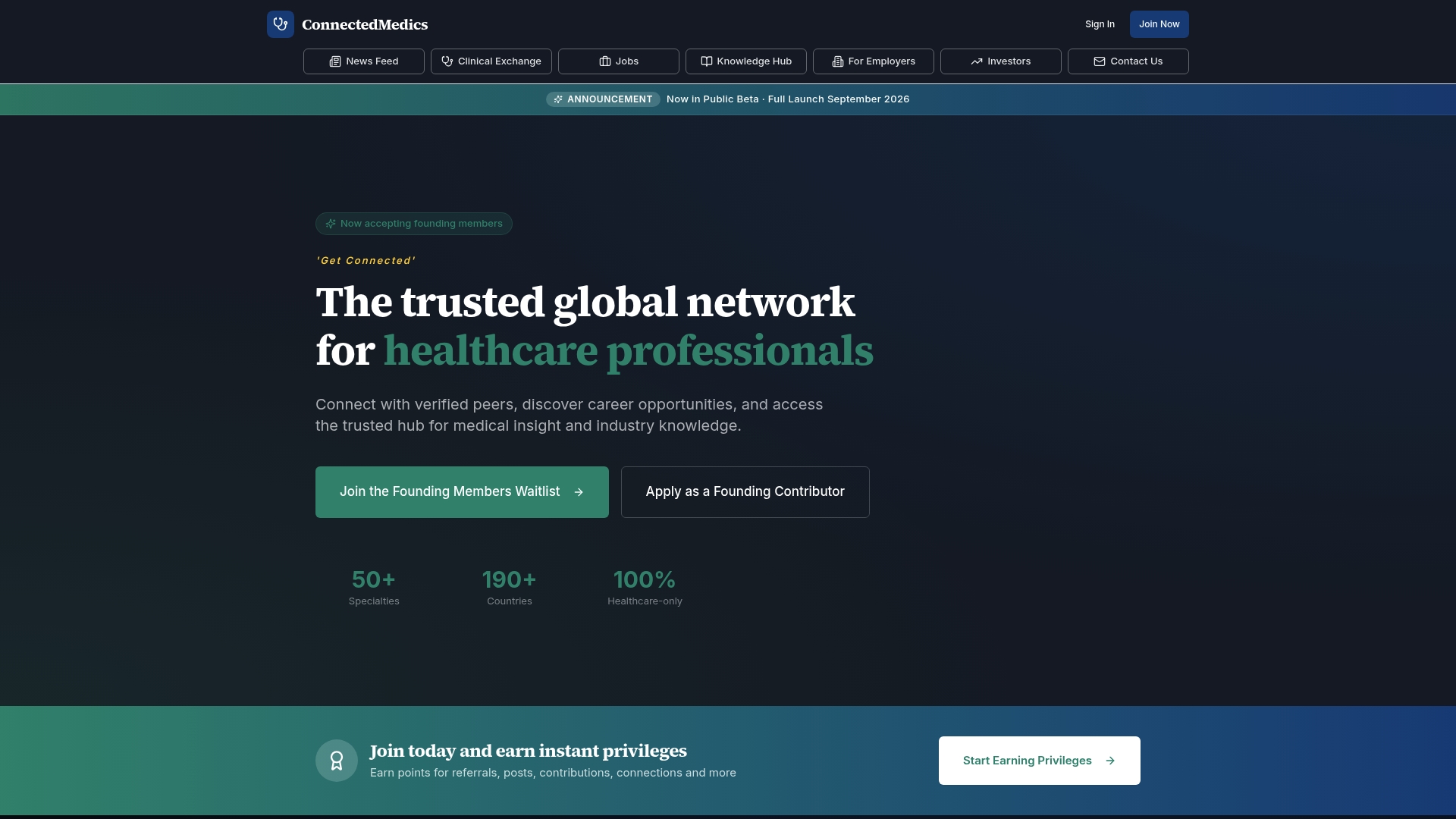
The platform provides verified healthcare professional profiles, specialty-led community forums for moderated peer discussion, a jobs board with numerous active healthcare vacancies filtered by specialty and role type, and a knowledge hub with curated clinical content contributed by verified medical experts. For a nurse building or joining a remote network, that means no separate tools for job leads, no unverified members in clinical discussions, and no hunting across multiple platforms for CE resources.
Join Connectedmedics to access verified peer communities, specialty job listings, and clinical resources in one place. Membership options are listed on the platform's main page.
Useful sources and further reading
- Remote Work in Nursing: Facilitators and Barriers | OJIN — Peer-reviewed research on the structural barriers and enablers of remote nursing work.
- Telehealth Nurse: 4 Ways for Supporting Your Patient — Practical guidance on remote patient support and telehealth nursing competencies.
- Connectedmedics — Healthcare professional network — Verified profiles, specialty communities, jobs board, and clinical knowledge hub for healthcare professionals.
- Peer Networking for Nurses: What It Really Means — Best practices for creating safe, effective online peer environments for nurses.
- Online Medical Education: Top 10 Resources for 2026 — CE and learning resources that can be integrated into community programming.