
A skills gap analysis in healthcare maps the competencies a role requires against what current staff can actually do, using workload and vacancy data to size the gap. Start by inventorying role-level competencies against patient workload, not job titles. Two signals quickly back this up: the National Center for Health Workforce Analysis supplies the labor data, and platforms like Connectedmedics surface live vacancy patterns that confirm what the numbers suggest.
TL;DR:
- A skills gap analysis should score proficiency levels and account for workload and replacement needs, not just vacancy counts or credentials.
- Healthcare roles face nearly 1.5 job openings per worker, with about 1.04 million unfilled jobs nationally, emphasizing capacity over recruitment.
- Data collection must include proficiency distribution, vacancy rates, retirement forecasts, and time-to-proficiency to produce credible insights.
- Using workload-based tools like WISN helps identify proficiency gaps masked by headcount-based staffing metrics.
- Repeating and updating the analysis annually ensures it remains relevant amid digital demand shifts and workforce retirements.
Table of Contents
- What Is a Healthcare Skills Gap Analysis, Exactly?
- Why It Matters Now: Key Workforce Data and Trends
- How to Conduct a Skills Gap Analysis (Step-by-Step)
- Where to Get Reliable Workforce Data
- Should You Hire, Reskill, or Reorganize?
- Turning the Analysis Into an Ongoing Process
- Case Studies: What Successful Analyses Look Like in Practice
- Common Pitfalls That Undermine a Skills Gap Analysis
- Skills Gap Analysis and Accreditation: Where They Overlap
- Why Verified Signals Change What a Gap Analysis Can Tell You
- How Connectedmedics Supports What Comes After the Analysis
- Sources
What Is a Healthcare Skills Gap Analysis, Exactly?
A skills gap analysis in healthcare is a competency audit. It compares the specific clinical, technical, and digital skills a role demands against the proficiency level staff currently hold, then flags the difference. That is a distinct exercise from a strategic gap analysis, which looks at business goals versus organizational capacity, or a vacancy report, which just counts open positions.
The distinction matters because vacancy counts hide competency problems. A unit can be fully staffed and still lack anyone certified on a new infusion pump or comfortable running a telehealth intake. Real skills mapping in healthcare uses a competency framework: a defined list of skills per role, scored on a proficiency scale (commonly novice, competent, proficient, expert).
Workload matters too. The WHO's Workload Indicators of Staffing Need (WISN) tool ties staffing and skill-mix decisions to actual patient volume rather than headcount targets set on paper. That connects competency data to demand in a way a static org chart never can.
Three things separate a real skills gap analysis from a superficial staffing review:
- It scores individual proficiency, not just presence or absence of a credential.
- It weights gaps by patient workload and acuity, following WISN-style logic.
- It accounts for replacement need, not just current vacancies.
Why It Matters Now: Key Workforce Data and Trends
The numbers explain the urgency better than any framework does. As of 2024, healthcare practitioner roles face close to 1.5 job openings for every available worker, with roughly 1.04 million healthcare jobs unfilled nationally. Advanced clinical roles run even hotter, with the same Chamber Foundation analysis putting some ratios above 1.7 openings per available worker.
Nearly 1.5 openings exist for every available healthcare worker, and around 1.04 million healthcare jobs sit unfilled. That is not a recruiting problem you solve by posting more listings. It is a skills and capacity problem that recruiting alone cannot fix.
Layer on the digital shift. An OECD analysis of 55.5 million job postings from 2018 to 2023 found rising demand for health information management, telehealth, and cybersecurity skills across health occupations. AI-specific mentions stayed small, at 0.2 to 0.3% of postings, so the near-term priority is practical digital fluency, not AI credentials.
A few forces are converging at once:
- Retirement-driven replacement need is climbing as the current workforce ages.
- Digital and telehealth skill demand is growing faster than most training pipelines can supply.
- Advanced clinical roles show the steepest opening-to-worker ratios in the labor market.
How to Conduct a Skills Gap Analysis (Step-by-Step)
Running this well takes a sequence, not a single survey. Skip a step and the results either overstate the problem or miss it entirely.
-
Define roles, services, and expected outcomes tied to workload. Start with the services you deliver, not your org chart. Which roles touch which patient volumes, and what outcome does each role need to produce? This is where WISN-style thinking earns its place: staffing and skill targets should scale with actual caseload, not a nominal headcount from three budget cycles ago.
-
Adopt or build a competency framework with a proficiency scale. Pick or design a skills list per role, scored consistently (novice through expert works fine). Consistency across departments is what makes the data usable later; a framework that changes meaning from unit to unit produces numbers nobody trusts.
-
Collect current-state data. Pull self-assessments, supervisor evaluations, HR records, vacancy rates, and retirement forecasts. This step is the most commonly rushed, and it is where the analysis either becomes credible or becomes guesswork.
-
Calculate and classify gaps by impact and urgency. Not every gap deserves the same response. A missing EHR module skill in a low-volume clinic is not the same emergency as a missing critical-care certification in an ICU running above capacity.
-
Produce a prioritized action plan with named owners and timelines. A gap analysis that ends in a spreadsheet nobody owns is a wasted exercise. Assign a name and a date to each closing action.
Supporting data points worth collecting alongside the core steps:
- Proficiency distribution by role and shift
- Current vacancy rate compared to the national ratio near 1.5 openings per worker
- Retirement-eligible headcount over the next three to five years
- Time-to-proficiency for the last three hires in each critical role
Pro Tip: Build the retirement-timeline question into your data collection from day one. A department that looks fully staffed today can lose half its senior competency within five years if nobody is tracking age distribution against skill concentration.
Where to Get Reliable Workforce Data
The quality of a skills gap analysis depends entirely on the quality of the inputs feeding it. Guessing at vacancy rates or borrowing national averages without adjusting for your service mix produces a report that looks rigorous and isn't.
Four sources cover most of what an administrator needs. The NCHWA/HRSA Health Workforce data hub provides occupational counts, supply and demand projections, and area-level resource files for local planning. The WHO's WISN tool offers a workload-based method for setting staffing standards by actual patient volume rather than fixed ratios. OECD's digital and AI skills research tracks which technical skills are gaining traction in job postings. The Chamber Foundation's skills gap report supplies the vacancy and openings-per-worker figures that put local numbers in national context.
| Metric | What it tells you | Where to find it |
|---|---|---|
| Vacancy rate by role | Immediate staffing pressure | Internal HR records, benchmarked against NCHWA data |
| Openings per available worker | Labor market severity for a role | Chamber Foundation skills gap report |
| Proficiency distribution | Where competency actually sits today | Internal competency assessments |
| Time-to-proficiency | How fast a new hire becomes fully effective | Internal training and onboarding records |
| Replacement forecast | Risk from retirements over 3 to 5 years | Internal HR age-distribution data, NCHWA projections |
Beyond raw numbers, three practices make the data usable:
- Benchmark internal vacancy rates against the national ratio before assuming a local anomaly is normal.
- Recalculate proficiency distribution at least twice a year, not once at hiring.
- Cross-check replacement forecasts against actual retirement filings, not just eligible-age counts.
Should You Hire, Reskill, or Reorganize?
Once gaps are ranked, the harder question is what to do about each one. A simple rubric helps: score every gap on urgency, trainability, patient-impact, and cost, then let the highest combined score dictate the response.
High urgency with high trainability usually points to reskilling. Micro-credentialing programs and short bootcamps close narrow technical gaps, such as a specific EHR module or a telehealth workflow, faster and cheaper than an external hire. High urgency with low trainability, on the other hand, often means recruiting is the faster path. Internal mobility pathways sit in between: moving a proficient nurse from a lower-acuity unit into a higher-need one can close a gap in weeks rather than the months a new hire search takes.
- Micro-credentials and short courses fit narrow technical or digital gaps.
- Internal mobility fits gaps where the skill exists elsewhere in the organization.
- External hiring fits gaps requiring licensure or years of specialized experience.
- Reorganization fits gaps caused by workload imbalance rather than a true skill deficit.
Judge success with concrete KPIs: gap closure rate, time-to-proficiency for new placements, and internal mobility rate. Retention readiness matters here too, since a values-mismatched hire that leaves within a year erases whatever the intervention saved. A practical guide to values-based hiring covers how cultural fit factors into that calculation.
Pro Tip: Weight trainability higher than most rubrics suggest. A motivated internal candidate who is 70% proficient and coachable often outperforms a fully credentialed external hire in the first six months, once onboarding time is factored in.
Turning the Analysis Into an Ongoing Process
A one-time skills gap analysis ages fast. Digital skill demand shifts within a year or two, and retirement timelines keep moving. Treat this as a cycle with a fixed cadence, not a project with an end date.
- Set a review cadence. Re-run the core analysis annually, and trigger an off-cycle review after any major service line change, EHR migration, or unexpected wave of resignations.
- Track four core KPIs continuously: gap closure rate, time-to-proficiency, vacancy reduction, and internal mobility rate.
- Assign governance. A cross-functional committee, spanning HR, clinical leadership, and finance, should own the budget and reporting line so findings don't stall in one department. A broader workforce planning framework helps set that governance structure up correctly the first time.
Case Studies: What Successful Analyses Look Like in Practice
The organizations that get real value from this exercise share a pattern: they tie competency data to a specific operational trigger, not a generic annual audit.
A mid-size hospital system facing rising ICU acuity used workload-based staffing logic to discover that its nurse-to-patient ratios looked adequate on paper but masked a proficiency gap in critical-care certifications. Applying WISN-style analysis against actual patient acuity, rather than headcount, revealed that roughly a third of ICU staff needed additional critical-care training within eighteen months. The fix combined internal mobility from step-down units with targeted certification funding, closing the gap without a costly external hiring push.
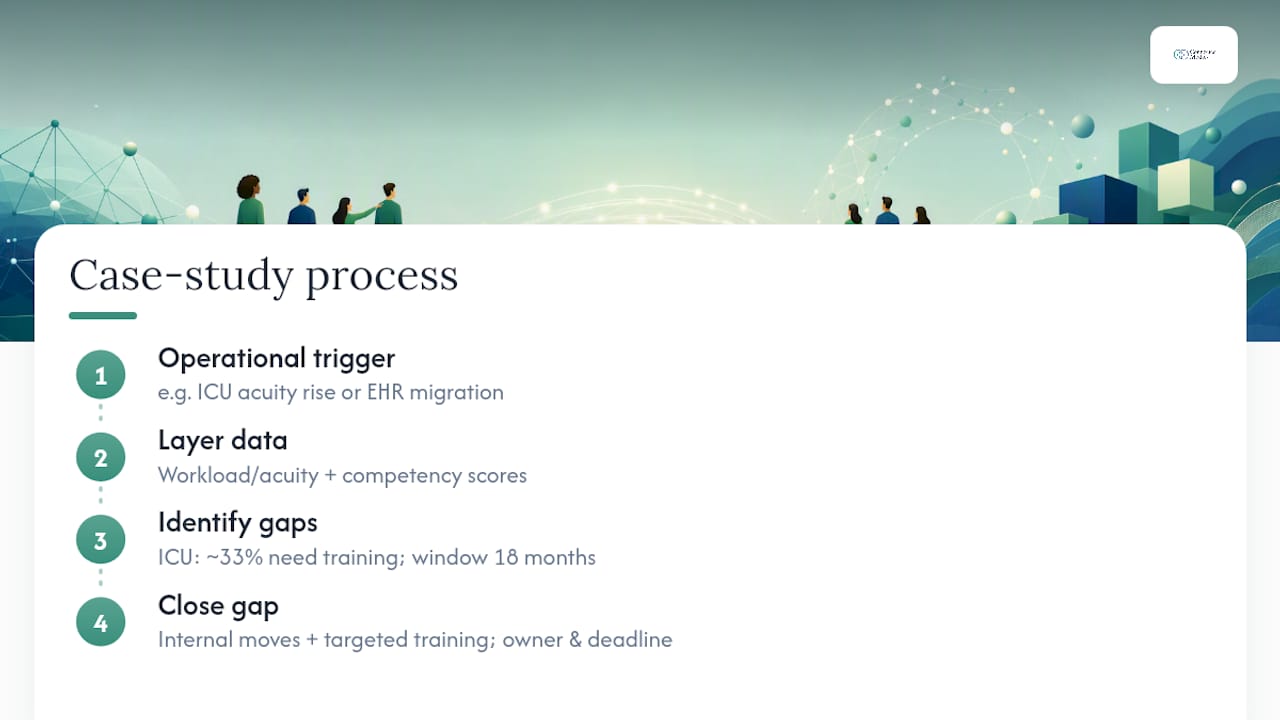
A regional clinic network facing EHR migration ran a competency audit specifically on digital skills before the changeover. Staff proficiency scores on the new system's core modules, tested during a pilot phase, identified three departments where training needed to start months earlier than the original rollout plan assumed. That early flag avoided a post-launch productivity collapse that similar organizations experienced without pre-migration testing.
Both cases share a structure worth copying: a specific operational trigger, workload or system data layered onto competency scores, and a closing action with an owner and a deadline. Neither treated the gap analysis as paperwork.
Common Pitfalls That Undermine a Skills Gap Analysis
Most failed skills gap analyses don't fail from bad intentions. They fail from a handful of repeatable mistakes.
The most common is confusing vacancy data with competency data. A fully staffed unit can still carry a severe skills gap, and a report that only counts open positions will miss it every time. A related mistake is using self-reported proficiency without any supervisor validation, which tends to inflate scores across the board and hides the true gap.
Inconsistent frameworks across departments create a second problem. If one unit scores proficiency on a three-point scale and another uses five points with different definitions, the aggregated data is functionally meaningless at the organization level. Standardize the scale before collecting a single data point.
Timing is a quieter pitfall. Running the analysis once and treating it as a permanent record ignores how fast digital skill demand and retirement timelines move. A report is stale within a year in most departments, sooner in ones facing a system migration.
Finally, plenty of organizations collect excellent data and then stop. No named owner, no deadline, no budget line means the findings sit in a shared drive. The fix isn't more analysis. It's committing to the action plan step with the same rigor as the data collection step.
Skills Gap Analysis and Accreditation: Where They Overlap
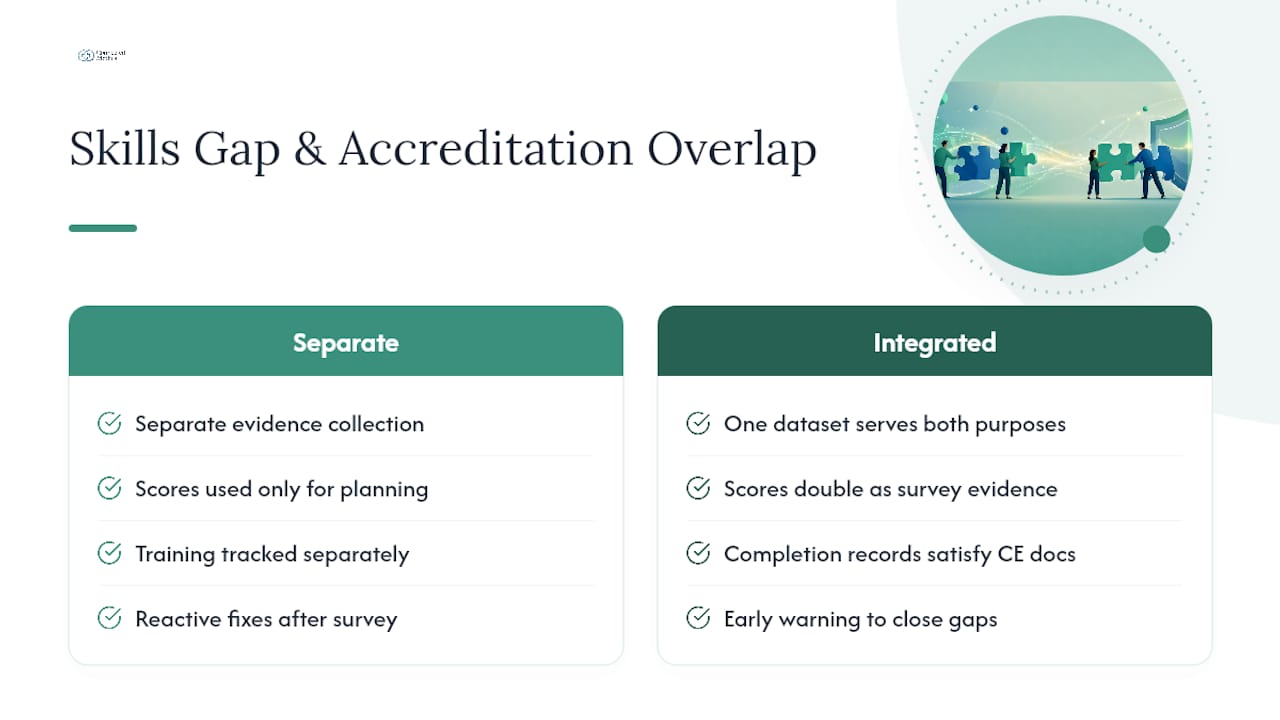
Accreditation bodies increasingly expect documented evidence of ongoing competency management, not a one-time credential check at hiring. A structured skills gap analysis produces exactly the paper trail most accreditation surveys ask for: role-specific competency definitions, proficiency assessment records, and a documented plan for closing identified gaps.
This overlap works in the administrator's favor. Instead of building a separate compliance exercise, folding accreditation requirements into the existing gap-analysis cycle means one dataset serves two purposes. Competency scores collected for workforce planning double as evidence during a survey. Training completion records tracked as a KPI for reskilling also satisfy continuing-education documentation requirements most accrediting bodies review.
The connection runs deeper for facilities managing specialty certifications. Where accreditation ties directly to a specific competency, such as advanced cardiac life support renewal rates or infection-control certification currency, the gap analysis becomes the early warning system. A proficiency dip flagged during a routine review gives a facility months of lead time to close the gap before a survey cycle exposes it as a finding. Treating accreditation compliance and skills gap analysis as separate workstreams duplicates effort for no real benefit. Treating them as one process, with shared data and a shared review cadence, cuts the administrative load while strengthening both.
Why Verified Signals Change What a Gap Analysis Can Tell You
Most gap analyses stall on one problem: internal data tells you what you're missing, but not whether the market can actually supply it. That's where verified vacancy signals earn their place in the process. When a specialty-specific job board shows sustained demand for a particular certification or digital skill across multiple facilities, it validates an internal finding instead of leaving it as an isolated guess.
Certain platforms carry this kind of demand signal by design, drawing on global boards with numerous active healthcare vacancies filtered by specialty. That data point, paired with internal proficiency scores, tells an administrator whether a gap is a local anomaly or part of a broader market shift. The platform's knowledge hub content, curated from clinical research and workforce trends, also gives reskilling programs a faster starting point than building training materials from scratch.
None of this replaces the core discipline of running the analysis well. It sharpens the read on what the numbers mean once you have them.
— David
How Connectedmedics Supports What Comes After the Analysis
This platform offers an alternative to sourcing candidates through generic professional networks that were never built for clinical hiring. Once your skills gap analysis identifies a shortage, the platform gives you a specialty-filtered path to verified candidates instead of sifting through unrelated profiles.
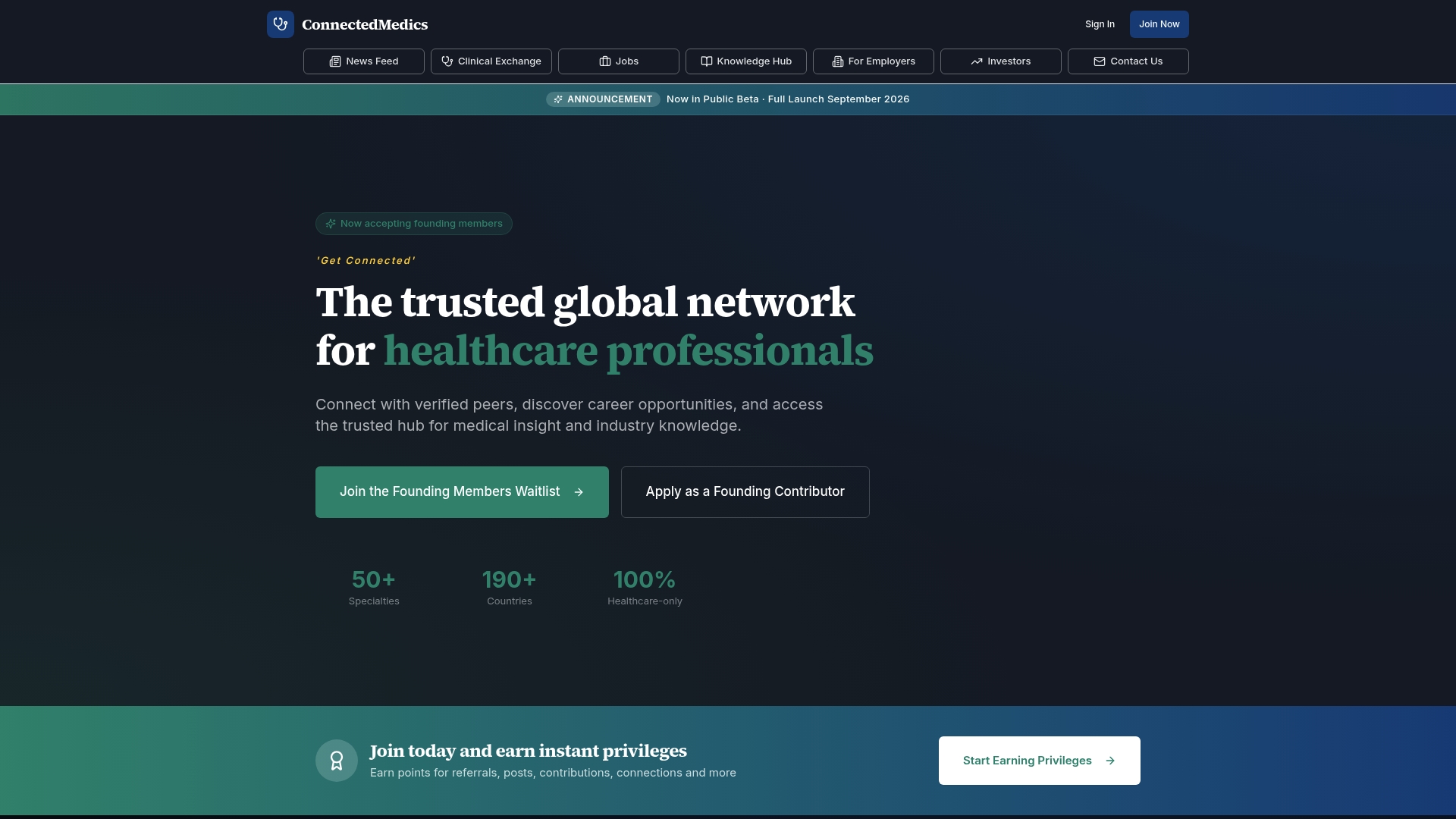
Employers can access a global jobs board built around specialty filters, enabling critical-care staffing gaps to be matched against clinicians with relevant backgrounds, rather than through generic searches. Verified profiles can reduce the screening time recruiters spend confirming credentials. The knowledge hub provides practical resources for internal mobility and reskilling paths, supplying training teams with curated clinical content. For teams tracking which competencies are rising in demand, resources like top skills healthcare employers are seeking pair well with internal gap data. Visit the Connectedmedics platform to explore verified profiles and post a specialty-specific vacancy today.
Sources
- Skills Gap: Different Skills, Different Gaps — U.S. Chamber Foundation
- Digital and AI skills in health occupations — OECD (2025)
- Workload indicators of staffing need (WISN) — World Health Organization