
Healthcare workforce planning is the strategic process of forecasting, designing, and managing the right mix of clinical and operational talent to meet patient care demands now and in the future. The American Hospital Association identifies workforce sustainability as the top operational priority for health systems in 2026, and the McKinsey Health Institute estimates that closing workforce gaps by 2030 could reduce the global disease burden by 7% and add $1.1 trillion to the global economy. That figure alone reframes workforce planning from an HR function into a public health imperative. This guide explains the core methodologies, emerging trends, technology applications, and best practices healthcare administrators need to build a workforce strategy that holds up under pressure.
What is healthcare workforce planning and why does it matter?
Healthcare workforce planning, also called strategic workforce planning in clinical settings, is the structured process of aligning staff supply with patient care demand across short, medium, and long-term horizons. It goes beyond filling open positions. It accounts for demographic shifts, training pipelines, retirement curves, care model changes, and the evolving mix of job roles in healthcare required to deliver safe, effective care.
The importance of workforce planning becomes clear when you look at what happens without it. Health systems that rely on reactive hiring face chronic agency dependency, higher labor costs, and staff burnout cycles that compound over time. Strategic workforce planning focuses on sustainability and long-term capability rather than short-term headcount filling. That distinction separates organizations that consistently deliver quality care from those perpetually in crisis mode.
For healthcare administrators, workforce planning sits at the intersection of finance, operations, and clinical quality. A well-executed plan reduces overtime costs, improves patient-to-staff ratios, and creates the organizational resilience needed to absorb demand surges without compromising care standards.

What are the core methodologies used in workforce planning?
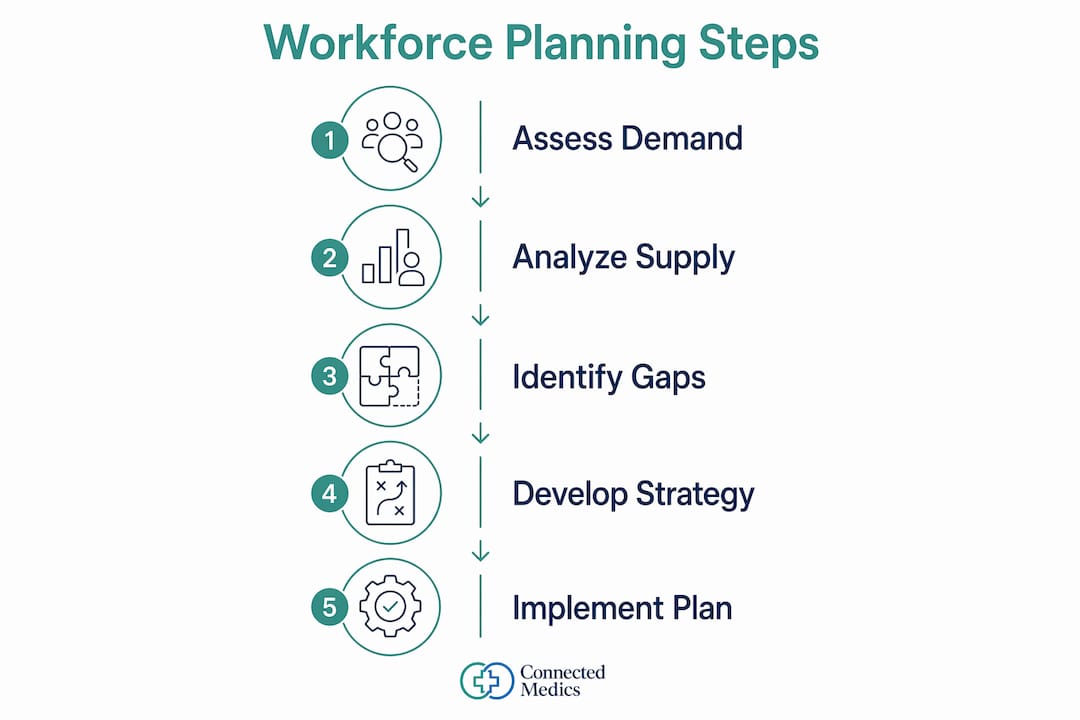
Several established frameworks guide workforce planning in healthcare, and the most widely adopted is the NHS six-step integrated planning model. The six steps move from defining the plan's scope to implementing and monitoring outcomes, with demand forecasting and gap analysis at the center. Organizations using this framework report significant turnover reduction of 40 to 50%, which translates directly into lower recruitment costs and more stable care teams.
The six core steps in integrated workforce planning are:
- Define the plan. Identify the service lines, time horizons, and stakeholders involved.
- Map current workforce. Audit existing headcount, skills, contract types, and retirement projections.
- Model future demand. Use patient volume, acuity data, and demographic trends to project clinical hours needed.
- Identify gaps. Compare supply projections against demand forecasts to surface shortfalls or surpluses.
- Develop solutions. Design recruitment, training, retention, and flexible staffing responses to close gaps.
- Implement and monitor. Track outcomes against targets and adjust plans based on operational data.
Beyond the six-step model, leading health systems in 2026 use five-year planning horizons that incorporate retirement curves, training pipeline lead times, and migration patterns. Annual budgeting cycles are too short to address structural workforce gaps. A physician trained today takes seven to ten years to reach independent practice, which means planning decisions made now determine clinical capacity a decade out.
Pro Tip: Start every workforce plan with service demand data, not headcount. Translate patient volume and acuity into required clinical hours first, then calculate the staff mix needed to deliver those hours. Plans built backward from headcount targets routinely underestimate complexity and overestimate flexibility.
How are healthcare organizations adapting to current staffing challenges?
The defining shift in healthcare workforce management over the past three years is the move from reactive crisis staffing to proactive capacity building. That shift is not cosmetic. It requires different data, different partnerships, and a different organizational mindset about what workforce management actually means.
"Strategic workforce planning is becoming a core executive function rather than an annual HR task." — Healthcare Business Today
Several trends are driving this adaptation across health systems globally:
- Blended workforce models. Healthcare organizations are adopting combinations of permanent staff, strategic contractors, and flexible agency staff to improve compliance, resilience, and cost control simultaneously.
- Staffing agencies as strategic partners. The transactional vendor model is being replaced. Staffing agencies now provide market intelligence, payroll solutions, and sustainable talent pipelines that feed long-term workforce plans rather than just filling immediate gaps.
- Retention as a planning variable. Burnout and administrative burden are now quantified inputs in workforce models, not soft HR concerns. Organizations that reduce documentation load and improve scheduling flexibility see measurable improvements in retention rates, which directly lowers the cost of workforce maintenance.
- Care model diversification. Virtual nursing, remote monitoring, and AI-augmented workflows are changing the skill profiles required at every level. Workforce plans that do not account for these shifts produce the wrong mix of staff for the care models being deployed.
The real role of staffing agencies in hospitals has expanded well beyond temporary placement. Agencies with deep market data can tell administrators where specific specialties are tightening nationally, what compensation benchmarks are shifting, and which training programs are producing graduates ready for immediate deployment. That intelligence is a planning asset, not just a recruitment convenience.
What role does technology play in modern workforce planning?
AI and digital tools are reshaping care delivery and workforce management, enabling more adaptive and sustainable models than manual planning processes allow. The practical applications fall into three categories: demand forecasting, scenario modeling, and scheduling automation.
| Capability | Traditional Approach | AI-Enabled Approach |
|---|---|---|
| Demand forecasting | Historical averages and seasonal patterns | Real-time acuity data, admission trends, and predictive modeling |
| Scenario planning | Annual budget assumptions | Dynamic "what-if" modeling for new service lines, reimbursement shifts, and care model changes |
| Scheduling | Manual shift allocation by unit managers | Automated float pool management with compliance and fatigue tracking |
| Retention risk | Exit surveys after departure | Predictive indicators flagging burnout risk before resignation |
AI-enabled scenario modeling allows health systems to simulate the workforce impact of decisions before they are made. Opening a new oncology service line, shifting from inpatient to ambulatory care, or adopting a new electronic health record system all carry workforce implications that can be modeled in advance rather than discovered after implementation.
Automation also reduces the administrative workload that drives clinician burnout. When scheduling, documentation, and compliance tracking are handled by digital systems, clinical staff spend more time on direct patient care. That is not just a quality improvement. It is a retention strategy with measurable financial returns.
Pro Tip: When evaluating workforce planning technology, prioritize platforms that integrate with your existing EHR and payroll systems. Standalone tools that require manual data entry defeat the purpose of automation and create new administrative burdens for the staff managing them.
What best practices should administrators follow for effective staffing?
Effective staffing in healthcare starts with a planning architecture that connects organizational strategy to daily operational decisions. Administrators who treat workforce planning as a discrete annual exercise consistently underperform against those who embed it as a continuous management function.
The following practices distinguish high-performing workforce planning programs:
- Anchor plans to service demand, not headcount. Effective workforce planning translates service goals into clinical hours before any staffing calculations begin. This prevents the common error of planning for the workforce you have rather than the workforce your care model requires.
- Build multi-year talent pipelines. Academic partnerships and internal float pools are the fastest path to cost control and surge readiness. Organizations that rely on last-minute agency placements pay a significant premium and sacrifice continuity of care.
- Integrate workforce planning at the executive level. Workforce strategy belongs in the C-suite alongside financial and operational planning. When it sits exclusively in HR, it loses the authority and budget alignment needed to drive real change.
- Monitor and adjust continuously. Long-term workforce planning balances immediate staffing needs with clinician development and reduces reliance on short-term fixes. Plans that are reviewed quarterly outperform annual plans because they catch emerging gaps before they become crises.
Tracking healthcare workforce trends in real time gives administrators the data needed to adjust plans before gaps become critical. The future of healthcare workforce management belongs to organizations that treat planning as a living process, not a document produced once a year.
Pro Tip: Build a skills inventory, not just a headcount register. Knowing that you have 40 nurses is less useful than knowing which of those nurses hold critical care certifications, which are approaching retirement, and which have expressed interest in leadership development. Skills data turns a headcount list into a strategic planning tool.
Key takeaways
Effective healthcare workforce planning requires integrating demand forecasting, multi-year pipeline development, and technology-enabled scenario modeling as a continuous executive function, not a periodic HR task.
| Point | Details |
|---|---|
| Start with service demand | Translate patient volume and acuity into clinical hours before calculating headcount needs. |
| Use multi-year horizons | Five-year planning frameworks account for training pipelines, retirement curves, and care model shifts. |
| Adopt blended workforce models | Combining permanent staff with strategic contractors improves resilience and controls labor costs. |
| Treat agencies as partners | Staffing agencies provide market intelligence and talent pipelines that support long-term planning goals. |
| Embed technology throughout | AI-enabled forecasting and scenario modeling prevent burnout and skill obsolescence before they occur. |
Why workforce planning deserves a seat at the executive table
The organizations I have watched struggle most with staffing are not the ones with the worst recruitment processes. They are the ones that treat workforce planning as something HR handles between budget cycles. That framing is the problem.
Workforce planning done well is indistinguishable from organizational strategy. When a health system decides to expand its cardiac surgery program or shift elective procedures to an outpatient setting, those are workforce decisions first. The clinical hours, the specialist mix, the training lead times, all of it flows from the care model. Leaders who understand that stop asking "how do we fill these roles?" and start asking "what workforce does our five-year service plan actually require?"
The technology piece is real, but it is not magic. AI forecasting tools are only as good as the service demand data fed into them. I have seen organizations invest in sophisticated workforce platforms and then populate them with last year's headcount numbers because no one built the service line analysis first. The tool becomes an expensive spreadsheet.
The most durable workforce strategies I have seen share one characteristic: they are built on honest conversations between clinical leaders, finance, and operations about what care delivery actually looks like three to five years out. That conversation is harder than buying software. It is also the only thing that actually works.
— David
Build your workforce strategy with Connectedmedics
Connectedmedics gives healthcare administrators and recruiters direct access to a verified global network of healthcare professionals across every specialty. With over 4,600 active vacancies on the healthcare jobs board and a knowledge hub built by verified medical experts, the platform supports both permanent recruitment and flexible staffing needs in one place. Recruiters can reach verified professionals by specialty, location, and experience level, cutting sourcing time and improving pipeline quality. For workforce planning teams building multi-year talent strategies, Connectedmedics provides the network infrastructure and clinical knowledge resources to support every stage of the planning cycle.
FAQ
What is the definition of healthcare workforce planning?
Healthcare workforce planning is the process of forecasting staff supply and demand to ensure health organizations have the right clinical and operational talent at the right time. It covers recruitment, retention, training pipelines, and flexible staffing strategies aligned to patient care goals.
Why is workforce planning important in healthcare?
Without structured workforce planning, health systems default to reactive hiring that drives up labor costs and increases burnout. The McKinsey Health Institute links closing workforce gaps to a 7% reduction in global disease burden and $1.1 trillion in economic value.
What is a blended workforce model in healthcare?
A blended workforce model combines permanent employees, strategic contractors, and agency staff to create a flexible, cost-controlled staffing structure. This approach improves surge readiness and reduces dependency on last-minute agency placements.
How does AI improve healthcare workforce planning?
AI enables real-time demand forecasting, "what-if" scenario modeling, and automated scheduling that manual processes cannot match. These tools allow administrators to anticipate workforce impacts of new service lines or care model changes before implementation.
How far ahead should healthcare organizations plan their workforce?
Leading health systems use five-year planning horizons that incorporate retirement projections, training pipeline timelines, and demographic trends. Annual planning cycles are too short to address structural gaps in specialized clinical roles.