
Shortlist two to three agencies. Request five verification items in writing before your first substantive conversation goes any further. That single move separates recruiters who avoid staffing disasters from those who inherit them six weeks in.
Learning to navigate home care agency selection as an employer or hiring partner comes down to verification speed. Agencies with clean operations answer these requests fast. Agencies with something to hide stall.
Ask for these five items on first contact:
- State license number and Medicare/Medicaid provider ID
- EVV aggregator name and current monthly compliance percentage
- 30-day shift fill rate
- Most recent incident/grievance summary
- Accreditation status (if any)
The single immediate ask that matters most: written confirmation of the provider ID and the EVV compliance rate. If an agency cannot produce both within a business day, treat that delay itself as data.
Key Takeaways
Reliable home care agency selection depends on verifying EVV compliance, shift fill rate, and licensure in writing before any pilot or partnership begins.
| Point | Details |
|---|---|
| Shortlist and verify first | Narrow to 2-3 agencies and request five documents in writing before deeper conversations. |
| EVV compliance is the leading signal | Target a 95% monthly compliance rate as a working benchmark for operational discipline. |
| Score finalists on a weighted rubric | Weight compliance and licensure at 25%, staffing at 20%, and reliability at 20% for a defensible decision. |
| Pilot before committing long term | Run a 30 to 90 day pilot with agreed KPIs before naming a preferred partner. |
| Use ConnectedMedics for direct sourcing | Turn to verified clinician profiles and targeted job postings when agency partnerships don't cover a specific hiring need. |
Table of Contents
- Vetting Checklist: What to Verify Before You Progress
- What Questions Should You Ask During Vetting Calls?
- What Operational Metrics Actually Predict Reliability?
- How Do You Score and Compare Finalist Agencies?
- How Do You Turn a Top Scorer Into a Preferred Partner?
- How Do Agencies Handle Insurance Coverage and Billing?
- What Should You Review in the Contract Terms?
- How Do Agencies Protect Data Privacy and Confidentiality?
- How Should You Read Agency Reputation and Online Reviews?
- Why Does Start-of-Care Timeline Matter So Much?
- Author Perspective: Practical Heuristics and Common Mistakes
- Finding Verified Clinicians Beyond Agency Partnerships
- Sources
Vetting Checklist: What to Verify Before You Progress
Verification order matters. Start with legal standing, then compliance systems, then staffing health, then clinical fit. Skipping ahead to "do they seem nice on the phone" is how recruiters end up with an agency that looks fine and performs poorly.
- Confirm state license and Medicare/Medicaid enrollment. Ask for the license number directly and cross-check it against your state's licensing portal. If the agency bills Medicare or Medicaid, its Care Compare listing should show an active provider ID and star ratings for timely initiation, patient survey results, and hospitalization rate.
- Ask which EVV aggregator the agency uses. Common systems include Sandata, HHAeXchange, AuthentiCare, and Tellus. Request the monthly compliance percentage. A 95% compliance rate is a reasonable working benchmark for daily operational discipline.
- Request accreditation status and incident summaries. The Joint Commission, CHAP, and ACHC accreditation aren't universal in this sector, but their presence signals a formal quality process. Pair that with a check of the OIG exclusions database for both the agency and its named clinical leadership.
- Clarify the staffing model. W-2 employees generally mean more oversight and consistency than 1099 contractors. Ask for the turnover rate and the 30-day shift fill rate, plus whether orientation is paid.
- Confirm service and specialty coverage. Wound care, dementia support, pediatric cases, and ventilator-dependent patients each require different staffing depth. Don't assume general capability covers specialty need.
Pro Tip: *Ask for the shift fill rate as a specific number, not a description. "We rarely have gaps" is marketing language.
What Questions Should You Ask During Vetting Calls?
Structured questions do the real work here. A well-run agency answers all of these directly and in writing. An agency that hedges, redirects, or promises to "follow up" on basic operational questions is telling you something.
Group your questions by category so nothing slips through:
- Service and staff: Are caregivers W-2 employees or 1099 contractors? Provide your background check policy and training curriculum in writing.
- Operational: What is your current 30-day shift fill rate for cases similar to ours? Can you share a recent acceptance log or sample schedule?
- Compliance: Which EVV aggregator are you enrolled with, and what is your monthly compliance percentage? Provide documentation.
- Finance: Do you bill Medicare, Medicaid, or the VA directly? Disclose any enrollment holds or pending audits.
- Communication: Who is the named clinical point of contact, and what is the after-hours escalation protocol?
Run these as a fixed script across every finalist, not a loose conversation that drifts differently with each call. Structured, consistent questioning exposes weak agencies faster than open-ended interviews, because it removes the agency's ability to steer the conversation toward its strengths and away from its gaps.
- Send the same five questions to all finalists in the same email format.
- Give each agency 48 hours to respond in writing.
- Flag any answer that arrives verbally only, with no documentation attached.
What Operational Metrics Actually Predict Reliability?
EVV compliance is the single best proxy for daily discipline. Agencies that hit their EVV numbers consistently tend to run tighter payroll, cleaner billing, and more auditable visit histories across the board.
Agencies sustaining EVV compliance above 95% show fewer billing denials and more auditable visit histories, according to Medicaid. Compliance rate predicts future operational problems better than the aggregator name alone.
Beyond EVV, four numbers tell you almost everything:
- Shift fill rate below 90% over a rolling 30-day window suggests a staffing bench that's too thin for reliable coverage.
- Turnover above local industry norms (ask the agency to disclose its own figure) usually means inconsistent care and repeated onboarding costs on your side.
- Start-of-care within 48 hours of referral acceptance, paired with low 30-day readmission rates, signals a functioning intake process rather than a bottlenecked one.
- Technology tier matters more than most recruiters assume: agencies running integrated platforms for EVV, care plans, and incident reporting produce audit-proof documentation almost automatically, while paper-based or fragmented systems generate gaps you'll discover only after something goes wrong.
How Do You Score and Compare Finalist Agencies?
A weighted rubric turns "this one felt more professional" into a defensible decision. Score each finalist 0 to 2 per criterion (zero for no answer, one for partial, two for full documentation), multiply by weight, and total the result.
- Compliance and licensure: 25%
- Staffing model and stability: 20%
- Operational reliability (fill rate, turnover): 20%
- Clinical capability match: 15%
- Responsiveness during vetting: 10%
- Financial transparency: 10%
In practice, one finalist might score full marks on compliance and licensure but only partial on responsiveness, while a competitor scores lower on staffing stability but higher on clinical specialty fit. The rubric surfaces that tradeoff instead of hiding it behind a gut impression, which supports pairing public ratings with internal tracking data rather than relying on reputation alone.
How Do You Turn a Top Scorer Into a Preferred Partner?
Don't jump straight to an exclusive arrangement. Run a 30 to 90 day pilot with agreed KPIs first, and put expectations in writing before the pilot starts.
- Track EVV compliance, shift fill rate, and on-time start during the pilot window.
- Require quarterly reporting once the pilot ends, with a named clinical contact for escalations.
- Build in contractual protections: backup staffing guarantees, defined notice periods, and a commitment to share documentation during audits.
Pro Tip: Preferred-partner relationships with agreed reporting metrics and a named clinical contact consistently reduce discharge friction and improve post-placement outcomes, which is why the pilot phase matters more than the sales pitch.
How Do Agencies Handle Insurance Coverage and Billing?
Ask directly whether the agency bills Medicare, Medicaid, private insurance, or the VA, and whether billing happens in-house or through a third party. Agencies that outsource billing aren't automatically worse, but you need to know who owns the process when a claim gets denied or delayed.
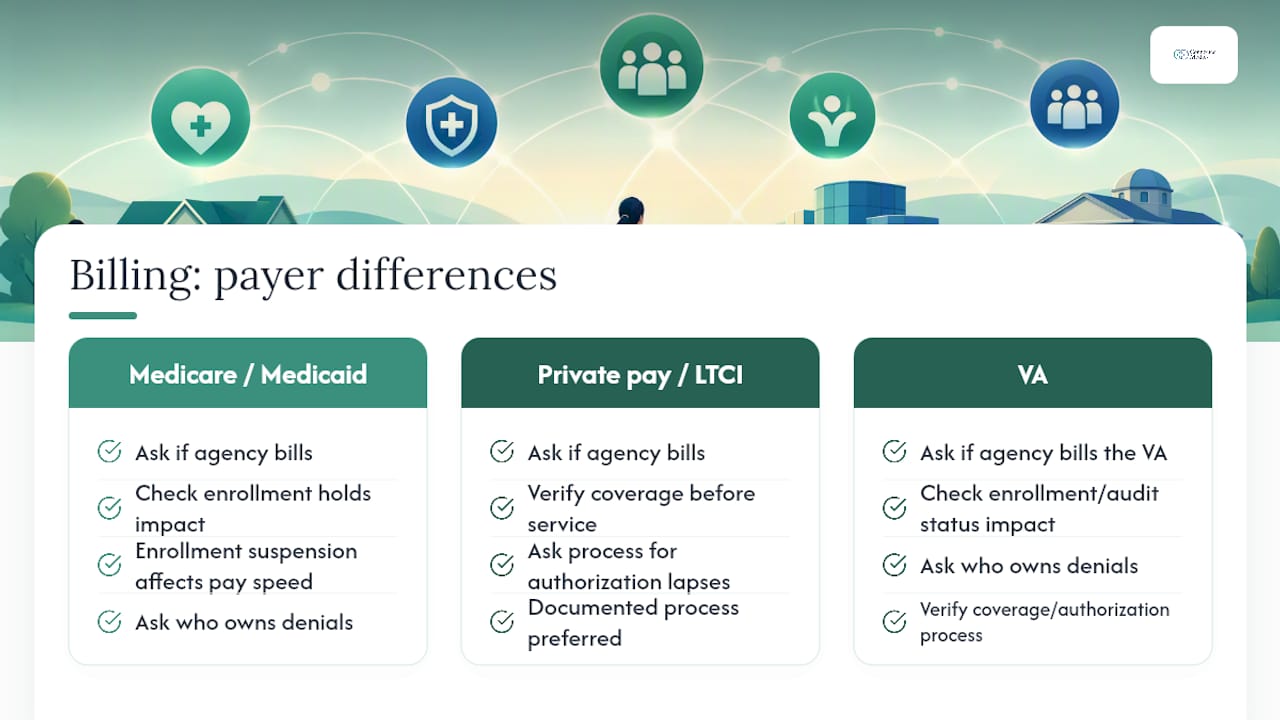
Request a plain answer on enrollment holds. An agency under a pending Medicare audit or with a Medicaid enrollment suspension can still operate, but that status affects how quickly it gets paid and how stable its cash flow is, which trickles down to caregiver pay reliability.
For private-pay or long-term-care-insurance cases, ask how the agency verifies coverage before service starts and what happens if a client's authorization lapses mid-episode. A well-run agency has a documented process for this. A disorganized one improvises, and the improvising often lands on the caregiver's paycheck or the referral source's reputation.
Billing support extends to how the agency documents visits for reimbursement. Agencies with integrated EVV and billing systems typically produce cleaner claims with fewer denials, since the visit data feeds directly into the billing record instead of being re-entered by hand. Ask whether visit verification data flows automatically into billing, or whether someone manually reconciles the two. Manual reconciliation is where errors, and disputes, tend to originate.
What Should You Review in the Contract Terms?
Read the service agreement before you sign anything, not after the first placement goes sideways. Pay attention to three things: notice periods, backup staffing commitments, and fee structure.
Notice periods for ending the relationship should be reasonable on both sides, typically 30 days. Anything longer locks you into an underperforming agency with no clean exit. Backup staffing language should specify what happens when a scheduled caregiver calls out. Vague language like "we will do our best to cover" isn't a commitment; a defined backup protocol is.
Fee structure needs to be explicit and itemized. Ask whether rates are flat per visit, hourly, or tiered by acuity level, and whether overtime, holiday, and mileage costs are built in or billed separately. Hidden fee escalators buried in an appendix are a common source of budget surprises months into a partnership.
Also check the liability and indemnification clauses. Who carries insurance for caregiver injury or client harm, and what's the agency's stated malpractice or general liability coverage? If the contract doesn't specify, ask for a certificate of insurance directly. A reputable agency produces this without hesitation, and the speed of that response tells you as much as the document itself.
How Do Agencies Protect Data Privacy and Confidentiality?
Ask how the agency handles protected health information under HIPAA, including how caregiver-facing apps store and transmit visit notes, medication logs, and EVV location data. Modern platforms typically encrypt this data in transit and at rest, but "typically" isn't good enough when you're the one accountable for a breach downstream.

Request the agency's written HIPAA policy and ask who has access to patient records: schedulers, billing staff, field caregivers, and at what permission level. An agency that can't articulate its access tiers likely hasn't thought through who can see what.
Ask specifically about EVV data handling, since these systems capture caregiver GPS location and visit timestamps. That's sensitive data about both the patient's location and the caregiver's movements. Confirm whether the aggregator platform (Sandata, HHAeXchange, AuthentiCare, or Tellus) meets your state's data retention and security requirements, and whether the agency has had any reported breaches or data incidents. A clean track record here doesn't guarantee future performance, but a history of incidents is a legitimate disqualifier.
How Should You Read Agency Reputation and Online Reviews?
Online reviews matter, but read them for patterns, not star averages. A 4.2-star agency with detailed reviews describing consistent caregiver quality is a stronger signal than a 4.8-star agency with thin, generic five-star reviews that seem solicited in bulk.
Look specifically for review themes around scheduling reliability, caregiver turnover, and communication responsiveness. Repeated complaints about last-minute cancellations or unreturned calls are operational red flags dressed up as customer service complaints. A single bad review means little; a cluster of similar complaints across a 12 to 18 month window means something.
Cross-reference online sentiment against your own vetting data. If an agency scores well on your rubric but shows a pattern of scheduling complaints online, dig deeper before finalizing. For localized or smaller agencies, a provider like Tucson In-Home Senior Care illustrates the kind of place-bound operation where local reputation and direct references often carry more weight than aggregate review scores, since the client base and referral network are smaller and more traceable.
Why Does Start-of-Care Timeline Matter So Much?
How fast an agency accepts a referral and starts care tells you almost everything about its intake operation. Ask directly: what's your average time from referral acceptance to first visit?
A 48-hour start-of-care window is a reasonable benchmark for most non-emergency cases. Agencies that consistently exceed this either have a staffing bench that's too thin or an intake process bottlenecked by paperwork. Both problems show up later as missed shifts.
Ask how the agency handles urgent referrals differently from standard ones, and whether it tracks its own acceptance-to-start metric internally. An agency that can produce this number on request, broken down by case type, almost certainly has better internal operations than one that answers with "it depends" and nothing more. Pair this metric with 30-day readmission data where available. Fast, well-executed starts of care correlate with fewer hospital bounce-backs, which matters directly if you're a discharge planner accountable for readmission metrics.
Author Perspective: Practical Heuristics and Common Mistakes
Three green flags: written EVV proof handed over without hesitation, paid orientation that includes shadow shifts, and a named clinical contact who answers calls.
Three red flags: evasive answers about staffing model or pay, no incident summary available on request, and an EVV compliance number that's vague or unspecified.
The practical move: vet three agencies, pilot one, keep one as a long-term preferred partner. Anything more scatters your oversight thin.
Finding Verified Clinicians Beyond Agency Partnerships
Agency vetting solves one problem: finding a reliable staffing partner for ongoing coverage. It doesn't solve the separate problem of sourcing individual clinicians directly, whether for a specialty role, a direct hire, or a targeted screening need that a general staffing agency can't fill fast enough.
Connectedmedics fills that gap as a direct sourcing channel rather than a staffing intermediary. The platform gives recruiters access to verified clinician profiles, specialty-filtered job postings, and screening tools built specifically for healthcare hiring instead of generic professional networking. When a home care agency partnership makes sense for volume coverage, use it. When you need to reach a specific specialist or fill a role an agency can't staff quickly, posting directly on a platform with over 4,600 active healthcare vacancies and verified profiles gets you in front of qualified candidates faster. Post a role or search verified clinician profiles on ConnectedMedics to see how targeted sourcing complements your agency vetting process.
Sources
Testimonials on an agency's website are marketing copy, not evidence. Ask instead for two or three direct references you can call yourself, ideally from placements similar in scope to what you're evaluating.
When you call a reference, ask specific, falsifiable questions: How many shift gaps occurred in the last six months? Was the caregiver replaced quickly when someone called out? Did billing or authorization issues ever disrupt care? Vague praise ("they were great") tells you less than a concrete answer to a concrete question.
Be wary of references an agency hand-picks without offering any alternative. If every reference sounds identically glowing and uses similar phrasing, ask for one more, ideally one the agency didn't proactively suggest. References who volunteer specific operational detail, including things that went wrong and how the agency fixed them, are more credible than references who only offer generic satisfaction.
- Medicaid
- How to choose a home health agency: A step-by-step guide for patients and families — NDPAP
- Medicaid waiver home care vendor selection guide — AveeCare