
Clinicians need a human-curated daily brief for point-of-care awareness; researchers need literature-indexing services like Embase, Ovid, and PubMed for reproducible surveillance. Policy analysts and journalists are better served by investigative outlets such as KFF Health News. Each group is solving a different problem, and no single feed covers all three well.
TL;DR:
- Daily clinical briefs provide quick, specialty-specific updates that are essential for point-of-care decisions but lack comprehensive literature coverage.
- Evidence databases like Embase, Ovid, and PubMed offer in-depth, reproducible, and auditor-friendly literature indexing necessary for research and systematic reviews.
- News aggregators tend to favor dramatic or recent findings, which can introduce bias, and often rely on press releases that overstate results or omit limitations.
- Pairing rapid news briefs with institutional access to indexed evidence sources ensures both speed and citation accuracy for clinicians and researchers.
- ConnectedMedics adds value by providing credentialed peer discussions, specialty context, and career insights alongside clinical updates, bridging gaps in traditional aggregation tools.
Table of Contents
- Medical News Aggregators: A Directory by Audience
- How Do You Choose the Right Feed for Your Role?
- Are News Aggregators the Same as Evidence Databases?
- Where ConnectedMedics Fits Alongside These Tools
- What Biases Show Up in Medical News Aggregation?
- Comparing the Major Aggregator Types
- Does Aggregation Change How Clinical Decisions Get Made?
- A Practical Daily Workflow Worth Copying
- A Curated Alternative Worth Adding to Your Routine
- Sources
- FAQ
Medical News Aggregators: A Directory by Audience
The term "medical news aggregators" covers three distinct categories of tools, and confusing them is the fastest way to waste an hour of clinical time or miss a safety signal in the literature. Curated daily briefs answer "what happened today," evidence databases answer "what does the literature actually show," and journalism outlets answer "what does this mean for patients and health systems." Here's how each category breaks down.
For clinicians who need fast, point-of-care awareness:
- Daily clinical briefs distill dozens of journal releases and agency updates into a five-minute read, usually delivered by email each morning.
- Specialty-specific digests (cardiology, oncology, infectious disease) filter out irrelevant noise, which matters more as journal output grows year over year.
- Medical News Today publishes expert-reviewed features and specialty coverage that works well for quick clinical context between patients.
- Healthline offers evidence-linked consumer and clinical-facing content with editorial review, useful when you need a patient-friendly explainer fast.
- Most of these briefs are free; premium tiers usually add archive search or CME credit tracking.
For researchers who need reproducible, audit-ready surveillance:
- Embase indexes conference abstracts and gray literature that standard aggregators skip entirely, which matters for systematic reviews and pharmacovigilance work.
- Ovid combines subscribed journal content with Open Access material and productivity tools built for research-intensive workflows.
- PubMed/NCBI (NIH) remains the free baseline for citation search, though it lacks the abstract and gray-literature depth Embase provides.
- ClinicalTrials.gov and PubMed Central round out the trio for anyone tracking trial registrations or full-text access.
- Institutional access is the norm here. Ovid's pay-per-view option is a practical workaround for clinicians whose institutions lack full journal subscriptions.
For policy analysts and anyone tracking health-systems trends:
- KFF Health News delivers investigative, data-driven reporting on health policy and costs that daily clinical briefs rarely touch.
- Major newspapers' health sections and public broadcasters add context on regulatory shifts and public health funding.
- MedlinePlus, maintained by the National Library of Medicine, aggregates authoritative consumer health topic pages sourced from federal agencies, a solid reference point when you need a plain-language baseline.
Subscribing takes minutes: most clinical briefs run on email or RSS, while database access typically routes through your institution's library portal. Start with one brief in your specialty and one database login, then expand once you know what you're actually missing. For a deeper breakdown of publisher-specific strengths, see our roundup of medical news sites for clinicians and researchers.
How Do You Choose the Right Feed for Your Role?
Start by naming the job the feed needs to do. A clinician scanning for drug interaction alerts has different requirements than a researcher building a systematic review, and picking a tool before defining the task is how most people end up with five overlapping subscriptions and no clear workflow.
- Match the tool to the decision. Clinical decisions need speed and specialty relevance; research surveillance needs completeness and citation trails; policy monitoring needs investigative depth.
- Check editorial rigor. Look for a named editorial board, disclosed review frequency, and evidence of clinician involvement in curation, not just headline aggregation.
- Verify sourcing transparency. Every claim should link to a primary study or press release, with evidence grading where applicable.
- Assess timeliness and delivery. Real-time alerts suit acute safety signals; a daily or weekly digest suits general awareness.
- Confirm access and auditability. If you'll need to cite a source in a systematic review or regulatory filing, confirm the platform indexes conference abstracts and gray literature, not just published papers.
- Weigh cost against conflict-of-interest disclosure. Sponsored content isn't disqualifying, but it should be labeled clearly.
Pro Tip: Before adding any new feed, ask whether it would survive a citation check in a manuscript or a chart note. If the answer is no, it belongs in your awareness pile, not your evidence pile.
For researchers building out a broader toolkit, our guide to clinical study networking tools covers platforms that pair well with the databases above.
Are News Aggregators the Same as Evidence Databases?
They are not, and treating them as interchangeable is a common mistake. News aggregators curate press releases, journal summaries, and journalism into digestible updates. Evidence databases like Embase, Ovid, PubMed, and ClinicalTrials.gov index the underlying literature itself, with structured metadata built for systematic search.
- A news brief tells you a new trial result made headlines; an evidence database lets you pull the trial's full methodology and appendix data.
- Aggregators rarely index conference abstracts or preprints comprehensively. Embase's coverage of gray literature is often decisive for early drug-safety signal detection that news coverage hasn't caught up to yet.
- Speed favors the brief; audit trail favors the database. You need both if your work touches patient care and publication.
The practical fix is pairing them: a fast daily brief for situational awareness, plus institutional access to an indexed database for anything that needs a citation trail. Ovid's own positioning reflects exactly this workflow, combining discovery tools with reproducible access to source content.
Where ConnectedMedics Fits Alongside These Tools
ConnectedMedics is a networking platform built for healthcare professionals, with a knowledge hub of clinical insights and healthcare vacancies. It reduces noise by pairing specialty-level briefs with peer discussion from verified contributors, rather than a generic feed sorted by publish date.
A curated brief tied to your specialty, cross-linked with peer discussion and job-market context, cuts the scanning time a generic feed can't.
This works well for staying current and networking around a finding. It is not a substitute for indexed databases when a citation needs to survive a systematic review.
What Biases Show Up in Medical News Aggregation?
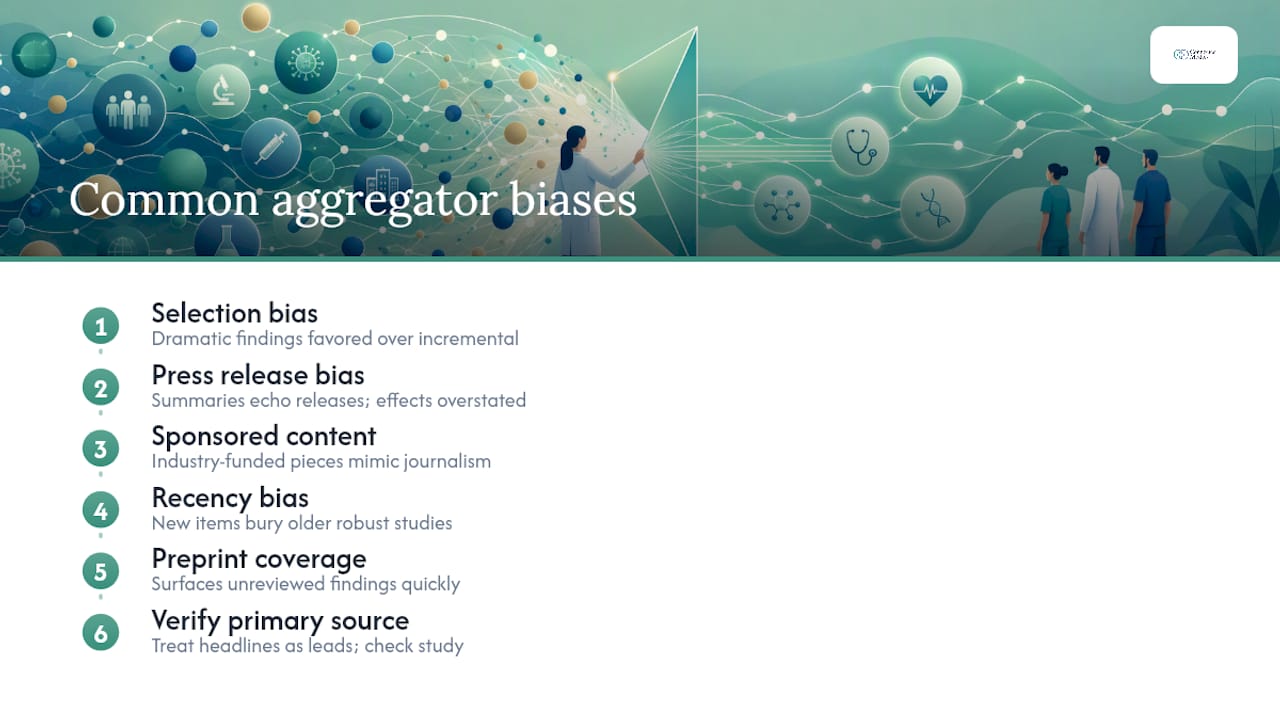
Selection bias is the biggest one. Aggregators tend to favor dramatic findings over incremental ones, because "study confirms modest effect" doesn't drive clicks the way "breakthrough treatment" does. That skews clinician perception toward outlier results.
Press release dependency compounds the problem. Many aggregators summarize a university or journal press release rather than the study itself, and press releases routinely overstate effect sizes or omit limitations sections entirely.
Sponsored content is another blind spot. Industry-funded features can read identically to independent journalism unless a publisher discloses funding clearly, and not all do.
Recency bias matters too. Aggregators are optimized for "what's new," which means a well-designed study from eighteen months ago gets buried under today's preprint, even if the preprint hasn't been peer reviewed. Preprint coverage itself is a double-edged sword: it surfaces findings faster but skips the peer-review step entirely, and few aggregators flag that distinction prominently.
None of this makes aggregators useless. It means treating a headline as a lead worth checking, not a citation worth using.
Comparing the Major Aggregator Types
No single source wins across every use case, so the comparison depends on what you're optimizing for.
| Source Type | Best For | Coverage Scope | Timeliness | Access Model |
|---|---|---|---|---|
| Clinical daily briefs | Clinicians, point-of-care awareness | News, journal summaries | Daily | Free, some subscription tiers |
| MedlinePlus | Patients, general clinical reference | Curated health topics | Ongoing updates | Free |
| Embase / Ovid | Researchers, systematic reviews | Primary literature, abstracts, gray literature | Continuous indexing | Subscription, institutional |
| PubMed / ClinicalTrials.gov | Researchers, trial tracking | Primary literature, trial registrations | Continuous indexing | Free |
| KFF Health News | Policy analysts, journalists | Investigative, policy-focused | Ongoing coverage | Free |
The strongest tools stay in their lane. Embase's abstract depth doesn't help a clinician who needs a five-minute morning read, and a news brief's speed doesn't help a researcher who needs an auditable citation.
Does Aggregation Change How Clinical Decisions Get Made?
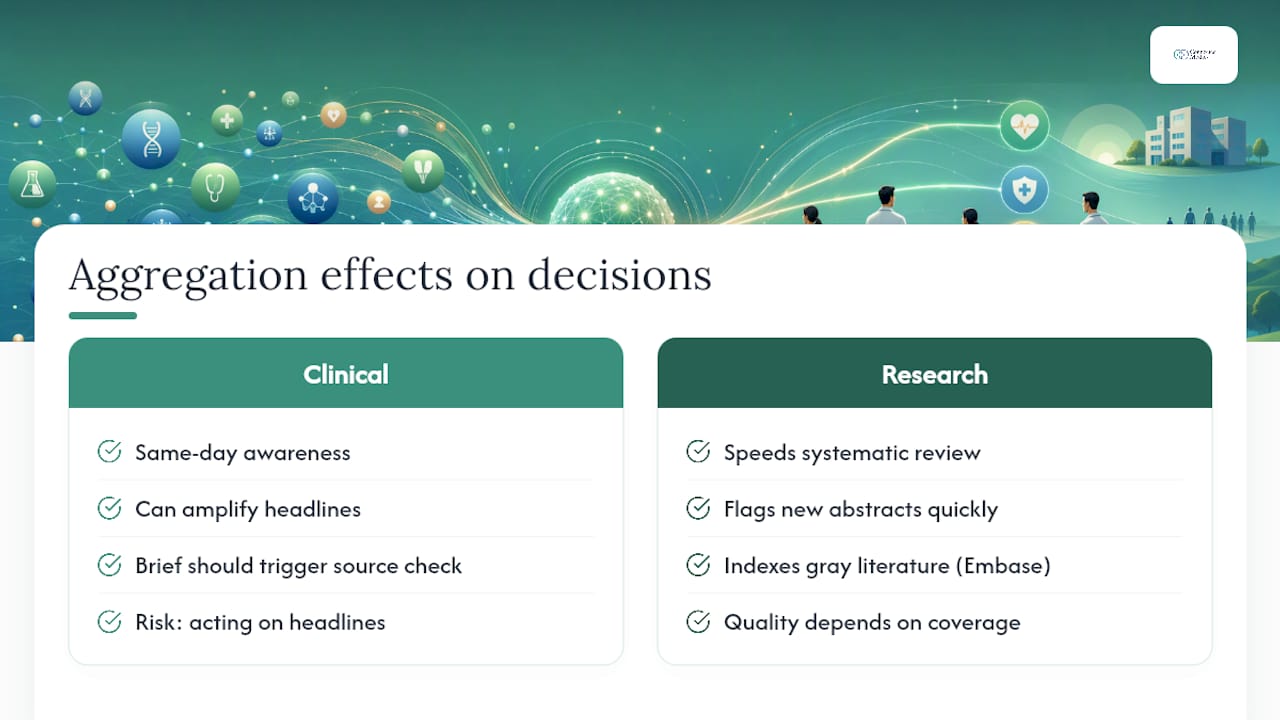
Faster access to summarized findings shortens the gap between publication and clinical awareness, which is generally a good thing. A relevant trial result can reach a specialist's inbox the same day it's published rather than months later at a conference recap.
The risk runs the other direction. When a clinician acts on a headline rather than the underlying study, aggregation can amplify overstated findings faster than it corrects them. This is where the pairing principle matters most: a brief should trigger a look at the primary source, not replace it.
For research decision-making, the effect is different. Literature-surveillance platforms speed up the systematic review process by flagging new abstracts and gray literature as they're indexed, which matters directly for pharmacovigilance timelines. The decision quality still depends on whether the platform's coverage is comprehensive enough to avoid missing a signal, which is exactly why Embase's gray-literature indexing carries weight in that world. Aggregation, used well, compresses time to awareness. Used carelessly, it compresses time to error.
A Practical Daily Workflow Worth Copying
Fifteen minutes covers it: one clinical brief skimmed over coffee, one research alert checked for anything flagged urgent, and everything else bookmarked for a thirty-minute weekly review. Batch the non-urgent items rather than reacting to each one as it lands. Before adding a new feed, check its editorial board, its sourcing links, and whether it duplicates something you already trust. If it doesn't clear that bar, skip it.
— David
A Curated Alternative Worth Adding to Your Routine
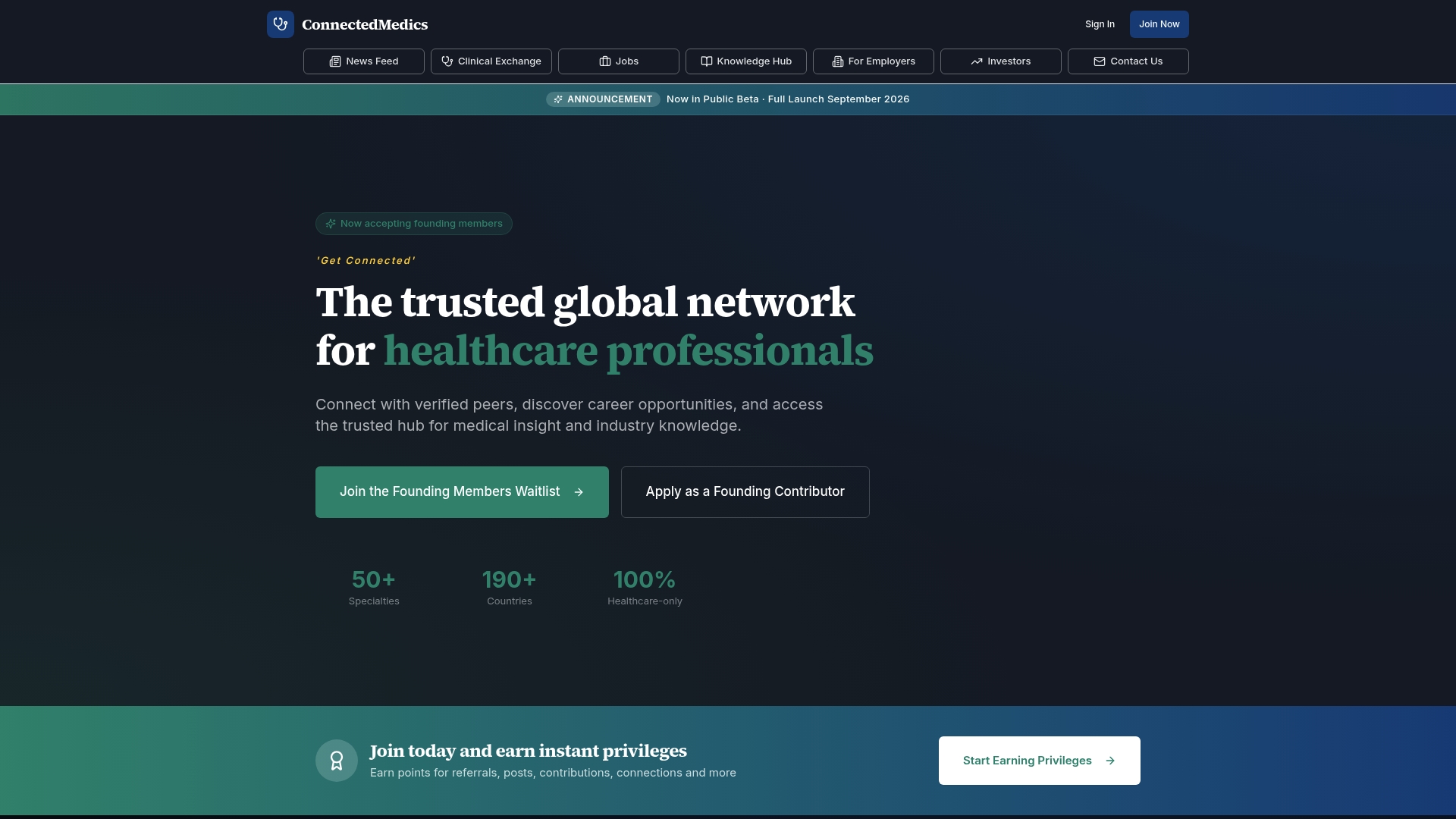
Daily briefs and indexed databases each solve half the problem. What's often missing is a place where curated clinical content sits next to verified peer input and the job market in your specialty, all in one login. ConnectedMedics fills that gap with specialty-led knowledge hub content summarized by contributors, discussion threads tied to credentials rather than anonymous comments, and a jobs board with active healthcare vacancies alongside the news.
Three things set it apart from a standard news brief:
- Verified contributors. Content in the knowledge hub, including pieces like this oncology trial roundup, comes from credentialed professionals rather than anonymous aggregation.
- Specialty briefs with context. Instead of a generic feed, updates are grouped by specialty and paired with discussion from peers working in that field.
- Career signal built in. Career-relevant content, like current healthcare salary trends, sits alongside clinical updates instead of requiring a separate platform.
Create a free profile at ConnectedMedics and add your specialty feed to see how it compares to your current morning routine.
Sources
FAQ
What is the best source for medical news?
There isn't one universal best source. It depends on the task: a curated daily brief works for point-of-care awareness, while Embase or PubMed works for research surveillance.
Which website is the most reliable source of medical information?
MedlinePlus, maintained by the National Library of Medicine, is among the most reliable public sources because it aggregates authoritative agency content with clear sourcing. For peer-reviewed literature, PubMed and Embase remain the standard.
What are the top 3 medical journals?
Rankings shift by specialty and metric, so no single list is definitive; broadly cited titles include The New England Journal of Medicine, The Lancet, and JAMA. Databases like Embase and Ovid index all three alongside thousands of other indexed titles.
What is the most reliable source of medical information for clinical decisions?
For clinical decisions, evidence syntheses built on large clinician-review teams, such as UpToDate, tend to outperform general news aggregators because of their editorial rigor. General aggregators are better suited to awareness than to decision support.
How is ConnectedMedics different from a standard medical news aggregator?
ConnectedMedics pairs curated specialty content with verified peer discussion and a jobs board, rather than functioning as a pure news feed. It complements evidence databases and news briefs instead of replacing either one.