
JAMA Network, Medscape, KFF Health News, Mayo Clinic News Network, The BMJ, and Endpoints News top the list of medical news sources worth a clinician's or researcher's limited attention. Each covers different ground: JAMA and Medscape translate peer-reviewed research into practice-ready updates, KFF Health News tracks policy shifts that affect reimbursement and access, Mayo Clinic News Network offers institutional clinical context, The BMJ blends research integrity with commentary, and Endpoints News delivers biotech and pharma intelligence you won't find in general health coverage. Short descriptors for each follow below.
- Research translation and clinical updates: JAMA Network, Medscape, Mayo Clinic News Network
- Policy and public affairs: KFF Health News
- Trade and industry reporting: Endpoints News, HealthLeaders Media, Forbes: Healthcare
- Broad public-facing outlets with strong health desks: NBC News, ABC News, CNN Health, BBC News, The Atlantic
Key Takeaways
The most reliable medical news strategy combines a research-translation source, a policy outlet, and a specialty trade publication rather than relying on any single site.
| Point | Details |
|---|---|
| Match source to role | Researchers prioritize research-translation and trade sources; clinicians combine clinical updates with policy digests. |
| Use a three-tier routine | Daily research briefs, weekly policy reads, and monthly long-form pieces cover most needs without overload. |
| Verify before you share | Check for primary-source links, named reviewers, and disclosed conflicts before acting on a headline. |
| Newsletters reduce overload | Curated digests from sources like KFF Health News are how most professionals manage volume. |
| Complement news with curation | Connectedmedics' Knowledge Hub filters research summaries by specialty and pairs them with verified clinician forums. |
This article is general information, not a substitute for advice from a qualified doctor. Consult a qualified healthcare professional about your own circumstances before acting on anything here.
Table of Contents
- Best Medical News Sites by Category
- How These Sites Compare for Your Role
- How to Follow Medical News Without Drowning in It
- How to Tell If a Medical News Story Is Trustworthy
- Where Connectedmedics Fits Alongside These Sources
- How Research Becomes a Clinical Headline
- What I Actually Read Every Week
- Get Curated Clinical News Built for Your Specialty
- Sources
Best Medical News Sites by Category
Choosing among the best medical news sites depends less on brand recognition and more on what your role actually demands; for example, exploring medical website examples that convert patients helps tailor your choice to the right audience and use case. A hospitalist tracking guideline changes needs something different than a health policy researcher watching legislative drafts. Here's how the field breaks down.
Research and clinical practice sites
- JAMA Network (medical news) — Bridges peer-reviewed studies and digestible news briefs, which JAMA Network positions as ideal for clinicians who need the clinical takeaway without reading the full trial. Offers specialty-specific alerts and table-of-contents email options.
- Medscape — Clinician-targeted reporting with specialty-specific coverage and physician commentary sections, per Medscape. Best for practice-level updates and CME-linked content; newsletters segment by specialty.
- Mayo Clinic News Network — Institutional research updates paired with clinician-facing resources, drawing on Mayo Clinic's own research pipeline. Best for a trusted, conservative read on emerging findings; offers email sign-up for research updates.
- The BMJ (US site) — Combines general medical reporting with editorial commentary that leans on The BMJ research integrity standards. Best for readers who want commentary alongside the primary literature; weekly digest available.
Policy and public affairs
- KFF Health News — Independent journalism focused on health policy, coverage gaps, and the financial mechanics of American healthcare, according to KFF Health News. Best for anyone tracking how legislation and reimbursement rules ripple into clinical practice; daily and weekly newsletters both run.
Trade, industry, and specialty reporting
- Endpoints News — Concentrated biotech and pharma reporting on trial results, FDA actions, and company moves, per Endpoints News. Best for readers tracking drug development pipelines; daily email digest is the primary format.
- HealthLeaders Media — Hospital administration and healthcare business coverage aimed at executives and analysts, states HealthLeaders Media. Best for administrators watching operational and financial trends; topic-specific newsletters available.
- Forbes: Healthcare — Industry and business-of-medicine reporting with an investor and executive lens. Best for market-level context on healthcare companies and innovation funding.
Broad public-facing outlets with strong health desks
- NBC News: Health, ABC News: Health, CNN Health, and BBC News: Health — Each maintains a dedicated health desk producing accessible coverage, though depth and clinical nuance vary by outlet, notes NBC News. Useful for gauging public awareness and media framing of a story, not for clinical decision-making.
- The Atlantic: Health — Long-form journalism that contextualizes health trends within culture and policy. Best for understanding how a medical story lands with the public.
- Medical News Today — Accessible summaries of published research aimed at a general readership, per Medical News Today. Best for quick patient-facing explanations or background reading before a deeper dive.
- Knowable Magazine — Explanatory science journalism connecting research findings to broader context, useful when you need the "why this matters" framing fast.
- WebMD — General-audience health content built on regular review by clinical experts, according to WebMD. Best for patient-education material clinicians can point people toward.
How These Sites Compare for Your Role
The best medical news sources aren't interchangeable. They split cleanly by audience, scope, and how you access them.
- Audience fit: Researchers and specialists get the most from JAMA Network, Medscape, and The BMJ. Administrators and analysts lean toward HealthLeaders Media and Forbes: Healthcare. General readers and patients are better served by WebMD or Medical News Today.
- Scope: Policy coverage lives almost exclusively at KFF Health News. Primary research translation is strongest at JAMA and Mayo Clinic News Network. Industry and pipeline news belongs to Endpoints News.
- Access model: Most outlets on this list are free with optional registration for newsletters; some specialty content on clinician platforms sits behind a professional registration wall rather than a paywall.
- Newsletter presence: Nearly every entry here runs some form of digest, which matters more than it sounds, since KFF Health News data shows curated newsletters are how most professionals actually manage information overload.
Which to pick: researchers should prioritize a research-translation source plus a specialty trade outlet. Clinicians do better combining a clinical-update source with a policy digest, since guideline changes rarely arrive without a reimbursement story attached.
How to Follow Medical News Without Drowning in It
A three-step routine keeps you current without turning your inbox into a second job:
- Daily brief — Skim one research-translation newsletter (JAMA or Medscape) for five minutes over coffee.
- Weekly deep-dive — Read one policy or trade digest (KFF Health News or Endpoints News) in full, since these stories move slower but matter more over time.
- Monthly reading list — Set aside 30 minutes for longer pieces from The BMJ, Knowable Magazine, or The Atlantic that add context rather than urgency.
Prioritize newsletter types in this order: research briefs first, policy digests second, specialty trade newsletters third. Journal table-of-contents alerts for two or three priority journals, combined with news briefs from JAMA or Medscape, cover most of what matters without duplicate effort.
Pro Tip: Set up one email filter that routes all newsletter subscriptions into a single folder tagged by source type. Skim it once daily instead of letting each newsletter interrupt your inbox as it lands.
How to Tell If a Medical News Story Is Trustworthy
Five checks separate a reliable medical news story from a press release dressed up as journalism:
- Does it link to the primary study or preprint, not just describe it secondhand?
- Is a named clinical reviewer or subject-matter expert credited?
- Are conflicts of interest or funding sources disclosed?
- Is opinion clearly separated from reported findings?
- Does the outlet operate with editorial independence from the institutions or companies it covers?
A headline claiming "New Drug Cuts Heart Attack Risk in Half" should send you looking for the trial's sample size and the reviewer's name before you act on it. Authority in medical reporting comes down to editorial review by working clinicians and transparent sourcing, not how fast a story broke.
Where Connectedmedics Fits Alongside These Sources
External news sites cover the world; Connectedmedics curates what matters to your specialty. The Knowledge Hub summarizes clinical research and trends contributed by verified medical professionals, which complements broad outlets by filtering noise down to specialty-relevant content.
- Verified clinician contributors, not anonymous bylines
- Curated summaries that sit alongside a global healthcare jobs board
- Peer discussion forums for interpreting studies with colleagues in your field
. David has also contributed to the Knowledge Hub. Readers wanting an integrated, clinician-focused digest can start at the Connectedmedics homepage or browse the Knowledge Hub directly.
How Research Becomes a Clinical Headline
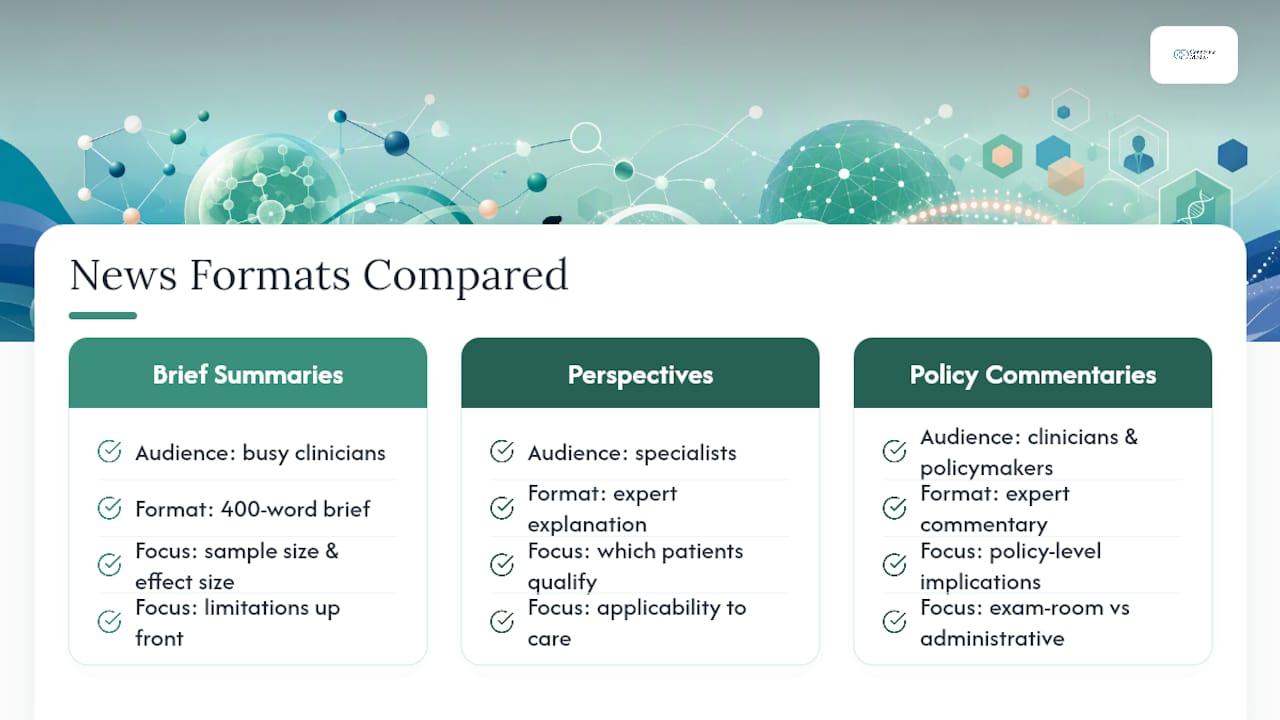
A trial gets published in a journal. Within days, a research-translation site turns it into a 400-word brief with the sample size, effect size, and a caveat about limitations up front. That's the format Medscape and JAMA run constantly, and it exists because busy clinicians need the study's practical implications, not the full methods section, on a schedule that fits between patients.

Perspective pieces go a step further. A cardiology trial showing a modest reduction in stroke risk reads very differently once a specialist explains which patients actually qualify for the intervention and which don't. That distinction between finding and application is why perspective and commentary formats help clinicians interpret how a study affects care more than a straight news report ever could.
Expert commentary sections at outlets like The BMJ do similar work at the policy level. A new CDC guideline becomes a news item everywhere. Only a handful of outlets pair it with a clinician explaining what changes in the exam room versus what's just administrative. Connectedmedics forums extend that same function informally: a physician can ask a specialty group how they're actually implementing a new guideline before their own practice catches up.
What I Actually Read Every Week
My own routine runs three tiers: a research-translation source for daily highlights, a policy outlet weekly, and a trade publication for anything that might change how a specialty practices next quarter. Mixing source types matters because a single outlet's blind spots become invisible if it's your only input. A pharma-funded story reads differently next to an independent policy piece covering the same drug's pricing debate.
Pro Tip: During breaking medical news, check whether the story links the actual press release or trial registration before sharing it. If it doesn't, wait an hour. The correction usually arrives fast.
— David
Get Curated Clinical News Built for Your Specialty
Following eight different outlets is manageable. Following eight outlets while also filtering for what's relevant to your specialty is a part-time job. Connectedmedics closes that gap with a Knowledge Hub built specifically around specialty relevance instead of general newsworthiness.
The Knowledge Hub pulls clinical insights and research summaries from verified medical professionals, so what you read has already been filtered by someone practicing in your field, not just an editor chasing traffic. It sits alongside a global jobs board and peer forums, meaning the same platform that keeps you current can also connect you with colleagues working the same clinical questions. Visit Connectedmedics to create a verified profile, or go straight to the Knowledge Hub to see this week's clinical summaries.