
Start with two things right now: a targeted search on specialized pharmacy career hubs and a verified professional profile on a specialty network like Connectedmedics. Hiring is uneven this year. Hospital systems, specialty pharmacies, managed care, and telepharmacy are actively recruiting, while some retail pipelines have tightened.
TL;DR:
- Hospital and specialty pharmacy roles favor candidates with strong clinical rotations, interdisciplinary experience, and disease-state knowledge, especially for remote or telepharmacy positions.
- Building a verified professional profile with clear keywords, clinical results, and current licensure significantly increases chances of connecting with recruiters and getting referrals.
- Tailoring resumes to highlight outcomes and specific interventions, paired with targeted application tracking and applying through niche boards, improves hiring success.
- Pharmacists should prioritize boards like ASHP and association career centers for current openings, and check employer sites directly to gain early access to job listings.
- Demand varies geographically, with underserved regions offering higher pay, sign-on bonuses, or loan repayment incentives, particularly for rural, telepharmacy, and federal roles.
Table of Contents
- Where to Find Pharmacist Jobs First
- Build a Verified Presence That Attracts Recruiters
- How Do You Tailor a Resume for Pharmacist Roles?
- Where Employers Are Hiring in 2026
- Track Openings and Apply Without the Chaos
- Interview Prep That Actually Moves the Needle
- Licensure and State Board Requirements
- Continuing Education and Certifications Worth Pursuing
- What Do Pharmacists Actually Earn?
- Full-Time, Part-Time, or Locum Tenens?
- Should You Relocate for a Pharmacist Job?
- Author Checklist: A Weekly Routine for an Effective Search
- How Connectedmedics Fits Your Job Search
- Quick Curated Links: Where to Go Next
- Sources
Where to Find Pharmacist Jobs First
Not every source deserves equal attention. Specialized pharmacy boards and association career centers surface roles that generic aggregators miss, often before they hit wider circulation.
CareerPharm, ASHP's pharmacy job board, posts listings alongside virtual career fairs and career resources built specifically for pharmacists. State pharmacy associations run similar operations. The NCAP Career Center lists regional and national openings plus career-planning tools, and association boards like it frequently carry member-only postings that never make it to broad job sites.
Hospital and health-system career pages deserve a direct visit, not just a search-engine detour. Health systems often post internally for weeks before syndicating to outside boards, so checking the employer site directly gets you ahead of the crowd. If you're building an application specifically for hospital settings, a dedicated hospital pharmacy playbook can help you position your rotations and clinical experience correctly.
General aggregators still have a place. Boards like iHirePharmacy host large volumes of pharmacist listings, but duplicates and stale postings are common, so cross-check posting dates before you invest time in an application.
Set up your search infrastructure now:
- Create alerts on two or three prioritized boards, not a dozen
- Bookmark five to ten target employer career pages and check them weekly
- Use association career centers for niche or regional openings aggregators don't carry
- Note posting dates so you don't chase listings that have gone cold
Build a Verified Presence That Attracts Recruiters
Posted job listings are only half the market. Referrals and direct outreach routinely surface roles before they're advertised, and a strong professional profile is what makes those connections possible. Pharmacy Times advises new graduates to optimize their professional and social profiles early, since a polished presence increases engagement from recruiters and mentors well before you submit a single application.

Your profile needs five things to work: a clear headline naming your specialty focus, a two-line clinical summary, searchable keywords tied to your practice area, current licensure status, and a contact method that doesn't require someone to dig for it.
Use verified healthcare networks like Connectedmedics alongside LinkedIn rather than instead of it. Connectedmedics verifies clinical credentials before granting access, which means the recruiters and peers you meet there are already screened for legitimacy, something general networks can't offer. A healthcare professional network built around verified specialties tends to produce warmer introductions than cold outreach on a generic platform.
Three tactical moves that convert networking into interviews:
- Send a three-line outreach message: who you are, what you're targeting, one specific question about their team
- Register for at least one virtual career fair per quarter and prepare two questions per employer beforehand
- Join a specialty forum or discussion group and post something substantive before you ever ask for a favor
Pro Tip: Comment thoughtfully on a clinical discussion before you ever ask a contact for a referral. People remember contributors, not just askers.
How Do You Tailor a Resume for Pharmacist Roles?
Lead with outcomes, not duties. A resume that says "provided medication counseling" tells a hiring manager nothing; one that says "reduced 30-day readmissions by identifying medication discrepancies during discharge counseling" tells them everything.
Rewrite rotation descriptions the same way. Instead of listing tasks, name the clinical result: interventions caught, protocols improved, patient outcomes affected. Keep your cover letter to a three-sentence value pitch: who you are clinically, the specific problem you solve for this employer, and why this role fits your trajectory.
Applicant tracking systems still matter. Mirror the exact job title and clinical keywords from the posting, since many systems filter on exact phrase matches before a human ever sees your resume.
Before you submit anything, run this check:
- Every bullet leads with a result, not a task
- Job titles match the posting's language exactly
- Licensure and certifications appear near the top, not buried at the bottom
- Contact information is current and consistent across every document
Where Employers Are Hiring in 2026
Retail chains have pulled back on new-grad pipelines this year, but the slack has moved elsewhere. Hospitals, specialty pharmacies, long-term care, managed care, telehealth, and compounding are all actively hiring, and each setting rewards a different kind of evidence on your application.
- Hospital and health system: emphasize clinical rotations, interdisciplinary rounding experience, and any acute-care exposure
- Specialty pharmacy: highlight disease-state knowledge and prior authorization or patient-support program experience
- PBM and managed care: lead with data literacy, formulary knowledge, and utilization management exposure
- Long-term care: stress medication reconciliation and geriatric dosing familiarity
- Telepharmacy: call out EHR comfort and any remote or telehealth exposure, since remote roles are competitive and reward specificity
Vary your search keywords by setting: "clinical pharmacist," "PBM pharmacist," "long-term care consultant pharmacist," and "telepharmacist" all pull different result sets. Float pool positions and structured training pipelines offer entry routes for pharmacists without a residency, and they're worth searching directly rather than assuming residency is the only door in.
Track Openings and Apply Without the Chaos
An unmanaged job search burns hours on duplicate listings and forgotten follow-ups. A simple system fixes both problems.
- Set alerts with two or three specific keywords per role type, tuned weekly if results are too broad or too sparse
- Build a tracker with five fields: employer, date applied, contact name, follow-up date, and status
- Use Boolean search operators (quotation marks for exact phrases, minus signs to exclude irrelevant terms) to cut through noise on aggregator sites
- Batch applications into a single time block twice a week rather than applying reactively every time a new listing appears
If your search stalls entirely, USAJOBS suggests refining search terms and filters when a query returns nothing. The same principle applies everywhere: a search that returns zero results usually means the keyword is too narrow, not that the jobs don't exist.
Interview Prep That Actually Moves the Needle
Prepare three STAR-format stories before any interview: a clinical intervention, a conflict you resolved with a provider or team member, and a time you caught an error. Interviewers ask about all three constantly.
Expect questions on medication safety protocols, how you handle high-volume pressure, and where you see the specialty in five years. Prepare specific, not generic, answers.
- Ask what a typical first ninety days looks like
- Ask how the role's scope has changed in the past year
- Ask what metrics define success in this position
Send a follow-up email within twenty-four hours naming one specific detail from the conversation. On offers, negotiate schedule and CE budget as readily as base pay; both move more often than employers advertise.
Pro Tip: Ask about scope and metrics before you ask about salary. It signals you're evaluating fit, not just compensation.
Licensure and State Board Requirements
Every pharmacist needs an active license in the state where the job is physically located, and licensure does not automatically transfer across state lines. Reciprocity through the National Association of Boards of Pharmacy's transfer process speeds things up, but processing times vary by state, sometimes by several weeks.
If you're applying to roles in multiple states, start reciprocity applications early rather than waiting for an offer. A pending license is a common reason strong candidates lose out to someone who's already cleared. Telepharmacy roles complicate this further: some states require the pharmacist to hold a license in the patient's state, not just their own, so confirm licensure scope before applying to remote positions that cross state lines.
Federal roles carry their own wrinkle. Many federal pharmacist positions, including those with the VA or Indian Health Service, accept licensure in any one state rather than requiring the specific state of employment, which opens doors that private-sector postings usually keep closed. Check each posting's licensure language directly rather than assuming standard state rules apply.
Board of pharmacy renewal cycles and continuing education requirements differ by state as well, so keep your CE hours current well before a license renewal deadline collides with an active job search.
Continuing Education and Certifications Worth Pursuing
Board certifications signal specialization to hiring managers scanning dozens of resumes. Board Certified Pharmacotherapy Specialist (BCPS), Board Certified Ambulatory Care Pharmacist (BCACP), and Board Certified Oncology Pharmacist (BCOP) credentials, all administered through the Board of Pharmacy Specialties, carry real weight for hospital and specialty roles specifically.
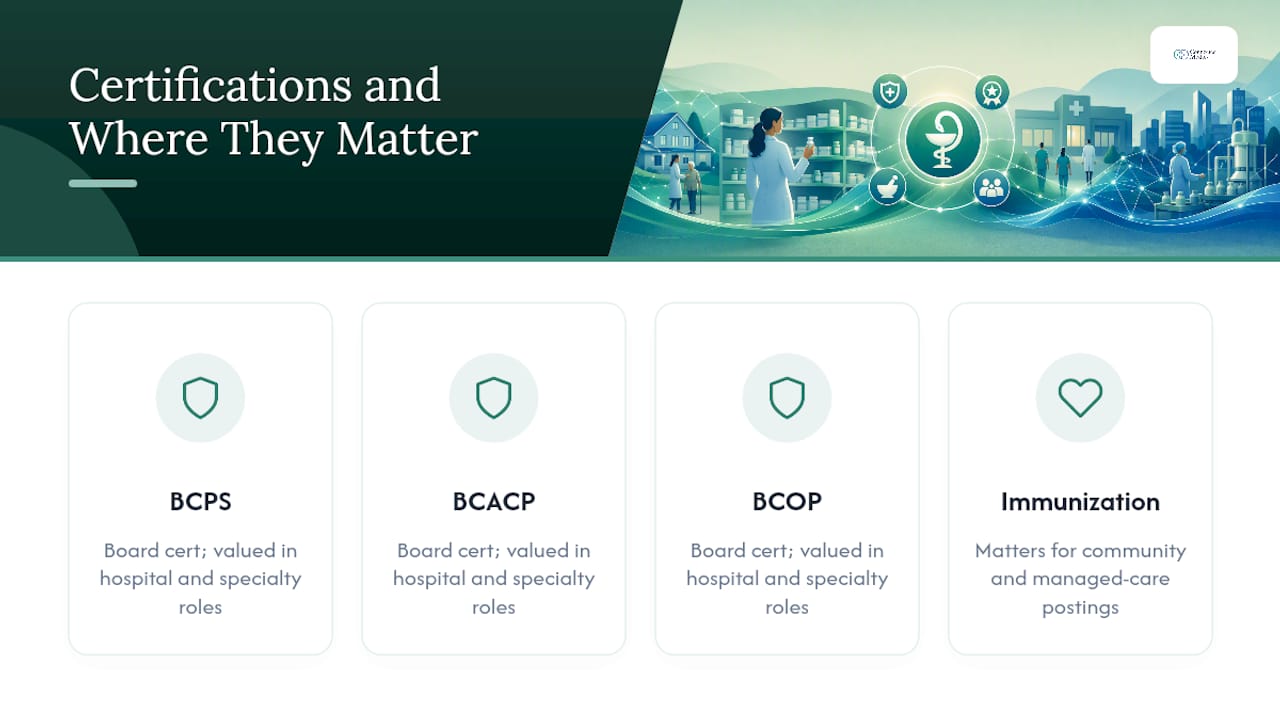
Immunization certification and Medication Therapy Management (MTM) training matter more for community and managed-care postings, where patient-facing services drive revenue.
Continuing education hours are a licensure requirement, but strategic CE choices do double duty: they keep your license active and build the specific expertise a target setting wants to see. A pharmacist targeting oncology roles who completes oncology-focused CE modules signals intent, not just compliance. The Knowledge Hub on Connectedmedics summarizes clinical research and trends that double as both CE-adjacent reading and interview preparation material.
Timing matters too. Complete certification exams before you start actively applying, not during; a credential listed as "in progress" carries less weight than one already earned.
What Do Pharmacists Actually Earn?
Pay varies substantially by setting, specialty, and geography. Labor-market data from SonicJobs shows thousands of active pharmacist listings spanning a wide pay band, with remote and specialty roles often clustering at the higher end.
Hospital and specialty pharmacy positions tend to pay more than community retail roles, reflecting the added clinical complexity and credentialing those settings demand. Managed care and PBM roles often trade slightly lower base pay for more predictable hours and stronger work-life balance, a tradeoff many pharmacists actively seek after years of retail scheduling.
Benefits packages vary just as much as base salary. Look closely at:
- Continuing education reimbursement and paid CE time
- Loan repayment assistance, especially in hospital and federal roles
- Sign-on bonuses in high-demand settings like specialty pharmacy and telepharmacy
- Shift differentials for night, weekend, or holiday coverage
Don't evaluate an offer on base salary alone. A lower base with strong loan repayment or CE support can outperform a higher base with thin benefits over a multi-year horizon.
Full-Time, Part-Time, or Locum Tenens?
Full-time roles offer benefits stability and a clearer path to specialization, but they lock you into one employer's schedule and culture. Part-time positions trade some income for flexibility, and they're increasingly common in managed care and remote clinical roles where employers value coverage over a fixed headcount.
Locum tenens work fills short-term staffing gaps, often at a premium hourly rate, and it suits pharmacists who want variety or are testing a new setting before committing. The tradeoff is inconsistent benefits and the administrative overhead of managing your own licensure across whatever states the assignments require.
Contract length matters as much as contract type. A three-month locum assignment tells you little about long-term fit; a twelve-month contract role functions almost like a working interview for a permanent position. Read the renewal language in any contract carefully; some convert automatically to at-will employment, others simply end.
If you're weighing supplemental or agency-based roles as a way to build experience across settings, guides on agency care positions walk through how contract staffing works in practice, including how assignments get sourced and structured.
Should You Relocate for a Pharmacist Job?
Demand isn't evenly distributed. Rural and underserved regions frequently carry the widest gaps between open positions and licensed applicants, which often translates into sign-on bonuses, loan repayment incentives, or above-market pay that urban postings rarely match.
Telepharmacy has changed the relocation calculus for some pharmacists, letting them serve patients in underserved states without physically moving, though state-specific licensure rules still apply to where the patient sits, not where you do. That makes telepharmacy a genuine alternative to relocation for the right candidate, not a full substitute for it.
Before relocating, weigh cost of living against the salary premium, confirm reciprocity processing time for the destination state, and research the specific health system's reputation, not just the market average pay. A high salary in a market with a difficult employer is a worse trade than a moderate salary somewhere with strong clinical support and low turnover.
Author Checklist: A Weekly Routine for an Effective Search
Run four moves every week: one new networking contact, two to three tailored applications, one follow-up on a pending application, and thirty minutes reviewing what worked. Track contacts made, applications sent, and interviews landed on a simple weekly dashboard; the ratio between those numbers tells you faster than gut feeling whether your approach needs adjusting.
One pattern shows up repeatedly: a pharmacist who spends more time on outreach than volume applications tends to convert to interviews faster, even applying to fewer total postings. Quality of contact beats quantity of applications almost every time.
— David
How Connectedmedics Fits Your Job Search
Everything above works better with a verified professional presence behind it, and that's exactly what Connectedmedics is built for. Instead of competing with unverified profiles and irrelevant connections on a generic network, your credentials are confirmed upfront, so recruiters browsing specialty filters know they're looking at a real, licensed pharmacist.
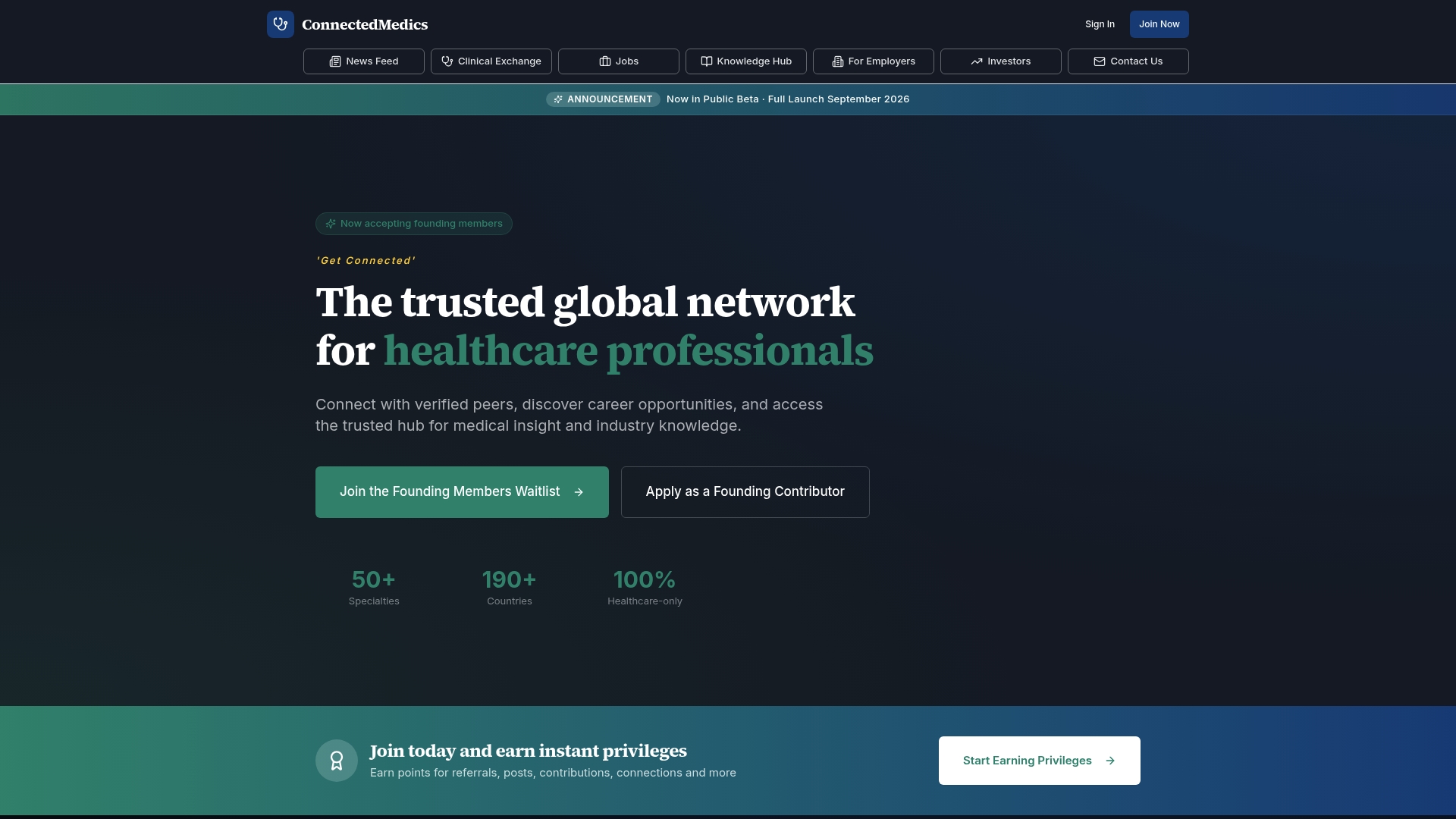
The jobs board carries over 4,600 active healthcare vacancies with specialty-specific filters, meaning your alerts stay targeted to hospital, specialty, PBM, or telepharmacy roles instead of a flood of unrelated listings. The knowledge hub gives you clinical research summaries you can reference in interviews, and direct messaging lets you reach employers without waiting for a posted job to appear.
To get started, complete your verified profile with your licensure and specialty focus, set filtered job alerts for your target settings, and join a specialty community relevant to your practice area. From there, messaging a hiring contact directly takes less effort than a cold application ever will.
Quick Curated Links: Where to Go Next
- CareerPharm for association-backed listings and virtual career fairs
- USAJOBS for federal pharmacist openings
- Medical job board guide for comparing board features side by side