
Start with the question, not the tool. For immediate staffing gaps, open the Workload Indicators of Staffing Need (WISN) tool. For national or state supply and demand projections, use the HWSM technical documentation behind HRSA's dashboard. For policy alignment, consult the Global health and care worker compact assessment tool. The sections below cover method selection, data prep, and validation.
TL;DR:
- Workforce assessments should combine multiple approaches, such as needs-based, workload, ratio, and qualitative methods, for more accurate results.
- Data sources like licensing boards, HRIS, EHRs, and international frameworks require careful reconciliation of definitions for active supply and demand.
- Using tools like WISN for workload and HWSM for long-term projections aligns assessment methods with specific questions and data maturity levels.
- Results should be presented as a range with scenarios to avoid misinterpretation as definite forecasts, especially for long-term or policy planning.
- Incorporating stakeholder input and validation processes ensures assessment findings lead to actionable staffing decisions rather than remaining only in reports.
Table of Contents
- Types of healthcare workforce assessments
- Which authoritative tools answer which planning question
- What to measure and where the data comes from
- Choosing the right method for your question and your data
- Running an assessment from scope to monitoring
- Reading the results without overreaching
- Turning assessment results into staffing decisions
- Speed versus rigor in workforce planning
- Getting from assessment results to actual hires
- FAQ
- Sources
Types of healthcare workforce assessments
Healthcare workforce assessments fall into four broad categories. Each answers a different question, and each needs different data.
Needs-based assessments start from a population health target: how many clinicians does a service area need to meet a defined level of care. These work well for long-term planning but require solid population and disease-burden data.
Workload or activity-based assessments measure what staff actually do: minutes per task, caseload per shift, time spent on documentation versus direct care. WISN is the reference method here. It requires time-and-motion data or validated activity-time standards, plus accurate staffing rosters.
Workforce-to-population ratio assessments compare the number of clinicians per 1,000 or 10,000 residents against a benchmark. They are fast to run and easy to communicate, but they say nothing about actual workload, skill mix, or whether staff are where patients are.
Qualitative and mixed-methods assessments gather input from frontline staff, managers, and patients through interviews, surveys, or focus groups. They surface issues that numbers miss, such as morale, safety culture, or informal workarounds, but they do not produce a defensible staffing number on their own.
A WHO rapid review identified 96 health and care workforce planning tools in use across 179 WHO member states, grouped into several approach categories, and concluded that no single tool is ideal for every planning question, with tool choice depending on the question and available data.
Quick reference for matching type to use case:
- Needs-based: use when planning for a new service line or population health target; needs demographic and epidemiological data.
- Workload/WISN: use when staffing levels feel mismatched to daily demand; needs time-activity data and current rosters.
- Ratio-based: use for a fast regional comparison or policy brief; needs population counts and licensing or registry data.
- Qualitative/mixed: use when quantitative results need context or buy-in; needs structured interview or survey protocols.
Each type has a limitation worth naming upfront. Needs-based models can overstate demand if they ignore delivery efficiency. Ratio models ignore distribution within a region, masking rural shortages behind a healthy state average. Workload models demand more data discipline than most facilities currently have on hand. Qualitative input, read alone, rarely survives a budget committee. Most credible assessments combine at least two of these approaches.
Which authoritative tools answer which planning question
Matching the tool to the question saves months of rework. Here is how the main options line up.
WISN answers "do we have the right number of staff for the work we actually do." It takes activity-time standards and current staffing counts as inputs and produces a workload-based staffing requirement per facility or unit. It is best suited to facility- or unit-level planners who can collect or access time-activity data. The WISN tool and software manual are published by WHO and include worked examples for different cadres.
HRSA's Health Workforce Simulation Model (HWSM) answers "what will supply and demand look like in five, ten, or twenty years, and what happens if we change training capacity or retirement age." It is an integrated microsimulation model that drives HRSA's public Workforce Projections Dashboard, taking demographic trends, training pipeline data, and service-use patterns as inputs and producing supply, demand, and percent-adequacy projections with scenario testing. The technical documentation explains the supply and demand modules separately, which matters because planning errors often come from conflating active supply with the larger pool of licensed but non-practicing clinicians. The model fits state and national planners more than single-facility managers, since its outputs are not granular to a specific hospital unit. The Workforce Projections Dashboard overview explains how percent adequacy, calculated as supply divided by demand, is presented alongside downloadable data for selected occupations and states.
WHO's National Health Workforce Accounts (NHWA) answers "how does our workforce compare on standard indicators, and can we report consistently against international benchmarks." NHWA is a structured indicator set covering workforce stock, distribution, education pipeline, and labor market dynamics, built for ministries and national planning units reporting to international bodies.
The WHO Global health and care worker compact assessment tool, published May 7, 2026, answers a different kind of question: "how well does our policy and legal framework align with recognized protections for health workers." It structures a review across domains including occupational safety, fair remuneration, and inclusivity, using guided questions and indicators rather than workforce counts. Its modular structure supports both a rapid overview and a deeper policy audit, which makes it a fit for health ministries and workforce policy teams rather than facility staffing managers.
Open-source and dashboard tools fill in the gaps between these four. Several of the 96 tools catalogued in the WHO rapid review support spatial mapping of workforce distribution or scenario testing for training-pipeline changes, which matters for planners trying to visualize shortages geographically rather than as a single national number.
Access notes, grouped by what each tool needs from you:
- WISN: download the software and manual directly from WHO; expect to invest time building local activity-time standards if none exist.
- HWSM and the dashboard: review the technical documentation first, then explore the public dashboard for pre-built state and national projections before attempting custom scenarios.
- NHWA: data submission and reporting happens through national health workforce units; individual facilities typically access published country profiles rather than submitting directly.
- Compact assessment tool: suited to a policy or workforce planning unit running a structured review, not a single-department exercise.
What to measure and where the data comes from
Every assessment, regardless of method, draws on a common set of indicators. Getting these right before running any model saves rework later.
Core indicators worth tracking as a baseline:
- Supply: the count of actively practicing clinicians by cadre, specialty, and location, distinct from the total licensed pool.
- Demand: projected service need based on population, utilization patterns, or facility volume targets.
- Percent adequacy: supply divided by demand, the headline figure in HRSA's dashboard.
- Geographic distribution: how supply varies across regions, which a national average can hide entirely.
- Attrition and retirement patterns: the rate at which the current workforce is expected to leave active practice.
Primary sources for these indicators include WHO's NHWA framework for internationally comparable workforce stock and distribution data, HRSA's technical documentation and dashboard for US supply and demand projections, state licensing boards for registry-level counts, and facility HRIS or EHR extracts for actual staffing and activity data at the unit level.
Data preparation is where most assessments stall. Licensing board counts often include inactive or retired license holders, inflating supply figures if used unadjusted. Facility rosters rarely distinguish budgeted positions from filled ones. EHR extracts capture clinical activity but miss administrative time, which WISN-style methods need to produce an accurate workload picture.

Before running any model, document your assumptions in writing: which definition of "active" you used, whether contract and travel staff are included in supply counts, and what time period the demand estimate covers. A mismatch in these definitions between data sources is the single most common cause of a workforce assessment that does not hold up under scrutiny.
Pro Tip: Reconcile supply and demand definitions across every data source before running a single calculation, not after you see a result you don't trust.
Choosing the right method for your question and your data
The right method depends on three things: the question you're answering, how mature your data is, and the time horizon you care about.
Start with the question. A staffing complaint about one unit calls for a workload method. A board question about regional shortages five years out calls for a simulation model. A funding application asking how your workforce compares internationally calls for NHWA indicators.
Next, check data maturity honestly. If you have reliable activity-time data and current rosters, WISN is within reach. If you only have aggregate headcounts and population data, a ratio-based comparison is the realistic starting point, with a note on its limitations attached.
Finally, match the time horizon. Immediate staffing questions need workload or ratio methods. Multi-year projections need a simulation model like HWSM. Policy alignment questions need the compact assessment tool regardless of horizon, since it measures structure rather than headcount.
A short checklist by method:
- Ratio-based: minimal data and minimal statistical expertise required; fastest to produce, weakest for operational decisions.
- WISN: moderate data burden (activity-time standards, current rosters); best run by someone with facility operations knowledge.
- HWSM-style simulation: heavy data and modeling expertise required; best handled at state or national level, not facility level.
- Qualitative/mixed: moderate effort, strong value for validating quantitative findings and building stakeholder buy-in.
Combine methods rather than picking one. A WHO rapid review on tool selection makes the point directly: no planning tool is universally best, and a mixed-methods approach strengthens both validation and the buy-in needed to act on results. When a question spans multiple time horizons or touches policy and operations at once, escalate to outside modeling expertise rather than stretching one tool past its design.
Running an assessment from scope to monitoring
A workforce assessment is only useful if it survives contact with a budget meeting. That takes a defined process, not just a model run.
- Define scope and the exact question. Write down what decision the assessment needs to inform, not just "assess our workforce."
- Assemble stakeholders early. Include frontline managers, HR, finance, and whoever owns the budget decision, before data collection starts, not after.
- Gather and reconcile data. Pull from licensing boards, HRIS, EHR extracts, and NHWA or HRSA baselines as relevant, documenting every assumption.
- Run the model. Apply the method chosen in the decision flow above, whether that's WISN, a ratio comparison, or a simulation.
- Validate results before presenting them. Use tracer methodology or manager-verified feedback to confirm the model matches what's happening on the ground.
- Translate findings into prioritized actions. Rank gaps by severity and feasibility rather than presenting a flat list of shortfalls.
- Set a monitoring cadence. Decide now when you'll re-run the assessment, not after the data goes stale.
Stakeholder roles matter more than most planners expect. Frontline managers catch data errors that a central planning team would never see, and finance needs the output framed in terms it can act on, like cost per filled vacancy, not just raw headcount gaps.
Validation deserves its own attention. Joint Commission guidance describes tracer methods, observing an employee's actual assignment lifecycle, as a way to uncover gaps that static personnel files and file audits miss entirely. The same guidance defines measures like HCSS-6, which tracks completeness of personnel files including credentials, competency evidence, and background checks, giving planners a structured way to sample and verify staffing data rather than trusting it at face value.
Pro Tip: Run a small tracer sample, even five or six staff assignments, before presenting model results company-wide. It catches data gaps no spreadsheet audit will flag.
Data governance should be settled before collection starts: who owns the raw data, who can see individual-level results, and how long records are retained. This matters more once personnel-level data enters the picture, since a workforce assessment can easily blur into a performance review if roles aren't clear from the outset.
Reading the results without overreaching
A workforce assessment produces a number. What that number means for a decision is a separate, harder question.
Common misreadings to watch for:
- Treating a projection as a guarantee. A ten-year supply-demand gap from a simulation model is a scenario under stated assumptions, not a forecast that will hold regardless of policy changes.
- Ignoring distribution within an average. A healthy regional ratio can still hide a severe shortage in one rural facility.
- Confusing licensed supply with active supply. Counting every license holder as a working clinician inflates supply and understates the real gap.
- Over-trusting a complex model over a simple one. A microsimulation model is not automatically more right than a workload study; it answers a different question.
Definition traps cause more bad decisions than bad math. If "shortage" means something different in your HRIS data than it does in the regional licensing registry, your percent-adequacy figure will mislead anyone who takes it at face value.
When presenting results to decision-makers, show a range, not a single number. Pair a base-case projection with a conservative and an optimistic scenario, and explain in plain language what assumption separates them. A decision-maker who sees only one number tends to treat it as fact. A decision-maker who sees a range tends to ask the right follow-up questions, which is usually the point of running the assessment in the first place.
Turning assessment results into staffing decisions
An assessment that stays in a report folder has not done its job. The practical test is whether findings change a hiring plan, a redeployment decision, or a training investment.
Consider a workload analysis that flags a unit running consistently over its WISN-calculated staffing requirement during evening shifts. Paired with manager-verified post-hire feedback on recent hires in that unit, the combination can point toward redeployment from an adjacent, under-utilized unit rather than an external hire, cutting both cost and time-to-fill. This kind of pairing, workload data plus structured manager feedback captured at the end of an assignment, creates an evidence trail that supports a redeployment case far better than either data source alone.
Automated, mobile-first manager evaluations captured at the end of an assignment and written back into a staffing system tend to get completed more reliably than annual reviews, simply because they're shorter and tied to a specific, recent assignment. That completion rate matters: a feedback process nobody finishes produces no evidence trail at all. Governance still applies here. Feedback data should be tied to role performance, not used informally for decisions it was never designed to support, and access to individual records should follow the same rules set during the data governance step of the assessment itself.
For planners building a reading list, our primer on healthcare workforce planning covers the core concepts behind the decision flow in this guide, and our piece on closing skills gaps with WISN walks through a workload-based skills gap exercise step by step. Operational models for backfilling gaps once they're identified are also worth studying, including approaches like structured outsourcing pods for home care agencies, which handle after-hours coverage and credentialing support as a standing operational response rather than a one-time fix.

Speed versus rigor in workforce planning
Every planner faces the same tension: leadership wants an answer this week, and the honest answer takes a month of data reconciliation. The fix isn't picking one side. It's being explicit about which you're giving.
A ratio-based estimate delivered in two days, labeled clearly as a rough comparison, is more useful than a six-week simulation delivered after the budget decision is already made. The reverse is also true: a policy change affecting training capacity for a decade deserves the slower, better-documented model, even when someone wants a number by Friday.
The bigger failure in most organizations isn't a bad assessment. It's running one assessment, filing it, and not revisiting it for three years while the underlying workforce shifts underneath it. Build a reassessment cadence into the process from day one, and treat the checklists in this guide as a starting structure to adapt, not a fixed template.
— David
Getting from assessment results to actual hires
A workforce assessment that identifies a gap still leaves the harder part: filling it with the right person, verified, and fast enough to matter.
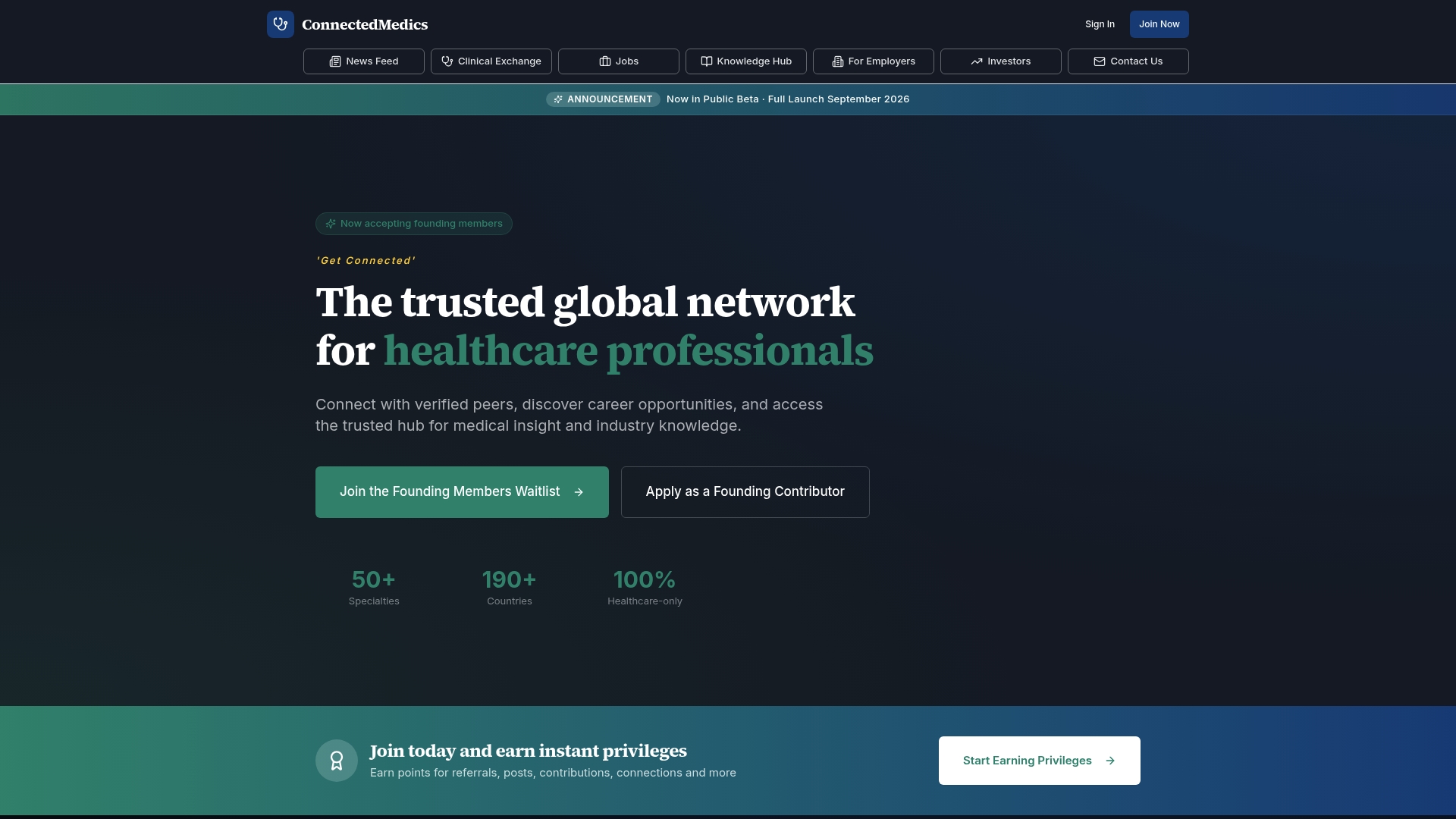
We built our platform around that exact handoff. It gives employers access to verified healthcare professional profiles, so a redeployment or hiring decision coming out of a workload analysis starts from credentialed candidates rather than unverified resumes. Our jobs board lets recruiters filter by specialty, matching the skill-mix gaps an assessment actually flags instead of a generic headcount number. The knowledge hub adds clinical research and workforce trend summaries for teams that want context alongside the hire.
What this looks like in practice:
- Verified profiles: filter candidates by specialty and credential status before you ever schedule an interview.
- Global jobs board: post against the specific gap your assessment identified, not a generic vacancy.
- Employer tools: our Growth plan runs £99 per month for recruitment tools and job postings; Premium Employer adds advanced sourcing and analytics for larger teams.
- Marketplace: our education and equipment marketplace supports upskilling once a competency gap is identified.
Start by reviewing our employer plans and posting against the gap your assessment just surfaced.
FAQ
What are the four types of health assessments?
In workforce planning, the four main types are needs-based assessments, workload or activity-based methods like WISN, workforce-to-population ratio comparisons, and qualitative or mixed-methods approaches. Each answers a different planning question, and most credible assessments combine at least two.
What kind of assessments can a healthcare worker observe?
Frontline staff can observe and contribute to workload or activity-based assessments, since these rely on actual time spent on tasks, and to qualitative assessments through interviews or surveys. Tracer methods, described in Joint Commission guidance, also involve observing a worker's real assignment lifecycle directly.
What is a healthcare workforce?
A healthcare workforce refers to the full set of clinicians, support staff, and allied professionals delivering care within a health system, tracked by cadre, specialty, and location. Planning bodies measure it through indicators like active supply, distribution, and attrition rather than a single headcount figure.
How often should a healthcare workforce assessment be repeated?
There's no single fixed interval that fits every organization or question, since the right cadence depends on how fast your local workforce and demand are shifting. A practical approach is to set a monitoring cadence as part of the assessment itself, rather than treating it as a one-time exercise.
Sources
- Workload Indicators of Staffing Need (WISN) tool
- HWSM technical documentation (HRSA)
- Health and care workforce planning tools (WHO rapid review)
- Health Care Staffing Services Certification Review Process Guide (Joint Commission)