
A healthcare vacancy is defined as an unfilled paid position within a healthcare organization that the employer actively intends to recruit for, either immediately or in the near term. Understanding what does healthcare vacancy mean explained in practical terms requires separating the term from related concepts like turnover rate, job openings, and staffing ratios. The NSI 2026 report puts the national registered nurse vacancy rate at 8.6%, with the U.S. nursing shortage estimated at 158,600 RNs. For healthcare professionals and job seekers, reading vacancy data correctly is the difference between targeting a real opportunity and chasing a position that may never be filled.
What does healthcare vacancy mean: definition and metrics
A healthcare vacancy refers to any authorized, budgeted position within a healthcare organization that remains unfilled and is being actively recruited. The term covers open requisitions, unfilled full-time equivalents (FTEs), and aggregate vacancy rates across departments or specialties. Eurostat and FRED both track vacancy figures at the macro level, while organizations like NSI measure them at the hospital and specialty level.

The vacancy rate formula is straightforward:
Vacancy Rate = (Vacant Positions ÷ Total Authorized Positions) × 100
This metric tells you the proportion of budgeted roles that are currently unfilled. It differs from turnover rate, which measures how many employees left over a given period. A hospital can have a low turnover rate and a high vacancy rate simultaneously, if it expanded headcount but cannot recruit fast enough to fill new roles.
Key distinctions in how vacancies are categorized:
- Open requisition: A formally approved request to hire, logged in an applicant tracking system like Workday or Oracle Taleo.
- Unfilled FTE: A budgeted full-time equivalent slot with no current occupant, which may or may not have an active requisition attached.
- Vacancy rate: The percentage of total authorized positions that are unfilled at a specific point in time.
- Temporary or agency-filled roles: Positions covered by contract or agency staff are often excluded from vacancy counts, which can understate true staffing gaps.
The distinction between permanent and agency-filled roles matters. When a hospital uses travel nurses to cover an ICU shortage, that position may not appear as a vacancy in official reporting even though a permanent hire is still needed. This gap between reported and actual vacancies is a known limitation of standard workforce metrics.
Current healthcare vacancy landscape and statistics in 2026
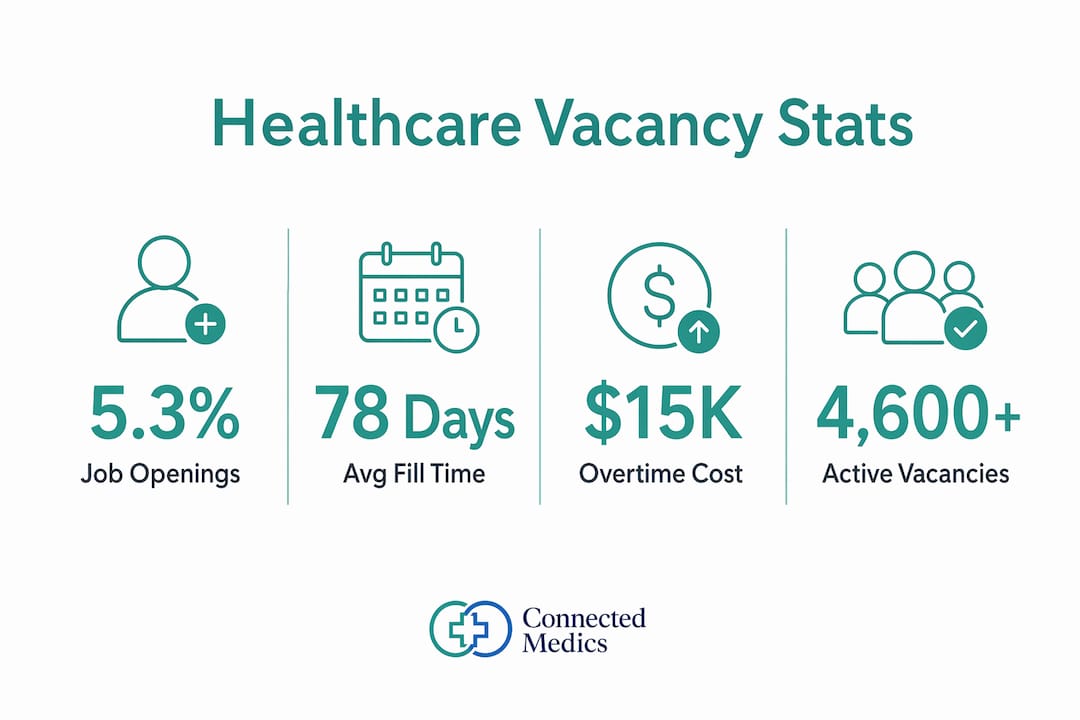
The healthcare job market in 2026 is both stable and persistently strained. The healthcare job opening rate sits at 5.3% as of March 2026 according to FRED data, meaning roughly 1 in 19 healthcare positions is unfilled at any given moment. That figure has held near elevated levels for several consecutive quarters, signaling a structural rather than cyclical problem.
| Metric | 2026 Value | Source |
|---|---|---|
| National RN vacancy rate | 8.6% | NSI 2026 |
| Hospitals with RN vacancy ≥10% | 33.1% | NSI 2026 |
| RN Recruitment Difficulty Index | 78 days | NSI 2026 |
| Healthcare job opening rate | 5.3% | FRED (March 2026) |
| Direct employer job postings growth | +1.2% YoY | Job Board Doctor |
Direct employer postings are up 1.2% year over year in early 2026, while agency postings have declined slightly but remain near 600,000 active listings. This split matters: rising direct postings suggest employers are trying to reduce agency dependency, but the volume of agency listings confirms that permanent hiring has not kept pace with demand.
"The RN Recruitment Difficulty Index of 78 days means the average hospital takes more than two and a half months to fill a single registered nurse position. Every day that role sits open carries direct cost implications in overtime, agency spend, and care quality risk."
The cost dimension of vacancies is significant. Each unfilled RN position generates ongoing overtime and agency costs that compound across a department. For healthcare organizations, vacancy management is not just an HR function. It is a financial and operational priority.
Pro Tip: When reviewing a job posting, check how long it has been listed. A posting active for more than 90 days on a platform like Indeed or a hospital's own careers page may signal budget constraints, a difficult-to-fill specialty, or a mismatch between the role requirements and available candidates in that market.
What factors influence healthcare vacancy rates
Healthcare vacancies are not simply the result of too few applicants. The WHO identifies workforce challenges spanning education, deployment, and retention as the root causes of persistent vacancies. This means a vacancy rate is a symptom of a system-wide issue, not just a recruitment failure.
Several factors shape why vacancies remain open longer in some specialties and regions than others:
- Educational pipeline bottlenecks: Nursing schools in the U.S. turned away over 90,000 qualified applicants in recent years due to insufficient faculty and clinical placement capacity. Fewer graduates mean fewer candidates for open roles.
- Geographic maldistribution: Rural and underserved areas report higher vacancy rates even when national figures look moderate. A vacancy in a metropolitan academic medical center and one in a rural critical access hospital represent very different recruitment challenges.
- Retention failures: High burnout rates in specialties like emergency medicine and critical care mean roles refill repeatedly, keeping vacancy rates elevated even when hiring is active.
- Staffing model shifts: Health systems are moving beyond traditional FTE models toward flexible workforce structures that combine part-time, per diem, and contract roles. This redesign changes how vacancies are counted and managed.
A counterintuitive reality noted by the WHO is that health worker unemployment can coexist with high vacancy rates in the same country. This happens when qualified workers are concentrated in urban areas while vacancies cluster in rural regions, or when credentialing and licensing barriers prevent workers from filling roles they are clinically qualified to perform.
Pro Tip: Do not interpret a high regional vacancy rate as a guaranteed job offer. Cross-reference vacancy data from sources like FRED, NSI reports, and workforce trend trackers to understand whether the vacancies in your specialty and target location are genuinely accessible.
How to interpret and navigate healthcare vacancies as a job seeker
Understanding vacancy data is one skill. Translating it into a job search strategy is another. The most reliable approach is to triangulate multiple data sources: FRED job opening rates, NSI specialty-specific vacancy reports, and live postings on specialized healthcare job boards.
Here is a practical framework for interpreting vacancy signals:
- Check the vacancy age. A posting active for fewer than 30 days on a healthcare jobs board is likely a genuine, funded opening. Postings older than 90 days warrant direct outreach to confirm the role is still active and budgeted.
- Distinguish vacancy type. Determine whether the role is a permanent hire, a contract-to-hire, or an agency-placed temporary position. Each carries different timelines, compensation structures, and long-term career implications.
- Assess the Recruitment Difficulty Index for your specialty. The 78-day average for RN recruitment means the process is slow by design. Factor this into your timeline when planning a job transition.
- Read vacancy dashboards critically. Vacancy figures often represent budgeted positions, and some open roles may not be immediately hireable due to onboarding cost limits or hiring freezes. A listed vacancy does not always mean an imminent start date.
- Use specialty-specific networks. Generic job platforms surface healthcare roles but lack the context that specialty-focused networks provide. Platforms built for healthcare professionals filter by credential, specialty, and location in ways that general job boards cannot replicate.
For those applying to healthcare vacancies efficiently, the key is targeting roles where the vacancy age, employer communication speed, and specialty demand align. A vacancy in a high-demand specialty at a hospital with a documented recruitment difficulty is a stronger opportunity than a role that has been reposted multiple times without being filled.
Pro Tip: Contact the hiring manager or recruiter directly within 48 hours of applying. Given the 78-day average recruitment timeline for RNs, early engagement significantly increases your visibility in a crowded applicant pool.
Key takeaways
Healthcare vacancies are best understood as budgeted, unfilled positions that reflect systemic workforce gaps, not just short-term hiring needs, and interpreting them accurately requires combining vacancy rate data with time-to-fill metrics and live job posting signals.
| Point | Details |
|---|---|
| Core definition | A healthcare vacancy is a budgeted, unfilled position actively being recruited for by a healthcare employer. |
| Vacancy rate formula | Divide vacant positions by total authorized positions and multiply by 100 to get the vacancy rate percentage. |
| 2026 RN vacancy data | The national RN vacancy rate is 8.6%, with an average recruitment time of 78 days per NSI 2026. |
| Systemic causes | Education bottlenecks, geographic maldistribution, and retention failures drive persistent vacancies beyond simple hiring gaps. |
| Job seeker strategy | Triangulate FRED data, NSI reports, and live job board postings to assess whether a listed vacancy is genuinely accessible. |
Why vacancy numbers alone can mislead you
I have spent years reviewing healthcare workforce data, and the single most common mistake I see from both job seekers and recruiters is treating a vacancy number as a straightforward signal. It is not. A hospital reporting 50 open RN positions may have budget approval for only 20 immediate hires. The other 30 are real vacancies in the system but not real opportunities this quarter.
The shift toward flexible staffing models described by Becker's Hospital Review reflects something I think is underreported: the 1.0 FTE as the default unit of healthcare employment is genuinely eroding. More roles are being structured as 0.6 or 0.8 FTEs, per diem arrangements, or hybrid contract positions. This changes what "vacancy" means in practice. A job seeker targeting full-time permanent roles may be looking at a market that is increasingly offering something different.
The WHO's observation about health worker unemployment coexisting with vacancies is the most important structural insight in this space. It tells you that vacancy rates are not a clean measure of demand. They are a measure of accessible demand, filtered through geography, credentialing, and institutional budget cycles. Understanding that distinction is what separates a strategic job search from a reactive one.
— David
Find verified healthcare vacancies on ConnectedMedics
ConnectedMedics is a global network built exclusively for healthcare professionals, with over 4,600 active healthcare vacancies listed by verified employers. The platform filters roles by specialty, location, and role type, cutting through the noise that generic job boards produce. Job seekers access a knowledge hub with clinical insights and workforce trend summaries alongside the jobs board, so career decisions are informed by current data. Recruiters use ConnectedMedics for direct outreach to credentialed professionals, reducing time-to-fill. For healthcare professionals who want verified roles and relevant connections in one place, ConnectedMedics is the starting point.
FAQ
What is the definition of a healthcare vacancy?
A healthcare vacancy is an unfilled, budgeted position within a healthcare organization that the employer is actively recruiting to fill. It differs from a job opening in that it is tied to an authorized headcount slot, not just an expressed intent to hire.
How is the healthcare vacancy rate calculated?
The vacancy rate is calculated by dividing the number of vacant positions by the total number of authorized positions, then multiplying by 100. A rate of 8.6% means roughly 1 in 12 authorized positions is currently unfilled.
Why do healthcare vacancies stay open so long?
The average RN vacancy takes 78 days to fill according to the NSI 2026 report, driven by a limited candidate pipeline, credentialing requirements, and geographic mismatches between available workers and open roles.
Can a healthcare vacancy be listed but not actually available?
Yes. Vacancy dashboards often reflect budgeted positions, and some listed roles may be on hiring holds due to onboarding cost limits or budget cycles. Confirming active recruitment status directly with the employer is recommended before investing significant application effort.
What is the difference between a vacancy rate and a turnover rate?
A vacancy rate measures the proportion of unfilled positions at a specific point in time. A turnover rate measures how many employees left over a defined period. High vacancy rates can result from expansion, not just departures, making the two metrics distinct workforce signals.