In 2026 the global health workforce stays undersupplied and keeps tilting toward outpatient and home-based roles. The World Health Organization now tracks a shortfall that keeps widening, and ILO data point to a large jobs gap despite stable headline unemployment. Hiring signals from healthcare-focused jobs boards back this up: there are many active vacancies, concentrated in home care, behavioral health, and ambulatory management. Employers who prioritize retention, clinician-facing AI, and home-care staffing now will absorb the shift better than those who wait.
TL;DR:
- Home health aides and behavioral health clinicians are among the fastest-growing roles due to demographic shifts and care moving to outpatient and home settings.
- Globally, the health workforce shortfall by 2030 is projected at over 11 million, with demand concentrated in long-term, outpatient, and remote monitoring roles.
- Despite stable unemployment around 4.9%, the actual jobs gap of roughly 408 million indicates widespread unmet labor demand across informal, underemployed, and discouraged workers.
- Workforce shortages are most severe in regions like Africa, where large populations face significant staffing gaps, and training expansion often exceeds actual hiring capacity.
- Effective strategies in 2026 focus on retention, clinician-led AI adoption, targeted immigration, and task-shifting, rather than solely increasing new hires.
Table of Contents
- 1. Overview of 2026 global healthcare employment projections
- 2. Drivers of change: demographics, delivery models, technology, and migration
- 3. Occupation and region outlook: where roles are growing fastest
- 4. Measuring the problem: vacancies, the jobs gap, and misleading unemployment numbers
- 5. Implications for employers and policymakers in 2026
- 6. How healthcare professionals should prepare for 2026 shifts
- 7. Practitioner signals: what our platform data shows
- 8. Author perspective: three priorities for 2026
- Finding and filling healthcare roles through ConnectedMedics
- FAQ
- Sources
1. Overview of 2026 global healthcare employment projections
The numbers behind the 2026 healthcare job market reflect both workforce growth and ongoing shortages coexistently.
The National Health Workforce Accounts 2026 report counts the global stock of health workers and tracks its distribution, density, and composition across regions. Alongside that count, the World Health Organization has revised its shortage projection upward: the global stock of health workers now exceeds 70 million, and the projected shortfall by 2030 is about 11.1 million workers. That is not a shrinking gap. It is a growing one, even as training pipelines expand.
Labor markets outside health care show a similar pattern of hidden strain. The ILO Employment and Social Trends 2026 report found global unemployment holding steady near 4.9%, a number that on its own sounds reassuring. But the same report measures a global jobs gap of roughly 408 million people who want work but are not counted as unemployed, whether because they have stopped looking or are stuck in informal or underemployed situations. Health care sits inside that gap in uneven ways: shortages in some roles and regions, oversupply without funded posts in others.
In the United States, Bureau of Labor Statistics data show continuing strong growth in managerial and ambulatory healthcare roles, with home health and outpatient services claiming a growing share of total healthcare employment. These national projections do not contradict the global picture. They sharpen it: growth is concentrated where care is moving, not evenly spread across every setting.
Reading these figures together requires one distinction that gets lost often:
- Need-based estimates calculate how many workers would be required to meet a population's health needs, regardless of funding or hiring budgets.
- Demand-based estimates calculate how many posts are actually funded and likely to be filled, which is usually a smaller number.
- The gap between the two explains why some countries report both "shortages" and unemployed clinicians at the same time.
Workforce planners who confuse these two measures tend to either overbuild training capacity without funded jobs waiting, or underinvest in training because headline unemployment looks fine. Both mistakes are visible in 2026 data.
2. Drivers of change: demographics, delivery models, technology, and migration
Four forces are reshaping who gets hired and where, and they are moving at different speeds.
- Aging populations are expanding long-term and home-based care demand. As more people live with chronic conditions and need ongoing support rather than acute hospital stays, demand shifts toward home health aides, care coordinators, and long-term care staff rather than inpatient roles.
- Care delivery is moving from hospitals to ambulatory and home settings. This changes the role mix employers need: fewer new inpatient beds staffed, more outpatient clinics, home visits, and remote monitoring programs needing coordination and nursing oversight.
- AI and automation are best framed as expertise amplification, not replacement. The Lancet's analysis of health AI points to ambient documentation, scheduling support, and claims processing as the highest-impact uses, tools that reduce clerical load so clinicians spend more time on direct care. The risk runs the other way too: poorly implemented AI can add new documentation and verification burden instead of removing it, which is why clinician-led design matters more than the technology itself. A recruitment AI pilot structured around compliance and recruiter time savings shows one way to test this without adding risk.
- Migration and recruitment imbalances persist. Wealthier health systems recruit trained clinicians from lower-income countries faster than those countries can replace them, a pattern often called brain drain. Co-investment models, where destination countries help fund training capacity in source countries, are one response gaining attention, though implementation remains uneven.
Of these four, the delivery-model shift is doing the most to change job postings right now. A hospital system reducing inpatient bed count and expanding home health does not cut total headcount. It reallocates it, and the skills needed for home-based coordination differ from those needed for bedside acute care.
3. Occupation and region outlook: where roles are growing fastest
Demand is not spread evenly across job titles or geography, and reading the aggregate shortage numbers without this layer misses where the actual hiring is happening.
- Home health aides are among the fastest-growing roles tied to the shift toward home-based long-term care, reflecting the demographic and delivery-model trends above.
- Nurse practitioners continue to expand their scope in primary and specialty care, partly filling gaps left by physician shortages in underserved areas.
- Health services managers see continuing strong growth per Bureau of Labor Statistics projections, as ambulatory and outpatient operations need more administrative and operational leadership.
- Behavioral health clinicians remain in high demand, a trend that predates 2026 but has not slowed, as mental health care integrates further into primary and specialty settings.
Regional disparities remain stark. The WHO Regional Office for Africa's 2026 workforce report estimates around 5.72 million health workers across the region as of 2024, with projected shortages that remain large relative to population health needs. The report's policy recommendations center on increased investment and aligning education output with actual employment capacity, not just training more people.
That last point surfaces what some researchers call the surplus paradox: a country can train more clinicians than its health system has funded posts to absorb, producing unemployed or underemployed trained workers alongside a measured "shortage" of care access. This happens when training expansion outpaces fiscal investment in hiring. The practical implication for global recruitment is that a country reporting a care-access shortage is not automatically a country with available, employable surplus workers ready to migrate. The two conditions can coexist, and workforce planners sourcing talent internationally need to check funded-post data, not just training-graduate counts.

4. Measuring the problem: vacancies, the jobs gap, and misleading unemployment numbers
A 4.9% unemployment rate and a 408 million-person jobs gap can both be true at once, and the difference between them is the single most useful thing a workforce planner can understand in 2026.
Unemployment rate counts only people actively looking for work who have not found it. It misses people who gave up searching, who work fewer hours than they want, or who work informally without being counted in formal labor statistics. The ILO's 2026 report built its global jobs gap measure specifically to capture this wider pool of unmet labor demand, landing at roughly 408 million globally even as the unemployment rate held near 4.9%.
Vacancy counts tell a third, different story: how many funded positions are open right now. A high vacancy count with stable unemployment suggests a skills or location mismatch rather than a raw labor shortage. Turnover and vacancy duration matter just as much as headcount. A unit that hires five nurses but loses six to burnout in the same year has negative net capacity despite a growing headcount on paper.
Employers and planners tracking 2026 workforce trends should monitor a short list of indicators rather than any single number:
- Vacancy duration, how long open positions stay unfilled, which signals skills mismatches better than vacancy count alone.
- Turnover rate by role and unit, since losses in specific departments (critical care, behavioral health) often outpace average turnover.
- Jobs gap versus unemployment rate, read together rather than separately, to avoid mistaking a stable headline number for a healthy labor market.
- Funded-post growth, which separates genuine hiring capacity from training-pipeline growth that has no job waiting at the end.
A practical guide to tracking these indicators walks through which metrics matter most for workforce planning in the current environment.
5. Implications for employers and policymakers in 2026
Translating these trends into action means prioritizing a short list of moves rather than reacting to every headline number separately.
Retention deserves the first dollar spent, not the last. Reducing clerical burden through clinician-led AI tools, improving pay transparency and career ladders, and building occupational stability specifically in long-term care roles (where turnover runs highest) does more to close the effective gap than recruiting alone, since every clinician who leaves erases the value of a new hire.

Workforce planning needs better data, not just more of it. Strengthening NHWA-style data systems inside an organization or region, and aligning training investment with actual absorption capacity rather than enrollment targets, prevents the surplus paradox described earlier from repeating at a local level.
Policy levers available to governments and large health systems include targeted immigration pathways for shortage occupations, direct fiscal investment in funded hiring capacity (not just training seats), and incentive structures that get clinicians into underserved areas rather than concentrating further in already well-staffed urban centers.
Operational changes matter at the unit level. Team-based care models and task-shifting, moving appropriate work from physicians to nurse practitioners, from nurses to medical assistants, from administrative staff to automated systems, let existing staff cover more ground without proportional headcount growth. A structured team pilot focused on SBAR communication and shared KPIs is one documented way organizations test task-shifting without losing accountability.
A short checklist for 2026 planning:
- Audit turnover and vacancy duration by department before setting hiring targets.
- Pilot one clinician-led AI tool focused on documentation or scheduling, not diagnosis.
- Review funded-post budgets against training-pipeline output annually.
- Build at least one task-shifting protocol into high-turnover units.
Pro Tip: Track vacancy duration by role every quarter. It flags skills mismatches months before turnover data catches up.
6. How healthcare professionals should prepare for 2026 shifts
Clinicians and managers who want to stay ahead of these shifts can focus preparation on a short set of concrete moves rather than trying to respond to every trend at once.
- Build skills tied to where care is moving: digital health literacy, chronic-care management, behavioral health competence, and care coordination across settings all map directly to the fastest-growing roles described earlier.
- Develop leadership and team-coordination skills early, even outside formal management roles, since task-shifting models increasingly ask senior clinicians to supervise broader teams rather than only deliver direct care.
- Target continuing education toward outpatient and home-based care, since that is where role growth concentrates, rather than assuming acute inpatient skills alone remain sufficient.
- Keep a verified professional profile current and visible on specialty-focused platforms, since recruiters increasingly filter by verified credentials and specialty match rather than browsing generic resumes.
- Use specialty job boards and professional communities to see real vacancy patterns in a target specialty or region before committing to a move or a training investment.
A growth-focused career guide for 2026 covers where demand is expanding in more depth for professionals weighing a specialty or location change.
7. Practitioner signals: what our platform data shows
The platform verifies professional profiles and lists a large number of active healthcare vacancies across specialties and regions, providing a practitioner-level view that complements the macro projections above.
- Specialty demand concentration: postings skew heavily toward home health, behavioral health, and ambulatory management roles, matching the occupational growth patterns described in national projections.
- Geographic patterns: vacancy density clusters in regions reporting the largest NHWA-tracked shortfalls, reinforcing that global shortage figures translate into real, visible job openings rather than abstract projections.
- Verified-network effect: credential-checked profiles let employers filter for specialty match faster, which shortens the mismatch window that drives up vacancy duration.
Recruiter and clinician feedback observed across our platform echoes the data: recruiters report the longest fill times in long-term care and behavioral health, while clinicians browsing specialty listings report the strongest interest in home-based and outpatient postings, a direct reflection of the delivery-model shift covered earlier in this article.
8. Author perspective: three priorities for 2026
The shortage numbers get the headlines, but the real story in 2026 is misallocation. We have enough trained workers in some regions and roles, and acute gaps in others, and no amount of aggregate hiring fixes that without targeted action.
Three priorities matter most. First, clinician-led AI adoption, built to recover time for direct care rather than add new documentation layers. Second, retention investment ahead of recruitment spending, since a stable team outperforms a constantly refreshed one. Third, deliberate expansion of home-based care staffing capacity, because that is where demand is moving fastest and where current training pipelines are least prepared.
Leaders who treat 2026 as a staffing puzzle to solve with more hires alone will keep missing the point. The puzzle is about where people work, not just how many exist.
— David
Finding and filling healthcare roles through ConnectedMedics
Posting a role or finding one in 2026 works better on a network built only for health care than on a generalist job site crowded with unrelated postings. We built ConnectedMedics around verified clinician profiles, specialty-specific filters, and a jobs board that currently lists more than 22,000 active healthcare vacancies, so recruiters and clinicians both skip the noise.
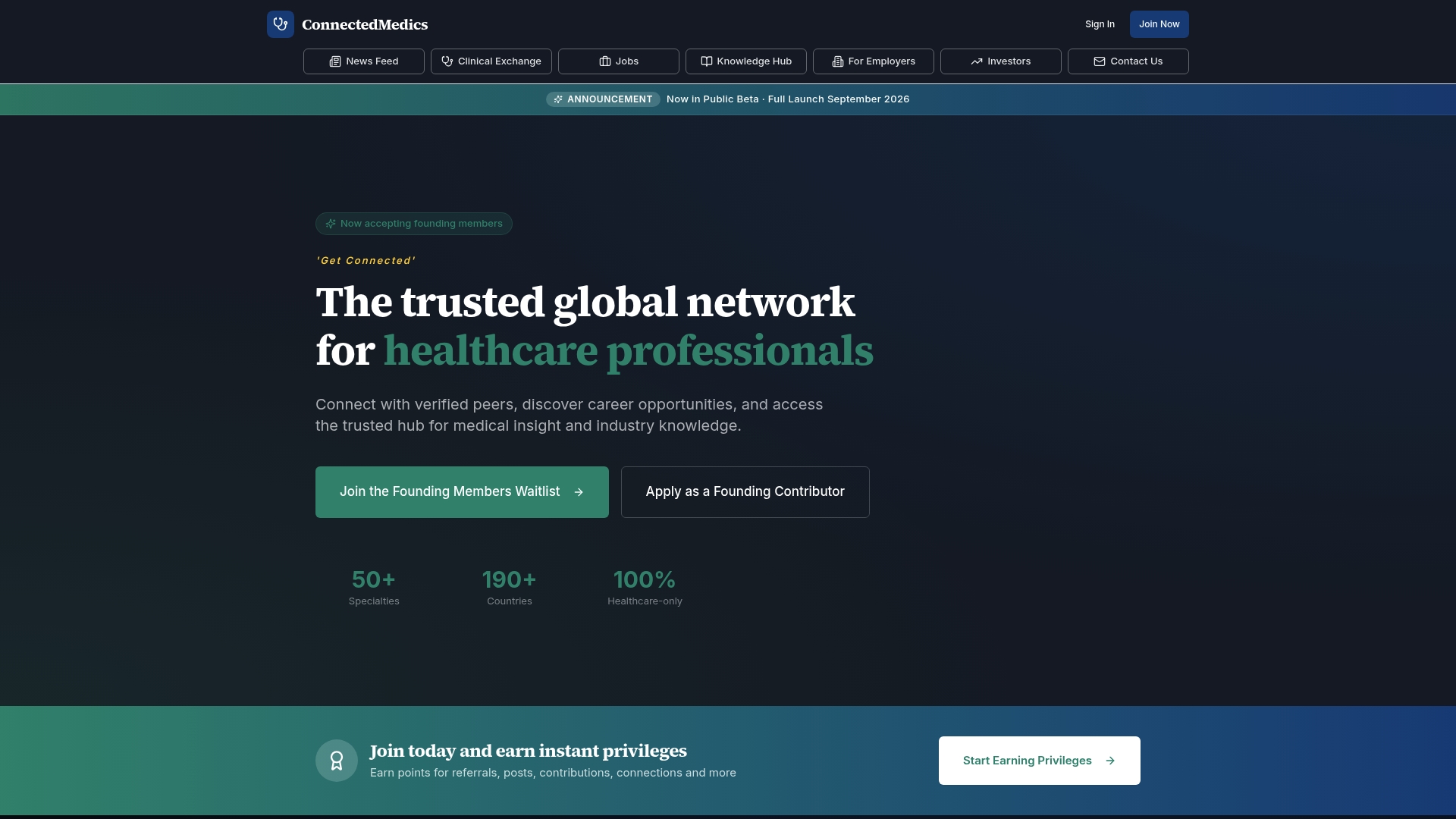
Recruiters get employer tools built for healthcare hiring specifically, not adapted from a generic applicant tracking system. Clinicians get a profile that verifies credentials once and surfaces it to every relevant specialty search after that.
- Recruiters: post a role through our employer plans and reach verified candidates filtered by specialty.
- Clinicians: build a verified profile and browse specialty-matched listings instead of sorting through unrelated postings.
- Teams scaling hiring: review Premium Employer features for expanded recruitment capacity.
Start with the employer hub to post a role or browse verified candidates today.
FAQ
What are the projected trends in the healthcare workforce for 2026?
Workforce trends for 2026 point to a persistent global shortfall alongside a shift in demand toward outpatient and home-based roles. The World Health Organization projects the global shortage reaching roughly 11.1 million workers by 2030, even as the overall health workforce stock exceeds 70 million.
What are the major health trends expected to be in 2026?
Care delivery continues moving from hospitals toward ambulatory clinics and home-based settings, driven by aging populations and chronic disease management needs. Clinician-led AI adoption, focused on reducing documentation and administrative burden rather than replacing clinical judgment, is expanding alongside this shift.
Which country has the best healthcare in the world in 2026?
No single authoritative 2026 ranking of "best" healthcare systems exists across the sources behind this article, and definitions of "best" vary widely by what is measured, access, outcomes, cost, or workforce density. Workforce reports like NHWA 2026 track distribution and density by region rather than ranking countries against each other.
What are the top 3 trends in the healthcare industry?
The three clearest 2026 trends are a persistent workforce shortfall despite growing total headcount, a shift in care delivery and job roles toward outpatient and home-based settings, and growing use of clinician-led AI tools to reduce administrative burden. Each trend connects directly to the others: the shift toward home-based care is part of why role-specific shortages persist even as the overall workforce grows.
What roles face the greatest healthcare staffing shortages in 2026?
Long-term care, home health, and behavioral health roles report the longest vacancy durations and the most acute shortages, based on patterns visible across Bureau of Labor Statistics projections and platform-level vacancy data. These roles align closely with the demographic and delivery-model shifts driving 2026 demand.
Sources
- National health workforce accounts: health workforce levels and trends 2026
- ILO — Global labour markets stable but strained (Employment and Social Trends 2026 summary)
- Bureau of Labor Statistics — Medical and health services managers