
The fastest path to a relevant opening is a specialty-filtered job board, not a general search engine. Set location and clinical-scope filters, save the search, and turn on alerts so new postings reach you first. Keep a tailored CV and license documents ready to attach. ConnectedMedics works as one verified marketplace where you can start that search today.
TL;DR:
- Using specialty-focused job boards and verified medical marketplaces speeds up the search and reduces time spent filtering irrelevant roles.
- Narrowing search filters to specific clinical scope, location, and nonnegotiables significantly improves the relevance and quality of job results.
- Customizing your CV for academic, community, or hospitalist roles increases your chances of standing out and passing initial screening.
- Reviewing contract details like call expectations, non-competes, and credentialing timelines is crucial before signing offers to avoid future conflicts.
- Building a verified profile on ConnectedMedics streamlines search efforts, offers accurate listings, and provides benchmarking tools for negotiations.
Table of Contents
- How do you run an effective family medicine jobs search?
- Job-search strategy: tactics to surface the right roles faster
- Which keywords narrow your search to the right roles?
- How should you tailor your CV for each role type?
- What should you check before signing a contract?
- How ConnectedMedics supports a faster, more precise search
- What separates fast applicants from stalled ones?
- Getting started on ConnectedMedics
- Sources
How do you run an effective family medicine jobs search?
Physicians waste hours scrolling generic job boards built for every industry at once. Family medicine roles vary too much (full spectrum, hospitalist, obstetrics, urgent care) for a keyword-blind search to work well. The fix is narrowing your sources first, then narrowing your filters.
Start with sources built for medicine, not general employment:
- Specialty job boards and physician marketplaces, including AAFP's Find A Job tool and verified platforms like ConnectedMedics
- Health system career pages, where hospitals and multi-site groups post openings directly, often with fuller compensation details than third-party boards
- Recruiter feeds and staffing agency lists, useful for volume but noisier and slower to filter
- Professional association listings, which sometimes surface academic or public-health roles that never reach commercial boards
Once you've picked your sources, filter aggressively. The AAFP recommends defining what you want from an employer before you search, not after. That means locking in a location radius or ZIP code range, choosing clinical scope (full-spectrum family medicine versus hospitalist-only versus outpatient), setting your target schedule or FTE, and flagging visa or relocation support if you need it.
Most physician boards, including AAFP's CareerLink-style filters, let you combine role type, visa assistance, and job function in a single query. That combination matters more than any single filter alone: a "family medicine" search without a location radius returns hundreds of irrelevant results, and a location search without clinical scope buries the roles that actually fit your practice style.
Save every search that returns decent results and turn on alerts immediately. A saved search with alerts means new postings land in your inbox the day they go live, often before a listing gets buried under recruiter spam. That speed matters: many well-matched roles get pulled from boards within a week or two of posting once a strong candidate applies.

Job-search strategy: tactics to surface the right roles faster
A scattershot search burns time on roles you'd never accept. Build a short list of nonnegotiables first, then let that list do the filtering for you.
- Write down three to five nonnegotiables before you search, such as call structure, EMR platform, panel size, or commute radius, and translate each one into a filter or keyword.
- Set alerts across two or three platforms, not just one, since coverage varies and a role posted on a health system's own page might never reach a general aggregator.
- Use simple email rules or a dedicated folder to triage incoming alerts by clinical scope, so full-spectrum roles and hospitalist roles never mix in the same inbox pile.
- Reach out directly when a posting is a strong fit, keeping the message to two or three sentences: who you are, your clinical focus, and why the role caught your attention.
- Follow up once, about a week later, if you haven't heard back, rather than repeatedly emailing the same recruiter or hiring manager.
This workflow does the sorting work up front instead of after you've already spent an evening reading fifty listings. For a broader breakdown of where physician searches typically go wrong, this guide on job-search friction points covers the most common time sinks.
Which keywords narrow your search to the right roles?
Generic terms like "family medicine physician" return too much noise. Specific keywords do the filtering that a location search alone can't.
The AAFP recommends searching with clinical-scope terms that match your actual interests rather than the broad job title:
- Full spectrum — for roles covering outpatient, inpatient, and often obstetrics
- Hospitalist — for inpatient-only positions without a clinic panel
- Family medicine with obstetrics — for roles that include deliveries
- Urgent care — for episodic, walk-in focused practice
- Sports medicine — for roles with a musculoskeletal or athletic focus
- Palliative care — for hospice-adjacent or comfort-care roles
- Academic family medicine — for teaching hospitals and residency programs
Pair those terms with your schedule and location needs in the search field. A string like "family medicine hospitalist part time [ZIP code]" or "full spectrum obstetrics [state] relocation assistance" filters out most irrelevant results in one pass. Add "no call" or "phone-only call" if that's a hard requirement, since some boards index those phrases directly from the job description text.
How should you tailor your CV for each role type?
The single CV you use for every application is the reason strong candidates get passed over. Academic programs and community practices read a CV for different signals entirely, and AMN Healthcare's CV guidance makes that distinction explicit: academic roles should lead with research and teaching, while community roles should lead with patient outcomes and panel management.
Keep two or three CV variants ready rather than editing one document under deadline pressure:
- Academic version — publications, teaching experience, and research first
- Community/outpatient version — panel size, quality metrics, and full-spectrum capabilities first
- Urgent care or hospitalist version — procedural volume and shift flexibility first
Alongside your CV variants, keep a standing checklist of documents so nothing delays an application: active licenses, board certification status, three professional references, letters of recommendation, and a clean malpractice history summary. Place any concrete metrics (patient satisfaction scores, panel size, quality measure performance) in the top third of the CV or in the opening line of your cover note. Hiring committees skim before they read closely, and the checklist approach outlined here walks through exactly what to have ready before you apply.
What should you check before signing a contract?
A strong salary number can hide a weak contract. Compensation model, productivity metrics, call expectations, benefits, CME allowance, malpractice coverage, and relocation terms all deserve scrutiny before you sign anything.
Some details get missed even by careful readers:
- Phone-only versus on-site call — a contract that says "call required" without specifying which type can mean very different lifestyles
- Non-compete wording — geographic radius and duration vary widely and can limit your next move
- Credentialing timelines — a start date tied to credentialing completion can slip by months if the employer is slow
- Productivity thresholds — bonus structures tied to RVUs or panel size should specify exactly how they're calculated
The ACP recommends seeking professional review, either legal counsel or a data-driven negotiation platform, before accepting an offer. Physicians commonly underestimate how much benchmarking data changes a negotiation; a contract that looks fair in isolation often isn't once compared against comparable postings that list actual pay ranges and benefits.
Pro Tip: Ask specifically for a "phone-only" call rotation paired with after-hours nurse triage. That single request, backed by clearly defined call credits, changes work-life balance more than almost any other line item in the contract.
How ConnectedMedics supports a faster, more precise search
ConnectedMedics builds its jobs board around verification rather than volume. Every clinician profile is verified, and the platform lists thousands of active healthcare vacancies filtered by specialty rather than mixed into a general job database.
That structure maps directly onto the search steps above:
- Specialty filters cut straight to full-spectrum, hospitalist, or urgent care roles without a generic keyword search
- Verified clinician profiles mean employers see accurate credentials up front, which speeds up early conversations
- Employer verification reduces the duplicate postings and low-quality recruiter outreach that waste hours on other boards
- A knowledge hub with clinical and career resources sits alongside the jobs board, so career research doesn't require leaving the platform
For a closer look at why verified marketplaces outperform general recruitment sites for physician searches specifically, this comparison breaks down the difference in match quality.
What separates fast applicants from stalled ones?
Have your CV variants ready before you need them. Set alerts, ask employers to define call terms precisely, and run every contract past a review resource before signing. The physicians who move fastest aren't the ones who search the most. They're the ones who were already prepared when the right posting appeared.
— David
Getting started on ConnectedMedics
ConnectedMedics gets you searching with verified employer information instead of guessing which postings are real. Set up a profile, upload your tailored CV, and let specialty and location alerts do the filtering that used to take hours of manual scrolling.
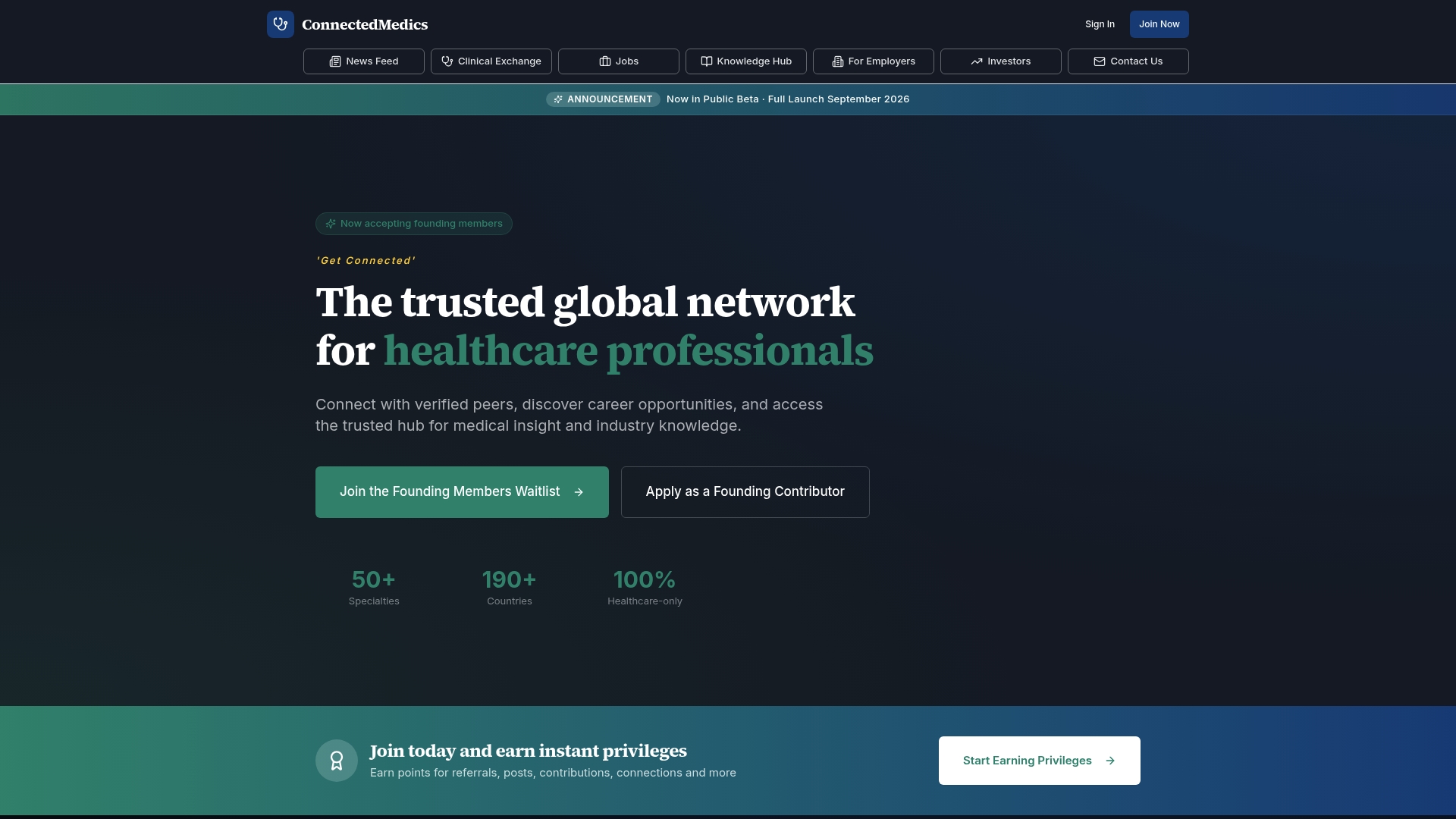
Creating a verified profile takes a few minutes: add your credentials, upload the CV variant that fits the roles you're targeting, and set alerts for your clinical scope and location radius. Because every listed employer on the platform is verified, you spend less time chasing postings that turn out to be duplicates or outdated recruiter listings. If compensation benchmarking matters to your next negotiation, the salary trends resource on the knowledge hub gives you comparison data before you talk numbers. Visit ConnectedMedics and set up your first alert today.
Sources
- Find A Job In Family Medicine | AAFP
- ACP physician contract review and compensation tools
- How to create a medical curriculum vitae (CV) | AMN Healthcare