
AI in healthcare recruitment now speeds screening, automates scheduling, and cuts credential-check time. Recruiters get faster shortlists, 24/7 candidate engagement, and better license/certification matching. The technology augments judgment on clinical fit and compliance, it doesn't replace human verification of credentials or final hiring decisions.
TL;DR:
- AI tools effectively speed up credential checks and candidate sourcing for high-volume roles with standardized licenses, like RNs and CNAs.
- Fast metrics such as time-to-shortlist and response rates improve within weeks, but measures like retention and satisfaction need a full hiring cycle.
- Proper pilot staging requires defining clear success criteria, ensuring system integration, and including human review to prevent bottlenecks.
- Bias often stems from training data reflecting narrow demographics, so regular impact testing and audit trails are essential for fairness.
- The most promising AI advances involve demand forecasting and real-time license verification, with explainability becoming a regulatory priority.
Table of Contents
- What AI Actually Does in Healthcare Recruitment
- What Metrics Actually Move (and When)
- How to Pilot AI Without Breaking Your Hiring Pipeline
- Risks, Bias, and Governance You Can't Skip
- Evidence That Backs the Claims
- How AI Changes the Candidate's Side of the Process
- Where AI Still Falls Short in Clinical Hiring
- Where AI Recruitment Is Headed Next
- Healthcare Organizations Already Seeing Results
- Author Perspective: Practical Priorities for Recruiters Piloting AI
- Where Connectedmedics Fits Into Your AI Pilot
- Sources
What AI Actually Does in Healthcare Recruitment
AI in healthcare recruitment breaks into five operational jobs, and each one solves a specific bottleneck recruiters already know by name.
Sourcing is the first. Clinicians, especially nurses, respiratory therapists, and rural physicians, often have thin LinkedIn footprints. AI sourcing tools pull from state license registries, specialty job boards, and SMS outreach channels that reach candidates who never touch a standard applicant funnel. Medical Economics reports that this kind of automation extends well past matching, into credentialing checks and demand forecasting.
Screening and ranking come next. Role-aware parsing tools treat licensure and board certification as hard filters, not optional keywords, so an unlicensed applicant never reaches a manager's desk. Scheduling agents then handle interview booking and reminder texts around the clock, which matters for shift workers who can't take recruiter calls during a hospital shift.
The remaining two jobs:
- Credential verification automation: cross-checks license numbers, expiration dates, and certification status against registries in minutes instead of days.
- Interview analysis: some platforms flag communication patterns or structured competency answers, though this remains the least mature use case and needs the heaviest human review.
- Explainable ranking: shows recruiters why a candidate scored where they did, rather than a black-box number.
Each function slots into an existing workflow step. None of them eliminate the recruiter, they compress the time between steps.
What Metrics Actually Move (and When)
Time-to-fill baselines give you a starting line. Medical Economics cites roughly 125 days to fill a primary care physician role and 59 to 109 days for experienced RNs. Those numbers matter because they show recruiters what "improvement" should be measured against, not an abstract industry average.
Statistic Callout: A 2004–2023 systematic review of AI in clinical trial recruitment found enrollment lifts of roughly 24% to 50% in oncology trials. That's trial recruitment, not clinical hiring, but it's the strongest peer-reviewed signal available for how much AI can move a recruitment funnel when applied correctly.
Two categories of metrics move at different speeds:
- Fast movers: screen-to-interview time, candidate response rate, and shortlist generation speed. These shift within the first two to four weeks of a pilot.
- Slow movers: quality of hire, 90-day retention, and hiring manager satisfaction. These need a full hiring cycle, often 60 to 90 days, before the data means anything.
Set your pilot baseline using your own last twelve months of time-to-fill data, not a national average. Then track the fast movers weekly and the slow movers quarterly.
How to Pilot AI Without Breaking Your Hiring Pipeline
Rolling out AI in healthcare recruitment works best as a staged pilot, not a platform swap. Here's the order that avoids the most common failure points.
- Define success metrics and non-negotiables first. Decide which checks are absolute, active RN license, current BLS certification, before you decide which tool checks them.
- Audit your ATS and HRIS integration points. AI tools are only as good as the data feeding them. Confirm your applicant tracking system can pass structured fields (license number, specialty, shift availability) to whatever tool you pilot.
- Choose a pilot role with high volume and simple credentialing. RN and CNA roles work well because licensure checks are standardized and applicant volume is high enough to generate real data fast.
- Set a measurement window. Thirty days for fast metrics, one full quarter for retention and manager satisfaction.
- Staff the human review stage before you launch. This is the step recruiters skip, and it's the one that causes the most damage.
- Build a feedback loop. Track false positives (good candidates the AI screened out) and false negatives (weak candidates it advanced) weekly, and feed corrections back into the scoring criteria.
Pro Tip: Run your pilot on a role you already have a hiring manager who checks candidate quality closely for. Their pushback is free quality control you won't get from a metrics dashboard.
One lesson from outside healthcare applies directly here. Adecco's experience rebuilding recruiting around AI agents showed that automating pre-screening can produce more qualified candidates faster than your team can process them. If you don't staff the downstream review step, faster sourcing just creates a bigger backlog. For a deeper walkthrough of screening mechanics specifically, see this practical playbook on AI resume screening for healthcare recruiters.
Risks, Bias, and Governance You Can't Skip
Bias in AI hiring tools usually enters through training data, not intentional design. If a model learns from five years of hires at a hospital system with a narrow demographic pattern, it can encode that pattern as a "good candidate" signal, even when the actual predictor is something unrelated like zip code acting as a proxy for other characteristics.
A 2026 systematic review of AI in recruitment and personnel selection frames this as a strategic-level risk, not just an operational glitch, and argues that bias and ethics management has to happen at the adoption stage, not after a complaint surfaces.
Practical controls that hold up under scrutiny:
- Run a disparate impact test on any tool's shortlist output before full rollout, comparing pass rates across demographic groups.
- Keep an audit trail of every ranking decision and the factors behind it, this supports both internal review and EEOC compliance documentation.
- Get explicit candidate consent for AI-assisted processing of application data, stated plainly, not buried in boilerplate.
- Stage your rollout with rate limits so a sudden spike in AI-sourced applicants doesn't overload the human reviewers checking them.
Evidence That Backs the Claims
The strongest peer-reviewed data point still comes from oncology trial recruitment, where AI-assisted methods lifted enrollment by 24% to 50% across studies from 2004 to 2023. That's a different funnel than staff hiring, but it's the clearest evidence that structured AI matching changes recruitment outcomes when the criteria are well defined.
Cleveland Clinic's coverage of AI in recruiting and sourcing adds a practitioner-level caution: recruiters have to actively shape and govern these tools, not just switch them on and walk away.
The platform currently lists a large number of active healthcare vacancies and publishes recruitment resources written by verified clinicians rather than anonymous contributors. That combination, real vacancy volume plus clinician-authored content, gives recruiters:
- A live view of specialty-level demand across the platform
- Credentialing context written by people who hold the credentials themselves
- A comparison point for whether your own pilot's applicant flow looks typical for your specialty
How AI Changes the Candidate's Side of the Process
Candidate experience often gets treated as a recruiter-side afterthought, but it's where AI adoption succeeds or fails fastest.
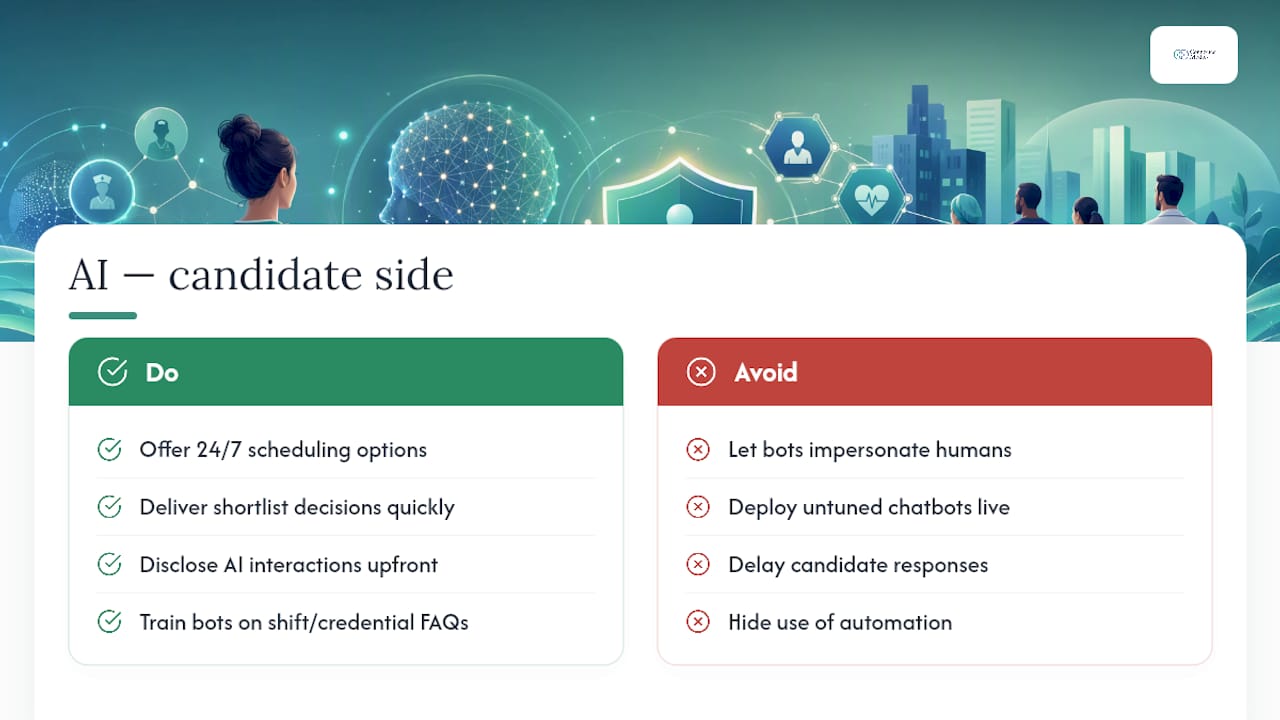
Nurses and physicians working rotating shifts rarely get to answer a recruiter's call during business hours. A 24/7 engagement agent that can schedule an interview at 2 a.m. after a night shift removes a real friction point, not a cosmetic one. Faster response times also change how candidates perceive an employer: a shortlist decision in three days instead of three weeks signals an organization that respects a clinician's time.
The risk runs the other direction too. A poorly tuned chatbot that can't answer basic questions about shift structure or credentialing requirements frustrates candidates faster than a slow human process would. Clinicians talk to each other, often within the same specialty community, and a bad automated experience travels through professional networks quickly.
Transparency matters more in healthcare hiring than in most industries. Candidates increasingly expect to know when they're interacting with an AI screening tool versus a person, and organizations that disclose this upfront tend to see better completion rates on application steps. Hiding the automation, or letting a bot pretend to be human, tends to backfire once candidates figure it out, and in a tight-knit clinical community, they usually do.
Where AI Still Falls Short in Clinical Hiring
AI in healthcare recruitment has real limits, and pretending otherwise sets up a pilot for failure.
Interview analysis tools remain the least mature function on the list. Reading tone, hesitation, or communication style through an algorithm works better for scripted competency answers than for the nuanced judgment calls that come up in a real clinical interview about handling a difficult patient interaction.
Credential verification automation depends entirely on the quality and currency of the registries it queries. A license database that lags behind actual renewal dates by even a few weeks can produce false negatives, flagging a currently licensed nurse as expired.
Generic, non-healthcare AI recruiting tools consistently underperform here because they're built around the assumption that candidates maintain active LinkedIn profiles. Many clinicians don't. A tool that can't query state license lookups, specialty board directories, or shift-aware SMS channels will miss a meaningful share of qualified candidates before screening even starts.
There's also a data quality ceiling. AI ranking is only as good as the structured data your ATS actually captures. If your system doesn't record specialty certifications in a searchable field, no amount of AI sophistication fixes that gap, the model simply can't rank what it can't see.
Where AI Recruitment Is Headed Next
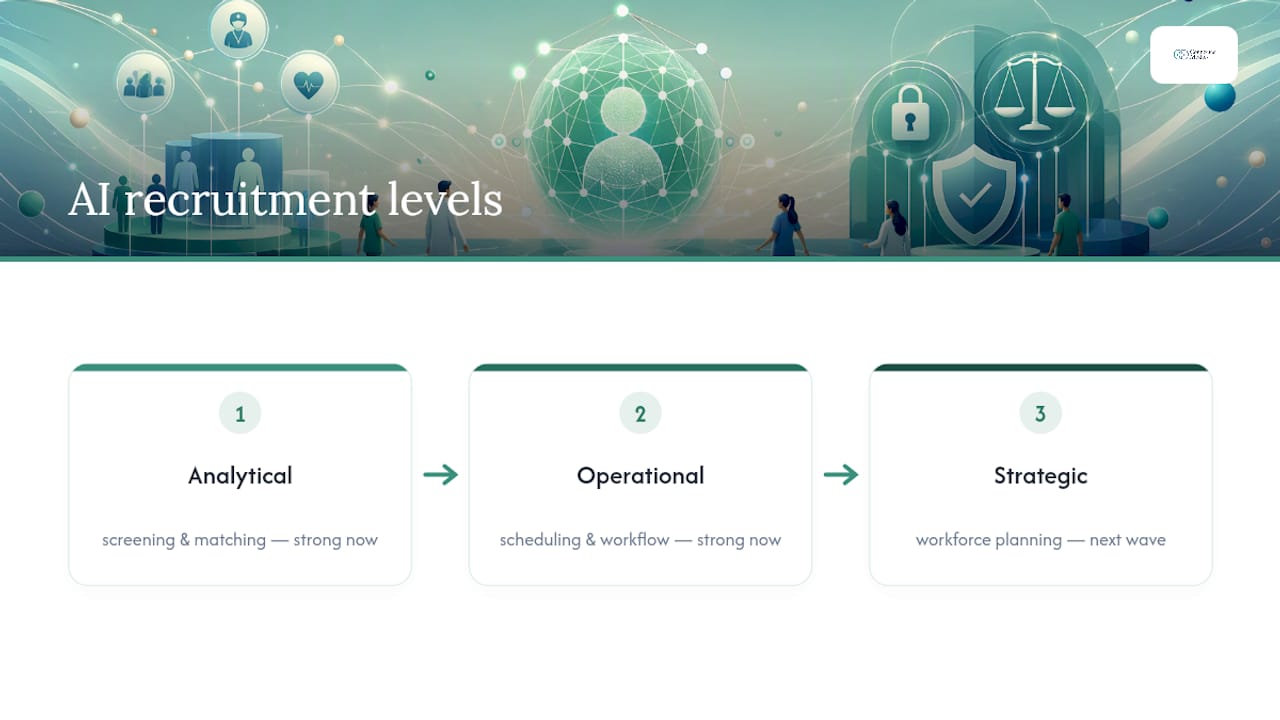
The 2026 systematic review on AI in recruitment frames the technology's trajectory across three levels: analytical (screening and matching), operational (scheduling and workflow), and strategic (workforce planning and demand forecasting). Healthcare recruitment is currently strongest at the analytical and operational levels, and strategic use is where the next wave of adoption is heading.
Demand forecasting tools that predict specialty shortages six to twelve months out, rather than reacting to open Rees after the fact, represent one of the clearer near-term shifts. Instead of scrambling to fill an ICU nursing gap, a health system could see the shortage forming based on retirement patterns, local population health data, and historical turnover.
Credential verification is also moving toward real-time registry integration rather than periodic batch checks, which would shrink the gap between a license renewal and a system reflecting it. Expect more platforms to combine license databases directly into ranking logic instead of treating verification as a separate downstream step.
The bigger shift, though, is toward explainability as a baseline requirement rather than a differentiator. As EEOC scrutiny of algorithmic hiring tools increases, recruiters will need vendors who can show their work, not just a ranked list. Tools that can't produce an audit trail explaining a ranking decision will face growing pressure from compliance teams, regardless of how accurate their matching claims to be.
Healthcare Organizations Already Seeing Results
Trade coverage from Medical Economics documents health systems using AI to compress the gap between application and first interview, particularly for high-volume roles like RN and medical assistant positions where credentialing criteria are standardized enough for a model to apply consistently.
The oncology trial recruitment data offers the clearest quantified case study available, even though it measures a different funnel than staff hiring. Enrollment gains of 24% to 50% across studies from 2004 to 2023 show what happens when AI-assisted matching is applied to a well-defined set of criteria, in that case, trial eligibility requirements. The same principle transfers to staff recruitment: the clearer and more codified your role criteria, the more reliably AI can act on them.
Cleveland Clinic's own analysis of AI in recruiting and sourcing reinforces this pattern from inside a major health system, noting that the organizations getting real value are the ones treating AI as a tool that requires active oversight rather than a set-and-forget system. The recruiters who succeed with these tools are the ones who keep tuning them, not the ones who deploy once and walk away.
Author Perspective: Practical Priorities for Recruiters Piloting AI
Start where the win is measurable. RN and CNA roles have standardized licensure checks, which means an AI tool's accuracy is easy to verify against a clear yes/no credential. Physician roles carry more ambiguity, save those for after your team trusts the system.
Staff the human review step before launch, not after candidates start piling up. That single decision determines whether your pilot looks like a success or a mess in month one.
Measure early and often, but don't optimize only for speed. A tool that hands you 200 shortlisted candidates in half the time isn't useful if hiring managers reject 80% of them. Track retention and manager satisfaction alongside time-to-shortlist, and demand explainability from any vendor before you scale past a pilot.
— David
Where Connectedmedics Fits Into Your AI Pilot
Connectedmedics gives recruiters a faster route to qualified, verified clinicians than building a sourcing pipeline from scratch. Instead of chasing candidates across LinkedIn, where most nurses and specialists barely show up, you're working from profiles Connectedmedics has already verified against credentials.
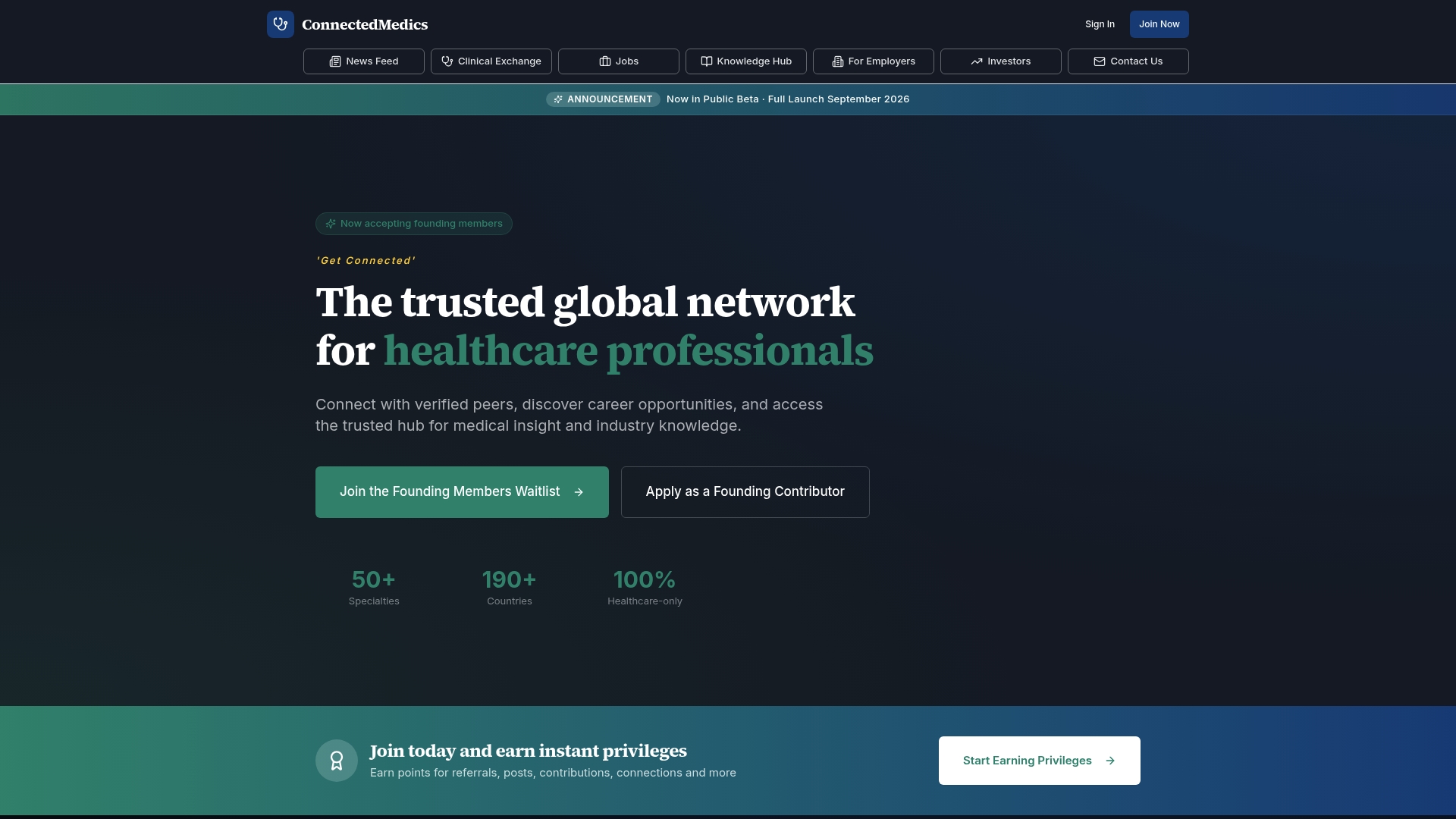
The platform's jobs board for recruiters puts your open roles in front of clinicians actively browsing specialty-specific listings, not a general applicant pool sorted by algorithm guesswork. Employers use the employer tools to post roles, filter by specialty, and pull candidate matches without rebuilding their ATS integration from the ground up. Pair that sourcing with the AI-driven adoption checklist covered above: pick a high-volume role, define your non-negotiable credential checks, and run a 30-day measurement window using Connectedmedics as your sourcing channel.
If you're ready to test this on your next open req, start with Connectedmedics and post your first role to see how verified candidate flow compares to your current pipeline.
Sources
- PMCID article on AI in clinical trial recruitment (2004–2023)
- How AI is streamlining health care recruitment — Medical Economics
- Artificial Intelligence: The Future of Recruiting and Sourcing? — Cleveland Clinic
- Systematic review of AI in recruitment and personnel selection — Springer (2026)