
Sourcing passive clinicians means combining specialty-level market mapping with relationship-first outreach, not job postings. Verified networks like ConnectedMedics, which list healthcare vacancies, give recruiters a base of credentialed professionals to map before outreach even starts. Expect a real pipeline, not instant hires. Most passive sourcing programs need weeks to months before conversations turn into candidates.
TL;DR:
- Sourcing passive clinicians requires mapping verified networks and specialty channels rather than relying on job postings, which can take weeks to months to yield candidates.
- Specialty communities, licensure directories, alumni groups, and referral networks outperform general job boards in surface high-quality, engaged clinicians who are not actively searching.
- Building a detailed, prioritized roster involves defining specific roles, mapping affiliations, and scoring prospects based on mobility and connection likelihood.
- Relationship-first outreach should focus on peer-level engagement and casual invitations, with follow-ups spaced out over weeks to nurture candidates effectively.
- Using verified, healthcare-specific platforms like ConnectedMedics streamlines market mapping, credential checking, and outreach, improving sourcing reliability and compliance.
Table of Contents
- Which Channels Actually Surface Passive Clinicians?
- How Do You Map the Market and Prioritize Prospects?
- What Does Relationship-First Outreach Look Like?
- How Do You Turn Outreach Into a Usable Pipeline?
- Does a 30-Day Sprint Prove Passive Sourcing Works?
- How Do You Read a Clinician's Career Motivation From the Outside?
- How Do You Build Trust Beyond the First Message?
- How Does Employer Branding Attract Clinicians Who Aren't Looking?
- Can AI and Analytics Find Clinicians Traditional Sourcing Misses?
- What Privacy Rules Apply Specifically to Clinician Sourcing?
- Why Should Recruiters Loop In Clinical Leadership Early?
- What Relationship-First Sourcing Looks Like in Practice
- How ConnectedMedics Helps You Reach Verified, Passive Clinicians
- Sources
- FAQ
Which Channels Actually Surface Passive Clinicians?
Job boards catch clinicians who are already looking. Passive clinicians, by definition, aren't there. A large share of qualified physicians across most specialties are not actively job searching at any given moment, and industry playbooks note that many in-demand candidates never see a posting-driven campaign at all. Recruiters who wait for applications are fishing in an empty pond.
Four channel types consistently outperform generic postings:
- Specialty communities and verified networks. Clinicians who moderate discussions, publish case notes, or answer peer questions on platforms built for healthcare are showing engagement signals a resume never captures.
- Licensure boards and association directories. State licensing boards and specialty associations confirm active practice status, which filters out lapsed or retired professionals before you spend outreach effort.
- Referral programs, alumni groups, and conference rosters. A current staff member's residency cohort or fellowship alumni list often produces warmer introductions than any cold channel.
- Enrichment tools and opt-in databases. These fill contact gaps fast but should always get cross-checked against licensure or association records before you send a single message, since stale contact lists are a common failure point.
Specialty-focused networks and licensure sources tend to produce higher-quality signals than mass-market platforms, simply because the people on them chose to be there professionally, not to job hunt.
How Do You Map the Market and Prioritize Prospects?
Passive sourcing collapses without a defined roster. Vague targets ("RNs," "physicians") produce vague results. A workable process runs in four steps.
- Define the role at the unit and specialty level. "ICU RN with ventilator management experience at a Level II trauma center" gives you something searchable. "RN" does not.
- Build the roster from affiliations and pipelines. Pull current hospital affiliations, residency and fellowship pipelines, and recent hires at comparable facilities to assemble a specialty-specific list.
- Segment by movement likelihood. Career stage, call burden, and geographic ties (a spouse's job, aging parents nearby, a mortgage) all predict how open someone is to a conversation.
- Score and prioritize. A workable scoring model weights career stage at 30%, referral connectivity at 30%, geographic ties at 20%, and recent role change signals at 20%, giving you a ranked list instead of a flat spreadsheet.
Active job seekers make up roughly 15 to 20% of the qualified talent pool in most healthcare specialties.
What Does Relationship-First Outreach Look Like?
A passive clinician who opens an email expecting a job pitch closes it fast. Lead with something peer-level instead: a shared interest in a clinical approach, a mutual connection, or an invitation to something low-stakes. Save the job description for later.
Effective first touches follow a pattern:
- Personal email from a real, identifiable sender. No generic "Talent Acquisition Team" address. A name and a direct reason for reaching out.
- Peer introductions. A current staff member reaching out carries more credibility than any recruiter cold email.
- Low-commitment invitations. A casual Q&A session or informal roundtable asks for far less than a screening call.
- LinkedIn as verification, not outreach. Use it to confirm someone's current role and tenure, not as a cold-apply channel.
Follow-up should stay light. Space messages over several weeks, ask small questions rather than pushing for a call, and log every response in your system. Peer-driven, personal messaging consistently outperforms automated mass email, which clinicians tend to recognize and ignore within seconds.
Compliance isn't optional at any volume. Email outreach falls under CAN-SPAM, which means accurate sender information and a working opt-out on every message. Calls and text messages carry TCPA exposure, so consent matters before dialing or texting — get it, or stick to consent-safe channels like email and professional network messaging. Honor every opt-out immediately, without exception.
Pro Tip: Send your first message on a Tuesday or Wednesday morning. Clinicians clear their inbox after a shift; weekend and Monday messages get buried fastest.
How Do You Turn Outreach Into a Usable Pipeline?
A passive candidate who says "not right now" isn't a dead lead. They're a future hire if your system remembers why they said no.
- Enrich every record as you go. Add practice context, current affiliation, and any signal of recent mobility, like a new certification or a department change.
- Tag consistently. A simple taxonomy works: specialty, readiness (now, 6 months, 12 months), reason for the delay, and referral source.
- Nurture on a light cadence. Quarterly touches, mixed with brief market updates, culture stories, or event invites, keep you visible without feeling pushy.
- Decide when to test formally. If a specialty has stalled for months, that's the signal to run a short sourcing sprint rather than keep guessing.
An ATS or CRM built around this tagging structure turns a pile of "maybe later" contacts into a searchable bench you can draw from months down the line.
Does a 30-Day Sprint Prove Passive Sourcing Works?
Four weeks is enough to know if a specialty responds to passive sourcing. Structured sprints follow a clear rhythm: pull your list in week one, launch outreach in week two, review replies and adjust messaging in week three, and make a scale-or-stop decision in week four.
Track four numbers throughout: reply rate, the rate at which replies convert to exploratory calls, how long it takes leads to move through the pipeline, and your cost per passive hire compared to active-channel hiring.
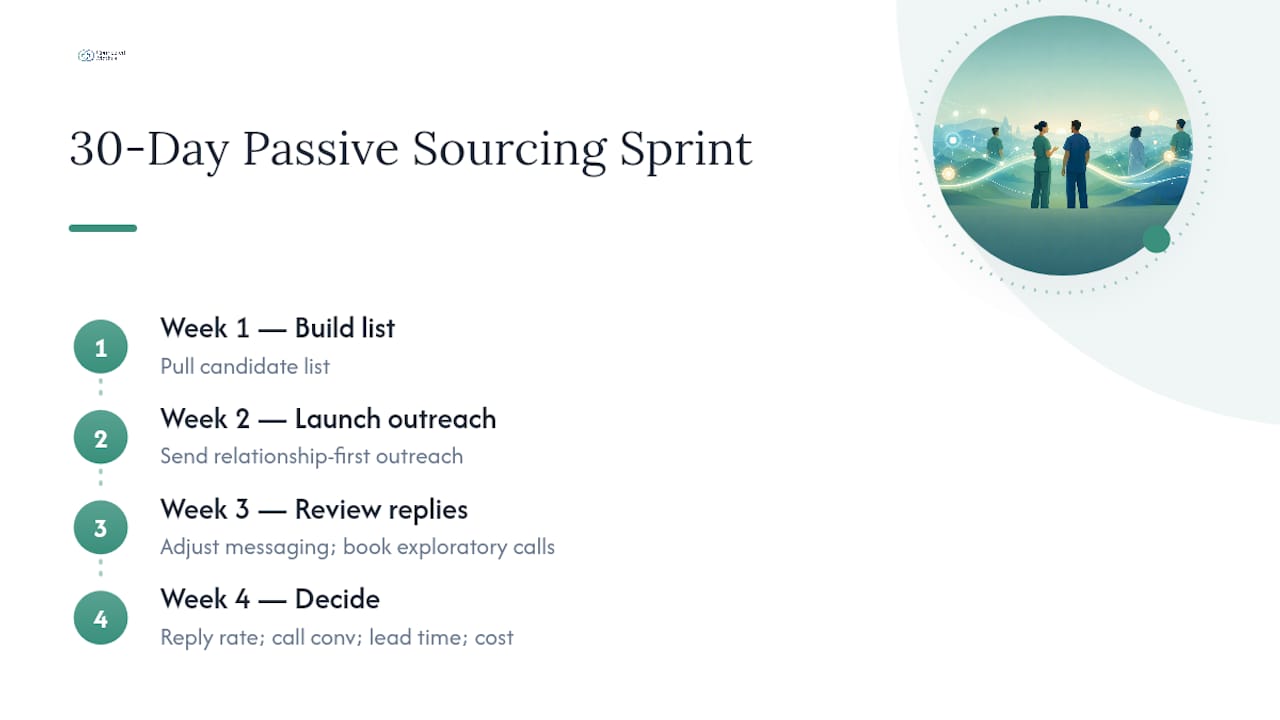
A repeatable reply rate paired with genuinely substantive exploratory conversations is your green light to scale. If a specialty consistently underperforms after one honest sprint, that's often the moment to bring in agency support rather than keep running the same playbook solo.
How Do You Read a Clinician's Career Motivation From the Outside?
Compensation rarely tells the whole story. Clinicians who've hit ten years in the same unit without a title change, a schedule shift, or new clinical exposure are often quietly ready for something new, even if their profile shows no activity.
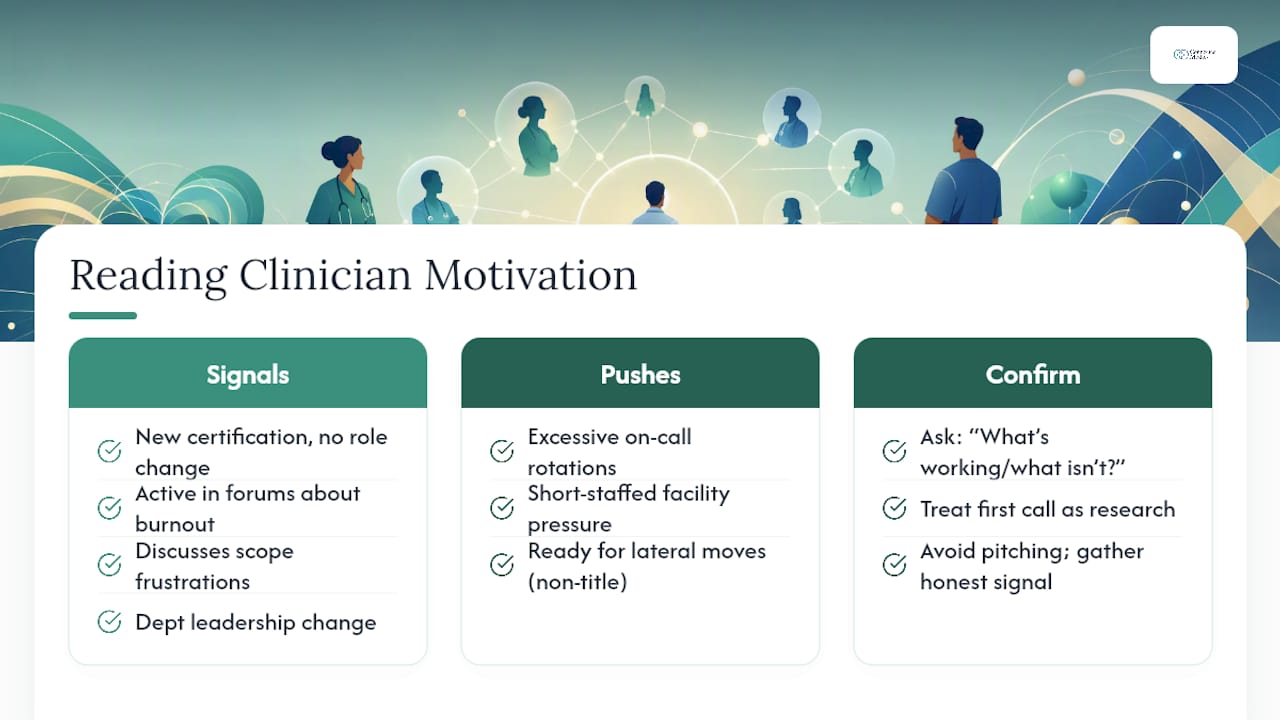
Watch for indirect signals: someone who recently completed a new certification but hasn't moved roles, a clinician active in specialty forums discussing burnout or scope-of-practice frustrations, or a staff member whose department just underwent a leadership change. None of these are job-search signals in the traditional sense, but they're career-driver signals.
Call burden matters more than most recruiters credit. A clinician working excessive on-call rotations at a short-staffed facility is often more open to a lateral move than someone with an easier schedule, even at similar pay. Geographic ties cut the other way: someone with kids in a specific school district or aging parents nearby needs a stronger reason to move, usually tied to lifestyle rather than money.
The best read comes from asking, not guessing. A casual conversation that opens with "what's working and what isn't at your current role" gathers more real signal than any data point scraped from a profile. Recruiters who treat the first conversation as research, not a pitch, get more honest answers and better long-term matches.
How Do You Build Trust Beyond the First Message?
One good email doesn't build a relationship. Clinicians remember whether a recruiter followed up with something useful or just disappeared after the first "not interested."
Consistency beats intensity. A quarterly check-in with a genuinely relevant update, a new opening in their subspecialty, a shift in local market pay, or an interesting case study, keeps you present without pressure. Clinicians who feel remembered as people, not leads, are far more likely to respond when their circumstances actually change.
Transparency about timelines matters just as much. If a role doesn't open for six months, say so. Clinicians who get vague, overly optimistic timelines from recruiters lose trust fast, and healthcare is a small enough world that reputation travels between colleagues quickly.
Small gestures compound. Congratulating a clinician on a certification, sharing a relevant clinical article, or simply remembering a detail from a prior conversation signals attention most recruiters skip. Passive candidates aren't comparing you to other recruiters in the moment. They're comparing you to the last recruiter who ghosted them after a single unanswered email, and that bar is lower than most people think.
How Does Employer Branding Attract Clinicians Who Aren't Looking?
Passive clinicians never see your job description until they're already curious about your organization. That curiosity comes from employer brand, not job ads.
A clear Employee Value Proposition answers one question before anyone asks it: why would a clinician who already has a stable job choose this organization instead? Culture, clinical autonomy, staffing ratios, and support for continuing education tend to matter more than base salary once a clinician is comfortable enough to consider leaving. Vague mission statements don't move anyone. Specific claims do.
Content that shows rather than tells works best: a short piece on how your unit handled a staffing challenge, a look at your CME support policy, or a note on nurse-to-patient ratios compared to regional norms. This is exactly the kind of material that also needs to be findable when a clinician researches your organization after a first conversation, which is where healthcare-specific search visibility becomes part of the sourcing funnel, not just a marketing afterthought.
Consistency across channels matters too. A clinician who sees one message on your careers page and a different tone in a recruiter's email notices the mismatch immediately, and it costs credibility you can't easily rebuild.
Can AI and Analytics Find Clinicians Traditional Sourcing Misses?
Licensure records and directories confirm who's practicing. They don't reveal who's ready to move. That gap is where analytics tools add real value beyond traditional sourcing.
Predictive scoring models, like the career-stage and connectivity weighting described earlier, can be automated across an entire specialty roster instead of calculated one profile at a time. Natural language tools can also scan public clinical discussion content for burnout or dissatisfaction language, flagging candidates worth a closer look without requiring manual review of every post.
The caution here matters as much as the capability. AI-driven sourcing tools are only as reliable as the underlying data, and unverified enrichment data produces false positives fast, wasting outreach effort on clinicians who moved jobs a year ago or never existed in that role at all. Pairing AI-flagged signals with a verified network, rather than treating either alone as sufficient, produces the most reliable shortlist.
What Privacy Rules Apply Specifically to Clinician Sourcing?
General outreach compliance covers email and calling rules. Clinician sourcing carries an extra layer most recruiters underestimate: the data itself is often more sensitive than a typical B2B contact list.
Licensure and credentialing records are public in most states, but scraping them at scale and combining them with other data sources to build a detailed profile edges toward practices that privacy-conscious clinicians notice and resent. Transparency about how you obtained someone's contact information, when asked, builds more trust than pretending the outreach was random.
Health system affiliations sometimes carry their own confidentiality expectations, particularly around active staff who haven't disclosed a job search to their current employer. Discretion isn't just a courtesy; it protects the clinician from workplace friction if a colleague or supervisor discovers the conversation prematurely. Never reference a clinician's employer by name in outreach in a way that could be forwarded or screenshotted carelessly.
Data retention deserves the same scrutiny. A "not now" response should update your record, not disappear into an inactive database indefinitely. Keeping stale, unconsented contact data longer than necessary increases both compliance exposure and the odds of reaching someone who's since changed roles entirely.
Why Should Recruiters Loop In Clinical Leadership Early?
Recruiters who source in isolation from clinical leadership miss half the signal. Department heads and charge nurses know who's frustrated, who's thriving, and who's quietly counting down to retirement long before any of that shows up in outreach data.
A short monthly sync between recruiting and clinical leadership surfaces useful intelligence: which units are experiencing turnover pressure, which specialties are about to lose senior staff to retirement, and which current employees might know someone in their old training cohort worth a warm introduction.
Clinical leaders also sharpen your role definitions. A recruiter guessing at what "strong ICU experience" means produces a vague search. A nurse manager describing the exact skill gaps on their unit produces a precise, specialty-level target that outreach can actually be built around.
This collaboration works both directions. Recruiters who share market intelligence, like regional pay trends or competitor staffing moves, give clinical leadership a clearer picture of retention risk before it becomes a resignation. Sourcing effectiveness improves fastest when it stops being a recruiting-only function and becomes a shared responsibility between the two groups.
What Relationship-First Sourcing Looks Like in Practice
Verified networks matter because patient care doesn't tolerate a bad hire discovered too late. A credential mismatch or a lapsed license found after onboarding costs far more than the time spent verifying it upfront.
One pattern shows up repeatedly: a clinician ignores a job posting entirely but responds within days to a peer asking a genuine clinical question. That's not luck. It's the difference between being sourced and being recruited. Passive sourcing done well protects staffing continuity in the specialties that can least afford a vacancy, and it shortens time-to-fill precisely because the relationship existed before the opening did.
— David
How ConnectedMedics Helps You Reach Verified, Passive Clinicians
Building the kind of specialty roster this guide describes takes hours of manual cross-referencing on generalist platforms never built for healthcare. ConnectedMedics is built specifically for that job: verified clinician profiles, specialty-level filters, and employer tools designed for posting roles and running outreach without leaving the platform.
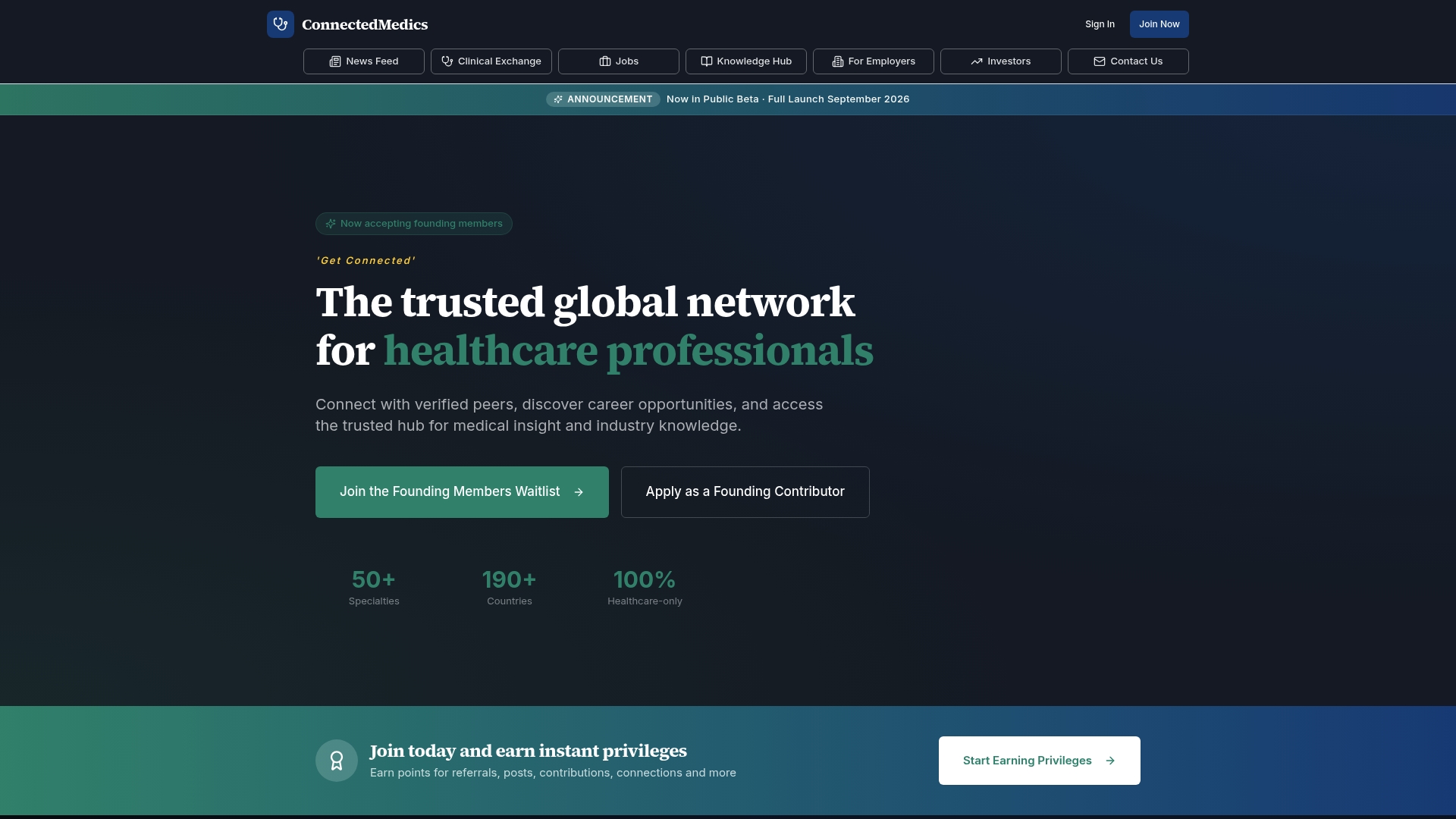
The platform lists healthcare vacancies alongside a base of credential-checked professionals, which means the market mapping step from earlier in this guide starts with verified data instead of scraped guesses. Recruiters can filter by specialty, review verified credentials before a single message goes out, and reach clinicians who are already engaged with a healthcare-specific network rather than scrolling a generalist job board.
The Growth plan runs $99 per month and includes access to these employer tools; Enterprise and Premium Employer options are available for teams sourcing at higher volume, with pricing available on request. Visit the employer page to compare plans and start building your specialty roster.
Sources
- The 2026 Playbook for Passive Healthcare Recruiting | Alpha Sophia
- Building a physician pipeline that keeps care open - Optigy Group
- How to Source Passive Nurse Candidates: The 80% Nobody’s Emailing (2026) | NurseSend
- 6 Proven Strategies for Engaging Passive Healthcare Candidates During the Holidays | Rave Health
FAQ
What Does "Sourcing Passive Clinicians" Mean?
It means identifying and engaging healthcare professionals who are currently employed and not actively applying to jobs, using market mapping and relationship-first outreach rather than job postings. Roughly 80 to 85% of the qualified clinician pool falls into this passive category at any given time.
How Long Does Passive Clinician Sourcing Take?
Expect weeks to months from first contact to hire, not days. A 30-day sprint can validate whether a specialty responds to outreach, but converting replies into actual hires typically takes longer.
Which Channels Work Best for Reaching Passive Clinicians?
Specialty communities, licensure directories, alumni networks, and clinician referral programs consistently outperform generic job boards for this audience. Verified professional networks tend to produce higher-quality contact signals than public enrichment tools used alone.
Is Cold Email Effective for Sourcing Clinicians?
Generic, automated mass email underperforms significantly compared to personal, peer-driven outreach. Relationship-first messaging that leads with a genuine reason for contact gets meaningfully higher reply rates.
What Does ConnectedMedics Cost for Employer Recruiting Tools?
The Growth plan costs $99 per month and includes access to employer recruiting tools on ConnectedMedics. Enterprise and Premium Employer pricing is available on request through the employer page.