
If you have room for a few hours a week, put them toward three lanes: expert witness and medico-legal consulting for the best pay per hour, locum tenens or telemedicine for dependable cash you can start collecting fast, and content or ownership plays for slower but scalable upside. Before you accept any clinical side work, read your employment contract and confirm your malpractice policy actually covers outside activities. That single check prevents the most common and most expensive mistake in this space.
The stakes are real enough to make the homework worthwhile. Nearly 39% of physicians already do some form of side work, and the split runs higher among men (42%) than women (34%). That is not a fringe behavior. It is close to two in five of your colleagues, and the reasons range from paying down loans faster to building a life outside the hospital that does not depend entirely on one employer.
- Best $/hour: expert witness and medico-legal review
- Best fast, predictable cash: locum tenens and telemedicine shifts
- Best long-term scalable upside: content, education, and ownership stakes
- Do this first: verify your malpractice coverage and contract terms before saying yes to anything
Key Takeaways
Physicians who prioritize expertise-priced lanes like expert witness work over time-priced clinical moonlighting build higher effective hourly income with less schedule strain.
| Point | Details |
|---|---|
| Rank by effective $/hour | Expert witness and consulting often beat locums once admin time and taxes are factored in. |
| Verify coverage first | Confirm your malpractice policy and employment contract permit the specific side work before starting. |
| Start with two lanes | Pair one expertise-priced gig with one fast-cash clinical gig for balance in the first 90 days. |
| Form an entity at scale | Consider an LLC or S-Corp once side income passes $10,000 to $15,000 a year. |
| Use a verified network | ConnectedMedics offers verified profiles and specialty job alerts to surface credible gigs faster. |
Table of Contents
- Physician Side Gigs by Category and Who They Fit
- What Physician Side Gigs Actually Pay Per Hour
- How to Choose the Right Side Gig for Your Situation
- Getting Started: Your First 90 Days
- Why a Verified Physician Network Changes the Math
- The Gap Between Side Gig Advice and Side Gig Reality
- Find Vetted Physician Side Gigs Faster
- Sources
Physician Side Gigs by Category and Who They Fit
Not every lane suits every specialty or schedule, and matching the right one to your situation matters more than chasing whatever a colleague mentioned in the break room.
- Clinical-adjacent work (locums, telemedicine, moonlighting). This is the most familiar lane because it uses your existing license and skills directly. Locum tenens agencies and telehealth platforms actively recruit across most specialties, and access is relatively easy if your license and credentials are current.
- Legal and expert witness work. This requires board certification, a clean CV, and usually five or more years of clinical experience before attorneys take you seriously. Referrals come through legal networks, expert witness directories, or word of mouth after your first few cases go well.
- Industry consulting and advisory boards. Pharmaceutical and device companies pay physicians to weigh in on clinical trial design, product usability, and market strategy. These opportunities tend to find specialists with a public track record, whether through publications, speaking, or a well-maintained professional profile.
- Content, education, and medical writing. This includes writing for medical education companies, building a YouTube channel, or authoring CME content. Early pay is often modest and audience-building takes months, but the ceiling is higher than almost any hourly lane once you have a following.
- Ownership plays. Investing in a surgery center, urgent care franchise, or medical spa demands capital and a longer timeline, often years before meaningful returns, but it is the only lane on this list with real equity upside.
- Low-yield activities. Paid surveys and market research panels are easy to start but rarely add up. They fill small gaps in a slow week, not a real income strategy.
What Physician Side Gigs Actually Pay Per Hour
Headline pay is misleading unless you convert it to an effective hourly rate. That means subtracting the unpaid admin time, factoring in taxes, and counting the hours it took to set the gig up in the first place, not just the hours you billed.
Take expert witness work as an example. A record review at $500 an hour sounds great until you add two unpaid hours drafting the report and preparing exhibits. Your real rate on that engagement drops closer to $350 an hour, still excellent, but worth knowing before you quote a flat fee to an attorney.
| Category | Typical hourly range | Time to start earning |
|---|---|---|
| Expert witness / IME | $300 to $800+ per hour for review and depositions | Months (needs CV, referral path) |
| Locums / telemedicine | Standard clinical rates, paid predictably | Weeks (credentialing dependent) |
| Industry consulting | Varies widely by engagement and specialty | Months (reputation dependent) |
| Content / medical writing | Low per hour early, compounds over time | Months to years |
Medico-legal work sits at the top of the pay scale for a reason: record review commonly runs $300 to $600 an hour, depositions run $400 to $800, and trial testimony day rates climb well past that. Physicians putting in 5 to 10 hours a week across side gigs generally land $2,000 to $8,000 a month, depending heavily on which lane they picked and how established they already are in it.
How to Choose the Right Side Gig for Your Situation
Run every opportunity through the same filter: time required, how you get paid, malpractice and contract friction, whether it can scale, and what it does to your reputation if it goes sideways.
Ask these questions before you sign anything:
- Does my malpractice policy cover this specific activity, or do I need a rider?
- Is payment structured as a flat fee, hourly, or contingent on outcome?
- Is there a written agreement, and does it include a noncompete or conflict-of-interest clause?
- Who owns the work product, and can I list this experience publicly?
Watch for red flags that show up more often than physicians expect. A client who wants to pay in cash "off the books" is asking you to take on legal risk for their convenience. Vague scope language, like "help review a few charts," with no defined hourly cap is how a two hour job turns into fifteen unpaid ones. And any employer who is cagey about your malpractice coverage for the role is telling you something important before you even start.
Pro Tip: Negotiate minimum block fees for depositions and retainers for ongoing consulting relationships. A two-hour minimum on a deposition, even if it runs shorter, protects you from a wasted afternoon of prep for a fifteen-minute conversation.

Expertise-paid work like collaboration agreements, utilization review, and expert witness consulting tends to deliver stronger returns than time-paid work, because clients are compensating you for judgment, not attendance.
Getting Started: Your First 90 Days
- Week 1: Read your employment contract in full and confirm what outside work it permits. Call your malpractice carrier and ask directly whether your policy extends to the side work you are considering.
- Weeks 2 to 4: Build a one-page professional bio, update your CV, and write a 90-second pitch you can deliver to a recruiter, attorney, or platform. Join one vetted physician network and set up your profile.
- Month 2: Pitch three specific opportunities, whether that is three expert witness firms, three telemedicine platforms, or three local practices needing coverage.
- Month 3 and beyond: Create a simple contract template you reuse for every new engagement. Price by the value of your expertise rather than a flat hourly guess, and ask satisfied clients for referrals once you have two or three completed engagements behind you.
Once your side income clears roughly $10,000 to $15,000 a year, it is worth talking to an accountant about forming an LLC or S-Corp. Below that threshold, reporting it on a Schedule C is usually simpler and cheaper to maintain.
Why a Verified Physician Network Changes the Math
Generic job boards were not built for the specific verification and specialty matching that medicine requires, and that gap costs you time you do not have. A physician-focused network that verifies licenses and credentials upfront cuts down on fraudulent postings and mismatched opportunities before you ever apply.
Vetted, physician-only networks meaningfully reduce the time it takes to find credible opportunities, and they lower the risk of landing in a low-quality or outright fraudulent gig.
Verified profiles also work in your favor as a candidate: a specialty filter and a confirmed license badge tend to get faster responses from recruiters than an unverified LinkedIn profile buried among thousands of unrelated professionals. Set specialty-specific job alerts, keep your credentials current on your profile, and you show up in searches recruiters are actually running.
The Gap Between Side Gig Advice and Side Gig Reality
Most of what gets written about physician side income treats every hour of work as equal, as if a survey panel and an expert witness deposition belong in the same conversation. They do not. The single biggest miscalculation physicians make is chasing the side gig that sounds interesting instead of the one that pays for the hours it actually consumes, admin included.
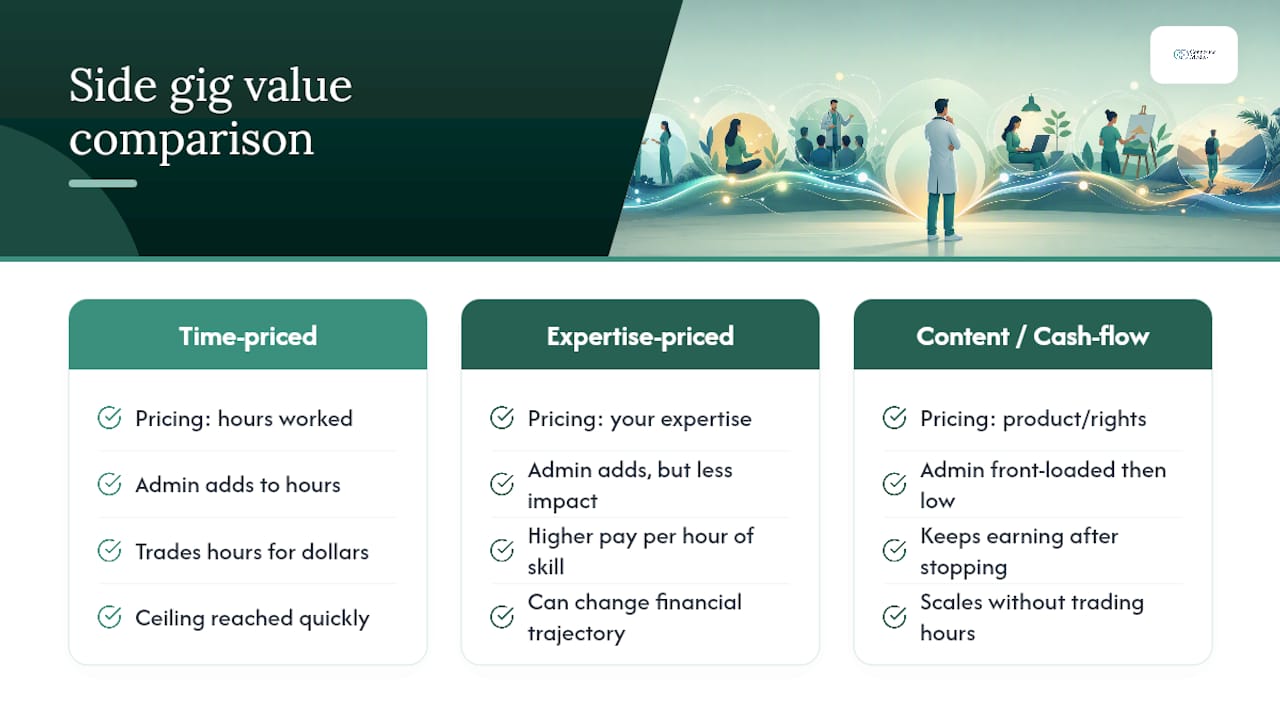
The conventional advice to "just start moonlighting" also undersells how quickly clinical-adjacent work hits a ceiling. You are still trading hours for dollars at roughly the same rate as your day job. The lanes that actually change your financial trajectory are the ones priced on expertise, not time: a well-reviewed expert witness report, a consulting relationship built on your specialty knowledge, or content that keeps earning after you stop actively working on it.
If you take one thing from this guide, let it be this: audit your current contract and coverage first, then pick one expertise-priced lane and one cash-flow lane, and give each ninety days before judging whether it is working.
— David
Find Vetted Physician Side Gigs Faster
Sorting through legal directories, consulting boards, and telehealth platforms one at a time eats the exact hours you were trying to free up. ConnectedMedics puts verified profiles, specialty filters, and a jobs board of more than 4,600 active healthcare listings in one place, so you spend your limited time evaluating real opportunities instead of screening out fake ones.

A verified profile also does work for you passively: recruiters and consulting firms searching by specialty and license status find you without a single cold pitch. The simplest next step is to create your verified profile on ConnectedMedics and turn on specialty-specific job alerts so new medico-legal, consulting, and telemedicine opportunities land in front of you as they post.
Sources
- Physician side gigs — Advisory
- Which physician side hustles pay best? — ResidencyAdvisor
- Three well-paying physician side gigs — SEAK