
There is no single healthcare work visa for the United States. The Congressional Research Service states that no visa category is dedicated solely to healthcare professionals. Nurses, doctors and other clinicians use general work categories, and the right one depends on citizenship, profession, license and employer. The employer is the key link: almost every route starts with a U.S. job offer. Finding that role comes first.
TL;DR
- No visa is made only for healthcare. Clinicians use temporary categories (H-1B, TN, J-1, E-3, O and others) or employment-based green cards.
- Canadian and Mexican citizens may qualify for TN status if the job is in a listed profession and a U.S. employer has offered it.
- Foreign doctors mostly use H-1B or J-1. J-1 can carry a two-year home-residence requirement, and Conrad 30 is one waiver route.
- A visa does not replace a state license. Nurses and doctors must meet state licensing rules as well.
- H-1B rules and fees have changed since 2025. Check the official pages for what applies when you apply.
Table of Contents
- Which U.S. visa categories healthcare workers use
- Nurses: routes and requirements
- TN status for nurses from Canada and Mexico
- Doctors: H-1B, J-1 and Conrad 30
- Licensing comes before practice
- What has changed in H-1B rules
- The process in order
- Where to look for a sponsoring employer
- Find U.S. healthcare roles on ConnectedMedics
- Our view
- FAQ
- Sources
Which U.S. visa categories healthcare workers use
The CRS report on health-care-worker immigration lists the temporary categories used by clinicians: H-1B, H-1B1, E-3, J-1, TN, O and H-2B. Each has its own conditions and limits.
Temporary means a fixed stay tied to a job or program. Permanent means an employment-based immigrant visa, also called a green card. USAGov describes these as permanent-worker routes. Sponsorship may involve a Department of Labor labor certification, then an employer's Form I-140 petition, depending on the category.
| Route | Type | Who it suits | Key point |
|---|---|---|---|
| TN | Temporary | Canadian and Mexican citizens in a listed profession | Needs a prearranged U.S. job |
| H-1B | Temporary | Physicians and other specialty-occupation roles | Employer petition; cap-subject registrations may apply |
| J-1 | Temporary | Physicians in graduate medical training | Possible two-year home-residence requirement |
| H-1B1 / E-3 | Temporary | Citizens of countries covered by those programs | Country-specific |
| O | Temporary | Individuals with extraordinary ability | High evidence bar |
| Employment-based green card | Permanent | Nurses, doctors and others with a sponsor | Often labor certification, then Form I-140 |
The table is a map, not an eligibility check. Each category has its own rules, and your passport, training and employer decide which fit.
Nurses: routes and requirements
Most foreign-trained nurses reach the U.S. through an employer. Two layers apply: immigration status and professional authorization.
Immigration status
For a covered temporary classification, the employer generally files Form I-129. USCIS explains that after approval it issues Form I-797, which is not itself a visa for travel. A worker outside the U.S. may then need to apply for a visa at a U.S. embassy or consulate. Petition approval and visa issuance are separate steps.
Many nurses also go the green card route, where the employer sponsors permanent residence. Our guide to the nurse visa for the USA covers routes, requirements and green card steps in more detail.
Healthcare worker certification
USCIS requires healthcare worker certification for nonphysician healthcare workers seeking admission mainly to perform covered healthcare labor. That includes registered nurses and licensed practical or vocational nurses, subject to regulatory exceptions. USCIS says this certification does not remove any applicable licensure requirement.
In practice, plan for three separate items:
- A U.S. employer willing to sponsor.
- The immigration petition and visa steps.
- State licensure, plus the certification where it applies.
A nurse who treats these as one process tends to lose time. Start the license and certification groundwork while looking for the employer, not after.
TN status for nurses from Canada and Mexico
TN is the route readers ask about most after the general question. USCIS states that TN applicants must be Canadian or Mexican citizens, work in a USMCA-listed profession in a prearranged U.S. job, and hold the qualifications required to practice that profession.
That gives four things to confirm:
- Citizenship. Canadian or Mexican. Other passports do not qualify.
- Profession. The job must fit a profession on the USMCA list. Read the list on the USCIS TN page and match it to the actual duties of the role, not only the job title.
- Prearranged job. A U.S. employer must have offered the position. TN does not let you arrive and search.
- Qualifications. You must hold the credentials needed to practice, which for clinical roles includes meeting the state's practice requirements.
The prearranged job is the step most applicants find hardest. A role on a specialty-filtered job board, with an employer that already hires from abroad, shortens that search.
Doctors: H-1B, J-1 and Conrad 30
Physicians have more routes, but two dominate: H-1B and J-1.
H-1B
CRS explains that H-1B physician eligibility generally requires the relevant medical license and examination qualifications. It is an employer-sponsored work category. For requirements, cap exemptions and fees in depth, see our guide to H-1B for doctors.
J-1
J-1 is an exchange-visitor training category. CRS notes that physicians in J-1 graduate medical training may be subject to a two-year foreign-residence requirement. The AMA says many international medical graduates come to U.S. residency on J-1 visas and that, without a Conrad 30 waiver, they must return home for at least two years.
Conrad 30
Conrad State 30 is one of the waiver routes. CRS describes it as tied to qualifying service in underserved areas. The practical meaning: a J-1 physician can seek a waiver by agreeing to work in an area short of doctors. Our explainer on the Conrad 30 waiver walks through how the program works.
Other routes
Physicians with exceptional records may look at O-1, and citizens of certain countries may use E-3 or H-1B1. Our overview of US work visas for doctors compares H-1B, J-1, TN, O-1 and the green card side by side.
Licensing comes before practice
A visa lets you enter and work for a named employer. It does not let you practice medicine or nursing by itself.
USCIS physician guidance explains that foreign-trained physicians who want to practice in the U.S. must meet the applicable state licensing requirements. Routes may include initial licensure or licensure by endorsement. Licensing is set state by state, so the state where you want to work decides the checklist.
What to do early:
- Pick target states before you apply widely, since each has its own board and rules.
- Gather diplomas, transcripts and registration history from your home country.
- Ask each prospective employer how it handles licensure timing for new hires.
Our guide to medical registration across borders helps with the registration side of a move.
What has changed in H-1B rules
H-1B is where recent rule changes concentrate. Two matter to clinicians.
Weighted selection. A Federal Register final rule dated December 29, 2025 provides for wage-level-weighted selection of cap-subject H-1B registrations. Beneficiaries at wage level IV are entered four times, level III three times, level II twice and level I once. The rule took effect February 27, 2026 and applies to registrations submitted on or after that date, starting with the FY 2027 registration season. Roles with higher wage levels therefore improve the odds in a lottery.

Fees. The AMA reports that a 2025 Presidential Proclamation imposed an additional $100,000 employer fee for certain initial H-1B petitions beginning September 21, 2025, and that healthcare groups sought clarification or exemptions for physicians. The AMA's October 21, 2026 page also describes a $103,265 H-1B fee as a proposed rule, not an already effective fee.
Because these rules shift, treat any figure as a snapshot. Before you commit, ask the prospective employer's immigration counsel which rules apply to your petition and check the official pages. Cap-exempt employers, such as some universities and nonprofit research settings, are covered in our H-1B for doctors guide.
The process in order
The order below fits most employer-sponsored routes. Details vary by category.
- Confirm your category. Match citizenship, profession and training to the routes above. A canadian nurse may look at TN; a physician graduate may look at H-1B or J-1.
- Start licensure and credential work. State boards set timelines, and delays here stall everything after.
- Find a sponsoring employer. Search for roles that state they hire internationally. Use specialty and location filters so each application fits.
- Employer files the petition. For covered temporary classifications this is generally Form I-129. Some categories need other steps first, and green cards often start with labor certification.
- Receive the approval notice. Form I-797 confirms the petition. It is not a travel visa.
- Apply at a U.S. embassy or consulate. If you are abroad, the visa is a separate application after approval.
- Enter and start work. Keep copies of all notices and your license documents.
Costs and timelines are not fixed. Government filing fees, premium processing options and consular wait times change, so use the USCIS and State Department pages for the figures that apply when you file, and ask the employer which costs it covers.
Where to look for a sponsoring employer
The employer is the bottleneck for most readers. General job sites mix clinical roles with everything else, and many listings never say whether the employer sponsors visas. A healthcare-only board with specialty filters removes much of that noise.
ConnectedMedics lists over 22,000 active healthcare vacancies, and work permits are available online. Members have verified profiles, which helps employers see credentials up front. Our healthcare job search checklist lays out how to prepare a search, and the healthcare recruitment platform guide shows how to use a platform well.
Find U.S. healthcare roles on ConnectedMedics
ConnectedMedics is a network for healthcare professionals. It has verified profiles, a global healthcare jobs board with specialty filters, peer discussion forums and curated medical news and research summaries. Nurses, doctors, pharmacists, healthcare assistants and home care assistants can browse roles and connect with peers in their specialty.
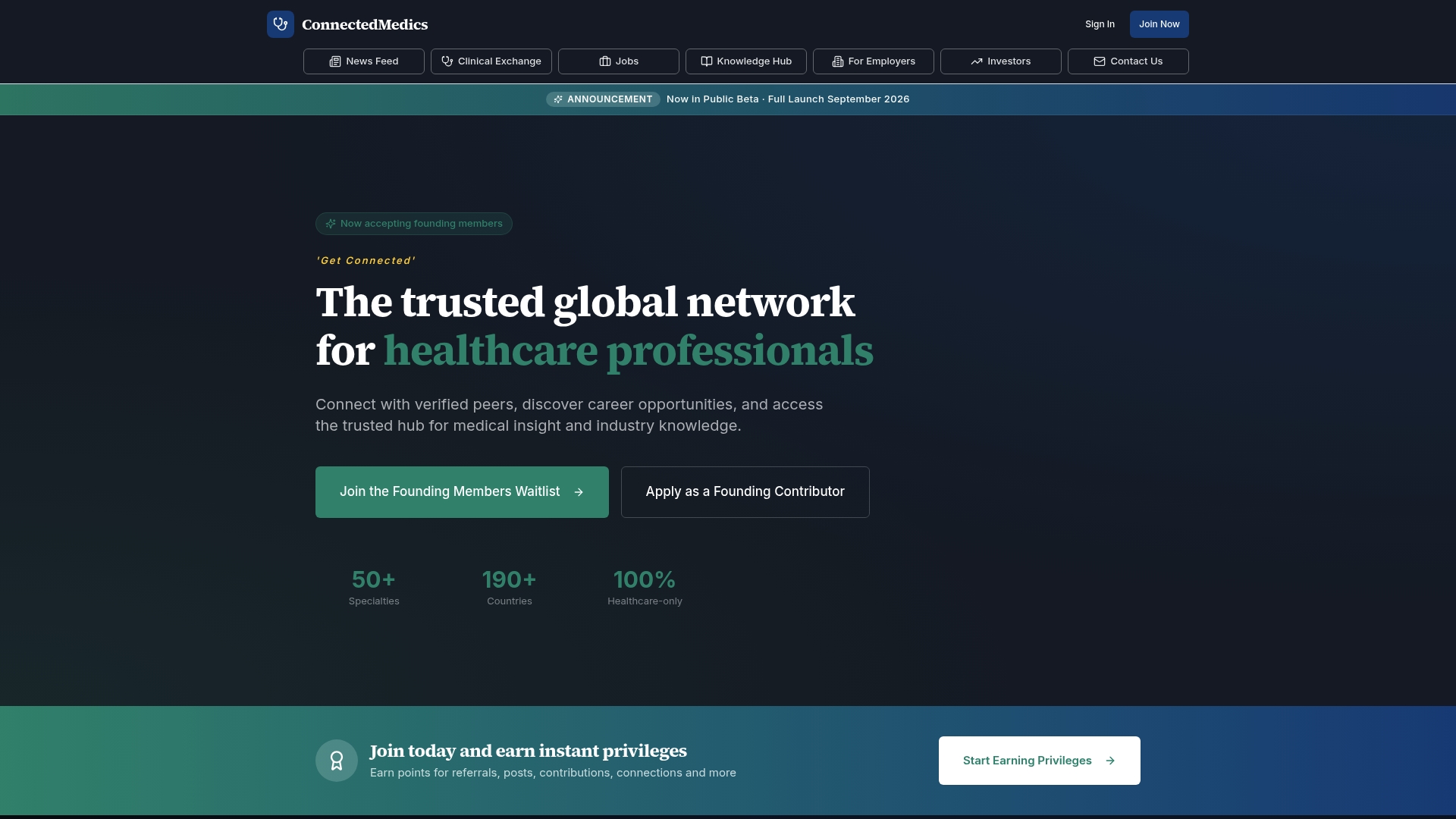
Employers that sponsor international clinicians can post roles and reach verified clinicians. The Free plan has no published price and the Growth plan is £99 per month. See the employer plans, or start at the ConnectedMedics home page to explore roles.
Our view
Visa routes are rule-bound and mostly the same for everyone. What differs is how fast a clinician reaches an employer that can sponsor.
Most people lose months on relevance. They scroll general listings, and they cannot tell which employers hire internationally or which roles fit their specialty.
We built ConnectedMedics for healthcare only. Profiles are credential-checked, the network spans 190+ countries, and the jobs board filters by specialty, so a nurse or a physician sees roles that fit.
We also add peer forums and research summaries, so you can ask colleagues who have made the move before you apply. Start there, then take the visa steps with your employer's immigration team.
David
FAQ
Is there a visa only for healthcare workers in the U.S.?
No. The CRS states that no category is dedicated solely to healthcare professionals. Clinicians use general work categories such as H-1B, TN or J-1, or employment-based green cards, depending on their profile.
Can a nurse use TN status?
Possibly, if the nurse is a Canadian or Mexican citizen with a prearranged U.S. job in a USMCA-listed profession and holds the qualifications to practice it. Check the list on the USCIS TN page against the role's actual duties.
Do doctors need a license before they get a visa?
A doctor must meet state licensing requirements to practice, and H-1B physician eligibility generally requires the relevant license and exam qualifications. Start state licensure early and ask the employer how timing is handled.
What is the Conrad 30 waiver?
It is one waiver route for J-1 physicians subject to the two-year foreign-residence requirement. It is linked to qualifying service in underserved areas, and each state runs its own slots.
Does an approved petition mean I can travel?
No. Form I-797 confirms the petition but is not a visa for travel. If you are outside the U.S., you may then need to apply for a visa at a U.S. embassy or consulate.
Sources
- CRS report R47528 on U.S. health-care-worker immigration
- USAGov: Immigrant visa to work in the U.S.
- USCIS: Petition Process Overview
- USCIS: Health Care Worker Certification
- USCIS: TN USMCA Professionals
- USCIS Policy Manual: Physician
- AMA: Immigration issues, visas and green cards
- Federal Register, December 29, 2025: H-1B weighted selection final rule