Professional isolation in nursing most often stems from systemic workplace drivers, not personal failings. The most common nursing career isolation challenges include shift-driven disconnection, leadership and communication gaps, moral distress, workplace bullying, rural or small-team practice, and unmentored technology changes. Start with one verified peer contact this week.
One-week reconnection checklist:
- Message one colleague or former classmate in your specialty today.
- Schedule a 15-minute check-in with your manager or charge nurse within three days.
- Set one firm boundary around a non-work activity before the week ends.
Pro Tip: If reaching out to a colleague feels awkward, keep it simple: "Hey, I've been feeling a bit disconnected lately. Would you have 10 minutes to catch up this week?" That's enough.
Crisis warning: If isolation is accompanied by thoughts of self-harm, suicidal ideation, or an inability to function at work or home, contact the 988 Suicide and Crisis Lifeline (call or text 988) or go to your nearest emergency department. Do not wait for a scheduled appointment.
Table of Contents
- What does professional isolation actually mean for nurses?
- What drives nursing career isolation challenges at work?
- How does isolation show up, and what does it cost?
- Evidence-based strategies for overcoming nursing isolation
- What can nurse leaders and employers do?
- When does isolation require professional or clinical help?
- What does the research say about professional isolation in nursing?
- Key Takeaways
- The part most nursing guides get wrong about isolation
- Connectedmedics: verified peer connections for isolated nurses
- Useful sources and further reading
What does professional isolation actually mean for nurses?
Professional isolation and personal loneliness are related but distinct. Personal loneliness is a subjective emotional state — the feeling of being disconnected from others in your life. Professional or clinical isolation is a workplace and career-stage phenomenon: it refers to a lack of access to colleagues, mentors, supervisors, or interprofessional consultation in the context of your nursing role.
A nurse can have a full social life outside work and still experience significant professional isolation on the job. The reverse is also true.
| Dimension | Professional Isolation | Personal Loneliness |
|---|---|---|
| Primary setting | Workplace, clinical environment | Personal and social life |
| Core experience | Lack of peer, mentor, or supervisory access | Subjective feeling of disconnection |
| Career impact | Skill stagnation, reduced collaboration | Emotional distress, reduced motivation |
| Measurable signs | No debrief access, solo specialty on shift | Reported feelings of emptiness or exclusion |
| Intervention focus | Organizational, structural | Psychological, social |
A systematic review on loneliness and nurses' wellbeing identifies social, environmental, and cultural elements as predictors of nursing loneliness, and notes that workplace programs, peer support, and technology-based solutions each address different dimensions of the problem.
Concrete examples of professional isolation in daily nursing work include: being the only nurse in your specialty on a night shift with no one to consult; starting a new graduate position with no assigned preceptor after week four; working in a rural clinic where the nearest colleague in your specialty is 90 minutes away; or navigating a new AI-assisted documentation system with no training or peer guidance.
What drives nursing career isolation challenges at work?
The causes of professional isolation in nursing are systemic. Understanding them helps you identify which ones apply to your situation.
Shift work and staffing shortages
Rotating shifts and night work fragment the social fabric of a unit. When staffing is thin, nurses spend shifts in task-completion mode with no time for peer discussion. Post-COVID staffing gaps have compounded this: workforce shortages, the rise of gig nursing, and rapid technology adoption have increased moral distress and alienation across U.S. healthcare settings.
Leadership and communication failures
Poor debriefing practices, absent supervisory feedback, and managers who are too stretched to maintain regular contact all create distance. A cross-sectional survey of Finnish nurses found that lack of coworker and supervisory support correlated most strongly with workplace loneliness. The same study linked loneliness to core burnout symptoms.
Workplace bullying and incivility
Lateral violence and incivility push nurses out of team conversations. When a new graduate is dismissed or ignored by senior colleagues, the result is not just hurt feelings — it is a functional loss of access to clinical knowledge and peer support.
Moral distress and compassion fatigue
Nurses who witness ethical violations or feel unable to provide adequate care often withdraw. That withdrawal looks like disengagement but is frequently a protective response to moral injury. COVID-era research documents how pandemic-era staffing gaps and fear of infection amplified both moral distress and professional isolation simultaneously.
Geographic and rural practice
Nurses in rural or small-team settings face the sharpest isolation risk. BMC Nursing research reports that rural and solo-practice nurses are up to six times more likely to report professional isolation, and that isolation often precedes an intention to leave within five years.
Technology changes without support
Unmentored AI tool rollouts and telehealth-only care models can deepen isolation. When nurses are expected to adopt new systems without shared training or peer discussion, the learning curve becomes a solitary experience. Workforce trend analysis shows this is an accelerating driver in 2026.
Mini case examples:
- New graduate: Assigned to a busy medical-surgical floor, no preceptor after week six. Asks questions and gets one-word answers. Stops asking.
- Rural nurse: Only RN in a small clinic. Nearest specialist is two counties away. Handles complex cases alone and has no debrief outlet.
- Night-shift nurse: Works 7 PM to 7 AM with a skeleton crew. Day-shift colleagues form the social core of the unit. Night-shift nurses are invisible to leadership.
Pro Tip: Testing connection doesn't require a long conversation. Try: "I've been working through [specific clinical situation] and wanted to get your perspective. Do you have 60 seconds?" Most colleagues say yes.
How does isolation show up, and what does it cost?
Signs to watch for
Isolation in nursing rarely announces itself clearly. It tends to surface through behavioral and emotional shifts:
- Withdrawing from team conversations or handoff discussions
- Reduced willingness to ask for help or offer input
- Emotional numbness or detachment during patient care
- Increased error rates or near-misses from reduced peer checking
- Frequent sick days or unexplained absenteeism
- Declining interest in continuing education or professional development
Consequences for nurses, teams, and patients
The organizational costs of nursing isolation are well-documented. Research on workplace loneliness and organizational outcomes links isolation to reduced engagement, higher turnover intent, and negative effects on performance. When nurses disengage, team cohesion drops and patient-safety risks rise.
A cross-sectional survey found that over 20% of nurses reported workplace loneliness at least occasionally, and that loneliness was directly linked to core burnout symptoms. Burnout, in turn, predicts turnover — and turnover worsens staffing ratios, which deepens isolation for the nurses who remain.
For managers: A nurse who has gone quiet is not necessarily fine. Reduced participation in team discussions is one of the earliest observable signs of professional isolation. Catching it early costs far less than replacing a departing nurse.
Evidence-based strategies for overcoming nursing isolation
Immediate actions (this week)
- Message one peer, former classmate, or colleague in your specialty. Keep it brief and specific.
- Request a 15-minute check-in with your manager or charge nurse. Frame it as a routine touchpoint, not a complaint.
- Join one moderated online specialty forum or professional nursing community and read three recent posts.
Short-term actions (1–3 months)
- Identify a potential mentor: someone two to five years ahead of you in your specialty. Use this script: "I admire how you handle [specific situation]. Would you be open to a monthly 20-minute call? I'd value your perspective."
- Use a 10-minute end-of-shift debrief prompt with one colleague: "What went well today? What was hardest? What would you do differently?"
- Negotiate one scheduling accommodation that protects a consistent social or recovery activity outside work.
Long-term strategies
- Formal mentorship: seek structured programs through your hospital, a professional nursing organization, or a specialty-led community. Peer networking for nurses through verified professional platforms offers access to colleagues outside your immediate unit.
- Specialty community membership: organizations like the American Nurses Association (ANA), the Emergency Nurses Association (ENA), and specialty-specific groups provide peer forums, continuing education, and advocacy resources.
- Employee Assistance Programs (EAPs): most U.S. hospital systems offer EAP access at no cost. EAPs provide short-term counseling, referrals, and crisis support.
Self-care for shift workers:
- Protect sleep: treat your sleep window as a clinical priority, not a preference.
- Use micro-breaks deliberately: a five-minute walk outside or a brief breathing exercise between patients reduces cumulative stress.
- Set a hard stop on work-related communication during off-hours when possible.
Pro Tip: The most sustainable coping strategy is one you can do in under five minutes. A short message, a brief debrief, a single forum post — these compound over weeks into a real professional network.
What can nurse leaders and employers do?
Organizational interventions have stronger evidence than individual coping alone. ANA guidance is direct: hiring without retention pathways is a common mistake. Nurses need advancement, acknowledgment, and structured peer support to stay engaged.
Leader checklist
- Launch or formalize a mentorship program pairing new graduates with experienced nurses for at least six months.
- Implement structured post-shift debriefs, especially after high-acuity events.
- Review scheduling practices for night-shift and rural staff to identify isolation risk.
- Enforce anti-bullying and civility policies with visible, consistent follow-through.
- Create protected time (even 15 minutes per week) for peer discussion or case review.
Measurement metrics
- Pulse surveys every 60–90 days asking directly about peer connection and supervisory support.
- Turnover intent questions in annual engagement surveys.
- EAP utilization rates as a proxy for unmet support needs.
- Absenteeism trends by shift and unit.
Intervention comparison
| Intervention | Primary benefit | Evidence strength |
|---|---|---|
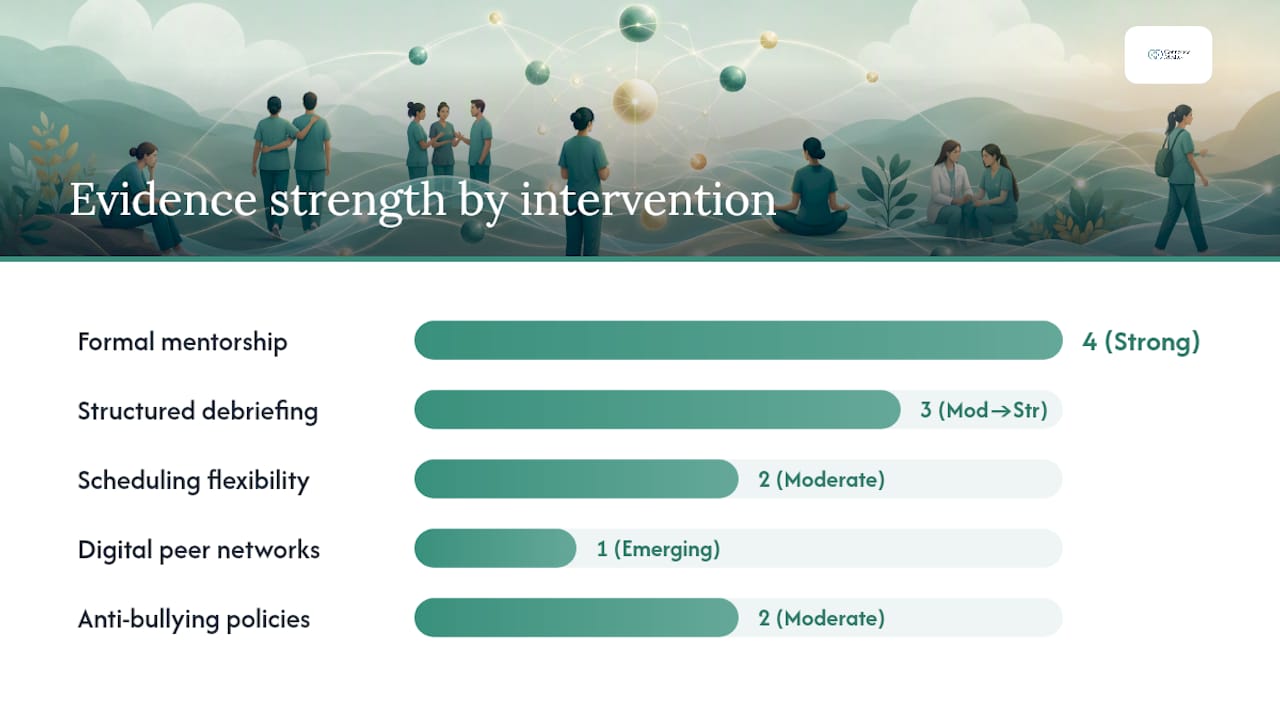
| Formal mentorship programs | Skill development, reduced isolation for new graduates | Strong |
| Structured debriefing | Moral distress reduction, team cohesion | Moderate to strong |
| Scheduling flexibility | Reduced shift-driven disconnection | Moderate |
| Digital peer networks | Access for rural and night-shift nurses | Emerging |
| Anti-bullying policies | Reduced incivility-driven withdrawal | Moderate |
Professional communities built for nurses are particularly useful for filling the gap when in-person peer access is limited by geography or shift pattern.
To pilot quickly: Start with a single unit. Run a 30-day structured debrief trial (10 minutes, three times per week, after high-acuity shifts). Measure participation and collect brief written feedback. Scale what works.
When does isolation require professional or clinical help?
Red flags that require immediate action
- Thoughts of self-harm or suicide
- Persistent inability to perform basic job functions
- Panic attacks or severe anxiety interfering with patient care
- Medication misuse or increased alcohol use to cope
- Feeling unsafe at work due to bullying, harassment, or threats
- Complete social withdrawal lasting more than two weeks
What does the research say about professional isolation in nursing?
Qualitative research on emergency nurses describes professional isolation as "feeling like an island" — a state driven by diminished interprofessional consultation and skills mismatches rather than by any individual nurse's social ability. That framing matters: it locates the cause in the system, not the person.
| Study / Source | Design | Key finding | Practical takeaway |
|---|---|---|---|
| Finnish nurses cross-sectional survey | Survey | A significant portion of nurses reported workplace loneliness at least occasionally; linked to burnout | Measure loneliness directly in engagement surveys |
| BMC Nursing rural practice analysis | Discussion paper | Rural and solo-practice nurses report much higher isolation; predicts intent to leave | Target rural nurses with mentorship and digital peer access |
| Emergency nursing qualitative study | Qualitative | "Feeling like an island" from lack of interprofessional consultation | Build structured consultation pathways |
| Workplace loneliness organizational outcomes | Review | Loneliness linked to turnover intent and reduced performance | Leader-member relationship quality is a modifiable factor |
| Post-COVID nursing crisis review | Review | COVID amplified moral distress and workforce instability | Post-crisis recovery requires active structural intervention |
Evidence-to-practice summary:
- Mentorship and structured debriefing have the strongest evidence base for reducing isolation.
- Digital peer networks show emerging evidence, particularly for rural and shift-based nurses.
- Individual self-care strategies help but do not substitute for organizational change.
- Measurement matters: isolation that is not tracked is not addressed.
Key Takeaways
Professional isolation in nursing is a systemic problem with measurable consequences for nurses, teams, and patients — and it responds to both individual and organizational action.
| Point | Details |
|---|---|
| Isolation is systemic, not personal | Shift work, staffing gaps, and leadership failures drive most nursing isolation. |
| Over 20% prevalence | A cross-sectional survey found over 20% of nurses reported workplace loneliness at least occasionally, linked to burnout. |
| Rural nurses face higher risk | BMC Nursing data shows rural and solo-practice nurses are much more likely to report professional isolation. |
| Mentorship and debriefing work | These two interventions have the strongest evidence base for reducing isolation across career stages. |
| Connectedmedics fills the peer gap | Verified specialty forums and a healthcare-specific jobs board give isolated nurses access to peers outside their immediate unit. |
The part most nursing guides get wrong about isolation
Most articles on nursing isolation focus on individual resilience: sleep more, set boundaries, practice mindfulness. That advice is not wrong, but it misses the structural reality. A nurse working a rotating night shift in a rural clinic with no preceptor and a manager who communicates by group text is not isolated because of a resilience deficit. The system created the conditions.
What actually moves the needle is low-stakes, repeated peer contact — not grand gestures. A three-minute debrief after a difficult case. A message to a former classmate. A post in a moderated specialty forum. These small actions rebuild the connective tissue that systemic pressures erode. The research on this is consistent: peer support and supervisory connection are the two most modifiable factors in workplace loneliness.
There is also a career-stage dimension that gets overlooked. New graduates face isolation from inexperience and lack of mentorship. Mid-career nurses face it from role stagnation and moral distress. Experienced nurses face it when their expertise goes unacknowledged and their clinical judgment is not consulted. Each stage needs a different intervention. A one-size mentorship program misses two of those three groups entirely.
The most honest thing to say to a nurse reading this: the isolation you feel is probably not about you. It is about the structure around you. That does not make it less painful, but it does mean the fix is partly outside your control — and that asking for organizational change is not weakness. It is clinical advocacy.
Connectedmedics: verified peer connections for isolated nurses
Nurses dealing with professional isolation need peers who understand their specialty, not a generic social network.
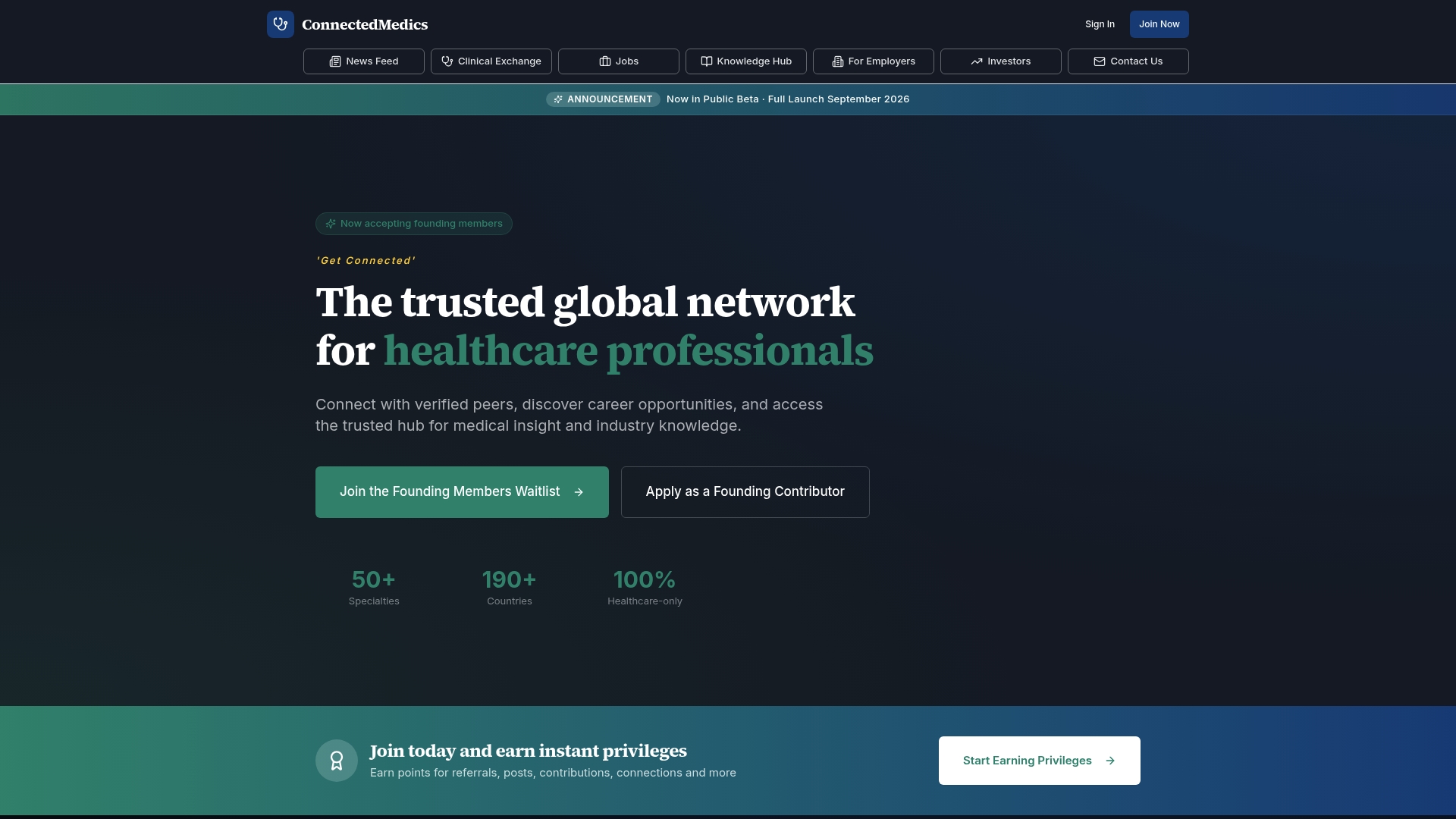
Connectedmedics is built specifically for healthcare professionals. Verified profiles mean you are connecting with real clinicians, not anonymous accounts. Specialty-led forums let you post a clinical question, discuss a difficult case, or simply read how peers in your field handle the same pressures you face. The platform also includes a healthcare jobs board with over 4,600 active vacancies and specialty-specific filters — useful if isolation-driven dissatisfaction is making you consider a move. Knowledge hub content, including curated clinical research summaries, keeps you connected to evidence without requiring hours of journal searching.
To start: create a basic verified profile, then join one specialty forum and read the active discussions. No long-term commitment required. Privacy settings let you control what colleagues and employers can see.
Visit Connectedmedics to set up a profile and find your specialty community.
Useful sources and further reading
The following sources were cited in this article. Each provides primary evidence or professional guidance on nursing isolation, burnout, and workplace wellbeing.
| Source | What it contributes |
|---|---|
| Resilience in Solitude: Loneliness and Nurses' Wellbeing | Systematic review of loneliness predictors and intervention categories (peer support, workplace programs, technology). |
| Antecedents and Outcomes of Workplace Loneliness in Finnish Nurses | Cross-sectional survey; prevalence data and psychosocial antecedents including supervisory support and bullying. |
| Nursing Crisis: Challenges After COVID-19 | Review of COVID-era amplification of moral distress, staffing gaps, and workforce instability. |
| Workplace Loneliness and Organizational Consequences | Evidence on reduced engagement, turnover intent, and performance linked to workplace loneliness. |
| BMC Nursing: Professional Isolation in Small Teams | Rural and solo-practice isolation risk elevated; association with intent to leave. |
| Perceptions of Professional Isolation Among Emergency Nurses | Qualitative study; "feeling like an island" framing and role of interprofessional consultation. |
| Journal of Hospital Administration: Nurses in the U.S. Workforce | System-level context on workforce shortages, technology adoption, and moral distress. |
| ANA: Issues in Nursing — How Nurse Managers Can Help | Professional guidance on retention, recognition, and leadership-driven support environments. |