
The fastest way to build multi-specialty research teams is a compact three-step launch: lock a shared mission, staff four core roles, and set governance before recruiting expands. Skipping any one of these is why so many interdisciplinary projects stall in Tuckman's "storming" phase.
Start with these three moves:
- Define the mission and success metric using an input-process-output framework before recruiting a single person.
- Fill four founding roles: principal investigator, statistician, coordinator, and one specialty co-lead.
- Write governance rules on day one, including data ownership and authorship order, not after the first disagreement.
Key Takeaways
Building a multi-specialty research team successfully requires a clear mission, four founding roles, and governance rules established before recruiting expands past the core group.
| Point | Details |
|---|---|
| Start with mission and roles | Lock the research question and staff PI, statistician, and coordinator before wider recruiting. |
| Screen for collaborative disposition | Prioritize humility, curiosity, and willingness to share authorship over credentials alone. |
| Set governance on day one | Write data-sharing and authorship rules before the first disagreement, not after. |
| Diversity drives measurable outcomes | Mixed-gender and cross-discipline teams show higher novelty and long-term research impact. |
| Use verified networks to recruit faster | ConnectedMedics lets teams filter by specialty and connect with verified clinicians directly. |
Table of Contents
- How Do You Build a Multi-Specialty Research Team Step by Step?
- Who Belongs on a Multi-Specialty Research Team?
- What Should You Look for When Recruiting Collaborators?
- How Do You Keep a Multi-Specialty Team Accountable?
- How Do You Measure Whether Your Research Team Is Succeeding?
- What Belongs on Your Onboarding Checklist?
- What Are the Warning Signs a Research Team Is Failing?
- What Can Other Teams Learn From M-CHOIR's Growth?
- Why Pragmatic Networking Beats Cold Recruiting
- How ConnectedMedics Supports Every Phase of Team Building
- Frequently Asked Questions
- Sources
How Do You Build a Multi-Specialty Research Team Step by Step?
Building the team happens in five phases, each with a decision point that gates the next.
Planning comes first. Define the research question, confirm funding source, and decide who holds final sign-off authority. Recruiting follows: identify the specialty gaps your question demands, then approach candidates directly rather than posting a generic call. Onboarding locks in data rules and role clarity before anyone touches a dataset. Execution is where weekly cadence gets tested against real deadlines. Evaluation closes the loop, feeding lessons back into team composition.
- Draft a one-page charter naming the research question and funding trigger.
- Recruit the PI, statistician, and coordinator before anyone else.
- Add specialty clinicians once the study design is fixed.
- Run a kickoff meeting covering authorship and data-sharing rules.
- Set a first evaluation checkpoint at 8 to 12 weeks.
Early phases need statistical and clinical expertise locked in. Later phases benefit from rotating specialty collaborators who join for specific sub-questions rather than the full project lifecycle.
Who Belongs on a Multi-Specialty Research Team?
Every functioning team needs a principal investigator who owns strategic direction, but the roles beneath that person determine whether the science actually gets done. A project manager or coordinator maintains cadence and cuts administrative friction, according to team-science research on interdisciplinary collaboration. Statisticians and data managers should join before data collection starts, not after someone realizes the sample size was wrong.
Beyond titles, prioritize attributes: humility, translational curiosity, and a track record of shared authorship. Teams led by people who show these traits collaborate more successfully across disciplines, per an MDPI review on interdisciplinary leadership.
| Study type | Core roles | Typical size |
|---|---|---|
| Retrospective review | PI, coordinator, one specialty clinician, biostatistician | 4 to 6 |
| Prospective cohort | PI, co-lead, coordinator, data manager, 2 to 3 specialty clinicians | 7 to 10 |
| Clinical trial | PI, co-leads, project manager, statistician, coordinators, rotating specialty consultants | 10 to 20+ |
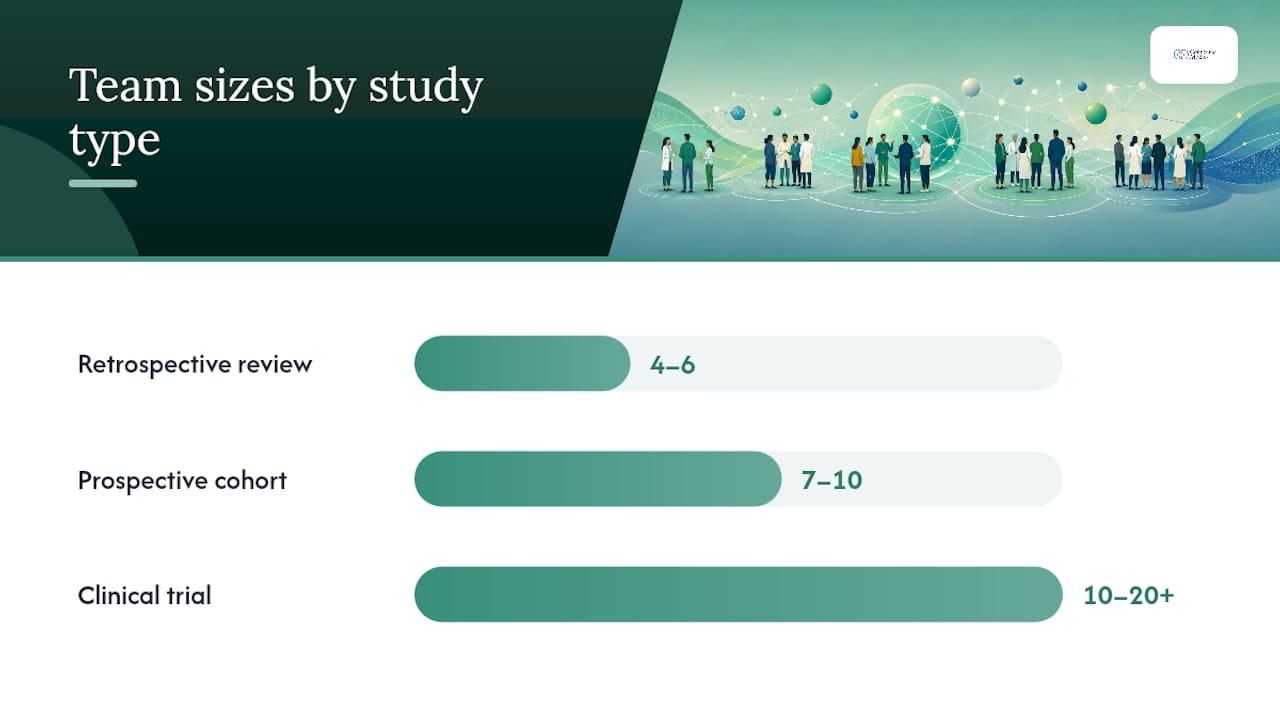
Add rotating collaborators once the core group is stable, not before.
What Should You Look for When Recruiting Collaborators?
Recruiting across specialties is different from hiring within one. You're screening for translation ability as much as technical skill: can this cardiologist actually work with a data scientist without a six-month learning curve?
Look for these signals during screening conversations:
- Prior coauthorship outside their home specialty.
- Willingness to share raw data and authorship credit upfront.
- A communication style that translates jargon rather than gatekeeps it.
- Availability that matches your project's real timeline, not an aspirational one.
Source candidates through several channels at once. Internal grand rounds and department meetings surface local talent. Specialty conferences widen the net. Bibliometric screening, or reviewing who publishes at the intersection of your two fields, finds people you'd never meet otherwise. Verified professional networks like ConnectedMedics add a fourth channel: searchable, specialty-tagged profiles instead of cold emails into the void.
Ask two questions in every screening call: "What's a project where you shared authorship credit generously?" and "How do you handle disagreement over methodology?" The answers tell you more than a CV ever will.
How Do You Keep a Multi-Specialty Team Accountable?
Governance works best as a hybrid: a PI who owns strategy, horizontal specialty leads who own their domains, and a coordinator who owns the calendar. This flatter structure, described in team-science literature on interdisciplinary research, avoids the bureaucratic layers that kill momentum in larger academic units.
Set communication rhythms early and stick to them:
- Weekly async updates, one paragraph per subteam, no meeting required.
- Monthly subteam check-ins for anyone touching shared data or methods.
- Quarterly all-hands to realign on the mission and flag scope creep.
- An annual in-person workshop if the team spans institutions.
Pro Tip: Write your conflict-resolution ground rules before the first disagreement happens, not during one. A one-paragraph agreement on how methodological disputes get escalated saves weeks of stalled progress later.
Facilitating the storming phase actively, rather than hoping it resolves itself, is what separates teams that reach "performing" from ones stuck cycling through friction.

How Do You Measure Whether Your Research Team Is Succeeding?
Vision alone doesn't produce papers. Map your project using the McGrath input-process-output model: inputs are your people and funding, process is how you collaborate, output is what gets published or funded.
Set project-level objectives with measurable results. An example: "Publish two peer-reviewed papers and secure one follow-on grant within 18 months" is a real objective; "advance the field" is not.
Schedule evaluation at fixed intervals rather than waiting for a crisis. At each checkpoint, ask whether the current team composition still matches the work ahead. Diversity itself is a measurable lever here: mixed-gender teams produce up to 7% more novel work and are 14.6% more likely to publish highly cited papers than same-gender teams, according to an analysis of 6.6 million medical papers. Use evaluation checkpoints to actively rebalance composition, not just track deadlines.
What Belongs on Your Onboarding Checklist?
New collaborators need five things before they touch a dataset:
- Access to shared documentation and the data-management plan.
- A written authorship agreement, signed before analysis begins.
- A role orientation covering who decides what.
- A first milestone due within two weeks of joining.
- A short "teaming" session to translate jargon and align on methods.
That last step matters more than it sounds. Skipping structured time for new collaborators to negotiate norms causes friction in budgeting and administration as much as the science itself.
For timelines: a retrospective chart review typically runs 8 to 12 weeks from kickoff to draft manuscript. A prospective study or early-phase trial needs 16 to 24 weeks before first results, with an IRB approval gate usually falling around week 4 to 6.
What Are the Warning Signs a Research Team Is Failing?
Watch for these red flags early:
- Unclear authorship order. Fix it with a written agreement in week one, not after submission.
- Rigid administrative layers. Flatten reporting lines before they calcify.
- No data-management rules. File naming and access conflicts derail projects more often than the science does, per practical guidance on managing interdisciplinary teams.
- Missing horizontal leadership. If specialty leads have no real authority, disengagement follows fast.
Two missed weekly updates in a row is your intervention trigger. Don't wait for three.
What Can Other Teams Learn From M-CHOIR's Growth?
The Michigan Comprehensive Hand Center for Innovation Research, known as M-CHOIR, scaled from 2 members to more than 40, producing 46 papers across 11 journals while landing major grant funding, according to a published case study on the center's growth.
The mechanism wasn't headcount. M-CHOIR centralized PI involvement even as the team grew, ran weekly update workflows that kept every subteam visible, and applied input-process-output thinking to connect strategy directly to output.
Three lessons transfer directly to any specialty combination:
- Centralize oversight even as headcount scales past a dozen people.
- Make weekly updates non-negotiable, not optional.
- Treat strategy and execution as one continuous loop, not two separate phases.
Why Pragmatic Networking Beats Cold Recruiting
Building interdisciplinary teams used to mean relying on whoever happened to sit in your building. That approach limits you to local expertise distance, and expertise distance is exactly what predicts long-term impact in research on team formation. Verified specialty filters cut the screening time that used to eat weeks of cold outreach, letting you evaluate real credentials instead of guessing from a LinkedIn headline.
How ConnectedMedics Supports Every Phase of Team Building
Recruiting across specialties usually means cold emails, conference hallway conversations, and hoping someone forwards your call for collaborators. ConnectedMedics cuts that search time by giving you verified profiles searchable by specialty, so you find the biostatistician or the second specialty clinician you actually need instead of whoever happens to reply.
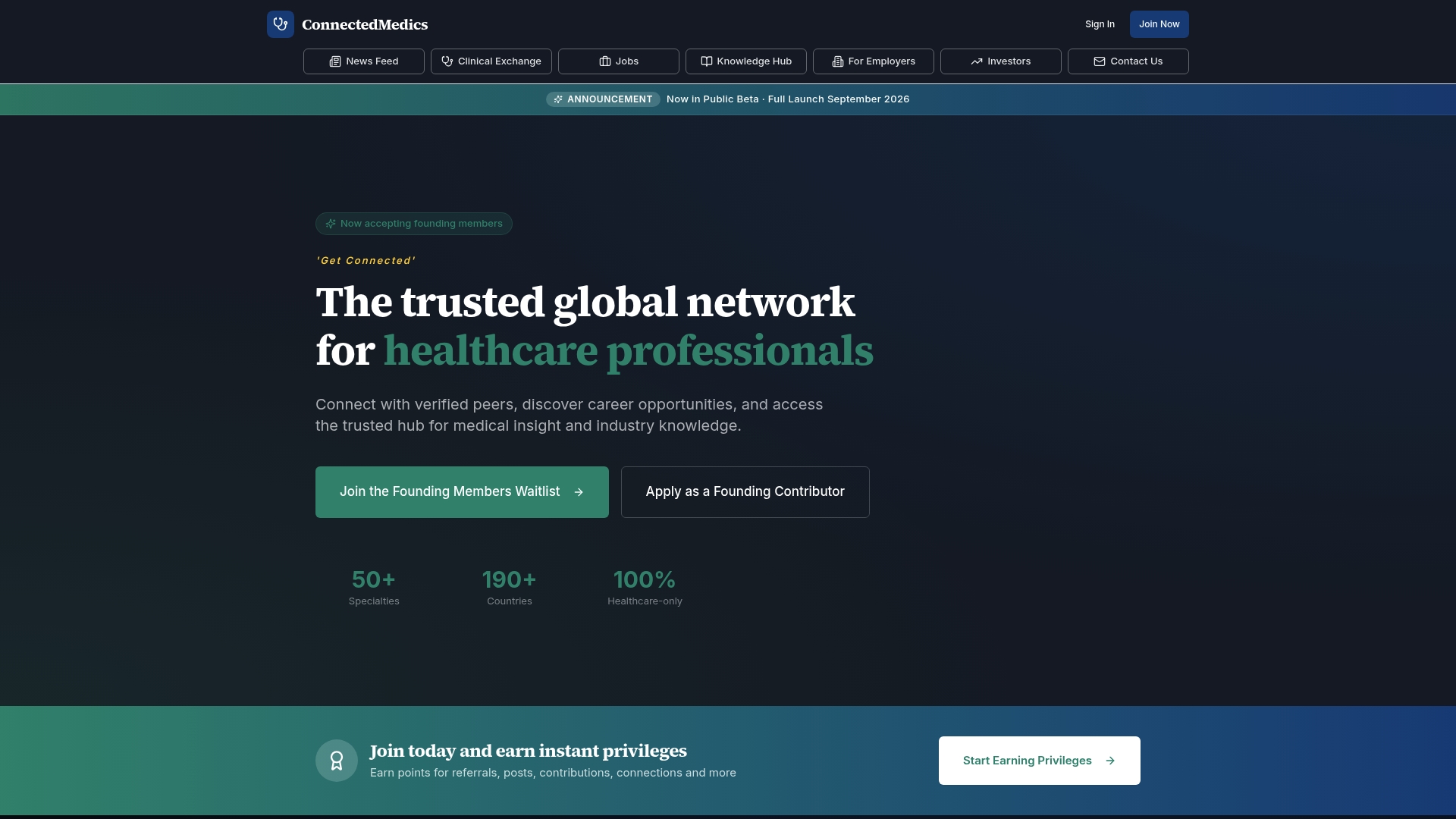
Use it across the roadmap: search verified profiles during recruiting, browse the knowledge hub for methods and precedent during onboarding, and keep specialty connections active for the next project once this one wraps. With more than 4,600 active healthcare vacancies and contributions from verified medical experts, the platform functions as both a hiring channel and an ongoing collaboration base.
If you're staffing a study right now, start with a specialist search on ConnectedMedics and see who's already active in your target specialty.
Frequently Asked Questions
How long does it take to build a multi-specialty research team? A core team of four to six people can be staffed within 4 to 6 weeks if the mission and roles are defined upfront. Full teams for clinical trials, including rotating specialty consultants, often take 3 to 6 months.
What is the biggest mistake teams make when forming multi-specialty research teams? Skipping written authorship and data-sharing agreements before the project starts. Unclear credit rules are one of the most common causes of interdisciplinary conflict, according to practical guidance on managing these teams.
Do multi-specialty teams need a formal governance structure? Yes, but it should stay light. A PI for strategy, horizontal specialty leads for domain decisions, and one coordinator for cadence covers most projects without adding bureaucratic layers.
How many people should be on a multi-specialty research team? It depends on study type. Retrospective reviews often run 4 to 6 people; prospective cohorts need 7 to 10; clinical trials frequently require 10 to 20 or more, including rotating collaborators.
Can a specialty-focused networking platform help with recruiting? Yes. Platforms with verified clinician profiles and specialty filters, such as ConnectedMedics, reduce the time spent screening candidates compared to generic professional networks or cold outreach.
Sources
- Developing interdisciplinary research teams in neurosurgery (JNS)
- M-CHOIR case study and lessons for clinical research teams (PMC)
- Gender-diverse teams produce more novel and higher-impact scientific ideas (PNAS)
- MDPI review on interdisciplinary team leadership and member selection