
Medication administration in home care is typically a shared, team-based responsibility led by a registered nurse (RN) or licensed clinician, supported by home health aides, family caregivers, pharmacists, and the prescriber. No single person owns the whole job. Each role covers a different piece.
Who does what, at a glance:
- RN or licensed clinician: administers complex doses (injections, IV medications), reconciles the medication list, and trains others.
- Home health aide/caregiver: prompts or assists with oral medications, only when the care plan and state rules allow it.
- Family caregiver: handles day-to-day reminders, refills, and observation between visits.
- Pharmacist: manages refills, interaction checks, and packaging like blister packs.
For urgent issues, call the pharmacy for dosing or interaction questions, the home health nurse or agency for a missed or wrong dose, and 911 for signs of a severe reaction such as difficulty breathing or unresponsiveness. Groups like the American Heart Association and the CDC publish guidance that shapes how agencies train staff for exactly this kind of coordination.
Key Takeaways
Safe medication administration in home care depends on clearly assigned roles, a single reconciled medication list, and consistent documentation shared across everyone involved.
| Point | Details |
|---|---|
| Shared responsibility | An RN typically leads administration and reconciliation, with aides, family, and pharmacists supporting specific tasks. |
| Five Rights discipline | Confirm right patient, drug, dose, route, and time every single time, not just on the first dose. |
| Delegation needs documentation | Agencies must document competency and a care-plan order before an aide can assist with medications. |
| Packaging and reminders reduce errors | Blister packs, pillboxes, and electronic reminders cut unintentional missed or doubled doses. |
| Ask about adherence, not just compliance | Roughly half of patients skip doses; simple questions about the last dose taken reveal problems early. |
Table of Contents
- Medication Management Versus Medication Administration in Home Care
- Who Does What: Home-Care Roles and Their Medication Duties
- Core Tasks and Safe Practices for Administering Medications at Home
- Training, Delegation, and Scope of Practice for Home Medication Help
- Common Medication Errors in Home Care and How to Prevent Them
- What the Research Says About Improving Medication Adherence
- Why Role Clarity in Medication Administration Actually Matters
- Get Connected With Verified Home Care Expertise
- Frequently Asked Questions
- Sources
Medication Management Versus Medication Administration in Home Care
These two terms get used interchangeably, and that's part of why families get confused about who's supposed to do what. Medication administration is the physical act: giving a pill, an injection, or a topical treatment at the correct time and dose. Medication management is everything around it: reconciling the drug list after a hospital discharge, ordering refills, storing medications safely, and watching for side effects.
A home health aide prompting someone to take a morning pill is administration. A nurse cross-checking that same pill against five other prescriptions for interactions is management.
Who typically owns each piece:
- Administration: RN, LPN (where permitted), trained aide under delegation, or the patient/family.
- Reconciliation and monitoring: RN or physician, often with pharmacist input.
- Ordering, packaging, refills: pharmacist, coordinated with family or a home care network platform.
Who Does What: Home-Care Roles and Their Medication Duties
Every role in home care touches medication somewhere, but the boundaries matter. Getting them wrong is how doses get missed or duplicated.
- Registered nurse (RN): performs injections and infusions, completes medication reconciliation after hospital transitions, and trains or supervises aides. Call the RN for adverse reactions, confusion about a new prescription, or a missed complex dose.
- LPN/LVN (where state scope allows): administers routine medications under RN or physician oversight. Call for day-to-day administration questions within their scope.
- Home health aide/caregiver: prompts, reminds, or physically assists with oral medications, but only when the care plan documents that delegation. Call for scheduling conflicts or if the patient refuses a dose.
- Family caregiver: tracks the daily schedule, restocks supplies, and observes for changes between professional visits. Call the RN or pharmacist, not 911, for non-urgent side effects.
- Pharmacist: fills prescriptions, flags interactions, and sets up multidose packaging. Call for refill timing, generic substitutions, or drug interaction questions.
- Physician/prescriber: writes and adjusts orders based on lab results and reported side effects. Call when a dose seems to be causing new symptoms.
- Case manager/social worker: coordinates communication between the agency, pharmacy, and family, and updates the care plan as needs change.
Core Tasks and Safe Practices for Administering Medications at Home
A safe medication process at home follows the same logic every time, whether it's a family member or a trained aide doing the work.
- Confirm the current order against the Medication Administration Record (MAR) or an updated med list.
- Check for the Five Rights before touching the medication.
- Prepare the dose in a clean, well-lit space, away from distractions.
- Verify the patient's identity, especially in shared living settings.
- Administer the medication using the correct technique for the route.
- Document the time, dose, and any observations immediately, not later.
- Monitor for expected effects and warning signs over the next hour.
- Dispose of sharps or unused controlled substances according to agency policy.
The Five Rights of medication administration: right patient (confirm identity every time, not just on day one), right drug (compare label to the order, not memory), right dose (measure, don't estimate), right route (oral, topical, injection as ordered), and right time (within the window the prescriber set, not "close enough").
Storage matters as much as the dose itself. Keep medications in their original containers, away from heat and humidity, and out of reach of children or confused adults. Controlled substances need locked storage and a count log. Sharps go in an approved disposal container, never loose in household trash.
- Reconcile the med list every time a prescription changes or a hospital visit happens.
- Use blister packs or multidose organizers from the pharmacy to cut down on missed or doubled doses.
- Communicate every change to the pharmacy and prescriber the same day, not at the next visit.
Training, Delegation, and Scope of Practice for Home Medication Help
Who's legally allowed to give a medication depends on the state and the type of provider involved. Rules vary widely, but most licensed agencies require documented competency and a signed care-plan order before delegating administration to an unlicensed aide. Nursing boards, not the agency itself, set the outer limits of what can be delegated.

Agencies typically require aides to complete medication competency training, demonstrate correct MAR documentation, and pass a review of safe handling for controlled substances before touching a client's medications. Regulatory bodies like the Care Quality Commission outline this kind of framework for medicines support in home settings.
Pro Tip: Ask any agency or visiting clinician three questions before care starts: What exactly is this aide trained and authorized to do with medications? Who signs off on delegation, and how often is it reviewed? Where is documentation kept, and can I see it?
Common Medication Errors in Home Care and How to Prevent Them
The most frequent errors in home settings aren't exotic. They're mundane, repeatable mistakes that compound over weeks.
- Missed doses, often from schedule confusion between multiple caregivers.
- Wrong dose, usually from measuring by eye instead of the prescribed amount.
- Wrong time, especially with medications that need to be taken with food or spaced apart.
- Accidental double-dosing when two caregivers each administer without checking the log.
- Drug interactions missed because a new prescriber didn't see the full list.
- Improper storage that degrades effectiveness or invites accidental ingestion.
- Documentation gaps that make it impossible to know what was actually given.
- Keep one master, reconciled med list, updated after every appointment.
- Use packaging aids and set phone or app reminders for anyone managing their own doses.
- Confirm the patient actually understands the instructions, not just that they nodded.
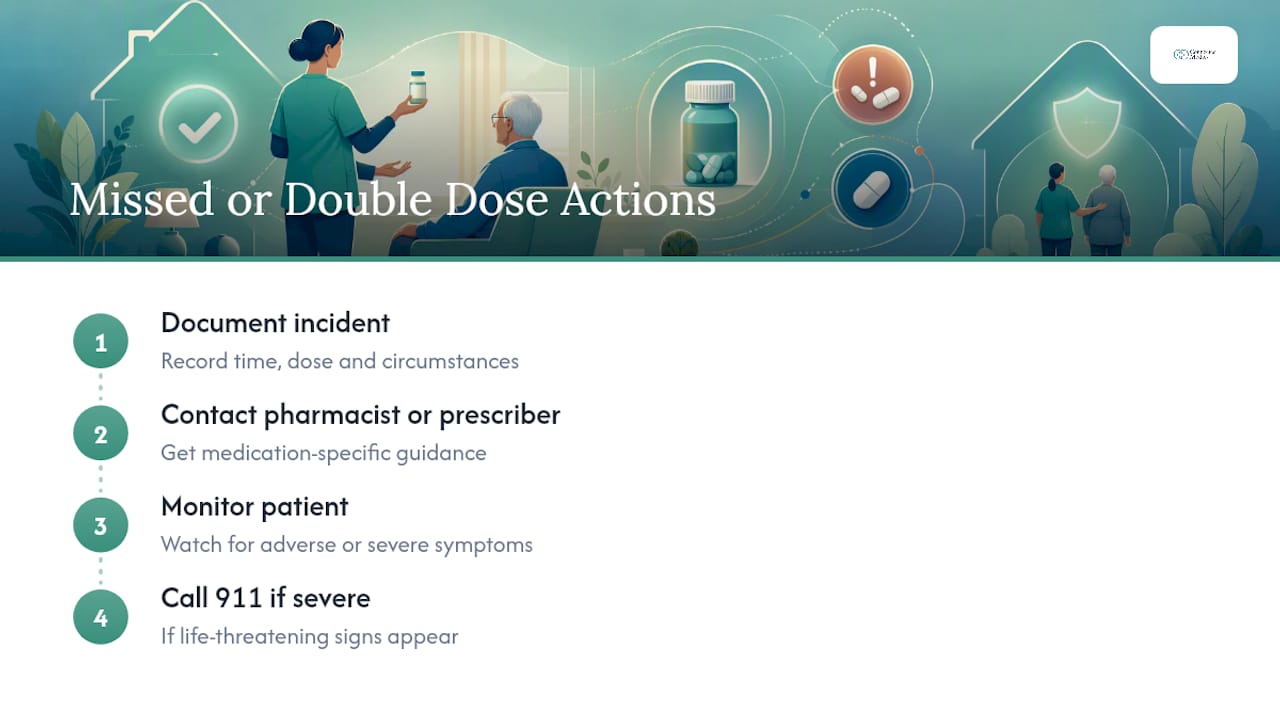
When an error happens, document what occurred, notify the prescriber or pharmacy immediately, monitor the patient closely, and call emergency services if symptoms are severe. About half of patients don't take medications exactly as prescribed, according to the Merck Manual, which is why simply asking "when did you last take this?" catches problems other checks miss.
What the Research Says About Improving Medication Adherence
Team-based care, packaging aids, and simple technology consistently outperform good intentions alone.
- Team-based interventions involving pharmacist-led reconciliation showed markedly higher adherence at 12 months than standard care, according to CDC research on adherence strategies.
- Pillboxes, blister packs, and electronic reminders reduce unintentional nonadherence at low cost.
- Nonadherence is tied consistently to worse outcomes and higher costs, which is why personalized, measured interventions beat generic reminders.
Nearly 3.8 billion retail prescriptions are filled in the U.S. every year, according to Statista, a scale where even small adherence gains ripple across millions of households.
Why Role Clarity in Medication Administration Actually Matters
Coordination failures, not clinical ignorance, cause most home medication errors I've seen described in case reviews. A clear handoff between the RN who reconciles the list and the aide who prompts the dose closes the gap where mistakes happen. Documentation on the MAR isn't paperwork for its own sake. It's the only record that tells the next person what actually occurred.
Patients do better when the conversation starts with their goals, not just their pill count. Asking "what does taking this medication let you do?" surfaces barriers that a checklist never will.
Get Connected With Verified Home Care Expertise
Coordinating medication roles across an RN, an aide, a pharmacist, and family members works best when everyone can actually reach each other and verify credentials. Connectedmedics gives healthcare professionals a verified network built specifically for this kind of coordination, with a knowledge hub that summarizes clinical research on adherence and safety so home care teams aren't piecing guidance together from scattered sources. Home care agencies looking to hire verified clinicians or connect with specialty-trained nurses can use Connectedmedics to build the kind of team-based structure the research above shows actually reduces errors. For families working alongside a local provider, resources like Seniors Helping Seniors offer additional hands-on guidance for day-to-day medication support.
Frequently Asked Questions
Who is legally responsible for medication administration in home care? Responsibility is shared: the RN or prescriber directs the plan, while aides and family members may assist only when the care plan and state delegation rules permit it.
Can a family caregiver give injections at home? Sometimes, after training from a home health nurse, but this depends on the medication and state rules; complex injections usually stay with licensed clinicians.
What's the difference between a home health aide and a nurse for medication tasks? An aide prompts or assists with routine oral medications under delegation; a nurse administers complex treatments, reconciles the full medication list, and manages adverse reactions.
How often should the medication list be reconciled? After every hospital discharge, new prescription, or significant health change, not on a fixed schedule alone.
What should I do if a dose is missed or doubled? Document it immediately, contact the pharmacist or prescriber for guidance, monitor the patient closely, and call 911 if severe symptoms appear.
This article is general information, not a substitute for advice from a qualified doctor. Consult a qualified healthcare professional about your own circumstances before acting on anything here.
Sources
- Medication Adherence: Taking Your Meds as Directed | American Heart Association
- Adherence to a Medication Regimen - Clinical Pharmacology - Merck Manual Professional Edition
- CDC MMWR: Strategies to improve medication adherence
- Medication adherence: Importance, issues and policy: A policy statement from systematic reviews | Frontiers in Pharmacology