Every international medical graduate who wants to practise medicine legally in the UK must hold registration with a licence to practise from the General Medical Council (GMC). This applies to all doctors, NHS or independent sector, full-time or locum. Practising without it is illegal.
The core eligibility requirements for relocation and licensing through GMC registration for international doctors are:
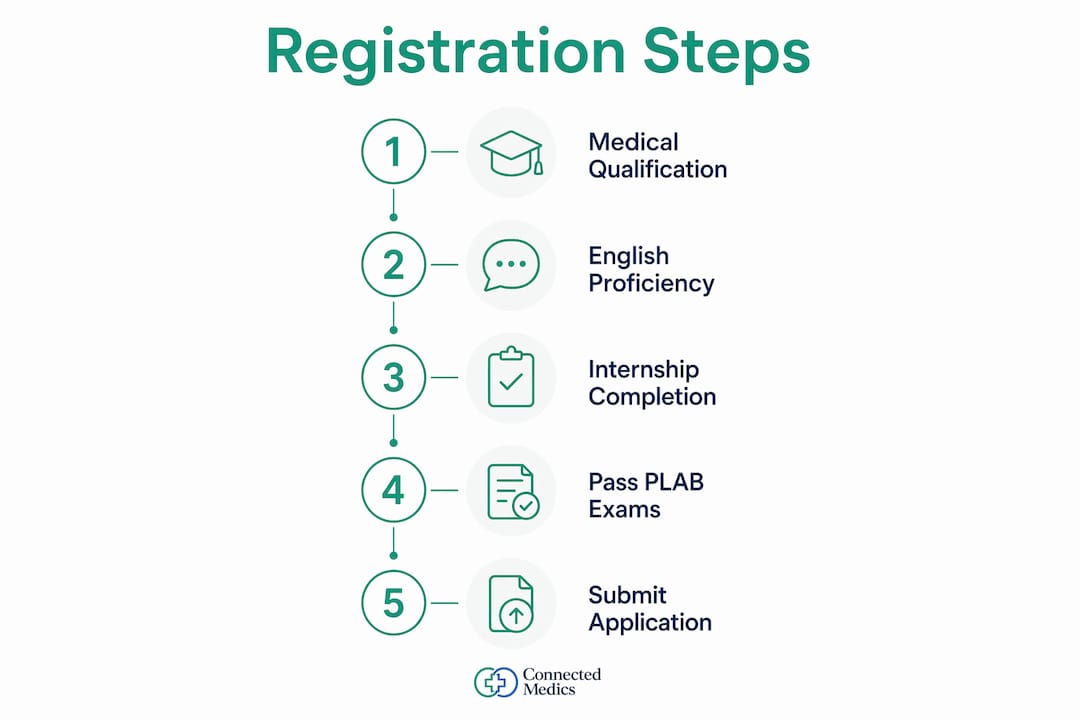
- A recognized primary medical qualification from a GMC-approved medical school
- Completion of an internship or equivalent postgraduate clinical experience
- English language proficiency, demonstrated through IELTS (overall score meeting GMC requirements) or OET
- A pass in both parts of the Professional and Linguistic Assessments Board (PLAB) test, within required time limits, unless an alternative qualification route applies
- A valid passport and photographic ID for identity verification
- Certificates of Good Standing from all previous medical regulators
- A full declaration of fitness to practise and a detailed five-year activity history
- Professional indemnity or insurance coverage
The registration fee for full GMC registration with a licence to practise is £408 in 2026, and the annual retention fee is also £408. Processing times and exact steps vary by route, but the framework below applies to the majority of international medical graduates.
How to complete GMC registration as an international medical graduate
The GMC registration process follows a defined sequence. Skipping or rushing any step typically causes delays.
- Confirm your qualification is recognized. Check the GMC's list of acceptable primary medical qualifications before doing anything else. ECFMG verification does not automatically mean GMC acceptance.
- Verify your documents. Use ECFMG or another GMC-approved channel to verify your primary medical qualification. Confirm GMC acceptance of your specific degree before incurring verification costs.
- Pass the English language test. Complete IELTS Academic (7.5 overall minimum) or OET. Your certificate must be no older than two years at the time of application.
- Pass both parts of PLAB. PLAB Part 1 can be taken at overseas test centers. PLAB Part 2 must be taken in the UK. Both parts must be passed within two years of applying for registration.
- Gather all required documents. This includes your primary medical qualification certificate, internship evidence, Certificates of Good Standing, passport, and a complete five-year activity history.
- Submit your application online. Use GMC Online to submit. The portal guides you through each document upload and declaration.
- Complete the in-person identity check. You must physically attend a GMC office in London or Manchester for a pre-registration identity check. This step cannot be completed remotely or from abroad.
- Receive your registration decision. Once all documents are verified and the identity check is done, the GMC processes your application. Timeline varies based on document completeness and application volume.
- Secure a job offer or NHS placement. Most NHS employers require full GMC registration before issuing a formal contract. New registrants must also work within a GMC-approved practice setting initially.
For a broader view of the international registration journey, Connectedmedics covers the key steps and licensing requirements for overseas graduates in detail.
What are the eligibility requirements for GMC registration?
Eligibility for full GMC registration depends on several factors, including where you qualified, your postgraduate experience, and your language proficiency.
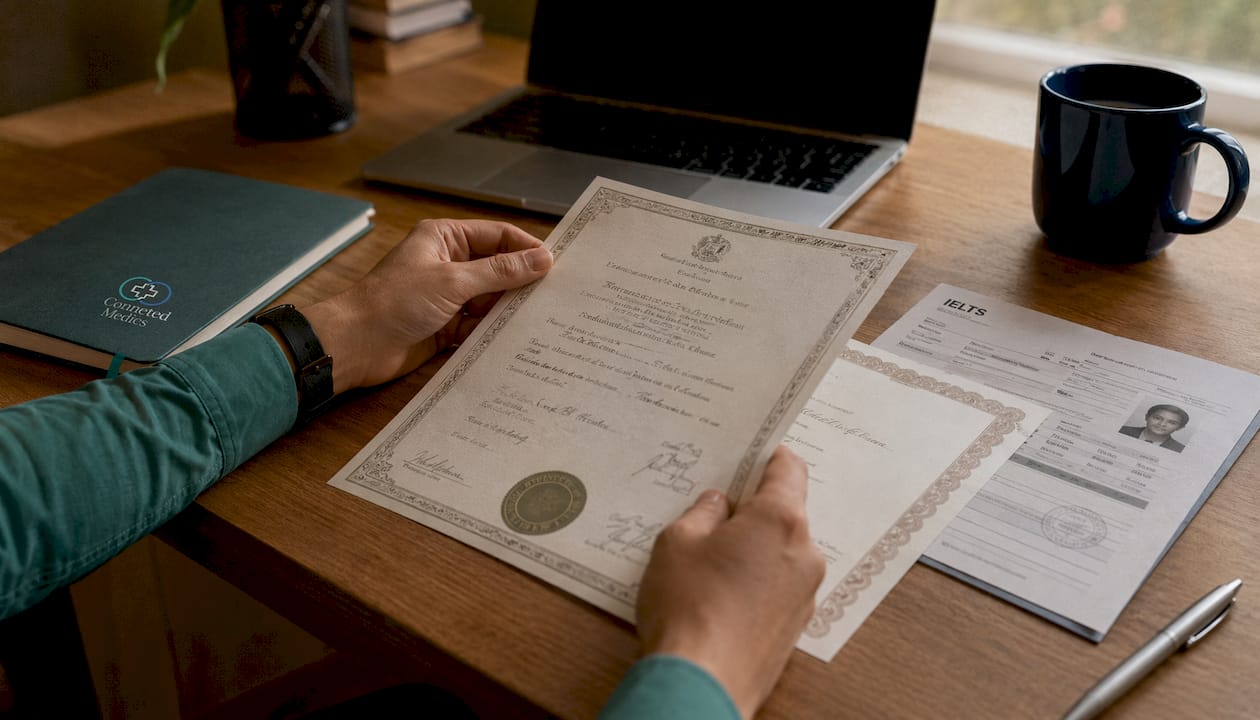
Primary medical qualification. Your degree must come from a medical school the GMC recognizes. The GMC publishes a list of acceptable overseas qualifications, and you should check it directly before applying. A qualification verified by ECFMG still needs to meet GMC's own criteria for acceptance.
Internship or postgraduate clinical experience. You must have completed an internship or an equivalent period of supervised clinical practice. The GMC specifies what counts as acceptable experience, and gaps in your clinical history will require explanation.
English language proficiency. The GMC accepts IELTS Academic (7.5 overall, with no component below 7.0) or OET. Both certificates must be issued within two years of your application date. Detailed score requirements and preparation guidance are available through resources like the IELTS for doctors guide on Connectedmedics.
PLAB or alternative route. Most international medical graduates must pass both PLAB parts. Alternatives include sponsorship by a GMC-approved sponsor or Medical Royal College, an acceptable postgraduate qualification, or eligibility for the specialist or GP register.
Fitness to practise declaration. You must declare any past or current fitness to practise proceedings, criminal convictions, or health conditions that could affect your practice. The GMC application guide makes clear that incomplete or inaccurate disclosures are among the most common reasons for delays or refusals.
Professional indemnity. GMC registration requires proof of appropriate indemnity coverage. NHS employment typically covers this automatically, but doctors working outside the NHS must arrange their own coverage separately.
What does GMC registration cost in 2026?
The standard fee for full GMC registration with a licence to practise is £408 in 2026. The annual retention fee to keep your registration active is also £408.
Beyond the GMC fee itself, budget for these additional costs:
- PLAB Part 1 and Part 2 exam fees. Fees are payable for both parts. Check the GMC website for current amounts, as they are updated periodically.
- ECFMG or document verification fees. Verifying your primary medical qualification through an approved channel carries its own cost.
- Document translation. Any document not in English must be translated by an approved translator. Translation costs vary by language and document volume.
- Travel to the UK for the identity check. You must attend a GMC office in person. Factor in travel, accommodation, and any visa costs for this trip.
- Professional indemnity insurance. If you plan to work outside the NHS, you will need to purchase your own coverage before you can practise.
Failure to pay the annual retention fee results in removal from the register. Doctors removed for non-payment must reapply and pay the full registration fee again to return.
How does GMC revalidation work after registration?
Revalidation is not a one-time event. It is an annual cycle of appraisal and review that every licensed doctor in the UK must complete to maintain their licence to practise.
The GMC decides, normally every five years, whether a doctor should be revalidated. The basis for that decision is the annual appraisal record built up over those years. NHS Employers and designated bodies support the process by assigning a Responsible Officer who oversees each doctor's appraisal.
To support revalidation, doctors must maintain records of continuing professional development, significant events, patient feedback, and colleague feedback. The GMC's Good Medical Practice publication sets the professional standards against which all of this evidence is measured.
Failing revalidation, or failing to engage with the appraisal process, can result in the GMC withdrawing a doctor's licence to practise. Restoration after that point requires a formal application and may involve additional assessment.
Tips for a smooth GMC registration application
The most common cause of delays is an incomplete or incorrectly routed application. These steps reduce that risk significantly.
- Use the GMC's Registration Application Finder first. The official tool identifies the correct registration route for your specific qualifications and experience. Applying through the wrong route wastes time and fees.
- Disclose everything in your five-year history. Any gap, any proceeding, any period of non-practice must be declared. The Medical Defence Union consistently flags incomplete disclosure as the leading cause of application refusals.
- Check document requirements before you gather them. Only original documents are accepted. Translations must meet GMC standards. Submitting photocopies or non-compliant translations forces a restart.
- Plan your UK visit early. The in-person identity check in London or Manchester must be scheduled in advance. If you are traveling from outside the UK, coordinate your visa and travel arrangements around this appointment, not the other way around.
- Confirm indemnity coverage before you apply. If you intend to work outside the NHS at any point, arrange your own professional indemnity insurance before submitting your application.
Pro Tip: Start your IELTS or OET preparation at least three to four months before your planned application date. Certificates expire after two years, so timing matters. If your certificate lapses before the GMC processes your application, you will need to retest.
What visa do international doctors need to relocate to the UK?
GMC registration and UK immigration are separate processes, but they are tightly linked in practice. You cannot complete the in-person identity check without being physically present in the UK, and most employers will not issue a job offer without confirmed GMC registration.
The most common visa route for international doctors is the Skilled Worker visa, which replaced the Tier 2 (General) visa. To apply, you need a job offer from a UK employer with a valid sponsor license, a Certificate of Sponsorship, and proof that the role meets the salary threshold set by the Home Office. The NHS is a licensed sponsor, so most NHS trusts can issue sponsorship directly.
Doctors relocating for postgraduate training may qualify under the Health and Care Worker visa, a subcategory of the Skilled Worker route that carries reduced visa fees and is exempt from the Immigration Health Surcharge. Eligibility depends on the specific role and employer. Full details on visa routes and requirements are covered in the visa guide for NHS doctors published by Connectedmedics.
Immigration rules are set by the Home Office and change periodically. Always verify current requirements directly with the Home Office or an authorized immigration advisor before applying.
How long does the full relocation and GMC registration process take?
The total timeline from starting your GMC application to your first day of practice in the UK typically spans several months. The exact duration depends on how quickly you gather documents, how long PLAB preparation takes, and how fast the GMC processes your application.
| Stage | Typical Duration |
|---|---|
| IELTS or OET preparation and testing | 2–4 months |
| PLAB Part 1 preparation and exam | 3 months |
| PLAB Part 2 preparation and exam | 2–4 months after Part 1 |
| Document gathering and verification | 4–8 weeks |
| GMC application processing | 4–8 weeks after identity check |
| Visa application and travel | 4–8 weeks |
| Total estimated timeline | 9 months |
These ranges assume no significant delays from incomplete documents or failed exams. Doctors who already hold a recognized postgraduate qualification and can bypass PLAB may complete the process faster. Those who need to retake PLAB or resubmit documents should add buffer time accordingly.
Starting the visa process in parallel with the later stages of GMC registration, rather than sequentially, is the most effective way to compress the overall timeline.
Key Takeaways
Full GMC registration with a licence to practise is a legal requirement for every doctor working in the UK, and the 2026 process requires passing PLAB, meeting English language standards, and completing an in-person identity check in the UK.
| Point | Details |
|---|---|
| Registration is mandatory | All doctors, NHS or private, must hold a GMC licence to practise before seeing patients. |
| PLAB and English tests have expiry dates | Both PLAB parts and your IELTS or OET certificate must be valid within two years of your application. |
| 2026 fees are £408 | The registration fee and the annual retention fee are each £408 in 2026; non-payment removes you from the register. |
| In-person identity check is required | You must attend a GMC office in London or Manchester; this step cannot be completed from abroad. |
| Revalidation is annual | Maintaining your licence requires an annual appraisal cycle, not just one-time registration. |
Connectedmedics supports international medical graduates at every stage of this process. The platform hosts over 4,600 active healthcare vacancies, verified professional profiles, and a knowledge hub with clinical insights contributed by practicing medical experts. Whether you are searching for your first NHS post or tracking the latest licensing updates, Connectedmedics connects you to the roles and resources that match your specialty.