
Start with specialty society career centers and a verified healthcare jobs network, then set alerts and upload a targeted CV the same day. That two-step move puts your profile in front of the highest-yield postings while automated matching works in the background. Physicians who follow this sequence typically see relevant interview invites within a few weeks, not months, because they've cut the noise out of a search that's usually cluttered with irrelevant listings.
TL;DR:
- Most oncology roles require board certification, a completed fellowship, and active licensure, with research positions often adding trial leadership or grant thresholds.
- Applying through specialty society career centers and verified healthcare networks increases the likelihood of relevant and timely interview invitations within a few weeks.
- Filtering searches by specialty, subspecialty, practice type, and location narrows thousands of results to highly relevant postings, including remote and hybrid options.
- Typical hiring timelines range from two to four months, with academic roles often taking longer due to credentialing and approval processes.
- Using verified specialty networks like Connectedmedics streamlines the search, employer screening, and matching process, reducing irrelevant listings and outreach.
Table of Contents
- Where Do Oncology and Hematology-Oncology Job Listings Live?
- How Do You Filter an Oncology Job Search by Specialty and Location?
- What Should You Check Before Applying to an Oncology Job Posting?
- How Do You Tailor a CV for an Oncology Job Application?
- What's the Typical Timeline and Compensation Range for Oncology Roles?
- Why Verified Specialty Networks Cut Search Time
- How Do Oncology Careers Advance, and What Continuing Education Is Required?
- Balancing an Active Job Search with a Full Clinical Schedule
- Find Verified Oncology Roles Through Connectedmedics
- Sources
- FAQ
Where Do Oncology and Hematology-Oncology Job Listings Live?
Postings scatter across five distinct source types, and each one skews toward a different kind of role. Knowing which to check first saves hours.
- Specialty society career centers: The ASCO Career Center and ASH Job Center together list 300 or more active oncology and hematology roles at any given time, and they skew heavily toward academic and research-track openings.
- Major cancer center career pages: Institutions like Memorial Sloan Kettering post clinical and research openings directly, making these pages a primary source for leadership and academic positions you won't always find aggregated elsewhere.
- Employer portals and physician recruiting networks: Sites like PracticeMatch aggregate several hundred oncology physician jobs across many states, filtered by specialty, location, and job type, and they're the fastest route to community and private practice openings.
- Nonprofit and advocacy organizations: The American Cancer Society and CancerCare post program management, patient navigation, and administrative roles that rarely show up on physician-specific boards.
- Verified healthcare networks: A specialty-filtered, verified platform run alongside society boards cuts through duplicate listings and generalist job-board clutter, surfacing postings that match your subspecialty rather than everything tagged "oncology."
Running two or three of these in parallel, rather than relying on one aggregator, is how most oncologists build a realistic picture of what's actually open in their target region.
How Do You Filter an Oncology Job Search by Specialty and Location?
Broad searches for "oncology jobs" return thousands of irrelevant results. Precision filtering fixes that in minutes.
- Set specialty and subspecialty filters first. Choose medical oncology, hematology/oncology, radiation oncology, or surgical oncology before touching location, since this single filter eliminates the largest chunk of noise.
- Separate clinical from research-track postings. Most boards let you toggle this early. If you want protected research time, filter it in rather than reading every listing to find out.
- Choose academic versus private practice. These postings have different application paths and different documentation requirements, so filtering here avoids wasted applications.
- Set a location radius, then layer in remote or hybrid options. Administrative, navigation, and some research-support roles increasingly allow hybrid schedules, but clinical oncology rarely does.
- Save your search and turn on email alerts. Prioritize alerts on specialty society boards and your verified network profile first, since these tend to carry the freshest academic and research listings.
Pro Tip: Run the same keyword search with "hematology-oncology," "heme-onc," and "hematology/oncology" separately. Boards index these differently, and skipping variants means missing postings that use a different label for the identical role.
What Should You Check Before Applying to an Oncology Job Posting?
Not every listing deserves an application. A quick triage against a few criteria separates strong-fit postings from ones that waste your time.
- Non-negotiable requirements: Board certification, completed fellowship, and active or eligible state licensure are almost always hard requirements, not preferences.
- Clinical schedule signals: Look for explicit mentions of clinic days per week, inpatient service rotation frequency, and call schedule. Vague language here usually means an unpredictable schedule once you're hired.
- Research and academic infrastructure: Protected research time, startup packages, and access to a clinical trials office signal a genuinely supported academic track rather than a clinical job with a research title attached.
- Red flags: Watch for vague productivity targets ("competitive RVU expectations" with no number), benefits described only as "comprehensive," or clinical volumes that sound unrealistic for the staffing described.
Postings that name specific infrastructure, like dedicated infusion suites or embedded clinical trials offices, tend to deliver on research promises more reliably than ones that mention research only in passing. That single detail is often a better predictor of day-to-day reality than the title on the job ad.
How Do You Tailor a CV for an Oncology Job Application?
Recruiters and applicant tracking systems screen for specific, quantifiable data points, not general descriptions of your training. Structure your CV to hand them exactly what they're filtering for.
- Front-load your board certification, fellowship, and licensure status. These get scanned first, often by software before a human ever opens the file.
- Quantify clinical volume, trial leadership, and grant funding. Clinical research and pharma-facing roles frequently screen against explicit numeric thresholds, so a CV that states "led 4 investigator-initiated trials" outperforms one that says "extensive trial experience."
- Match your cover letter to the institution's stated priorities. If the posting emphasizes multidisciplinary tumor boards, mention your experience presenting at them.
- Prepare for scenario-based interview questions. Oncology interviews often probe how you'd handle a difficult prognosis conversation or a treatment-plan disagreement with a colleague, not just your technical background.
Pro Tip: List exact numbers wherever possible: trials led, grant dollar amounts, annual patient volume. These figures often function as literal screening filters in both automated systems and recruiter shortlists, so a vague "significant experience" line gets filtered out before a person sees it.
Guides like ASCO Connection's tips for landing an oncology job reinforce a consistent theme: specificity in your materials beats polish every time.
What's the Typical Timeline and Compensation Range for Oncology Roles?
Oncology hiring cycles tend to run longer than general medicine, largely because credentialing and department-level approvals add steps that other specialties skip.
- Timeline: Expect several weeks from initial application to first interview, and often two to four months total from posting to signed offer once credentialing and reference checks are factored in.
- Base compensation: Compare base salary against regional benchmarks for your subspecialty, not national averages, since radiation oncology and surgical oncology pay structures differ meaningfully from medical oncology.
- Additional components: Signing bonuses, loan repayment programs, retirement matching, health and dental insurance, and CME support are the standard categories employer pages list, and nonprofit and academic employers frequently highlight flexibility and benefits as retention tools.
- Negotiation priorities: Rank loan repayment and CME support high if you're early career; prioritize retirement match and call schedule flexibility if you're mid-career.
- When to bring in help: Use a recruiter for market intelligence on comparable offers, and get legal review before signing any contract with a noncompete or productivity-based compensation clause.
Why Verified Specialty Networks Cut Search Time
Generalist job boards mix oncology postings with every other specialty, which means recruiters searching them get flooded with irrelevant applicants and physicians get flooded with irrelevant outreach. A verified, healthcare-only network with specialty tagging solves this from both directions.
- Verified profiles let recruiters confirm board certification and fellowship status before ever reaching out, which cuts down on mismatched inquiries.
- Specialty filters mean an oncology posting reaches oncologists specifically, not a generic pool of "physicians."
- Running a verified network alongside society boards and employer pages, rather than instead of them, gives you both depth (society boards) and reach (broader specialty matching) at once.
Connectedmedics applies this model directly, pairing verified clinician profiles with specialty-filtered job listings so oncology postings surface for oncology-trained applicants rather than getting buried in a general feed.
How Do Oncology Careers Advance, and What Continuing Education Is Required?
Career progression in oncology typically follows one of three tracks: clinical leadership (division chief, medical director), academic advancement (assistant to full professor, research funding milestones), or subspecialty deepening (added certification in areas like neuro-oncology or gynecologic oncology).
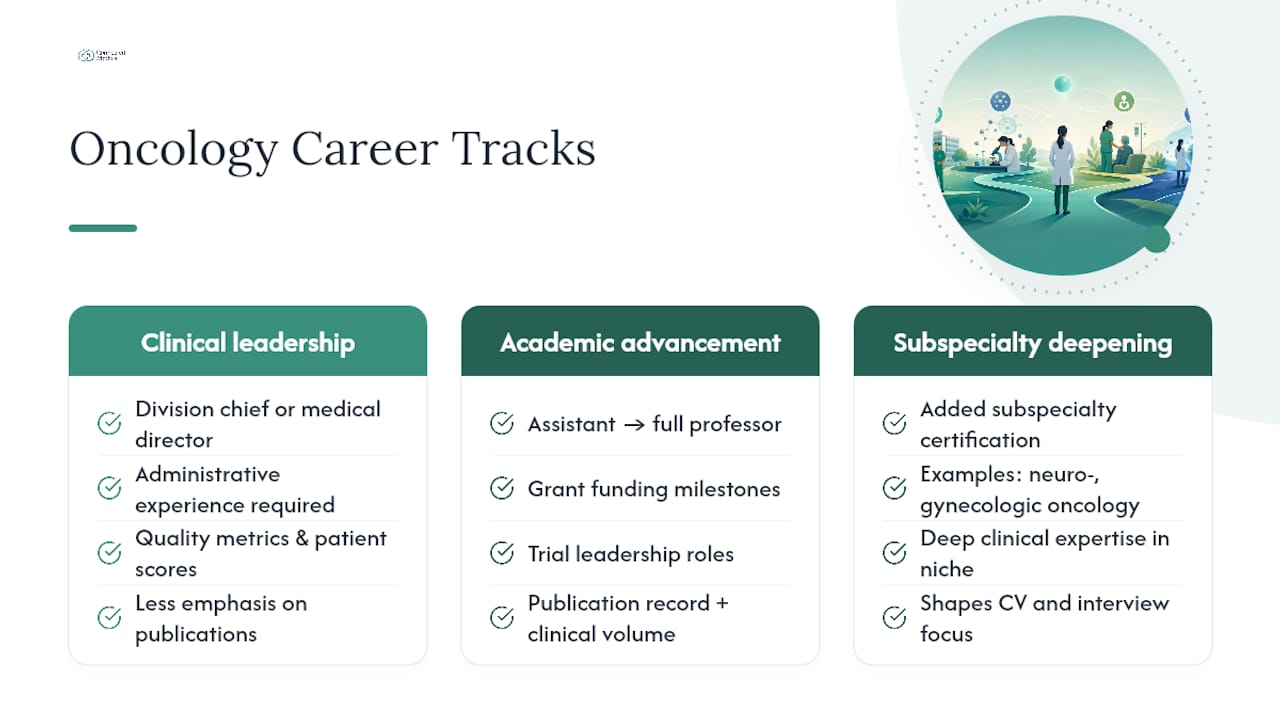
Board recertification cycles, usually every ten years through the relevant American Board of Medical Specialties member board, anchor the continuing education requirement, but most institutions also mandate annual CME hours tied to state licensure. Academic tracks add a second layer: promotion committees typically weigh grant funding, trial leadership, and publication record alongside clinical volume, so physicians aiming for a research-heavy career need to document those metrics from year one rather than retrofitting a CV later.
Community and private practice tracks reward a different mix. Leadership roles there often hinge on administrative experience, quality metrics, and patient satisfaction scores rather than publication count. Fellows and early-career oncologists benefit from deciding which track they're aiming for before their first job search, since the CV, the interview talking points, and even which job boards to prioritize shift depending on the answer. A physician targeting an academic medical center benefits from researching infrastructure investments in specialty research at target institutions before applying, since that context shapes what questions to ask in an interview.
Balancing an Active Job Search with a Full Clinical Schedule
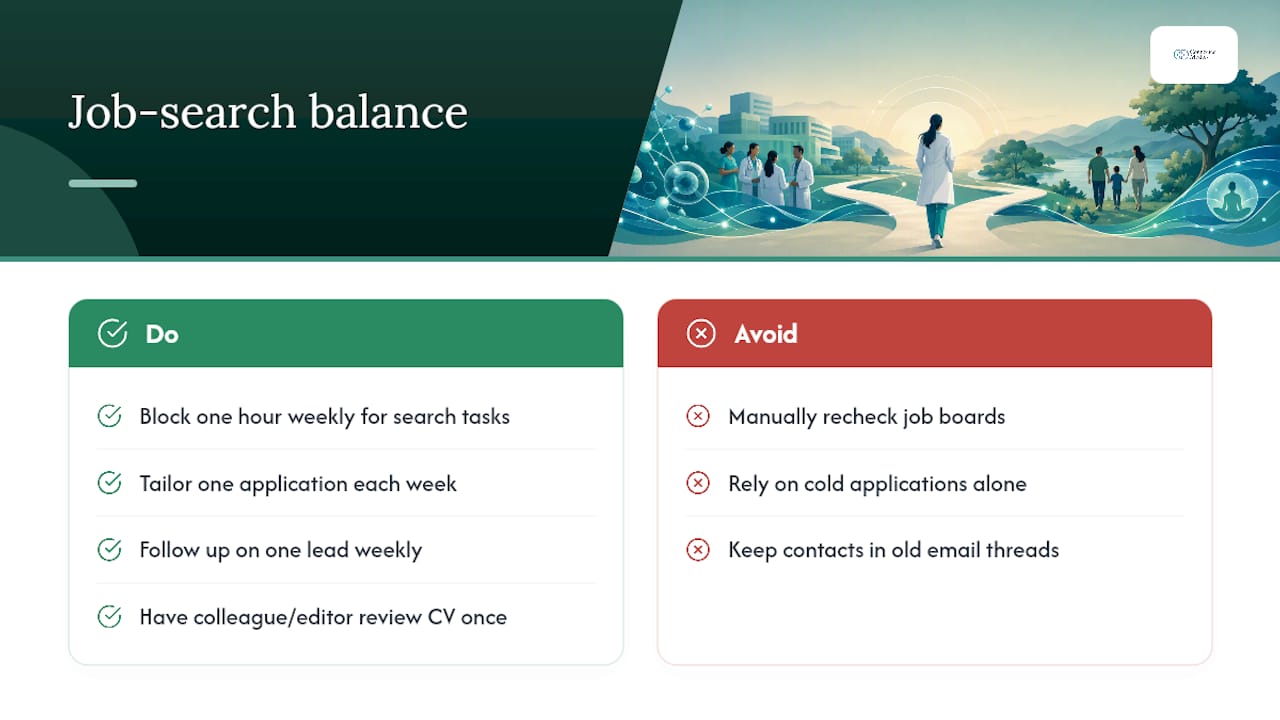
Block one hour a week, not more, for search tasks: reviewing new alerts, tailoring one application, and following up on one lead. Delegate what you can. Have a colleague or professional editor review your CV once before submission, and let alerts handle the day-to-day scanning instead of manually rechecking boards.
The highest-quality leads rarely come from cold applications. They come from a call schedule colleague mentioning an opening, a tumor board contact from a conference, or a departing physician giving you the first tip. A verified specialty network makes those connections easier to maintain between conferences, since it keeps your professional contacts organized in one place instead of scattered across old email threads.
— David
Find Verified Oncology Roles Through Connectedmedics
Connectedmedics is the alternative to sorting through generalist job boards for oncology openings: a healthcare-only network with verified clinician profiles and specialty filters built specifically so oncology and hematology-oncology postings reach oncology-trained applicants, not a generic pool of physicians.
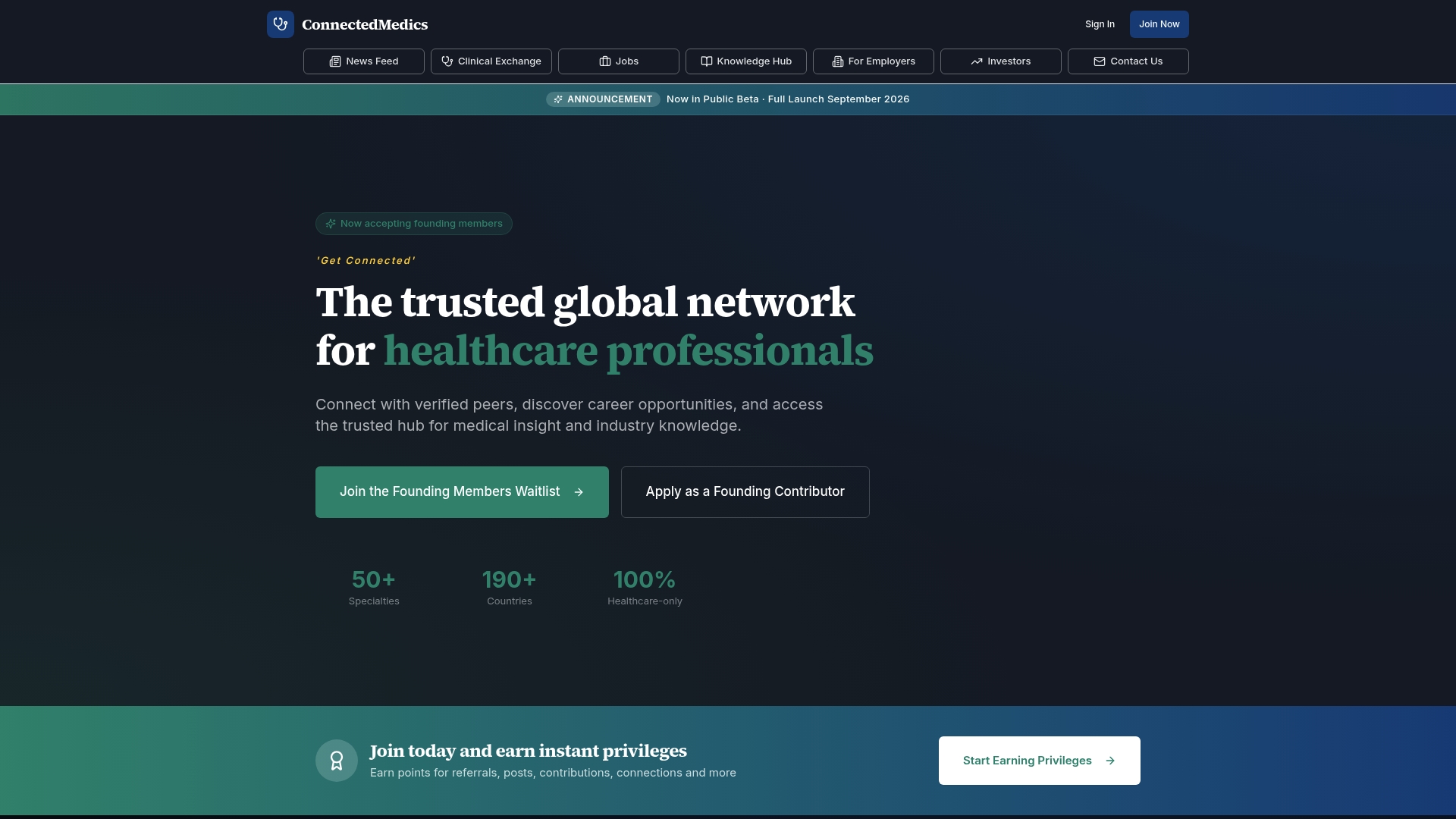
The platform's jobs board pairs AI-powered matching with credential verification, so recruiters see applicant certifications upfront and users see postings filtered to their subspecialty rather than every "oncology" tagged listing on a generalist site. Employers use the same system from the other side, posting through Free, Growth, and Enterprise plans or unlocking targeted candidate matching through Premium Employer tools. Create a verified profile, upload your CV, and set specialty and location alerts today to start surfacing oncology roles that match your training instead of your search terms.
Sources
- ASCO Career Center
- Search Jobs | Memorial Sloan Kettering Cancer Center
- Employment Opportunities | American Cancer Society
- Oncology Physician Jobs | PracticeMatch
FAQ
How Do I Start an Oncology Jobs Search Efficiently?
Begin with a specialty society career center like the ASCO Career Center and a verified healthcare network, then set alerts and upload a tailored CV immediately. This combination surfaces academic and research roles alongside community openings without manually checking dozens of separate sites.
Where Are the Best Oncology Job Openings Listed?
Specialty career centers and major cancer center pages carry the most academic and research-track oncology job openings, while aggregated physician networks like PracticeMatch list several hundred postings across community and private practice settings. Nonprofit employers add a third category focused on program and patient-support roles.
What Credentials Do Most Oncology Job Listings Require?
Board certification, a completed fellowship in the relevant oncology subspecialty, and active or eligible state licensure are standard, non-negotiable requirements on nearly every posting. Research-track roles often add specific trial-leadership or grant-funding thresholds as screening criteria.
How Long Does It Take to Get an Oncology Job Offer?
Most oncology hiring cycles run two to four months from application to signed offer, longer than general medicine due to added credentialing steps. Academic and leadership roles at major cancer centers tend toward the longer end of that range.
Does Connectedmedics Help With Oncology Career Opportunities?
Connectedmedics offers verified clinician profiles and specialty-filtered job listings designed to match oncology physicians with relevant openings rather than generic postings. Current employer plan pricing is listed on the Connectedmedics employer page.