
Crowdsourcing clinical data from professionals works when you limit contributors to verified healthcare providers and pair that gate with deidentification, IRB oversight, and standards-based integration through FHIR and HL7. A systematic review of 188 studies found crowdsourcing effective for tasks like surgical-skill evaluation and AI annotation, with real cost and feasibility advantages over traditional expert-only review.
The core setup requires five elements:
- Professional verification before task access
- Deidentification and privacy controls
- Decomposed, testable task design
- Consensus-based quality assurance
- Integration with existing EHR/EDC systems
The FDA itself uses crowdsourcing platforms to collect stakeholder input on trial protocols, and ConnectedMedics operates as one of the verified professional networks capable of supplying qualified contributors for this kind of work.
Key Takeaways
Reliable clinical crowdsourcing requires verified professional contributors, deidentified data, decomposed tasks, layered quality controls, and standards-based integration with existing clinical systems.
| Point | Details |
|---|---|
| Restrict to verified professionals | Use institutional email, license checks, or manual credential review before granting any data access. |
| Match method to use case | Crowdsource for annotation and insight; use FHIR/HL7-based EHR/EDC capture for regulated trial data. |
| Build layered QA | Combine qualification tests, quorum consensus, expertise weighting, and ML-assisted pre-highlighting. |
| Secure IRB and DUA first | No identifiable health data access happens before IRB approval and a signed data-use agreement. |
| Use a verified network | ConnectedMedics offers a pre-verified clinician pool that speeds recruitment and supports auditable onboarding. |
Table of Contents
- When Should You Crowdsource Clinical Data From Professionals?
- How Do You Design Tasks That Produce Reliable Clinical Labels?
- How Do You Recruit and Verify a Professional Crowd?
- What Privacy and Compliance Controls Are Required?
- Which Platform Architecture Fits Clinical Crowdsourcing?
- What Quality Controls Keep Crowdsourced Labels Reliable?
- What Does a Clinician Chart Review Pilot Look Like?
- What Risks Could Derail Your Crowdsourcing Project?
- What Should Your First 8 Weeks Look Like?
- What Actually Works When You Recruit Clinicians?
- Where a Verified Network Simplifies Recruitment
- Frequently Asked Questions
- Sources
When Should You Crowdsource Clinical Data From Professionals?
Crowdsourcing earns its place when you need annotation, novel clinical insight, protocol feedback, or labeled data for AI training. A crowdsourcing framework built for medical chart review proves this works at scale, using deidentified records and trained medical annotators instead of a live EHR feed.
It's the wrong tool for regulatory trials, primary safety endpoints, or anything requiring source data verification. Those cases demand direct EHR-to-EDC capture through FHIR and HL7 automation, which reduces transcription error and satisfies GCP and 21 CFR Part 11 requirements.
Run your project through these filters before choosing a path:
- Data sensitivity: Can this dataset be deidentified without losing clinical value?
- Regulatory weight: Does this feed a primary trial endpoint, or support secondary insight?
- Source authenticity: Do you need a verifiable chain back to the original chart?
- Timeline and scale: Do you need hundreds of labels fast, or a handful with perfect provenance?
- Expertise depth: Does this task need a subspecialist, or general clinical judgment?
How Do You Design Tasks That Produce Reliable Clinical Labels?
Decomposed, objective tasks beat broad, open-ended ones almost every time. A binary flag, a multiple-choice question with visual examples, or a short text extraction produces far more consistent results than asking an annotator to "summarize this chart."
Break work down in layers: document level, then paragraph, then sentence, then discrete data field. Chart review favors structured extraction questions; image annotation favors bounding boxes or categorical labels tied to reference examples. The medical chart review framework built exactly this kind of layered task structure and used Pybossa, an open-source platform for configurable task presenters, to manage it.
Before any task goes live, run a pilot and collect:
- Inter-rater agreement across a sample set
- Time-per-task, to catch tasks that are too ambiguous
- Sensitivity and specificity against a gold-standard set
- Worker throughput under realistic conditions
Pro Tip: Build two or three worked examples into every task interface, and require a short qualification run before granting access to live data. Annotators who pass a 10 to 15 item quiz produce measurably cleaner labels than those thrown straight into production work.
How Do You Recruit and Verify a Professional Crowd?
Restrict participation to verified professionals from the start, using institutional email domains, medical license numbers, or manual credential review. This single decision determines whether your labels are trustworthy or noise.
Good recruitment channels include specialty societies, academic medical centers, residency and fellowship programs, and curated professional networks like ConnectedMedics, which maintains verified clinician profiles specifically for this kind of collaboration. Verification methods range from simple domain checks to manual license lookups, and sensitive tasks often warrant multi-factor verification on top of credential proof.
Keep contributors engaged with a mix of incentives:
- Honoraria tied to completed, quality-passed tasks
- CME credit where your institution can arrange it
- Authorship or acknowledgment credit on resulting publications
- Light gamification, which unpublished practice reports suggest can meaningfully improve sustained engagement among clinical annotators
Before anyone touches real data, walk them through consent, a signed data-use agreement, role-based access setup, a short training module, and a qualification test. Document each contributor's competencies so you can defend your annotation quality later.
What Privacy and Compliance Controls Are Required?
Plan for IRB approval or a documented IRB exemption, plus a formal data-use agreement, before anyone touches identifiable health data. Skip this step and the entire project is exposed, regardless of how good your task design is.
Your compliance checklist needs:
- A tested deidentification routine applied before any data reaches a contributor
- Minimum-necessary data patches, so annotators see only what the task requires
- DUA language covering permitted use, retention, and destruction
- Role-based access controls tied to verified credentials
- Audit logging on every view and every annotation
- A documented disaster recovery plan
The FDA already runs its own crowdsourcing programs to gather stakeholder input on drug development and protocol design, which sets a real regulatory precedent for structured, well-governed crowdsourcing in clinical contexts.
Pro Tip: Automate deidentification wherever possible, then add a human spot-check on a sample of outputs. Combine that with full audit logs, and you have a defensible trail if a regulator or an IRB asks how the data moved.
Beyond privacy mechanics, treat your clinician contributors fairly. Compensation should reflect actual time spent, and off-hours expectations need to be explicit in your recruitment materials, not buried in a consent form nobody reads closely.
Which Platform Architecture Fits Clinical Crowdsourcing?
Use private, access-controlled platforms for anything touching protected health information, and avoid public crowds like Amazon Mechanical Turk entirely for PHI-adjacent work. Public crowd workers lack the credentials and, often, the domain expertise clinical tasks demand, and the underlying privacy risks compound quickly once you're dealing with real patient records, even deidentified ones.
A sound architecture layers tiered access on top of a deidentified data store, serves short-lived task views instead of persistent file access, and logs every interaction. Build in FHIR and HL7 integration points so labeled outputs can flow back into your downstream systems without manual re-entry.
For tooling, Pybossa remains a solid open-source option for building configurable annotation interfaces, while platforms like OpenClinica's Unite handle EHR-to-EDC automation when you need source data rather than crowd-generated labels.
Pro Tip: Add highlighting, learning-to-rank search, and pre-populated examples to your annotation interface. These small UX additions cut task time noticeably and reduce careless errors, especially on longer chart-review tasks.
What Quality Controls Keep Crowdsourced Labels Reliable?
Layer your QA: qualification tests up front, ongoing performance scoring throughout, and quorum-based consensus rules on every task. No single mechanism catches everything on its own.
Set a quorum size (three to five annotators is common for ambiguous clinical tasks), define your majority threshold, and build in an expert override for cases where consensus fails. Dynamic re-weighting, where consistently accurate annotators carry more influence over time, tends to sharpen results as your pool matures.
ML can help without replacing human judgment. Pre-highlighting likely findings, using active learning to route ambiguous cases to your most experienced annotators, and letting a model suggest labels for human confirmation all speed the process while keeping accuracy checks in place.
Systematic review evidence shows crowdsourced labeling has matched expert-level accuracy on several specific health tasks, including AI training annotation and surgical-skill assessment, though results vary by task complexity.
Track these metrics continuously:
- Sensitivity and specificity against your gold-standard set
- Cohen's kappa or Fleiss' kappa for inter-rater agreement
- Per-worker accuracy over time
- Drift monitoring, to catch quality decay before it spreads
What Does a Clinician Chart Review Pilot Look Like?
A study team paired with IRB-approved annotators should run this, not a lone researcher improvising on the fly. The workflow follows a clear sequence:
- Select and deidentify your source data.
- Design decomposed annotation tasks and build the interface.
- Recruit verified professional annotators and run a qualification test.
- Launch the pilot on a small sample set.
- Apply consensus aggregation rules to pilot outputs.
- Validate pilot results against expert gold labels.
- Iterate on task design based on agreement scores and feedback.
Target thresholds worth setting before you start: strong inter-rater agreement on your gold set, most items reaching quorum on the first pass, and a reasonable time-per-task that doesn't burn out your annotators. A typical timeline runs weeks 0 to 2 for prep and IRB submission, weeks 2 to 4 for onboarding and the pilot run itself, and weeks 4 to 6 for analysis and design iteration.
What Risks Could Derail Your Crowdsourcing Project?
The critical risks are privacy breaches, weak worker competency, regulatory noncompliance, and re-identification of supposedly deidentified data. Any one of these can shut a project down.
Operational headaches include a limited pool of qualified annotators, annotation fatigue on long tasks, and bias if your contributor pool skews toward one specialty or region. Watch for red flags like uncontrolled PHI access, missing IRB or DUA documentation, unfair compensation models, and thin audit trails.
Mitigate with tiered access controls, small but rigorous gold-standard sets, and scheduled annotator retraining to keep skills sharp.
What Should Your First 8 Weeks Look Like?
Start with the fundamentals: define your objectives clearly, prepare IRB materials or document your exemption, and settle on data minimization terms and DUA language before recruiting a single contributor.
- Weeks 1 to 2: Finalize objectives, IRB submission, and DUA drafts. Owner: study lead.
- Weeks 2 to 3: Build verification workflow and recruit initial annotator pool. Owner: recruitment coordinator.
- Weeks 3 to 5: Build task interface, deidentification script, and qualification test. Owner: technical lead.
- Weeks 5 to 6: Run the pilot with a gold-standard validation set. Owner: study team.
- Weeks 6 to 8: Analyze results, refine tasks, document lessons for scale-up. Owner: study lead.
Before touching live data, confirm you have a working deidentification script, a passed qualification test for every annotator, audit logging turned on, and a finished gold-standard set ready for comparison.
What Actually Works When You Recruit Clinicians?
Realistic timelines run longer than most teams expect. Clinicians say yes to short, well-scoped task bursts far more often than open-ended commitments, and the biggest source of pushback is vague scope, not compensation. Be specific about time investment up front and you'll see far higher follow-through.
Recognition matters more than most protocols account for. A clear feedback loop showing contributors how their annotations shaped a result keeps engagement high without inflating incentive budgets. ConnectedMedics built its verified network around exactly this kind of transparency between contributors and the research they support.
Pro Tip: Batch tasks into 15 to 20 minute bursts rather than long sessions, and send a short summary of pilot results back to every contributor. That single email does more for retention than most incentive programs.
Where a Verified Network Simplifies Recruitment
Building a private crowd from scratch means solving verification, credentialing, and onboarding before you write a single annotation task. That's real overhead for a research team already stretched across protocol design and IRB paperwork.
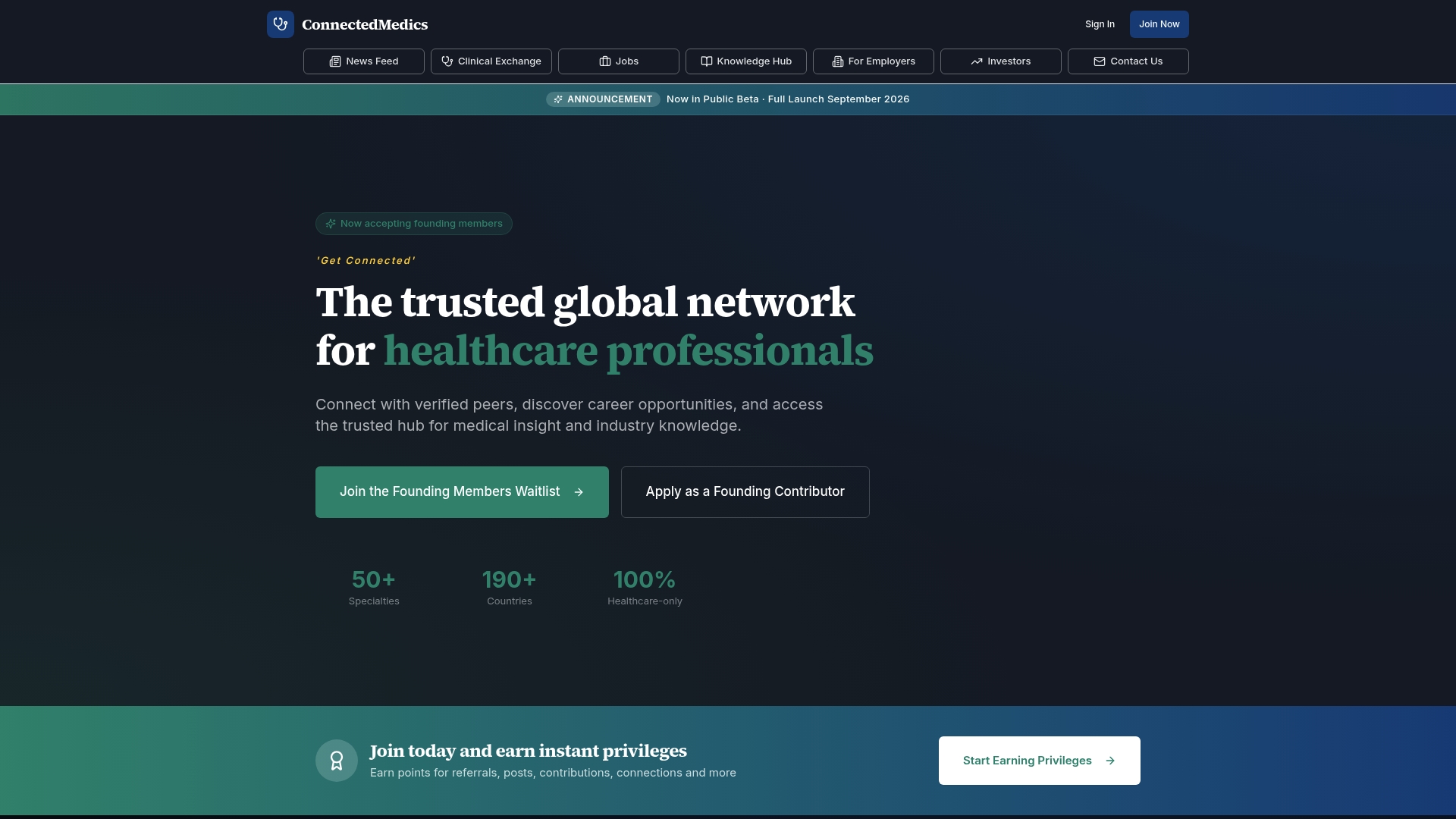
ConnectedMedics shortens that path by giving you a pool of already-verified healthcare professionals, filterable by specialty, ready to onboard for annotation or advisory work. Profiles carry verified credentials from the start, so you skip the manual license-checking most teams build in-house. Specialty filters help you match task complexity to actual clinical expertise, and the platform's structure supports the kind of audit trail an IRB or DUA reviewer expects to see. If your team is planning a professional-crowdsourcing pilot, explore ConnectedMedics to see how a verified clinician pool fits into your recruitment plan before you build one from zero.
Frequently Asked Questions
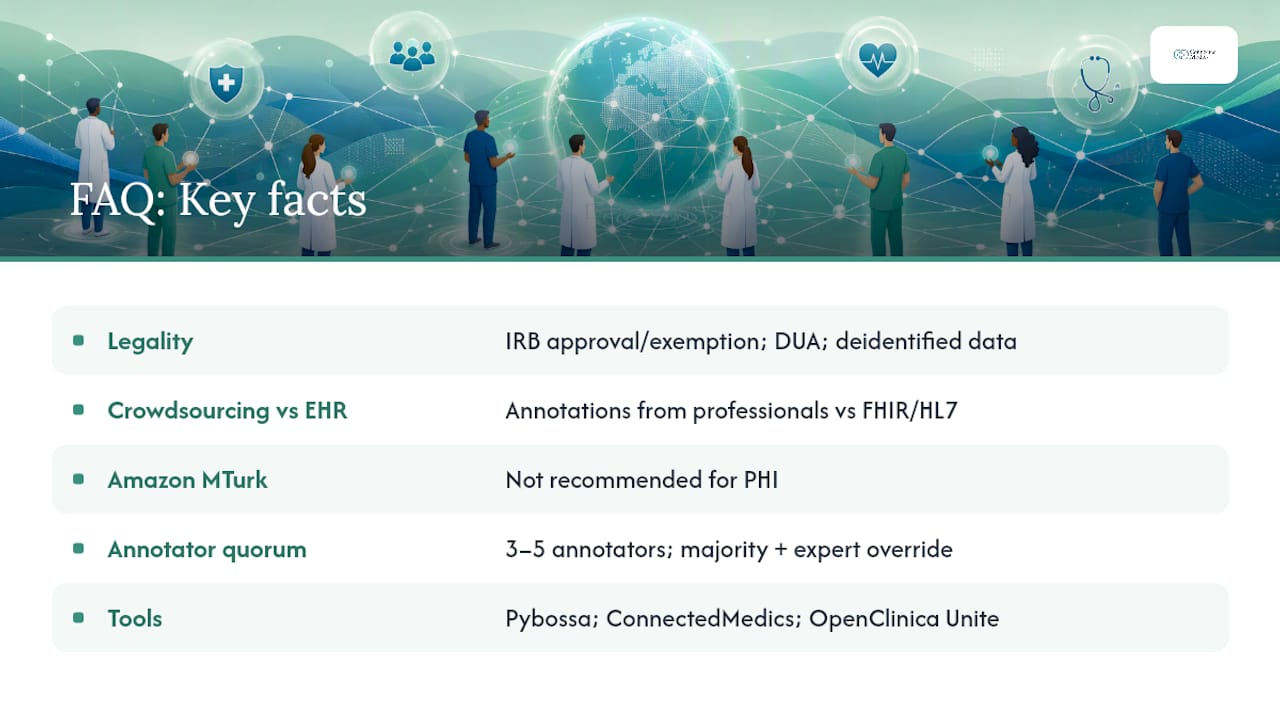
Is it legal to crowdsource clinical data from healthcare professionals? Yes, when the project has IRB approval or a documented exemption, a signed data-use agreement, and deidentified data. The FDA itself runs crowdsourcing programs for stakeholder input under similar governance principles.
What's the difference between crowdsourcing and EHR-to-EDC capture? Crowdsourcing gathers annotations, labels, or insight from professionals reviewing deidentified material. EHR-to-EDC capture, using FHIR and HL7 standards, pulls verified source data directly from clinical records for regulated trial use.
Can Amazon Mechanical Turk be used for clinical data tasks? Generally no, for anything touching protected health information. Public crowds lack the credentialing and expertise clinical tasks require, and privacy risk rises sharply without professional-only access controls.
How many annotators do you need for reliable consensus? Three to five annotators per ambiguous task is a common quorum size, with majority thresholds and expert override rules to resolve disagreement.
What tools support professional clinical crowdsourcing? Pybossa offers an open-source framework for building annotation task interfaces. ConnectedMedics provides a verified professional network for recruitment, and OpenClinica's Unite supports EHR-to-EDC automation for source data.
This article is general information, not a substitute for advice from a qualified doctor. Consult a qualified healthcare professional about your own circumstances before acting on anything here.
Sources
- FDA crowdsourcing
- A crowdsourcing framework for medical data annotation (PMC5961774)
- Crowdsourcing in health and medical research: a systematic review | Infectious Diseases of Poverty