
An appraisal for GPs is an annual, confidential, peer-facilitated review of your whole scope of practice. It produces a personal development plan (PDP), a written summary, and an appraiser statement used for credentialing, Maintenance of Certification (MOC), and privileging. Success means a focused portfolio, clear PDP goals, and a confirmed appraiser statement.
Key success criteria at a glance:
- Succinct written summary covering all practice roles
- SMART PDP items with measurable outcomes
- Appraiser statement confirming the discussion met standards
- Evidence aligned with credentialing bodies: AAFP, ABFM, FSMB, and your state medical board
- Connectedmedics as a verified career resource for networking and job evidence
Table of Contents
- What does an appraisal for GPs actually cover?
- Who conducts appraisals and what should you expect from them?
- How to prepare: building your evidence portfolio step by step
- What is the typical appraisal process and timeline?
- Why appraisal must stay separate from performance management
- Common mistakes GPs make preparing for appraisal
- U.S. resources and templates for GP appraisal
- How to use appraisal outputs in job searches and networking
- Key Takeaways
- Why appraisal is worth more than most physicians give it
- Connectedmedics: a verified network for appraisal-ready physicians
- Useful sources and further reading
What does an appraisal for GPs actually cover?
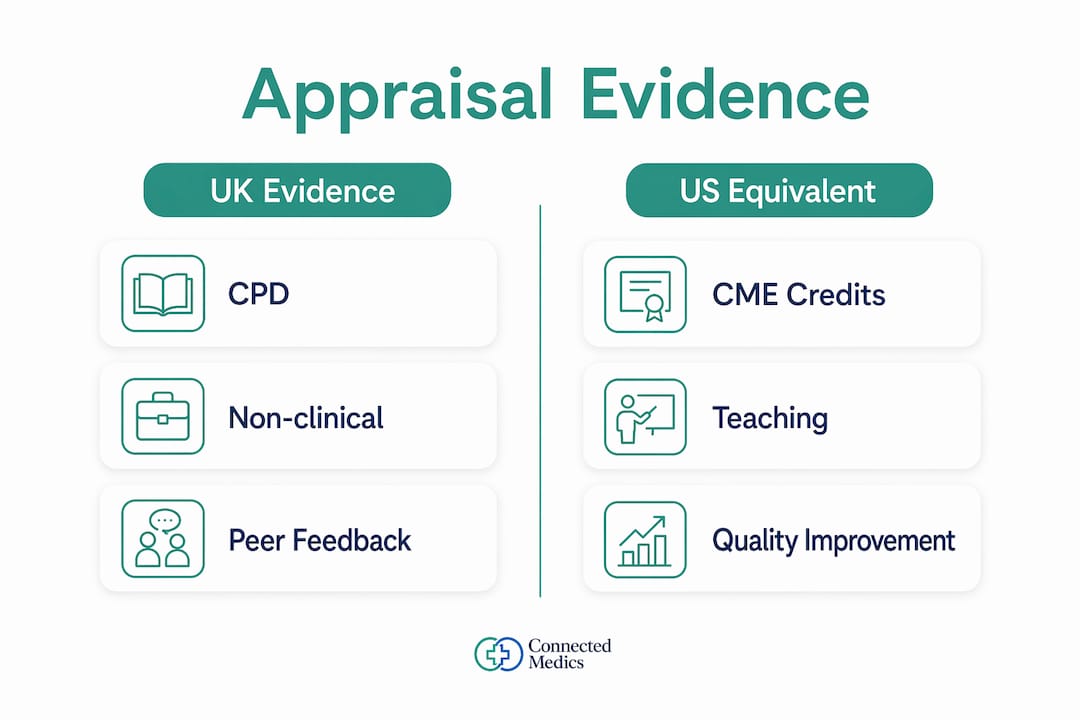
The scope is broader than most physicians expect. Supporting information must reflect your entire scope of work, including non-clinical roles.
Six core evidence categories and their U.S. equivalents:
| Evidence Category | U.S. Equivalent | Example |
|---|---|---|
| Continuing Professional Development (CPD) | CME credits, conferences | AMA PRA Category 1 credits |
| Quality Improvement (QI) activity | PDSA cycles, clinical audit | Practice-level outcome data review |
| Significant events | Adverse event / near-miss review | Root cause analysis documentation |
| Patient feedback | Patient satisfaction surveys | Press Ganey or CAHPS results |
| Colleague feedback | Multi-source feedback (MSF) | Peer review |
| Complaints and compliments | Patient grievances / commendations | Written complaint responses |
Non-clinical activities count too. Teaching medical students, serving on a hospital committee, conducting research, locum or sessional roles, and volunteer clinical work should all appear in your portfolio. A portfolio that covers only direct patient care gives an incomplete picture of your professional contribution.
Who conducts appraisals and what should you expect from them?
Your appraiser is a trained peer, typically an experienced practicing physician, appointed through a formal process. The Medical Appraisal Guide 2022 describes the appraiser's dual role: providing a protected, confidential space for reflection while confirming the process meets regulatory standards.
A credible appraiser reviews your supporting information before the meeting, facilitates honest reflection during it, helps shape your PDP, and provides a written statement for credentialing or MOC submissions. They challenge and encourage in equal measure — without that balance, the conversation becomes either a rubber stamp or an interrogation.
Practical signals of a credible appraiser:
- Completed formal appraiser training and annual updates
- Independent from your direct line management
- Calibrated judgment: asks follow-up questions rather than accepting surface answers
- Familiar with sessional, locum, and multi-site practice structures
Pro Tip: Ask your appraiser upfront whether they have experience with your specific practice model (e.g., locum, academic, multi-site). Mismatched experience leads to generic feedback that misses your actual development needs.
How to prepare: building your evidence portfolio step by step
Most preparation time goes into gathering evidence, not the meeting itself. Clinicians who keep a rolling learning log throughout the year produce stronger reflections and reduce last-minute workload significantly.
Preparation checklist (work through this in order):
- Export your scope-of-work declaration: list every clinical and non-clinical role, including private practice, teaching, and any locum sessions.
- Pull your CME/CPD log: document learning activities with brief reflective notes on impact, not just hours.
- Gather QI evidence: PDSA cycles, audit results, or outcome data reviews with a short note on what changed.
- Collect significant event records: one or two well-analyzed events carry more weight than a long list of incidents.
- Request colleague MSF: use a recognized, externally collated tool; plan at least six weeks ahead.
- Compile patient feedback results: include your reflection on themes, not just scores.
- Review last year's PDP: note progress against each goal before drafting new ones.
- Draft your challenges, achievements, and aspirations narrative: two to three paragraphs is sufficient.
Sample PDP template (copy and adapt):
- Goal: What do you want to achieve?
- Measure: How will you know you have achieved it?
- Timeline: Target completion date
- Support needed: Course, mentor, protected time, funding
Keep PDP goals to three to five items. Overloaded PDPs rarely get completed. Treat appraisal as a narrative-building exercise across your full credentialing cycle, collecting evidence incrementally rather than in a single pre-appraisal sprint.
Pro Tip: For each evidence item, write two to three sentences: what happened, what you learned, and what changed in your practice. That structure satisfies reflective requirements without turning your portfolio into a dissertation.

What is the typical appraisal process and timeline?
The appraisal cycle is annual. Scotland's Medical Appraisal guidance recommends 2–3 hours for the meeting itself; preparation typically takes considerably longer, and is usually distributed throughout the year.
Before the meeting:
- Book your slot at least eight weeks out
- Submit your portfolio to the appraiser at least two weeks before the meeting
- Review your previous PDP and note progress
During the meeting:
- Discuss each evidence category and your reflections
- Agree on new PDP goals
- Flag any concerns about scope, workload, or wellbeing
After the meeting:
- Receive the written summary and appraiser statement
- File documentation with your credentialing office or medical staff office
- Submit relevant evidence to ABFM for MOC credit where applicable
Appraisal outputs — the written summary, PDP, and appraiser statement — are the primary documents your credentialing office and MOC body use to confirm ongoing fitness to practice. Keep copies organized and accessible.
In U.S. settings, appraisal evidence feeds directly into hospital privileging reviews, ABFM MOC submissions, and state medical board license renewals. Check your specific board's requirements, as timelines and documentation formats vary by state.
Why appraisal must stay separate from performance management
The BMA's best practice guidance is direct: appraisal must remain distinct from performance management to protect honest reflection and prevent conflicts of interest. When the two processes merge, physicians self-censor, and the developmental value disappears.
Signs that appraisal and performance management are being conflated:
- Your appraiser is also your direct supervisor or department chief
- Appraisal outcomes are referenced in disciplinary proceedings
- You feel unable to discuss a significant event honestly
Confidentiality safeguards checklist:
- Appraiser is independent from your line management
- Documentation is stored separately from HR or employment files
- Third-party identifiable information is removed from all submitted evidence
- Concerns about fitness to practice follow a separate, defined escalation pathway
Pro Tip: If you are a sessional or locum GP with multiple reporting lines, clarify in writing which designated body is responsible for your appraisal before the cycle begins. Ambiguity here creates gaps in your credentialing record.
For multi-site physicians, the medical staff office at your primary hospital is usually the right starting point for resolving reporting-line questions.
Common mistakes GPs make preparing for appraisal
Treating appraisal as a tick-box exercise is the most common and most costly mistake. It converts a career-planning tool into an administrative burden with no return.
Pitfalls to avoid:
- Submitting exhaustive, unfocused documentation: volume does not equal quality
- Starting preparation in the final two weeks before the meeting
- Failing to include non-clinical roles (teaching, management, research)
- Mixing appraisal with job-planning or line-management reviews
- Writing descriptive notes instead of reflective ones ("I attended a conference" vs. "I changed my prescribing approach after attending a conference on polypharmacy")
High-impact habits:
- Keep a rolling learning log: add a two-sentence note after any significant clinical or professional event
- Link QI activity to patient outcomes, not just process compliance
- Ask your appraiser for one concrete next-step suggestion per PDP goal
Pro Tip: When documenting a significant event, use this structure: what happened, your immediate response, what the review found, and what you changed. Appraisers consistently report that this format produces the most useful reflective conversations.
U.S. resources and templates for GP appraisal
| Organization | What it provides | Relevant for |
|---|---|---|
| AAFP | CME tracking, practice improvement modules | CPD/CME evidence, QI activity |
| ABFM | MOC requirements, self-assessment modules | MOC submissions, credentialing |
| FSMB | State board requirements, licensure data | State-level credentialing |
| State medical boards | Local documentation requirements | License renewal, privileging |
| Medical staff office | Hospital-specific appraisal forms | Privileging, credentialing |
Practical template sources:
- AAFP's practice improvement tools include patient feedback instruments and QI templates
- ABFM's MOC portal provides self-assessment modules that double as QI evidence
- Your hospital's medical staff office typically holds credentialing-aligned appraisal forms
- Medical CPD courses and clinical guideline summaries on Connectedmedics can supplement your CPD log
For sessional and locum GPs, the FSMB's Interstate Medical Licensure Compact documentation is also relevant when describing scope of work across state lines.
How to use appraisal outputs in job searches and networking
Appraisal outputs are career evidence. A PDP milestone showing you led a QI project that reduced medication errors is a concrete interview answer, not just a credentialing checkbox.
Practical use cases:
- Convert QI project outcomes into CV bullet points with measurable impact
- Use PDP milestones as behavioral interview examples ("Tell me about a time you improved a clinical process")
- Package your appraisal narrative summary as a professional development statement for job applications
- Reference your MSF results to demonstrate peer relationships and teamwork
Ask your appraiser directly for introductions or referrals. Appraisers are experienced clinicians with broad networks; a single conversation can open a mentorship or partnership opportunity. For GP partnership roles, documented appraisal evidence of leadership and QI activity is frequently a differentiator.
Pro Tip: After five annual appraisals, review your PDPs as a set. The pattern of goals you set and achieved tells a career story. Use that narrative in senior applications and networking conversations — it shows intentional professional growth, not just compliance.
Key Takeaways
Appraisal for GPs works best as a year-round, evidence-driven process that produces a focused PDP, a credentialing-ready summary, and a documented record of professional growth.
| Point | Details |
|---|---|
| Annual cycle, not a sprint | Collect evidence incrementally throughout the year; preparation is typically much longer and ongoing compared to the 2–3 hour meeting. |
| Six evidence categories | Cover CPD, QI activity, significant events, patient feedback, colleague feedback, and complaints/compliments. |
| Keep appraisal separate | Never mix appraisal with performance management; independence protects honest reflection and credentialing integrity. |
| Outputs serve multiple purposes | Written summary, PDP, and appraiser statement feed into MOC, privileging, and state board renewals. |
| Connectedmedics supports career steps | Use the platform's verified profiles and jobs board to surface appraisal evidence for job searches and peer networking. |
Why appraisal is worth more than most physicians give it
The gap between what appraisal promises and what most physicians get from it comes down to preparation habits. Physicians who treat the process as a once-a-year document dump miss the point entirely. The ones who keep a rolling log, write brief reflective notes after significant events, and use PDP goals to track real skill development walk into the meeting with something to say. They also walk out with something useful: a documented narrative of professional growth that holds up in a job interview, a credentialing review, or a conversation with a potential mentor.
One PDP goal focused on improving chronic disease management documentation led, in practice, to a quality improvement project, a co-authored practice protocol, and a new clinical lead role. That progression did not happen because of the appraisal form. It happened because the physician treated the PDP as a genuine commitment rather than a compliance exercise. The appraisal process created the structure; the physician did the work.
Connectedmedics offers a place to connect with peers who approach professional development the same way: verified profiles, specialty-specific communities, and a jobs board with active vacancies for physicians ready to act on what their appraisal revealed.
Connectedmedics: a verified network for appraisal-ready physicians

Physicians who complete a strong appraisal cycle have documented evidence of clinical competence, QI leadership, and peer relationships. Connectedmedics gives that evidence somewhere to go. The platform's verified professional profiles let you surface appraisal-backed credentials to recruiters and peers without sharing confidential documentation. The global jobs board carries thousands of active healthcare vacancies with specialty-specific filters, so the career move your PDP pointed toward is searchable in one place. The knowledge hub, contributed by verified clinicians, supports ongoing CPD and QI reflection between appraisal cycles. Create a verified profile, connect with specialty peers, and let your appraisal evidence work for your career.
Useful sources and further reading
Primary U.S. authorities:
- AAFP: practice improvement modules, CME tracking, and patient feedback tools
- ABFM: MOC requirements and self-assessment resources
- FSMB: state board requirements and Interstate Medical Licensure Compact guidance
- State medical boards: local credentialing and license renewal documentation
International guidance referenced:
- NHS England: What is medical appraisal?
- Medical Appraisal Guide 2022
- RCGP: Supporting information guidance
- RCGP: Appraisal guide introduction
- AoMRC: Medical appraisal guidance
- BMA: Best practice for medical appraisals
- Medical Appraisal Scotland: FAQs
This article is general professional information, not legal or regulatory advice. Confirm current requirements with your state medical board, credentialing office, or relevant specialty body for your specific situation.