
Healthcare data governance is essential because it makes health data accurate, secure, interoperable, and auditable, enabling safe patient care, legal compliance, and reliable value from analytics and AI. Without it, U.S. health systems face regulatory penalties, preventable clinical errors, and data that cannot support modern decision-making.
Key reasons governance matters now:
- Compliance: HIPAA Security and Privacy Rules require documented access controls, risk assessments, and breach response. The 21st Century Cures Act adds interoperability and information-blocking obligations.
- Patient safety: Analyses cited by Johns Hopkins identify medical errors as a leading source of preventable harm. Data integrity is a direct lever for reducing those errors.
- Interoperability: Standards like HL7 FHIR and the ONC's API requirements depend on governed, consistently labeled data to function.
- AI-readiness: Models trained on ungoverned data inherit its gaps, biases, and inconsistencies. Governance is the prerequisite for safe clinical AI.
- Cost control: Duplicate records, claim denials, and manual rework all trace back to poor data quality. Governance reduces each of them.
The sections below cover the definition and scope of governance, its concrete benefits, the framework components you need to build, a step-by-step roadmap, U.S. regulatory obligations, interoperability standards, AI governance requirements, the consequences of inaction, and the KPIs that prove ROI.
Key Takeaways
Effective healthcare data governance requires defined ownership, documented policies, and measurable quality standards applied consistently across the data lifecycle to support safe care, regulatory compliance, and reliable analytics.
| Point | Details |
|---|---|
| Patient safety depends on data quality | Incomplete or conflicting records contribute to medical errors; governance creates a single source of truth that reduces that risk. |
| Compliance is not optional | HIPAA, the 21st Century Cures Act, and ONC interoperability rules each impose governance-relevant obligations that require documented controls. |
| Interoperability requires governed data | HL7 FHIR APIs and vocabulary standards like SNOMED CT and LOINC only work reliably when the underlying data is consistently defined and maintained. |
| AI safety starts with data governance | WHO guidance confirms that AI models used in clinical settings must be trained on ethically sourced, representative, and governed datasets. |
| Start small and measure | A 90-day pilot on one critical data element with a named steward and baseline KPIs is the proven entry point for building a governance program that scales. |
Table of Contents
- Why healthcare data governance matters: definition and scope
- How does governance improve care quality, compliance, and operations?
- What does an effective governance framework look like?
- How do you build a governance program step by step?
- What does governance cost, and how do you measure the return?
- What U.S. regulations require healthcare data governance?
- Which standards and technical tools enable governed data exchange?
- Why does governance matter specifically for AI and analytics?
- What happens when healthcare data governance fails?
- Evidence, studies, and what practitioners report
- Why governance deserves a place on every clinical leader's agenda
- Sources
Why healthcare data governance matters: definition and scope
Healthcare data governance, sometimes called health information governance (HIG), is the set of people, processes, policies, and technology that ensures data is available, accurate, protected, and used appropriately across its full lifecycle. The term "information governance" is the standard industry label promoted by AHIMA, which defines it as the accountability framework for managing health information as a strategic asset rather than a byproduct of clinical operations.
Scope: what governance covers
Governance applies across every data type a health system generates or receives:
- Clinical data: EHR records, physician notes, problem lists, medication lists, lab results, imaging reports
- Administrative data: patient demographics, provider directories, scheduling, billing codes
- Claims and financial data: payer submissions, remittance, revenue cycle records
- Registry and public health data: disease registries, immunization records, reportable conditions
- Device and monitoring data: wearables, remote patient monitoring, bedside telemetry
- Genomic and precision medicine data: sequencing results, pharmacogenomics
- Unstructured text: free-text notes, discharge summaries, scanned documents
It also spans every lifecycle stage: creation, storage, access, sharing, archiving, and destruction. Governance without lifecycle coverage leaves gaps. A policy that controls who can access a record but says nothing about how long it is retained or how it is destroyed is incomplete.
Roles in a governance program
- Executive sponsor (CDO, CIO, or CMIO): accountable for program funding, authority, and alignment with organizational strategy
- Data governance council: cross-functional body that sets policy and resolves disputes
- Data stewards: domain-level owners responsible for quality, definitions, and compliance within a data domain (e.g., patient demographics, medications)
- Privacy and security officers: ensure HIPAA compliance, manage breach response, and oversee access controls
- Data consumers: clinicians, analysts, and administrators who use data and report quality issues
Standards bodies and regulators shape what governance must cover. AHIMA provides practice frameworks and role definitions. The ONC sets interoperability and information-blocking rules. HL7 FHIR defines the technical exchange standard. Together, they form the external reference architecture that any U.S. governance program must align with.
How does governance improve care quality, compliance, and operations?
The practical case for governance rests on four categories of benefit: clinical quality, regulatory compliance, operational efficiency, and innovation capacity.
Clinical quality and patient safety
Governance creates a single source of truth for clinical data. When a patient's medication list is consistent across the EHR, the pharmacy system, and the care team's view, the risk of prescribing errors drops. A scoping review published in PMC found that health information governance directly improves data quality and supports better clinical decision-making and patient outcomes. That connection is not theoretical. Analyses cited by Johns Hopkins identify medical errors among the leading causes of preventable harm in the U.S., and incomplete or conflicting records are a documented contributor.
Referral accuracy is a concrete example. When provider directory data is governed and regularly validated, referring physicians reach the right specialist on the first attempt. When it is not, patients are sent to incorrect locations, out-of-network providers, or clinicians who no longer practice at a given site.
Compliance and risk reduction
HIPAA's Security Rule requires documented access controls, encryption standards, risk assessments, and breach notification procedures. The 21st Century Cures Act adds a separate layer: health systems must make patient data accessible via APIs while simultaneously preventing information blocking. Balancing those two obligations requires governance. Without defined policies for consent workflows, API access scopes, and audit logging, organizations cannot demonstrate compliance with either law.
Operational efficiency and cost savings
Industry reporting documents that poor governance produces duplicate records, fragmented local policies, and significant extra operational costs. Duplicate patient records alone inflate storage costs, create billing errors, and require manual reconciliation. Master data management (MDM) and enterprise master patient index (EMPI) tools reduce duplicates, but they require governed data definitions to work correctly.
Claim denial rates are another direct financial signal. When diagnosis codes, procedure codes, and patient identifiers are inconsistently formatted or mapped, payers reject claims. Governance that enforces coding standards and data validation at the point of entry reduces that rejection rate.
Innovation and analytics readiness
Better-governed datasets produce more reliable population health analyses, faster research turnaround, and AI models that perform consistently across patient subgroups. Organizations that have not governed their data find that analytics projects stall at the data preparation stage, consuming most of the project budget before any insight is generated.
What does an effective governance framework look like?
A governance framework is not a single tool or a one-time policy document. It is a set of interconnected components that together create accountability for data across the organization.
Core structural components:
- Governance charter: a formal document that defines the program's scope, authority, decision rights, and escalation paths. Without a charter, governance has no mandate.
- Data governance council: the cross-functional body that approves policies, resolves disputes, and sets priorities. Membership typically includes clinical, IT, legal, compliance, and finance representatives.
- Policies: written rules covering data access, data retention, data integrity, breach response, and secondary use. Each policy needs an owner, a review cycle, and an enforcement mechanism.
- Data catalog and metadata management: a searchable inventory of data assets that captures, at minimum, the data owner, business definition, sensitivity classification, lineage, and last quality check date. A catalog is the operational backbone of governance. Without it, stewards cannot find what they are responsible for.
- Data quality processes: defined rules for completeness, accuracy, timeliness, and consistency, plus workflows for flagging and resolving quality issues.
- Identity and access management (IAM): role-based access controls, multi-factor authentication, and periodic access reviews that limit data exposure to authorized users.
- Audit logging: automated records of who accessed, modified, or exported data, retained for the periods HIPAA requires.
- Breach response plan: documented procedures for detection, containment, notification, and post-incident review, aligned with HHS requirements.
Role definitions and decision rights
AHIMA's practice brief recommends assigning clear decision rights at each level. The governance council sets policy. Data stewards enforce it within their domain. Technical leads implement the controls. Legal and compliance officers validate that policies meet regulatory requirements. Without explicit decision rights, governance stalls because no one knows who can approve a change.
A note on data catalogs
Protected health information (PHI) frequently exists in fields that are generically named, such as free-text comment fields or custom EHR attributes. Proactive data discovery and classification are necessary to find it before it creates a compliance liability. A catalog that captures sensitivity classification at the field level, not just the table level, closes that gap.
Policy templates to adapt
Three policies every program needs from day one:
- Data access policy: who can request access, what approval is required, how access is reviewed, and how it is revoked when a role changes.
- Data integrity policy: what constitutes an authoritative source for each critical data element, how conflicts between systems are resolved, and who is responsible for corrections.
- Data retention policy: how long each data type is retained, where it is stored, and how it is destroyed at end of life, aligned with HIPAA and applicable state laws.
How do you build a governance program step by step?
Governance programs that try to cover everything at once rarely succeed. The practical approach is to start with a defined scope, demonstrate value quickly, and scale from there.
Numbered roadmap
- Secure executive sponsorship. A CDO, CIO, or CMIO must own the program. Without budget authority and organizational mandate, governance remains advisory.
- Define scope. Choose one or two data domains for the pilot. Patient demographics and the medication list are common starting points because they affect nearly every downstream process.
- Prioritize critical data elements (CDEs). Identify the specific fields that matter most for clinical safety, compliance, or analytics. For a demographics pilot, that typically means patient name, date of birth, address, and medical record number.
- Appoint data stewards. Assign a steward for each domain in scope. The steward is accountable for quality, definitions, and issue resolution within that domain.
- Build the data catalog. Document each CDE: owner, definition, source system, sensitivity, lineage, and current quality score.
- Set and publish policies. Draft the access, integrity, and retention policies for the pilot scope. Get council approval and publish them.
- Run the pilot. Measure baseline quality metrics for the CDEs, apply governance controls, and re-measure after 90 days.
- Measure and iterate. Report results to the governance council and executive sponsor. Use the pilot findings to refine the approach before scaling.
Roles and responsibilities
| Activity | Executive Sponsor | Data Governance Council | Data Steward | IT / Technical Lead | Security / Privacy Officer | Legal / Compliance |
|---|---|---|---|---|---|---|
| Charter approval | Approves | Drafts | Input | Input | Input | Reviews |
| Policy development | Approves | Drafts | Domain input | Technical input | Privacy review | Legal review |
| Data catalog build | Funds | Prioritizes | Populates | Implements | Classifies PHI | Reviews |
| Pilot execution | Monitors | Oversees | Leads | Builds controls | Audits access | Validates |
| KPI reporting | Receives | Reviews | Reports | Provides metrics | Reports incidents | Reviews |
| Scale-out decisions | Decides | Recommends | Input | Scopes | Risk assessment | Compliance check |
Change management
Governance is as much a cultural shift as a technical one. Legacy oversight structures and siloed workflows are among the most common barriers to adoption. Practical steps that help:
- Involve clinical staff in defining data quality rules, not just IT. Clinicians who helped write the rules are more likely to follow them.
- Tie governance metrics to existing performance dashboards so data quality is visible alongside clinical and financial KPIs.
- Run short training sessions focused on the specific policies that affect each role, rather than broad governance theory.
- Celebrate early wins publicly. A measurable reduction in duplicate records or a measurable drop in claim denials is a concrete signal that the program is working.
Pro Tip: Start with the medication list as your first critical data element pilot. It touches prescribing, pharmacy, billing, and care transitions, so improvements there produce visible, cross-departmental results within 90 days.
What does governance cost, and how do you measure the return?
Governance programs require real investment. Setting honest expectations upfront prevents programs from being defunded when early costs appear before early returns.
Cost categories
- People: a CDO or governance program manager, data stewards (often part-time reallocations from existing roles), and training time for clinical and administrative staff
- Tools: data catalog software, MDM and EMPI platforms, identity and access management systems, audit logging infrastructure
- Integration: connecting source systems to the catalog and quality monitoring tools
- Process redesign: time spent rewriting workflows, updating SOPs, and running change management activities
Governance program timeline
| Phase | Months | Key Activities |
|---|---|---|
| Foundation | 0–3 | Secure sponsorship, draft charter, select pilot scope, appoint stewards, baseline quality metrics |
| Pilot and tooling | 3–9 | Build data catalog, set policies, run pilot, deploy MDM/EMPI for pilot domain, measure results |
| Enterprise rollout | 9–18 | Scale to additional domains, integrate governance into EHR workflows, establish steady-state operations and reporting |
KPIs that demonstrate value
- Data completeness rate: percentage of required fields populated for each CDE
- Duplicate record rate: number of duplicate patient records as a percentage of total records, tracked monthly
- Claim denial rate: percentage of claims denied on first submission, segmented by denial reason
- Time-to-analytics: average time from data request to analysis-ready dataset
- API-enabled data exchanges: number of successful FHIR API transactions per month
- Breach incident count: number of reportable incidents per quarter
- Rework hours saved: staff hours no longer spent on manual data reconciliation
Simplified ROI example
A mid-size health system might spend a few hundred thousand dollars over approximately 18 months on a governance program covering demographics and the medication list. If that program reduces duplicate records, cuts claim denials, and saves substantial staff hours per month in manual reconciliation, the financial return from those improvements alone can offset program costs within that timeframe. The figures above are illustrative; actual results depend on baseline data quality and organizational scale.
What U.S. regulations require healthcare data governance?
U.S. health systems operate under a layered regulatory environment where governance is not optional. Three federal frameworks drive most of the obligation.
HIPAA Security and Privacy Rules
The HIPAA Security Rule requires covered entities and business associates to implement administrative, physical, and technical safeguards for electronic protected health information (ePHI). Governance-relevant obligations include:
- Documented access controls with role-based permissions
- Encryption of ePHI at rest and in transit
- Regular risk assessments and risk management plans
- Workforce training on security policies
- Audit controls that record and examine activity in systems containing ePHI
- Breach notification to HHS and affected individuals within defined timeframes
Recent regulatory proposals reinforce these requirements. Proposed cybersecurity rules would tighten incident response and cyber resilience standards for healthcare organizations, making governance programs that include security controls and documented breach response procedures even more necessary.
21st Century Cures Act and ONC information-blocking rules
The 21st Century Cures Act prohibits information blocking, which is any practice that unreasonably restricts access, exchange, or use of electronic health information. Health systems must make patient data available via certified APIs. The ONC's interoperability rules specify that those APIs must use HL7 FHIR R4 as the exchange standard.
Governance is what makes compliance possible. An organization cannot prevent information blocking if it does not know where its data lives, who controls it, or whether it is in a format that APIs can serve. Comparing regulatory frameworks across regions shows that the U.S. approach places unusually strong emphasis on API-based access, which makes technical governance controls a legal requirement, not just a best practice.
Compliance action checklist
- Maintain audit logs for all ePHI access, with retention periods that meet HIPAA minimums
- Document consent and authorization workflows for data sharing and secondary use
- Implement API governance controls: access scopes, token management, rate limiting, and audit trails
- Conduct annual HIPAA risk assessments and document remediation actions
- Monitor state-level privacy laws (California CMIA, New York SHIELD Act, and others) that may impose stricter requirements than federal law
- Assign a designated privacy officer and a security officer with documented responsibilities
Which standards and technical tools enable governed data exchange?
Governance policies need technical infrastructure to enforce them. Three layers matter: exchange standards, vocabulary standards, and integration patterns.
HL7 FHIR and API-based exchange
HL7 FHIR (Fast Healthcare Interoperability Resources) is the dominant standard for API-based clinical data exchange in U.S. health systems. FHIR defines data resources (Patient, Observation, MedicationRequest, and others) and RESTful API patterns that allow systems to query and retrieve specific data elements without full record transfers. Governance controls for FHIR APIs include:
- Defining access scopes that limit what each application can retrieve
- Mapping consent records to API permissions so data is only shared when authorization exists
- Logging every API transaction for audit purposes
- Rate-limiting to prevent bulk extraction that could constitute a breach
Vocabulary and terminology standards
Consistent terminology is what makes data machine-readable and comparable across systems. Key standards to adopt:
- SNOMED CT: clinical concepts, diagnoses, and procedures
- LOINC: laboratory and clinical observations
- ICD-10: diagnosis and procedure coding for billing and reporting (maintained by the CDC)
- RxNorm: normalized drug names for medication data
Standardization and normalization are necessary to make unstructured and semi-structured health data usable for analytics and AI. Without a governed vocabulary layer, the same concept appears under dozens of local labels, and no query returns a complete result.
Integration patterns
- Canonical data model: a single agreed-upon data structure that all source systems map to, reducing transformation complexity
- Enterprise master patient index (EMPI): a system that assigns a unique identifier to each patient across all source systems, resolving duplicate and overlapping records
- ETL vs. real-time APIs: batch ETL pipelines work for analytics warehouses; real-time FHIR APIs are required for clinical decision support and patient-facing applications
- Identity resolution: matching records across systems using probabilistic or deterministic algorithms, governed by defined match thresholds and manual review workflows
Why does governance matter specifically for AI and analytics?
AI models in clinical settings inherit the quality of the data they are trained on. A model trained on incomplete, biased, or inconsistently labeled data will produce unreliable outputs, and in a clinical context, unreliable outputs cause harm.
WHO guidance is explicit: governance is essential to ensure health data used for AI is ethically sourced, representative, and free from bias. That is not a soft recommendation. It is a prerequisite for deploying AI safely. AI ethics guidance from WHO extends this to large multimodal models, emphasizing that dataset provenance and governance documentation are necessary for accountability.
AI governance checklist
- Dataset inventory: document every dataset used for model training, including source system, date range, patient population, and known gaps
- Consent for secondary use: confirm that data used for model training is covered by patient consent or falls within a recognized exception
- De-identification standards: apply Safe Harbor or Expert Determination methods per HIPAA before using data for model development
- Representativeness review: check that training data covers the demographic and clinical subgroups the model will be applied to
- Labeling standards: define and document annotation guidelines so labels are consistent across the training set
- Model explainability: require that deployed models can produce an explanation for each output that clinical staff can interpret
- Validation and monitoring metrics: track model performance by subgroup, not just overall accuracy
Monitoring after deployment
- Model drift detection: compare current model outputs against baseline performance on a held-out validation set, on a defined schedule
- Subgroup performance monitoring: track accuracy, sensitivity, and specificity separately for age groups, racial and ethnic categories, and clinical subpopulations
- Data lineage for model inputs: maintain a record of which data version was used for each model training run so results can be reproduced and audited
Governance for AI in diagnostic radiology illustrates how these controls apply in a high-stakes clinical setting. The same principles apply to any clinical AI application.
What happens when healthcare data governance fails?
Poor governance produces concrete, documented harms. The pattern is consistent: data quality degrades, compliance gaps accumulate, and eventually an incident forces a response that costs far more than a governance program would have.
Breach incidents and regulatory fines
Healthcare remains the most targeted sector for cyberattacks. Organizations without documented access controls, audit logs, and breach response plans face both the direct cost of an incident and HHS enforcement action. HIPAA fines scale with the level of negligence, reaching into the millions of dollars for willful neglect.
Clinical errors from bad data
Inaccurate medication lists cause adverse drug events. Duplicate patient records lead to care being delivered to the wrong patient or under the wrong identifier. Outdated provider directory data sends patients to incorrect locations. Each of these is a direct patient safety failure that traces back to a data quality problem that governance would have caught.

Operational and financial waste
Industry reporting documents that ungoverned data produces duplicate records, fragmented local policies, and extra operational costs. Revenue cycle teams spend significant time correcting coding errors and resubmitting denied claims, all of which is avoidable rework.
Risks from poor governance:
- Patient safety events from incomplete or conflicting clinical records
- HIPAA enforcement actions and civil monetary penalties
- Inability to meet 21st Century Cures Act interoperability requirements, risking information-blocking findings
- Degraded analytics and AI model performance from low-quality training data
- Reputational damage following a publicized breach or patient harm event
- Slowed research and innovation because data cannot be trusted or shared
Cybersecurity exposure
Proposed federal cybersecurity rules signal that regulators view healthcare's current security posture as inadequate. Organizations without governance programs that include security controls, access reviews, and incident response documentation are exposed to both the regulatory risk and the operational disruption of a major cyber incident.
Evidence, studies, and what practitioners report
The case for governance is not built on theory. Peer-reviewed research, authoritative body guidance, and practitioner experience all point in the same direction.
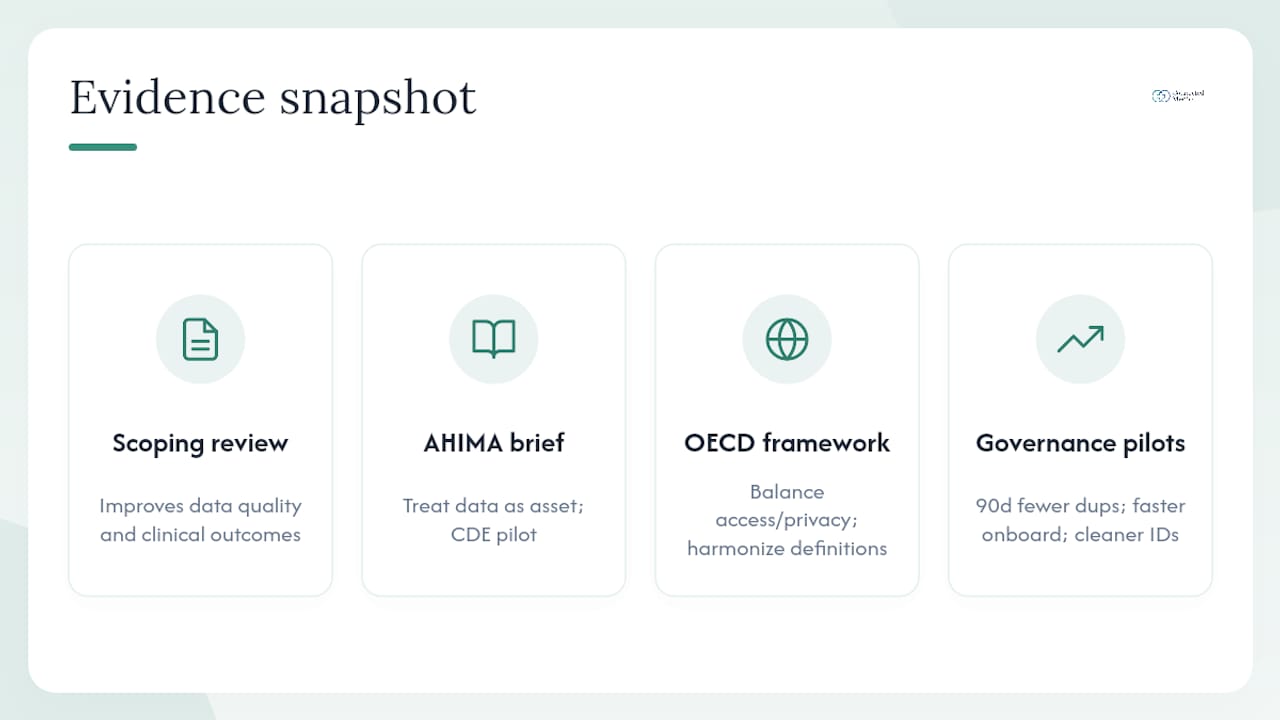
A scoping review in PMC found that health information governance frameworks improve data quality and support better clinical decision-making and patient outcomes. The review examined governance programs across health systems and identified consistent patterns: organizations with defined stewardship roles and data quality processes produced more reliable data, which translated into measurable improvements in care coordination and clinical safety.
AHIMA's practice brief recommends that organizations shift from treating data as a byproduct of operations to treating it as a strategic asset with defined ownership, quality standards, and lifecycle management. The brief specifically recommends starting with a critical data element pilot to demonstrate ROI before scaling.
The OECD's health data governance framework calls for national governance structures that balance data availability for research and public health with privacy and security protections. While the OECD framework addresses national-level policy, its principles map directly to organizational governance programs: harmonized definitions, clear accountability, and proportionate access controls.
A real-world pattern from governance pilots
Health systems that have run structured governance pilots on patient demographics consistently report three outcomes within 90 days: a measurable reduction in duplicate records, faster onboarding of new analytics use cases because data definitions are documented, and improved claim acceptance rates because patient identifiers are cleaner. The specific numbers vary by organization, but the directional pattern is consistent across published case reports and industry accounts.
Why governance deserves a place on every clinical leader's agenda
The conventional framing of data governance as an IT compliance project misses the point. Governance is a clinical and strategic function. The data that flows through a health system determines what clinicians see, what administrators decide, and what AI models recommend. Governing that data is not a back-office activity.
The evidence reviewed here points to one consistent finding: organizations that treat data as a strategic asset, assign clear ownership, and measure quality systematically produce better outcomes across every dimension that matters, from patient safety to regulatory standing to analytics performance.
The practical starting point is not a multi-year enterprise program. It is one critical data element, one data steward, and one 90-day pilot with a measurable baseline. That is enough to demonstrate value, build credibility with clinical leadership, and justify the next phase of investment.
Connectedmedics provides a professional network where healthcare administrators, data managers, and clinicians share governance frameworks, implementation lessons, and regulatory updates. For professionals working through governance challenges, the Connectedmedics knowledge hub offers peer-contributed insights and curated research summaries from verified medical experts.
Pick one critical data element. Appoint a steward. Measure the baseline. The program builds from there.
Sources
- A framework for health information governance: a scoping review - PMC
- Healthit
- Healthcare data governance practice brief - AHIMA
- Health data governance in the age of artificial intelligence: policy imperatives for the WHO European Region
- Health data governance for the digital age - OECD (2022)
- Medical errors may be third leading cause of death - Johns Hopkins Hub
- What Is the Role of Data Governance in Healthcare? | HealthTech
- HIPAA Security Rule NPRM - HHS
This article is general information, not a substitute for advice from a qualified doctor. Consult a qualified healthcare professional about your own circumstances before acting on anything here.