
A virtual journal club is a scheduled, digitally hosted discussion of a research paper, run live over video, asynchronously through a forum, or as a mix of both. The format gives clinicians and trainees access to experts and peers regardless of location, and it keeps a permanent, searchable record of the discussion. A small, repeatable workflow and a handful of common tech tools are all you need to run one well.
TL;DR:
- Virtual journal clubs expand participation across institutions and shifts, offering remote expert input and creating lasting, searchable discussion archives.
- A five-stage setup—from preparation to curation—can be implemented in two to three weeks using minimal budget and standard digital tools.
- Hybrid formats with live streams and asynchronous comments work best for larger or multi-institution groups, with clear milestones aiding shift workers' involvement.
- Assigning a designated person for post-session summaries significantly increases the likelihood of timely and effective documentation.
- Using a central repository, a live discussion tool, and social media tracking ensures effective archiving, broad reach, and ongoing engagement.
Table of Contents
- Why Run a Virtual Journal Club?
- How Do You Set Up a Virtual Journal Club Step by Step?
- Agenda Templates You Can Copy for Any Format
- Who Should Run the Club: Roles and Rotation
- What Technology and Archiving Setup Works Best?
- How Do You Facilitate a Focused Session?
- How Do You Keep Shift Workers and Remote Participants Included?
- How Do You Measure Whether the Club Is Working?
- What Usually Goes Wrong (and How to Fix It Fast)
- How ConnectedMedics Supports Journal Club Organizers
- Organizer Perspective: What One Habit Changed
- Use ConnectedMedics as Your Knowledge Hub and Recruitment Channel
- Sources
- FAQ
Why Run a Virtual Journal Club?
A well-run virtual journal club pulls in specialists who would never make it to an in-person meeting, and it lets shift workers catch up on their own schedule instead of missing the session entirely. The JGME multimodal model shows that combining synchronous and asynchronous channels builds a community of practice across institutions, not just a single department.
Benefits worth building around:
- Broader access to subject-matter experts who can join remotely as discussants
- Flexible participation for people on rotating shifts or in different time zones
- An archived record that turns one hour of discussion into a lasting reference
- Cross-institutional networking that a local, in-person club can't offer
Pick your format by group size and goal. A small trainee group wants a quick live session. A large, multi-site group benefits from an asynchronous forum with a central hub post anchoring the discussion. Bigger, mixed audiences do best with a hybrid setup: livestream plus a threaded comment section that stays open for days.
How Do You Set Up a Virtual Journal Club Step by Step?
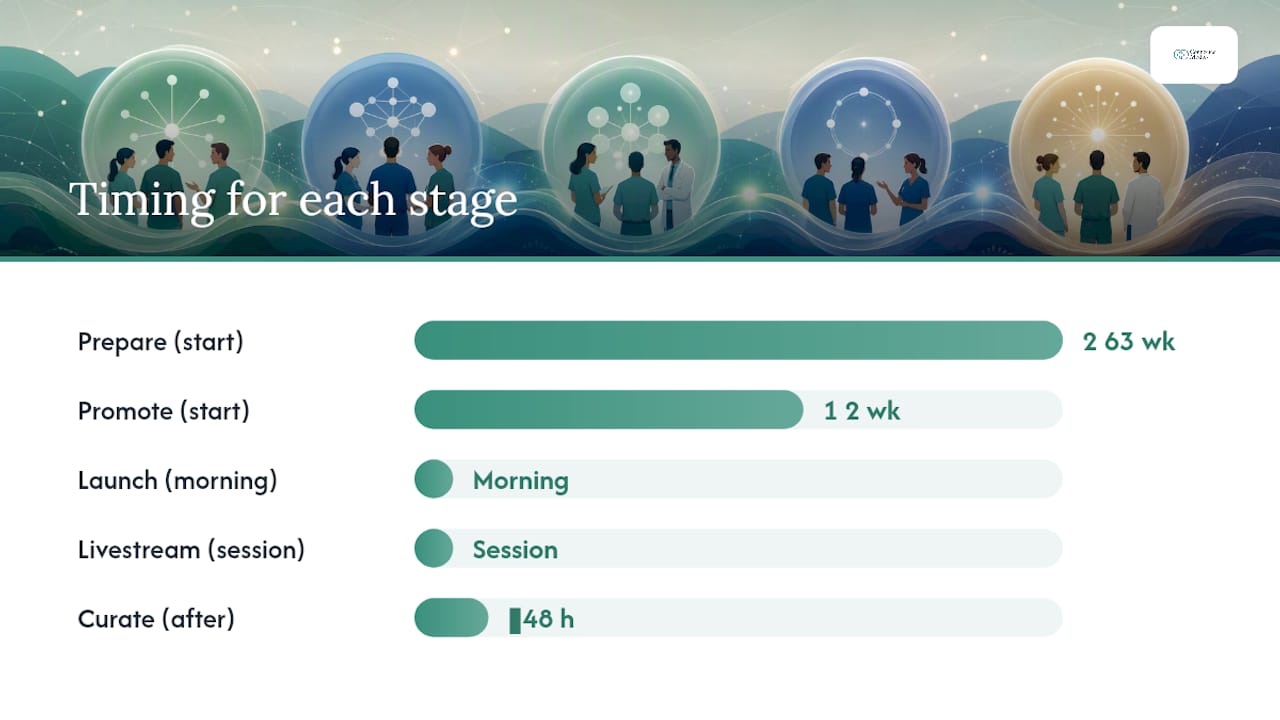
The JGME paper on multimodal journal clubs outlines a five-stage workflow that a small team can execute in two to three weeks without extra budget or software.
- Prepare (start 2 to 3 weeks out): pick the paper, draft 3 to 5 guiding discussion questions, and assign the core roles.
- Promote (1 to 2 weeks out): send the announcement through email and department channels, and if you're using Twitter, register your hashtag on Symplur so you can track it later.
- Launch: post the paper, guiding questions, and any slides to your central hub the morning of, so latecomers have context before the live session.
- Livestream: keep the session moving with clear time splits and a set speaker order, ideally with the primary facilitator opening and the discussant answering questions midway through.
- Curate: archive the recording, publish a written summary within 48 hours, and post one or two follow-up prompts to keep asynchronous comments coming.
Pro Tip: Assign the curation task to a specific person before launch day. Summaries that wait a week almost never get written, and the recording sits unwatched without a text anchor pointing back to it.
This same five-stage rhythm scales down for a trainee-only club or up for a multi-institution one. The stages don't change, only the time you allot to each.
Agenda Templates You Can Copy for Any Format
Different audiences need different time budgets. Society-run clubs, including ASM's Clinical Microbiology Virtual Journal Club, typically run a short presenter segment followed by faculty discussion, and ACCP's sessions run 45 to 60 minutes with an author or expert discussant, recorded for later viewing.
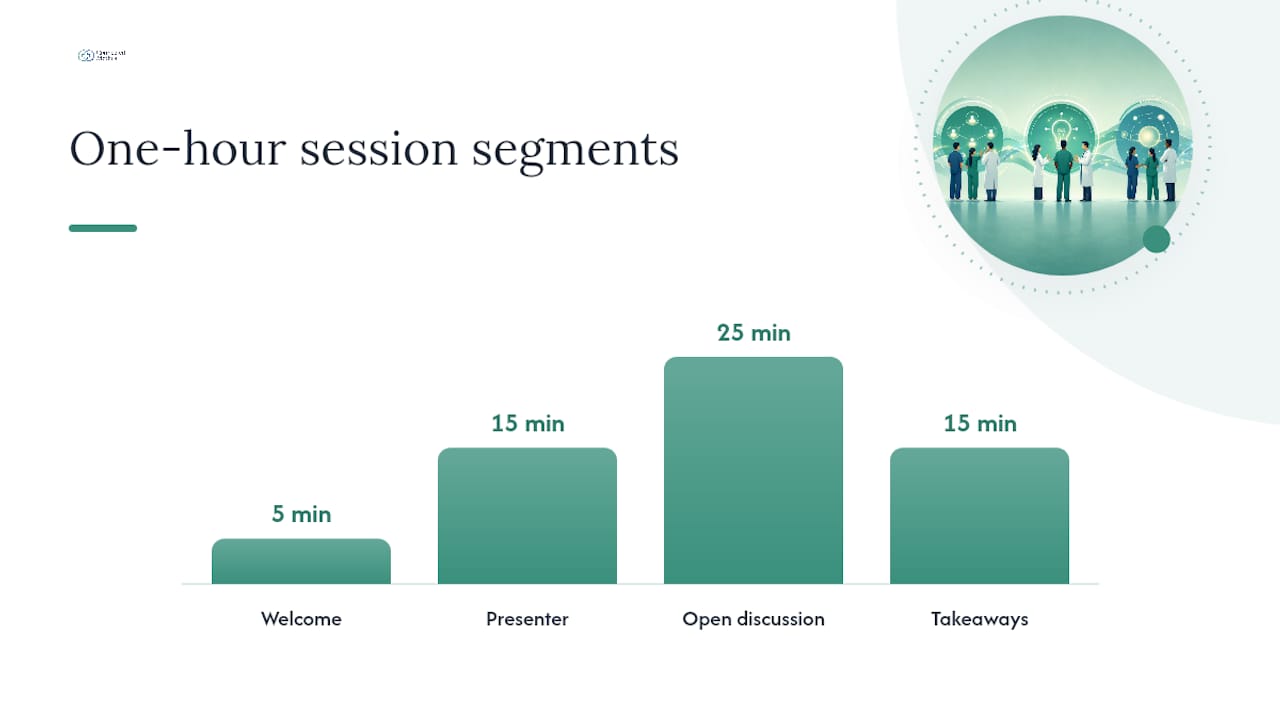
One-hour live template:
- Minutes 0 to 5: welcome, housekeeping, guiding questions on screen
- Minutes 5 to 20: presenter summary of methods and findings
- Minutes 20 to 45: open discussion with the discussant
- Minutes 45 to 60: takeaways and next steps
Trainee-focused template (30 minutes):
- 5 minutes framing, 15 minutes structured critique, 10 minutes action items
Two-week asynchronous timeline:
- Day 1: post paper and questions to the forum
- Day 3 to 5: early comment window opens
- Day 7: mid-window livestream discussion
- Day 8 to 13: continued asynchronous commentary
- Day 14: summary post closes the cycle
Monthly cadence works well for most groups, matching the schedule ASM uses for its own club.
Who Should Run the Club: Roles and Rotation
The JGME model assigns at least four core roles to keep the workload sustainable and the discussion focused across platforms.
- Primary facilitator: owns the agenda, opens and closes the live session, keeps discussion on the guiding questions
- Session moderator: manages the chat, queues questions, and enforces time limits
- Social media or engagement lead: posts to the hub, monitors the hashtag, and drives asynchronous comments
- Presenter and expert discussant: summarizes the paper and answers methodological questions live
Rotate these roles every few sessions. A platform where clinicians already share expertise can make it easier to find willing discussants for topics outside your core team's specialty.
What Technology and Archiving Setup Works Best?
A single platform rarely covers everything a virtual journal club needs. The JGME approach recommends a central repository paired with a live tool and a social channel, which increases both reach and archive value compared with running everything through one app.
- Central repository: hosts the paper link, guiding questions, slides, recording, and written summary in one place
- Live tool checklist: confirm recording is on, captions are enabled, screen share works, and participant mic controls are set before the session starts
- Social channel: use a registered hashtag through Symplur to track impressions and reach over time
- Archiving workflow: upload the recording, embed it in the repository post, and attach the summary the same week
Purpose-built platforms exist for hosting and annotating journal club activity, but a blog or knowledge hub combined with a video tool and a hashtag covers the same ground for most groups. Some organizers also lean on telemedicine and digital health tools already in use at their institution to manage video and participation logistics.
How Do You Facilitate a Focused Session?
Facilitating a journal club well means steering the group toward appraisal, not summary. The Rice University checklist approach keeps sessions tight with a short, scripted opening and a dedicated timekeeper.
- Run a tech check 15 minutes before start: audio, screen share, recording.
- Open with a one-line framing of why this paper matters to the group.
- Assign a timekeeper to flag when discussion drifts past its allotted minutes.
- Ask targeted appraisal questions: Where could bias have entered the design? Are the endpoints clinically meaningful? Does this apply to your patient population? What's the next study that should follow this one?
- Close with two or three concrete takeaways and one action item per attendee.
How Do You Keep Shift Workers and Remote Participants Included?
Clinicians on rotating shifts miss live sessions by default, so a two-week asynchronous window with a mid-window livestream preserves participation without dragging the discussion out indefinitely.
- Set clear milestones (early comments, midpoint livestream, closing summary) so latecomers know where to jump in
- Use threaded comments and simple polls to moderate discussion without a live moderator present
- Post captions and a transcript for the recording, and note whether the session counts toward CME credit
Pro Tip: Publish the summary post even before every comment thread closes. Clinicians catching up three days later read the summary first and only dig into the thread if something specific interests them.
Nurses and allied health educators managing similar shift constraints have found success with asynchronous, thread-based discussion formats that don't depend on everyone logging in at the same time.
How Do You Measure Whether the Club Is Working?
There's no single agreed-upon standard for journal club effectiveness, but a handful of free analytics tools give organizers a workable baseline.
- Quantitative: pageviews on the repository (Google Analytics), video views (YouTube analytics), hashtag impressions (Symplur)
- Qualitative: short post-session surveys, self-reported practice changes, learner reflections shared in the thread
Present both types of data together when reporting to department leads or a CME committee. A hashtag with growing impressions each month is a useful trend line, even without a formal benchmark to compare it against.
What Usually Goes Wrong (and How to Fix It Fast)
Most virtual journal club problems repeat across groups, and most have a quick fix.
- Low attendance → Move to a two-week asynchronous window instead of one fixed live slot.
- Discussion turns into a recap → Open with appraisal questions, not a summary request.
- Recording never gets watched → Post the written summary within 48 hours as an entry point.
- Tech failures mid-session → Run a 15-minute check before every livestream, no exceptions.
How ConnectedMedics Supports Journal Club Organizers
A verified clinician community removes a real bottleneck: finding a qualified discussant outside your immediate department. ConnectedMedics' knowledge hub can double as a central repository for guiding questions and curated summaries, cutting the admin load of chasing recordings and slide decks across separate tools.
Organizer Perspective: What One Habit Changed
The single biggest fix I've seen work across different clubs is assigning the summary write-up before the session even starts. Groups that wait to figure out "who writes it up" almost never publish one.
— David
Use ConnectedMedics as Your Knowledge Hub and Recruitment Channel
The workflow above works with a blog, a video tool, and a hashtag stitched together by hand. If that stitching is the part that keeps stalling your club, ConnectedMedics gives you a verified clinician community and a knowledge hub in one place, so you're not rebuilding your repository from scratch every cycle.
Organizers get two concrete advantages here: a pool of specialists to approach as discussants without cold-emailing strangers, and a curated content archive where a session summary sits alongside other clinical research summaries instead of getting buried in a blog nobody checks. If you want a working example of how a curated summary reads on the platform, the Nature Medicine summary in the knowledge hub shows the format.
Visit ConnectedMedics to set up a verified profile and start browsing the specialty communities where your next discussant is probably already active.
Sources
- Creating a Virtual Journal Club: A Community of Practice Using Multiple Social Media Strategies (JGME / PMC)
- Virtual Journal Club | ACCP
- Clinical Microbiology Virtual Journal Club | ASM
- 5 simple steps to organizing a virtual journal club (Rice University)
FAQ
What Happens at a Journal Club?
A presenter summarizes a research paper's methods and findings, then the group discusses its strengths, limitations, and clinical relevance, usually guided by a facilitator and a set of prepared questions.
What Is the Difference Between a Seminar and a Journal Club?
A seminar typically delivers information from an expert to an audience, while a journal club centers on group critique and discussion of a specific paper, with participants doing much of the analytical work themselves.
What Is a Virtual Journal Club?
It's a journal club run through digital tools instead of an in-person room, combining live video discussion, asynchronous forum comments, or both, so participants can join from any location and revisit the archived recording later.
How Do You Facilitate a Journal Club?
Open with a short framing statement, assign a timekeeper, and steer questions toward critical appraisal (bias, endpoints, applicability) rather than a plain summary of the paper, closing with concrete takeaways.