
SHO locum positions are temporary Senior House Officer roles that allow junior doctors to work flexibly across hospitals, clinics, and specialist departments without a fixed training contract. These short-term doctor placements fill staffing gaps during periods of high demand, staff absences, or service pressures. They are common across general medicine, emergency departments, surgery, pediatrics, and psychiatry.
Key features of locum SHO roles:
- Temporary contracts ranging from single shifts to placements lasting several months
- Available across a wide range of specialties and healthcare settings
- Require current medical registration, relevant clinical experience, and valid certifications
- Support clinical care continuity without long-term employment commitments
- Offered on a full-time or part-time basis, including on-call, nights, and weekends
Where to find SHO locum jobs in the US and UK
Locum doctor opportunities come through several main channels. NHS Trust Staff Banks are often the most direct route. NHS Trust Staff Banks tend to offer the highest-paying and most stable locum roles, cutting out agency fees and reducing administrative steps. NHS Professionals runs a dedicated Doctors Direct service listing vacancies across partner Trusts by specialty and location.
Locum agencies are the other main source. Agencies source placements across NHS Trusts and private hospitals, often filling urgent gaps quickly. For doctors working across state lines in the US, hospital systems, urgent care networks, and community health organizations also post temporary positions directly.
Where to search for locum SHO roles:
- NHS Trust Staff Banks (direct applications, often higher pay)
- NHS Professionals Doctors Direct portal
- Locum recruitment agencies specializing in medical placements
- Hospital and health system career portals
- Professional networking platforms with verified healthcare job boards, such as Connectedmedics, which lists over 4,600 active healthcare vacancies
Pro Tip: Register with your local Trust Staff Bank before approaching external agencies. Direct bank shifts typically pay more and involve less paperwork.
What are the main benefits of locum SHO work?
Locum work pays more per hour than equivalent training-grade posts, and that gap is real. An SHO working three days per week as a locum can earn more than a colleague in a full-time Trust post, making it a practical way to save quickly for a house deposit or extended travel.
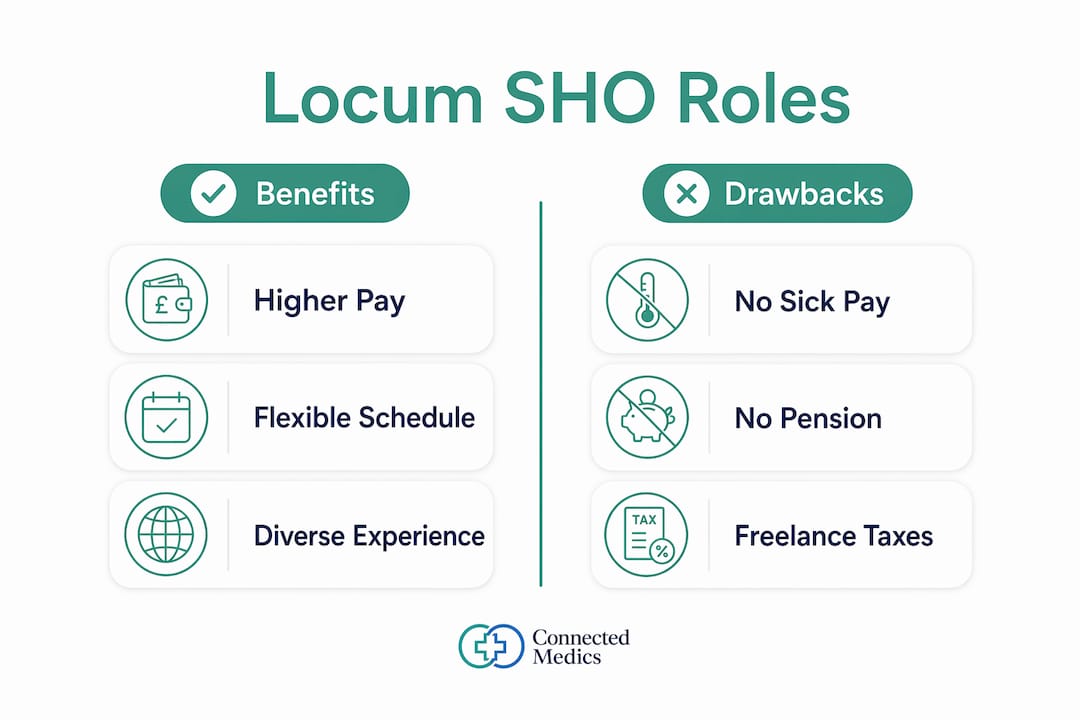
Beyond pay, the flexibility is a genuine draw. Doctors choose their own shifts, adjust their schedule week to week, and avoid the rigid rota commitments of a training post. Exposure to different clinical environments also builds a broader skill set faster than a single rotation allows.
Key benefits at a glance:
- Higher hourly rates compared to standard junior doctor roles
- Full control over shift selection and working pattern
- Exposure to diverse specialties and geographic locations
- Opportunity to build professional contacts across multiple departments
- No long-term contract obligation
The trade-off is real. Locum doctors typically do not receive sick pay, pension contributions, or other standard employee benefits, so financial planning matters.
What qualifications do you need for locum SHO roles?
The requirements for locum SHO jobs are consistent across most NHS Trusts and US hospital systems. GMC registration with a license to practice is mandatory for UK roles. In the US, doctors must hold a valid state medical license for each state where they intend to work, and managing licensure across multiple states requires careful planning.

Most postings require a minimum of two years of postgraduate clinical experience as well as proving eligibility and professional visibility on platforms like LinkedIn. ALS certification (Advanced Life Support) is a standard requirement before starting shifts. For doctors whose primary training was not conducted in English, proof of English language proficiency is required, typically through standardized testing. Guidance on meeting these language standards is available through resources like the IELTS prep guide for doctors.
Standard requirements for locum SHO positions:
- Full medical registration (GMC in the UK; state licensure in the US)
- Minimum two years of postgraduate clinical experience
- Valid ALS or equivalent life support certification
- Right to work documentation
- At least two professional references
- Occupational health clearance and relevant background checks
Pro Tip: Check expiry dates on ALS certification and medical registration well before applying. Expired credentials are the most common cause of onboarding delays.
How to apply and start working as a locum SHO
The application process is straightforward once credentials are in order. Start with an updated CV that highlights relevant rotations, specialty experience, and any previous locum work. Tailor it to the specialty you are applying for rather than submitting a generic document.
Register with NHS Trust Staff Banks and locum agencies simultaneously. Most agencies have online portals where you upload documents, including proof of registration, certifications, and references. Processing times vary, so starting early avoids gaps between finishing one role and starting the next.
Steps to get started:
- Update your CV to reflect relevant specialty rotations and clinical experience
- Register with Trust Staff Banks and at least one locum agency
- Submit all required documents: registration proof, ALS certificate, references, occupational health clearance
- Complete mandatory induction training before your first shift in a new department
- Confirm contract terms, shift details, and payment arrangements in writing before starting
Resources like the locum doctor jobs UK communities guide outline where verified opportunities are listed and how to navigate the application process efficiently.
Special considerations for junior doctors pursuing locum SHO roles
Many junior doctors use locum SHO roles during F3 years or planned career breaks to explore specialties and locations before committing to a training program. This is a deliberate career move, not a fallback. Working across different departments and hospitals builds a clearer picture of where a long-term career fits best.
Tax and financial management require attention. Locum doctors operate as freelancers, which means managing their own tax obligations, either through a limited company or an umbrella company. In the US, self-employment tax rules apply, and quarterly estimated payments are standard. Getting this wrong creates problems at year-end, so setting up the right structure early matters.
Building a professional network during locum periods also pays off later. Contacts made across departments and Trusts often lead to stable contracts, specialty training opportunities, and strong references. Doctors who treat each placement as a networking opportunity tend to find the next role faster.
Legal and contractual details to check before signing:
- Indemnity coverage: confirm your medical defense organization covers locum work
- Payment terms: weekly or monthly, and whether the agency or Trust pays directly
- Shift cancellation policies and notice periods
- IR35 status in the UK, or self-employment classification in the US
For doctors navigating medical registration across borders, understanding portability of licenses is a prerequisite before accepting placements in new locations.
Pro Tip: Use Connectedmedics to access verified locum job listings, connect with other healthcare professionals, and stay current with clinical developments between placements.
Connectedmedics gives junior doctors direct access to over 4,600 healthcare vacancies, verified professional profiles, and a knowledge hub built by medical experts. It is a purpose-built platform for healthcare professionals who need relevant job leads and peer connections, not a generic job board.
Key Takeaways
Locum SHO positions offer junior doctors higher hourly pay, flexible scheduling, and broad clinical exposure, but require current registration, ALS certification, and careful financial planning.
| Point | Details |
|---|---|
| Pay advantage | Locum SHO rates run higher per hour than equivalent training-grade posts. |
| Core requirements | GMC registration, minimum two years of experience, and valid ALS certification are standard. |
| Best source for roles | NHS Trust Staff Banks typically offer higher pay and fewer fees than external agencies. |
| Tax responsibility | Locum doctors manage their own taxes as freelancers, through a limited or umbrella company. |
| Career strategy | Many junior doctors use locum roles during F3 years to explore specialties before committing to training. |